



 Chat with AI
Exam 43: Animal Transport Systems

Exam 1: Biology and Its Themes46 Questions
Exam 2: Atoms and Molecules61 Questions
Exam 3: The Chemistry of Water55 Questions
Exam 4: Carbon: the Basis of Molecular Diversity52 Questions
Exam 5: Biological Macromolecules and Lipids71 Questions
Exam 6: Energy and Life65 Questions
Exam 7: Cell Structure and Function66 Questions
Exam 8: Cell Membranes67 Questions
Exam 9: Cellular Signaling62 Questions
Exam 10: Cell Respiration68 Questions
Exam 11: Photosynthetic Processes64 Questions
Exam 12: Mitosis63 Questions
Exam 13: Sexual Life Cycles and Meiosis64 Questions
Exam 14: Mendelian Genetics65 Questions
Exam 15: Linkage and Chromosomes54 Questions
Exam 16: Nucleic Acids and Inheritance65 Questions
Exam 17: Expression of Genes70 Questions
Exam 18: Control of Gene Expression66 Questions
Exam 19: Dna Technology56 Questions
Exam 20: The Evolution of Genomes47 Questions
Exam 21: How Evolution Works60 Questions
Exam 22: Phylogenetic Reconstruction66 Questions
Exam 23: Microevolution65 Questions
Exam 24: Species and Speciation65 Questions
Exam 25: Macroevolution58 Questions
Exam 26: Introduction to Viruses54 Questions
Exam 27: Prokaryotes61 Questions
Exam 28: The Origin and Evolution of Eukaryotes66 Questions
Exam 29: Nonvascular and Seedless Vascular Plants72 Questions
Exam 30: Seed Plants64 Questions
Exam 31: Introduction to Fungi56 Questions
Exam 32: An Introduction to Animal Diversity58 Questions
Exam 33: Invertebrates58 Questions
Exam 34: Vertebrates66 Questions
Exam 35: Plant Structure and Growth68 Questions
Exam 36: Transport in Vascular Plants73 Questions
Exam 37: Plant Nutrition51 Questions
Exam 38: Reproduction of Flowering Plants59 Questions
Exam 39: Plant Signals and Behavior60 Questions
Exam 40: The Animal Body58 Questions
Exam 41: Chemical Signals in Animals62 Questions
Exam 42: Animal Digestive Systems58 Questions
Exam 43: Animal Transport Systems58 Questions
Exam 44: Animal Excretory Systems49 Questions
Exam 45: Animal Reproductive Systems64 Questions
Exam 46: Development in Animals68 Questions
Exam 47: Animal Defenses Against Infection65 Questions
Exam 48: Electrical Signals in Animals62 Questions
Exam 49: Neural Regulation in Animals69 Questions
Exam 50: Sensation and Movement in Animals68 Questions
Exam 51: An Overview of Ecology71 Questions
Exam 52: Behavioral Ecology64 Questions
Exam 53: Populations and Life History Traits73 Questions
Exam 54: Biodiversity and Communities71 Questions
Exam 55: Energy Flow and Chemical Cycling in Ecosystems80 Questions
Exam 56: Conservation and Global Ecology75 Questions
Select questions type


Which of the following would be the consequence if the direction of water flow over the gills of a fish was reversed, moving water inward past the operculum, past the gills, then out the mouth?

Free
(Multiple Choice)
4.9/5  (85)
(85) Correct Answer: Verified
A
While jogging, a person has a stroke volume of 130 mL/beat and a heart rate of 120 beats per minute. Their resting stroke volume is 70 mL/beat and resting heart rate is 60 beats per minute. Which answer best describes the effect of jogging on the person's cardiac output?
Free
(Multiple Choice)
4.9/5 (86)
(86) Correct Answer:Verified
VerifiedD
The velocity of blood flow lowest in capillaries because ________.
Free
(Multiple Choice)
4.8/5 (75)
(75) Correct Answer:Verified
VerifiedD
Which of the following is the correct sequence of blood flow in birds and mammals?
(Multiple Choice)
4.7/5 (70)
(70) A researcher investigating the effect of temperature on hemoglobin saturation collected the data represented in the graph. Which of the following claims is most consistent with the data? 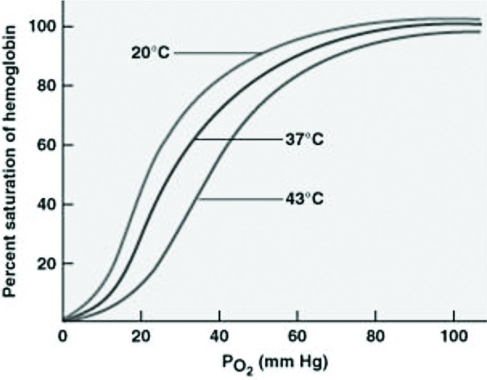
(Multiple Choice)
4.8/5 (66)
(66) Which of the following are the only vertebrates in which blood flows directly from respiratory organs to body tissues without first returning to the heart?
(Multiple Choice)
4.7/5 (68)
(68) Which of the following respiratory systems is independent from a fluid-based circulatory system?
(Multiple Choice)
4.8/5 (82)
(82) Which of the following is an adaptation of the avian lung that best helps meet the metabolic demands of flight?
(Multiple Choice)
4.7/5 (74)
(74) The bar-headed goose is one of the highest flying birds in the world, having been observed flying at over 27,000 feet. Which of the following adaptations would provide an advantage for flying at high altitudes?
(Multiple Choice)
5.0/5 (90)
(90) Which biological membranes must atmospheric molecules of oxygen cross to become bound to hemoglobin for transport in mammals?
(Multiple Choice)
4.8/5 (82)
(82) A decrease of blood pH from 7.4 to 7.2 would cause hemoglobin to ________.
(Multiple Choice)
4.8/5 (64)
(64) Which type of circulatory system is most likely present in organisms with a circulating body fluid that is distinct from the fluid that directly surrounds the body's cells?
(Multiple Choice)
4.9/5 (76)
(76) Which of the following statements correctly compares respiration in fish and in mammals?
(Multiple Choice)
4.8/5 (76)
(76) Which of the following indicates a diagnosis of hypertension in adults?
(Multiple Choice)
4.8/5 (79)
(79) Compared with the interstitial fluid that bathes active muscle cells, blood reaching these cells in arterioles has a ________.
(Multiple Choice)
4.8/5 (58)
(58) What is the partial pressure of oxygen (PO2) when the air in a testing chamber is mixed so that its oxygen content is 10% and its overall air pressure is 400 mm Hg?
(Multiple Choice)
4.8/5 (79)
(79) Organisms belonging to a species with a high resting cardiac output are most likely to have which of the following characteristics?
(Multiple Choice)
4.7/5 (77)
(77) Which of the following examples illustrates the process of countercurrent exchange?
(Multiple Choice)
5.0/5 (83)
(83) During aerobic exercise, the partial pressure of oxygen in muscle cells will ________, thus the rate of diffusion of oxygen into the muscle tissue from the blood will ________.
(Multiple Choice)
4.8/5 (82)
(82) 
Filters
- Essay(0)
- Multiple Choice(0)
- Short Answer(0)
- True False(0)
- Matching(0)