



 Chat with AI
Exam 2: Atoms and Molecules

Exam 1: Biology and Its Themes46 Questions
Exam 2: Atoms and Molecules61 Questions
Exam 3: The Chemistry of Water55 Questions
Exam 4: Carbon: the Basis of Molecular Diversity52 Questions
Exam 5: Biological Macromolecules and Lipids71 Questions
Exam 6: Energy and Life65 Questions
Exam 7: Cell Structure and Function66 Questions
Exam 8: Cell Membranes67 Questions
Exam 9: Cellular Signaling62 Questions
Exam 10: Cell Respiration68 Questions
Exam 11: Photosynthetic Processes64 Questions
Exam 12: Mitosis63 Questions
Exam 13: Sexual Life Cycles and Meiosis64 Questions
Exam 14: Mendelian Genetics65 Questions
Exam 15: Linkage and Chromosomes54 Questions
Exam 16: Nucleic Acids and Inheritance65 Questions
Exam 17: Expression of Genes70 Questions
Exam 18: Control of Gene Expression66 Questions
Exam 19: Dna Technology56 Questions
Exam 20: The Evolution of Genomes47 Questions
Exam 21: How Evolution Works60 Questions
Exam 22: Phylogenetic Reconstruction66 Questions
Exam 23: Microevolution65 Questions
Exam 24: Species and Speciation65 Questions
Exam 25: Macroevolution58 Questions
Exam 26: Introduction to Viruses54 Questions
Exam 27: Prokaryotes61 Questions
Exam 28: The Origin and Evolution of Eukaryotes66 Questions
Exam 29: Nonvascular and Seedless Vascular Plants72 Questions
Exam 30: Seed Plants64 Questions
Exam 31: Introduction to Fungi56 Questions
Exam 32: An Introduction to Animal Diversity58 Questions
Exam 33: Invertebrates58 Questions
Exam 34: Vertebrates66 Questions
Exam 35: Plant Structure and Growth68 Questions
Exam 36: Transport in Vascular Plants73 Questions
Exam 37: Plant Nutrition51 Questions
Exam 38: Reproduction of Flowering Plants59 Questions
Exam 39: Plant Signals and Behavior60 Questions
Exam 40: The Animal Body58 Questions
Exam 41: Chemical Signals in Animals62 Questions
Exam 42: Animal Digestive Systems58 Questions
Exam 43: Animal Transport Systems58 Questions
Exam 44: Animal Excretory Systems49 Questions
Exam 45: Animal Reproductive Systems64 Questions
Exam 46: Development in Animals68 Questions
Exam 47: Animal Defenses Against Infection65 Questions
Exam 48: Electrical Signals in Animals62 Questions
Exam 49: Neural Regulation in Animals69 Questions
Exam 50: Sensation and Movement in Animals68 Questions
Exam 51: An Overview of Ecology71 Questions
Exam 52: Behavioral Ecology64 Questions
Exam 53: Populations and Life History Traits73 Questions
Exam 54: Biodiversity and Communities71 Questions
Exam 55: Energy Flow and Chemical Cycling in Ecosystems80 Questions
Exam 56: Conservation and Global Ecology75 Questions
Select questions type


Which of the following has the smallest total mass?

Free
(Multiple Choice)
4.9/5  (79)
(79) Correct Answer: Verified
A
Compared with 31P, the radioactive isotop 32P has ________.
Free
(Multiple Choice)
4.7/5 (84)
(84) Correct Answer:Verified
VerifiedD
Van der Waals interactions may result under which of the following conditions?
Free
(Multiple Choice)
4.8/5 (85)
(85) Correct Answer:Verified
VerifiedA
Nitrogen (N) is more electronegative than hydrogen (H). Which of the following is a correct statement about the atoms in ammonia (NH3)?
(Multiple Choice)
4.7/5 (75)
(75) Under which of the following conditions will an atom be the most stable?
(Multiple Choice)
4.8/5 (78)
(78) The atomic number of sulfur is 16. Sulfur combines with hydrogen by covalent bonding to form a compound, hydrogen sulfide. Based on the number of valence electrons in a sulfur atom, predict the molecular formula of the compound.
(Multiple Choice)
4.8/5 (72)
(72) In the following structure where A and B represent two different elements, the valency of A is ________ and B is ________. 
(Multiple Choice)
4.8/5 (90)
(90) We can represent atoms by listing the number of protons, neutrons, and electrons-for example, 2p+, 2n0, 2e- for helium. Which of the following represents the 18O isotope of oxygen?
(Multiple Choice)
4.9/5 (65)
(65) Trace elements are those required by an organism in only minute quantities. Which of the following is a trace element that is required by all forms of life?
(Multiple Choice)
4.9/5 (84)
(84) 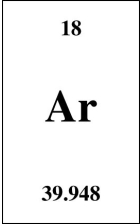 How many electrons are present in the +2 ionic form of the atom in the Periodic Table block shown in the figure?
 (Multiple Choice)
4.9/5 (86)
(86) What coefficients must be placed in the following blanks so that all atoms are accounted for in the products?
C6H12O6 → ________ C2H6O + ________ CO2
(Multiple Choice)
4.9/5 (80)
(80) About 25 of the 92 natural elements are known to be essential to life. Four of these 25 elements make up approximately 96% of living matter. Which of the following elements account for most of the remaining 4% of an organism's mass?
(Multiple Choice)
4.8/5 (77)
(77) An ion with six protons, seven neutrons, and a charge of 2+ has an atomic number of ________.
(Multiple Choice)
4.8/5 (83)
(83) How many electrons are present in a H- and H+ ion respectively?
(Multiple Choice)
4.8/5 (80)
(80) Which pair of elements is most likely to react if bought together?
(Multiple Choice)
4.8/5 (87)
(87) Which of the following is true of oxygen that has 8 protons, 8 neutrons, and 8 electrons?
(Multiple Choice)
4.8/5 (88)
(88) Which of the following types of representation would work best to indicate the type and number of atoms in a molecule?
(Multiple Choice)
4.9/5 (74)
(74) 
Filters
- Essay(0)
- Multiple Choice(0)
- Short Answer(0)
- True False(0)
- Matching(0)