



 Chat with AI
Exam 2: Atoms and Molecules

Exam 1: Biology and Its Themes46 Questions
Exam 2: Atoms and Molecules61 Questions
Exam 3: The Chemistry of Water55 Questions
Exam 4: Carbon: the Basis of Molecular Diversity52 Questions
Exam 5: Biological Macromolecules and Lipids71 Questions
Exam 6: Energy and Life65 Questions
Exam 7: Cell Structure and Function66 Questions
Exam 8: Cell Membranes67 Questions
Exam 9: Cellular Signaling62 Questions
Exam 10: Cell Respiration68 Questions
Exam 11: Photosynthetic Processes64 Questions
Exam 12: Mitosis63 Questions
Exam 13: Sexual Life Cycles and Meiosis64 Questions
Exam 14: Mendelian Genetics65 Questions
Exam 15: Linkage and Chromosomes54 Questions
Exam 16: Nucleic Acids and Inheritance65 Questions
Exam 17: Expression of Genes70 Questions
Exam 18: Control of Gene Expression66 Questions
Exam 19: Dna Technology56 Questions
Exam 20: The Evolution of Genomes47 Questions
Exam 21: How Evolution Works60 Questions
Exam 22: Phylogenetic Reconstruction66 Questions
Exam 23: Microevolution65 Questions
Exam 24: Species and Speciation65 Questions
Exam 25: Macroevolution58 Questions
Exam 26: Introduction to Viruses54 Questions
Exam 27: Prokaryotes61 Questions
Exam 28: The Origin and Evolution of Eukaryotes66 Questions
Exam 29: Nonvascular and Seedless Vascular Plants72 Questions
Exam 30: Seed Plants64 Questions
Exam 31: Introduction to Fungi56 Questions
Exam 32: An Introduction to Animal Diversity58 Questions
Exam 33: Invertebrates58 Questions
Exam 34: Vertebrates66 Questions
Exam 35: Plant Structure and Growth68 Questions
Exam 36: Transport in Vascular Plants73 Questions
Exam 37: Plant Nutrition51 Questions
Exam 38: Reproduction of Flowering Plants59 Questions
Exam 39: Plant Signals and Behavior60 Questions
Exam 40: The Animal Body58 Questions
Exam 41: Chemical Signals in Animals62 Questions
Exam 42: Animal Digestive Systems58 Questions
Exam 43: Animal Transport Systems58 Questions
Exam 44: Animal Excretory Systems49 Questions
Exam 45: Animal Reproductive Systems64 Questions
Exam 46: Development in Animals68 Questions
Exam 47: Animal Defenses Against Infection65 Questions
Exam 48: Electrical Signals in Animals62 Questions
Exam 49: Neural Regulation in Animals69 Questions
Exam 50: Sensation and Movement in Animals68 Questions
Exam 51: An Overview of Ecology71 Questions
Exam 52: Behavioral Ecology64 Questions
Exam 53: Populations and Life History Traits73 Questions
Exam 54: Biodiversity and Communities71 Questions
Exam 55: Energy Flow and Chemical Cycling in Ecosystems80 Questions
Exam 56: Conservation and Global Ecology75 Questions
Select questions type


Which of the following models represents an atom that is most likely to form a cation with a charge of +1?
(Multiple Choice)
4.9/5  (71)
(71) A salamander relies on hydrogen bonding to stick to various surfaces. Therefore, a salamander would have the greatest difficulty clinging to a ________.
(Multiple Choice)
4.9/5 (84)
(84) 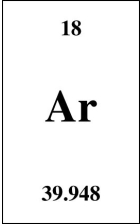 How many electrons are present in the neutral atom represented in the Periodic Table block in the figure?
 (Multiple Choice)
4.9/5 (77)
(77) An ion that consists of 7 protons, 6 neutrons, and 11 electrons has a net charge of ________.
(Multiple Choice)
4.9/5 (79)
(79) Which of the following best explain why argon, which is a noble gas, does not react with other elements. Noble gases ________.
(Multiple Choice)
4.8/5 (81)
(81) Which of the following correctly describes chemical equilibrium?
(Multiple Choice)
4.8/5 (67)
(67) A covalent bond is likely to be polar under which of the following conditions?
(Multiple Choice)
4.7/5 (85)
(85) Which of the following factors will increase the rate of reaction in the forward direction?
(Multiple Choice)
4.8/5 (76)
(76) Molybdenum has an atomic number of 42. Several common isotopes exist, with mass numbers from 92-100. Based on this information, which of the following is also true of molybdenum?
(Multiple Choice)
4.7/5 (78)
(78) What is the atomic number of the cation formed in the reaction in the illustration?
(Multiple Choice)
4.8/5 (72)
(72) Which of the following models represents an atom that is most likely to form an anion with a charge of -1?
(Multiple Choice)
4.8/5 (82)
(82) Which one of the following describes the correct trends in electronegativity in the periodic table?
(Multiple Choice)
4.8/5 (73)
(73) Which of the following statements correctly describes any chemical reaction that has reached equilibrium?
(Multiple Choice)
4.8/5 (91)
(91) How many electron pairs are shared between carbon atoms in a molecule that has the formula C2H4?
(Multiple Choice)
4.9/5 (89)
(89) An atom has four electrons in its valence shell. What types of covalent bonds is it capable of forming?
(Multiple Choice)
4.7/5 (87)
(87) Oxygen has an atomic number of 8 and, most commonly, a mass number of 16. Thus, what is the atomic mass of an oxygen atom?
(Multiple Choice)
4.9/5 (78)
(78) 
Filters
- Essay(0)
- Multiple Choice(0)
- Short Answer(0)
- True False(0)
- Matching(0)