



 Chat with AI
Exam 12: Mitosis

Exam 1: Biology and Its Themes46 Questions
Exam 2: Atoms and Molecules61 Questions
Exam 3: The Chemistry of Water55 Questions
Exam 4: Carbon: the Basis of Molecular Diversity52 Questions
Exam 5: Biological Macromolecules and Lipids71 Questions
Exam 6: Energy and Life65 Questions
Exam 7: Cell Structure and Function66 Questions
Exam 8: Cell Membranes67 Questions
Exam 9: Cellular Signaling62 Questions
Exam 10: Cell Respiration68 Questions
Exam 11: Photosynthetic Processes64 Questions
Exam 12: Mitosis63 Questions
Exam 13: Sexual Life Cycles and Meiosis64 Questions
Exam 14: Mendelian Genetics65 Questions
Exam 15: Linkage and Chromosomes54 Questions
Exam 16: Nucleic Acids and Inheritance65 Questions
Exam 17: Expression of Genes70 Questions
Exam 18: Control of Gene Expression66 Questions
Exam 19: Dna Technology56 Questions
Exam 20: The Evolution of Genomes47 Questions
Exam 21: How Evolution Works60 Questions
Exam 22: Phylogenetic Reconstruction66 Questions
Exam 23: Microevolution65 Questions
Exam 24: Species and Speciation65 Questions
Exam 25: Macroevolution58 Questions
Exam 26: Introduction to Viruses54 Questions
Exam 27: Prokaryotes61 Questions
Exam 28: The Origin and Evolution of Eukaryotes66 Questions
Exam 29: Nonvascular and Seedless Vascular Plants72 Questions
Exam 30: Seed Plants64 Questions
Exam 31: Introduction to Fungi56 Questions
Exam 32: An Introduction to Animal Diversity58 Questions
Exam 33: Invertebrates58 Questions
Exam 34: Vertebrates66 Questions
Exam 35: Plant Structure and Growth68 Questions
Exam 36: Transport in Vascular Plants73 Questions
Exam 37: Plant Nutrition51 Questions
Exam 38: Reproduction of Flowering Plants59 Questions
Exam 39: Plant Signals and Behavior60 Questions
Exam 40: The Animal Body58 Questions
Exam 41: Chemical Signals in Animals62 Questions
Exam 42: Animal Digestive Systems58 Questions
Exam 43: Animal Transport Systems58 Questions
Exam 44: Animal Excretory Systems49 Questions
Exam 45: Animal Reproductive Systems64 Questions
Exam 46: Development in Animals68 Questions
Exam 47: Animal Defenses Against Infection65 Questions
Exam 48: Electrical Signals in Animals62 Questions
Exam 49: Neural Regulation in Animals69 Questions
Exam 50: Sensation and Movement in Animals68 Questions
Exam 51: An Overview of Ecology71 Questions
Exam 52: Behavioral Ecology64 Questions
Exam 53: Populations and Life History Traits73 Questions
Exam 54: Biodiversity and Communities71 Questions
Exam 55: Energy Flow and Chemical Cycling in Ecosystems80 Questions
Exam 56: Conservation and Global Ecology75 Questions
Select questions type


Amount of DNA per nucleus over the cell division cycle. 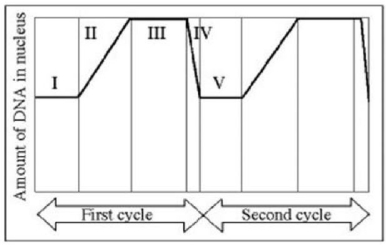 At which point in the accompanying figure does MPF reach its highest activity during the cell division cycle?
Free
(Multiple Choice)
4.8/5  (93)
(93) Correct Answer: Verified
C
A research team used a culture of lymphocytes with radioactively labeled T nucleotides to study the cell cycle. They found that the lymphocytes incorporated the labeled nucleotide at a significantly higher rate after a pathogen was introduced into the culture. Which of the following conclusions is most consistent with the results?
Free
(Multiple Choice)
4.9/5 (77)
(77) Correct Answer:Verified
VerifiedB
The decline of MPF activity at the end of mitosis is due to ________.
Free
(Multiple Choice)
4.8/5 (79)
(79) Correct Answer:Verified
VerifiedC
Use the figure to answer the question below. 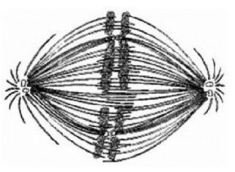 If the cell whose nuclear material is shown in the accompanying figure continues toward completion of mitosis, which of the following events would occur next?
 (Multiple Choice)
4.9/5 (63)
(63) If there are 24 centromeres in a cell at anaphase of mitosis, how many chromosomes will be found in each daughter cell following cytokinesis?
(Multiple Choice)
4.8/5 (89)
(89) The mass of DNA per nucleus in a certain fungus ranges from 4 to 10 picograms. Nuclei with 5 picograms of DNA are most likely derived from cells in which of the following parts of the cell cycle?
(Multiple Choice)
4.9/5 (84)
(84) Besides the ability of some cancer cells to over proliferate, which of the following situations is most likely to result in a tumor?
(Multiple Choice)
5.0/5 (82)
(82) Cell A has half as much DNA as cells B, C, and D in a mitotically active tissue. Cell A is most likely in ________.
(Multiple Choice)
4.8/5 (71)
(71) Which of the following statements best explains how neurons and some other specialized cells divide infrequently?
(Multiple Choice)
4.9/5 (79)
(79) Taxol is an anticancer drug extracted from the Pacific yew tree. In animal cells, Taxol prevents microtubule depolymerization, which interferes with which of the following processes?
(Multiple Choice)
4.7/5 (83)
(83) The unlettered circle at the top of the accompanying figure shows a diploid nucleus with four chromosomes that have not yet replicated. The circles labeled 1 to 5 show various combinations of these chromosomes. 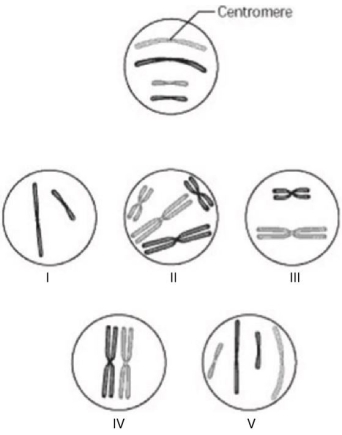 Which chromosomal configuration would be observed in one daughter cell after telophase of mitosis?
 (Multiple Choice)
4.9/5 (78)
(78) In which phase of mitosis do the sister chromatids become daughter chromosomes?
(Multiple Choice)
4.8/5 (88)
(88) What is the name of the region on duplicated chromosomes where the sister chromatids are most closely attached to each other?
(Multiple Choice)
4.8/5 (84)
(84) Which of the following molecules is maintained at a relatively constant level throughout the cell cycle but requires a cyclin to become catalytically active?
(Multiple Choice)
4.9/5 (84)
(84) Certain unicellular eukaryotes, including diatoms and some yeasts, have mechanisms of nuclear division that resemble intermediate steps in the evolution of mitosis. Which of the following is a characteristic feature of nuclear division in these organisms?
(Multiple Choice)
4.9/5 (81)
(81) Eukaryotic chromatin is composed of which of the following macromolecules?
(Multiple Choice)
4.9/5 (91)
(91) Which of the following statements best describes how cytokinesis differs between plant and animal cells?
(Multiple Choice)
4.8/5 (88)
(88) Which of the following cellular events occur in the G1 phase of the cell division cycle?
(Multiple Choice)
4.8/5 (73)
(73) At which phase of the cell cycle do centrioles begin to move apart in animal cells?
(Multiple Choice)
4.8/5 (72)
(72) 
Filters
- Essay(0)
- Multiple Choice(0)
- Short Answer(0)
- True False(0)
- Matching(0)