



 Chat with AI
Exam 27: Prokaryotes

Exam 1: Biology and Its Themes46 Questions
Exam 2: Atoms and Molecules61 Questions
Exam 3: The Chemistry of Water55 Questions
Exam 4: Carbon: the Basis of Molecular Diversity52 Questions
Exam 5: Biological Macromolecules and Lipids71 Questions
Exam 6: Energy and Life65 Questions
Exam 7: Cell Structure and Function66 Questions
Exam 8: Cell Membranes67 Questions
Exam 9: Cellular Signaling62 Questions
Exam 10: Cell Respiration68 Questions
Exam 11: Photosynthetic Processes64 Questions
Exam 12: Mitosis63 Questions
Exam 13: Sexual Life Cycles and Meiosis64 Questions
Exam 14: Mendelian Genetics65 Questions
Exam 15: Linkage and Chromosomes54 Questions
Exam 16: Nucleic Acids and Inheritance65 Questions
Exam 17: Expression of Genes70 Questions
Exam 18: Control of Gene Expression66 Questions
Exam 19: Dna Technology56 Questions
Exam 20: The Evolution of Genomes47 Questions
Exam 21: How Evolution Works60 Questions
Exam 22: Phylogenetic Reconstruction66 Questions
Exam 23: Microevolution65 Questions
Exam 24: Species and Speciation65 Questions
Exam 25: Macroevolution58 Questions
Exam 26: Introduction to Viruses54 Questions
Exam 27: Prokaryotes61 Questions
Exam 28: The Origin and Evolution of Eukaryotes66 Questions
Exam 29: Nonvascular and Seedless Vascular Plants72 Questions
Exam 30: Seed Plants64 Questions
Exam 31: Introduction to Fungi56 Questions
Exam 32: An Introduction to Animal Diversity58 Questions
Exam 33: Invertebrates58 Questions
Exam 34: Vertebrates66 Questions
Exam 35: Plant Structure and Growth68 Questions
Exam 36: Transport in Vascular Plants73 Questions
Exam 37: Plant Nutrition51 Questions
Exam 38: Reproduction of Flowering Plants59 Questions
Exam 39: Plant Signals and Behavior60 Questions
Exam 40: The Animal Body58 Questions
Exam 41: Chemical Signals in Animals62 Questions
Exam 42: Animal Digestive Systems58 Questions
Exam 43: Animal Transport Systems58 Questions
Exam 44: Animal Excretory Systems49 Questions
Exam 45: Animal Reproductive Systems64 Questions
Exam 46: Development in Animals68 Questions
Exam 47: Animal Defenses Against Infection65 Questions
Exam 48: Electrical Signals in Animals62 Questions
Exam 49: Neural Regulation in Animals69 Questions
Exam 50: Sensation and Movement in Animals68 Questions
Exam 51: An Overview of Ecology71 Questions
Exam 52: Behavioral Ecology64 Questions
Exam 53: Populations and Life History Traits73 Questions
Exam 54: Biodiversity and Communities71 Questions
Exam 55: Energy Flow and Chemical Cycling in Ecosystems80 Questions
Exam 56: Conservation and Global Ecology75 Questions
Select questions type


Which of the following traits do archaeans and eukaryotes have in common?

Free
(Multiple Choice)
4.8/5  (74)
(74) Correct Answer: Verified
D
The thermoacidophile Sulfolobus acidocaldarius is an archaean organism that can tolerate environments that are high in temperature and low in pH. It lacks peptidoglycan, but still possesses a cell wall. Which of the following statements is likely to be an accurate description of this species?
Free
(Multiple Choice)
4.8/5 (82)
(82) Correct Answer:Verified
VerifiedC
Chloramphenicol is an antibiotic that targets prokaryotic ribosomes, but not eukaryotic ribosomes. Based on an understanding of eukaryotic origins, which of these questions might be a target for research on chloramphenicol from this observation?
Free
(Multiple Choice)
4.9/5 (80)
(80) Correct Answer:Verified
VerifiedC
Broad-spectrum antibiotics inhibit the growth of most intestinal bacteria. Consequently, assuming that nothing is done to counter the reduction of intestinal bacteria, a hospital patient who is receiving broad-spectrum antibiotics is most likely to exhibit which of the following characteristics?
(Multiple Choice)
4.7/5 (84)
(84) The following question refers to the figure.
In this eight-year experiment, a population of E. coli, begun from a single cell, was grown in low-glucose conditions for 20,000 generations. Each culture was introduced to fresh growth medium every 24 hours. Occasionally, samples were removed from the population, and its ability to survive in low-glucose conditions was tested against that of members sampled from the ancestral E. coli population. 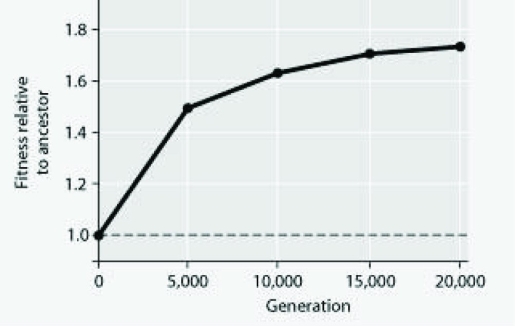 E.coli cells typically make most of their ATP by metabolizing glucose. Under the conditions of this experiment, how would E. coli generation times in the experimental lines and low-glucose conditions be described?
 (Multiple Choice)
5.0/5 (84)
(84) Which of the following statements correctly describes a process by which bacteria become resistant to antibiotics?
(Multiple Choice)
4.7/5 (93)
(93) The CRISPR-Cas system helps some prokaryotes defend against infection by viruses. Which of the following statements correctly describes how this system works?
(Multiple Choice)
4.9/5 (78)
(78) Which of the following types of pathogenic prokaryotes cause cholera?
(Multiple Choice)
4.7/5 (87)
(87) Which of the following structures is most likely missing in a bacterium that regenerates from an endospore lacking any of the plasmids from the original cell?
(Multiple Choice)
4.8/5 (81)
(81) Which of the following statements correctly describes F- cells and F+ cells?
(Multiple Choice)
4.8/5 (76)
(76) Most ecosystems on Earth rely on sunlight as the primary energy source for the synthesis of organic compounds that living organisms need. Sunlight does not penetrate deep enough in the ocean to provide energy for organisms living near hydrothermal vents. How can these densely populated communities survive without energy from the sun?
(Multiple Choice)
4.9/5 (90)
(90) Jams, jellies, preserves, honey, and other foods with high sugar content hardly ever become contaminated by bacteria, even when the food containers are left open at room temperature. Which of the following statements best explains the inability of bacteria to survive in such an environment?
(Multiple Choice)
4.8/5 (84)
(84) In which part of a bacterium is the complete chromosome found?
(Multiple Choice)
4.9/5 (94)
(94) A fish that has been salt-cured subsequently develops a reddish color. You suspect that the fish has been contaminated by the extreme halophile Halobacterium. Which of these features of cells removed from the surface of the fish would support your suspicion?
(Multiple Choice)
4.9/5 (85)
(85) A type of bacteria colonizes on the surface of a leaf, where it obtains nutrition from the leaf's nonliving, waxy covering without harming the plant, and inhibits the growth of other microbes that are plant pathogens. If this bacteria gains access to the inside of a leaf, however, it causes a fatal disease in the plant. Once the plant dies, the bacterium and its offspring decompose the plant. What is the correct sequence of ecological roles played by the bacterium in the situation described here?
(Multiple Choice)
4.9/5 (91)
(91) Which of the following processes leads to genetic recombination by the introduction of viral DNA into a bacterium?
(Multiple Choice)
4.8/5 (86)
(86) The following table depicts characteristics of five prokaryotic species (1-5). Use the information in the table to answer the question.
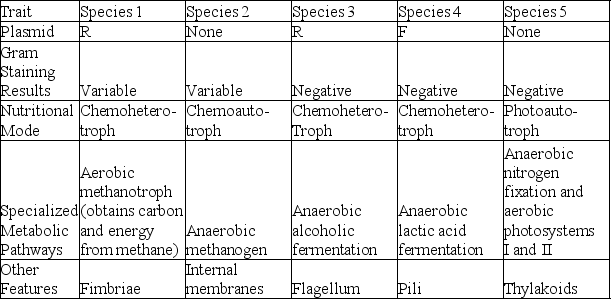 Which species most likely includes cells that are Hfr cells?
 (Multiple Choice)
4.8/5 (79)
(79) The following table depicts characteristics of five prokaryotic species (1-5). Use the information in the table to answer the following question.
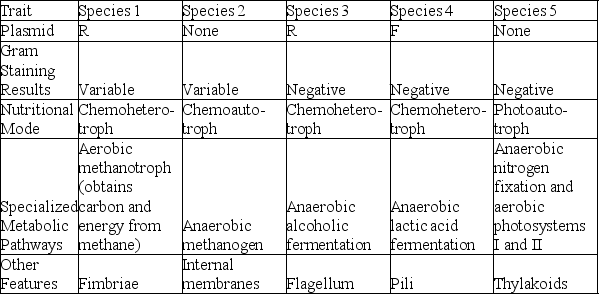 Which two species contain more cytoplasmic phospholipid membranes than the others?
 (Multiple Choice)
4.9/5 (75)
(75) Use the following information and graph to answer the question.
The figure depicts changes to the amount of DNA present in a recipient cell that is engaged in conjugation with an Hfr cell. Hfr cell DNA begins entering the recipient cell at time A. Assume that a fragment of the recipient cell's chromosome is exchanged for a homologous fragment from the Hfr cell's DNA. 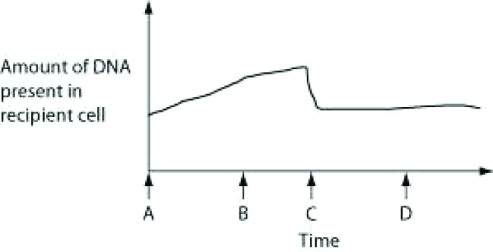 Which of the following processes is responsible for the shape of the curve at time B?
 (Multiple Choice)
4.8/5 (90)
(90) 
Filters
- Essay(0)
- Multiple Choice(0)
- Short Answer(0)
- True False(0)
- Matching(0)