



 Chat with AI
Exam 27: Prokaryotes

Exam 1: Biology and Its Themes46 Questions
Exam 2: Atoms and Molecules61 Questions
Exam 3: The Chemistry of Water55 Questions
Exam 4: Carbon: the Basis of Molecular Diversity52 Questions
Exam 5: Biological Macromolecules and Lipids71 Questions
Exam 6: Energy and Life65 Questions
Exam 7: Cell Structure and Function66 Questions
Exam 8: Cell Membranes67 Questions
Exam 9: Cellular Signaling62 Questions
Exam 10: Cell Respiration68 Questions
Exam 11: Photosynthetic Processes64 Questions
Exam 12: Mitosis63 Questions
Exam 13: Sexual Life Cycles and Meiosis64 Questions
Exam 14: Mendelian Genetics65 Questions
Exam 15: Linkage and Chromosomes54 Questions
Exam 16: Nucleic Acids and Inheritance65 Questions
Exam 17: Expression of Genes70 Questions
Exam 18: Control of Gene Expression66 Questions
Exam 19: Dna Technology56 Questions
Exam 20: The Evolution of Genomes47 Questions
Exam 21: How Evolution Works60 Questions
Exam 22: Phylogenetic Reconstruction66 Questions
Exam 23: Microevolution65 Questions
Exam 24: Species and Speciation65 Questions
Exam 25: Macroevolution58 Questions
Exam 26: Introduction to Viruses54 Questions
Exam 27: Prokaryotes61 Questions
Exam 28: The Origin and Evolution of Eukaryotes66 Questions
Exam 29: Nonvascular and Seedless Vascular Plants72 Questions
Exam 30: Seed Plants64 Questions
Exam 31: Introduction to Fungi56 Questions
Exam 32: An Introduction to Animal Diversity58 Questions
Exam 33: Invertebrates58 Questions
Exam 34: Vertebrates66 Questions
Exam 35: Plant Structure and Growth68 Questions
Exam 36: Transport in Vascular Plants73 Questions
Exam 37: Plant Nutrition51 Questions
Exam 38: Reproduction of Flowering Plants59 Questions
Exam 39: Plant Signals and Behavior60 Questions
Exam 40: The Animal Body58 Questions
Exam 41: Chemical Signals in Animals62 Questions
Exam 42: Animal Digestive Systems58 Questions
Exam 43: Animal Transport Systems58 Questions
Exam 44: Animal Excretory Systems49 Questions
Exam 45: Animal Reproductive Systems64 Questions
Exam 46: Development in Animals68 Questions
Exam 47: Animal Defenses Against Infection65 Questions
Exam 48: Electrical Signals in Animals62 Questions
Exam 49: Neural Regulation in Animals69 Questions
Exam 50: Sensation and Movement in Animals68 Questions
Exam 51: An Overview of Ecology71 Questions
Exam 52: Behavioral Ecology64 Questions
Exam 53: Populations and Life History Traits73 Questions
Exam 54: Biodiversity and Communities71 Questions
Exam 55: Energy Flow and Chemical Cycling in Ecosystems80 Questions
Exam 56: Conservation and Global Ecology75 Questions
Select questions type


The following table depicts characteristics of five prokaryotic species (1-5). Use the information in the table to answer the following question.
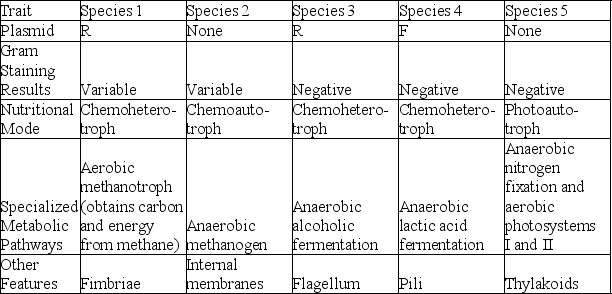 Which species is capable of directed movement?
 (Multiple Choice)
4.8/5  (71)
(71) Mitochondria are thought to be the descendants of certain alpha proteobacteria. They are, however, no longer able to lead independent lives because most genes originally present in their genome have moved to the nuclear genome. Which phenomenon accounts for the movement of these genes?
(Multiple Choice)
4.8/5 (94)
(94) Which of the following statements correctly describes exotoxins and endotoxins produced by various bacteria?
(Multiple Choice)
4.7/5 (79)
(79) If all prokaryotes on Earth suddenly vanished, which of the following would be the most likely and most direct result?
(Multiple Choice)
4.8/5 (76)
(76) Which of the following characteristics is most likely found in plaque on human teeth if plaque is a biofilm?
(Multiple Choice)
5.0/5 (88)
(88) The predatory bacterium Bdellovibrio bacteriovorus is able to penetrate a gram-negative bacterium that has a slimy cell covering. What is the correct sequence of structures penetrated by B. bacteriovorus on its way to the prey's cytoplasm?
(Multiple Choice)
4.7/5 (59)
(59) A bacterium has the following characteristics:
∙ It adheres to the human intestinal lining using a feature that protects it from phagocytes, bacteriophages, and dehydration
∙ It can survive being boiled
∙ It contains no plasmids and relatively little peptidoglycan
Which of the following characteristics allows this bacterium to adhere to the intestinal lining?
(Multiple Choice)
4.9/5 (64)
(64) A process that cannot produce genetic variation in bacterial populations is ________.
(Multiple Choice)
4.9/5 (90)
(90) Which of the following describes a bacterium that lives in the human intestine and causes disease?
(Multiple Choice)
4.9/5 (67)
(67) A bacterium has the following characteristics:
∙ It adheres to the human intestinal lining using a feature that protects it from phagocytes, bacteriophages, and dehydration.
∙ It can survive being boiled.
∙ It contains no plasmids and relatively little peptidoglycan.
Which of the following characteristics allows this bacterium to survive in a human who is taking penicillin pills?
(Multiple Choice)
4.9/5 (79)
(79) Some bacteria possess antibiotic resistance, as well as the ability to survive through adverse conditions. Where in this type of bacteria is the DNA located?
(Multiple Choice)
4.7/5 (78)
(78) Living organisms can be divided into two groups: autotrophs and heterotrophs. How do these two groups differ?
(Multiple Choice)
4.7/5 (85)
(85) Which of the following statements is the most likely result of conjugation involving a bacterium that contains a copy of a plasmid containing a gene for tetracycline resistance with one that does not?
(Multiple Choice)
4.8/5 (81)
(81) The following question refers to the figure.
In an eight-year experiment, a population of E. coli, begun from a single cell, was grown in low-glucose conditions. The culture was transferred to fresh growth medium every 24 hours. Periodically, samples were removed from each population and the ability to survive in low-glucose conditions was compared with the original (ancestral) E. coli population. 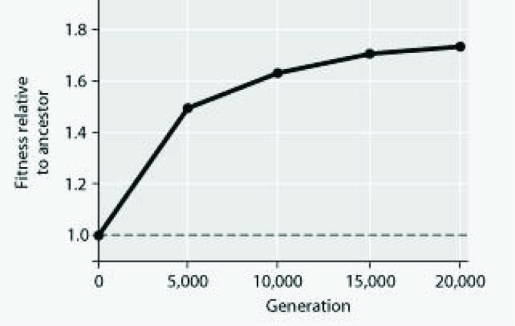 The cells in the cell line grown in low-glucose conditions showed the effects of which of the following processes?
 (Multiple Choice)
4.9/5 (90)
(90) Use the following information and graph to answer the question.
The figure depicts changes to the amount of DNA present in a recipient cell that is engaged in conjugation with an Hfr cell. Hfr cell DNA begins entering the recipient cell at time A. Assume that a fragment of the recipient cell's chromosome is exchanged for a homologous fragment from the Hfr cell's DNA. 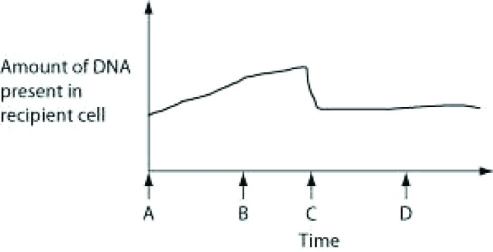 At which time can the recipient cell first be described as "recombinant"?
 (Multiple Choice)
5.0/5 (77)
(77) Which of the following statements about flagella provides the best support for the claim that the flagella from eukaryotes and bacteria evolved independently?
(Multiple Choice)
4.7/5 (78)
(78) Which of the following characteristics describe most existing bacteria?
(Multiple Choice)
4.8/5 (81)
(81) Which of the following traits do archaeans and bacteria have in common?
(Multiple Choice)
4.9/5 (84)
(84) 
Filters
- Essay(0)
- Multiple Choice(0)
- Short Answer(0)
- True False(0)
- Matching(0)