



 Chat with AI
Exam 40: The Animal Body

Exam 1: Biology and Its Themes46 Questions
Exam 2: Atoms and Molecules61 Questions
Exam 3: The Chemistry of Water55 Questions
Exam 4: Carbon: the Basis of Molecular Diversity52 Questions
Exam 5: Biological Macromolecules and Lipids71 Questions
Exam 6: Energy and Life65 Questions
Exam 7: Cell Structure and Function66 Questions
Exam 8: Cell Membranes67 Questions
Exam 9: Cellular Signaling62 Questions
Exam 10: Cell Respiration68 Questions
Exam 11: Photosynthetic Processes64 Questions
Exam 12: Mitosis63 Questions
Exam 13: Sexual Life Cycles and Meiosis64 Questions
Exam 14: Mendelian Genetics65 Questions
Exam 15: Linkage and Chromosomes54 Questions
Exam 16: Nucleic Acids and Inheritance65 Questions
Exam 17: Expression of Genes70 Questions
Exam 18: Control of Gene Expression66 Questions
Exam 19: Dna Technology56 Questions
Exam 20: The Evolution of Genomes47 Questions
Exam 21: How Evolution Works60 Questions
Exam 22: Phylogenetic Reconstruction66 Questions
Exam 23: Microevolution65 Questions
Exam 24: Species and Speciation65 Questions
Exam 25: Macroevolution58 Questions
Exam 26: Introduction to Viruses54 Questions
Exam 27: Prokaryotes61 Questions
Exam 28: The Origin and Evolution of Eukaryotes66 Questions
Exam 29: Nonvascular and Seedless Vascular Plants72 Questions
Exam 30: Seed Plants64 Questions
Exam 31: Introduction to Fungi56 Questions
Exam 32: An Introduction to Animal Diversity58 Questions
Exam 33: Invertebrates58 Questions
Exam 34: Vertebrates66 Questions
Exam 35: Plant Structure and Growth68 Questions
Exam 36: Transport in Vascular Plants73 Questions
Exam 37: Plant Nutrition51 Questions
Exam 38: Reproduction of Flowering Plants59 Questions
Exam 39: Plant Signals and Behavior60 Questions
Exam 40: The Animal Body58 Questions
Exam 41: Chemical Signals in Animals62 Questions
Exam 42: Animal Digestive Systems58 Questions
Exam 43: Animal Transport Systems58 Questions
Exam 44: Animal Excretory Systems49 Questions
Exam 45: Animal Reproductive Systems64 Questions
Exam 46: Development in Animals68 Questions
Exam 47: Animal Defenses Against Infection65 Questions
Exam 48: Electrical Signals in Animals62 Questions
Exam 49: Neural Regulation in Animals69 Questions
Exam 50: Sensation and Movement in Animals68 Questions
Exam 51: An Overview of Ecology71 Questions
Exam 52: Behavioral Ecology64 Questions
Exam 53: Populations and Life History Traits73 Questions
Exam 54: Biodiversity and Communities71 Questions
Exam 55: Energy Flow and Chemical Cycling in Ecosystems80 Questions
Exam 56: Conservation and Global Ecology75 Questions
Select questions type


Which of the following is a unique characteristic of smooth muscle?

Free
(Multiple Choice)
4.7/5  (94)
(94) Correct Answer: Verified
C
Which of the following structural features of the digestive system improves the efficiency of exchange of energy and materials with the environment?
Free
(Multiple Choice)
4.9/5 (73)
(73) Correct Answer:Verified
VerifiedA
Which daily quantity is the least reliable indicator of an animal's metabolic rate, independent of whether an organism is an endotherm or ectoderm?
Free
(Multiple Choice)
4.7/5 (85)
(85) Correct Answer:Verified
VerifiedD
What tissue lines most exchange surfaces of multicellular animals?
(Multiple Choice)
4.8/5 (72)
(72) Which of the following is a typical characteristic of connective tissues?
(Multiple Choice)
4.9/5 (87)
(87) You are studying a large tropical reptile that has a high and relatively stable body temperature. How do you determine whether this animal is an endotherm or an ectotherm?
(Multiple Choice)
4.8/5 (78)
(78) Use the model of circulation in the leg of a Canada goose to answer the following question. 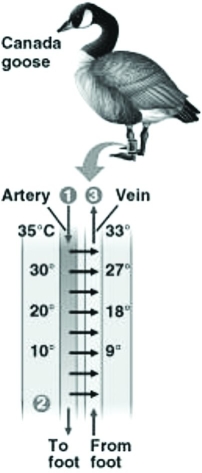 Which of the following is the best interpretation of the model?
 (Multiple Choice)
4.8/5 (84)
(84) Use the model of circulation in the leg of a Canada goose to answer the following question. 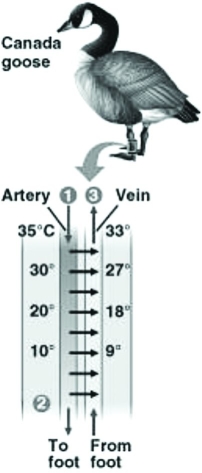 The countercurrent arrangement of blood vessels is an adaptation that allows the goose to ________.
 (Multiple Choice)
4.8/5 (68)
(68) Which of the following organisms is most likely to have the highest total annual energy expenditure per unit mass?
(Multiple Choice)
4.8/5 (87)
(87) Which of the following is a characteristic of nervous system signals?
(Multiple Choice)
4.8/5 (78)
(78) Which of the following properties are displayed by cardiac muscle cells?
(Multiple Choice)
4.9/5 (92)
(92) To study circadian rhythms in European hamsters, researchers measured mRNA levels for two clock genes (Per2 and Bmal1) in individuals who were not hibernating, and therefore had normal body temperature and individuals who were hibernating, and therefore had lower-than-normal body temperature. Both sets of individuals were kept in total darkness. The results are shown in the figure. Which statement is best supported using the data? 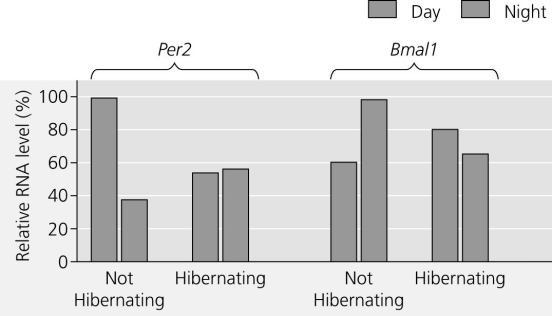
(Multiple Choice)
4.8/5 (83)
(83) Blood is best classified as connective tissue because ________.
(Multiple Choice)
4.9/5 (81)
(81) Which of the following animals most likely uses the largest percentage of its energy budget for homeostatic regulation?
(Multiple Choice)
4.9/5 (77)
(77) Compared with a smaller cell, a larger cell of the same shape has ________.
(Multiple Choice)
4.8/5 (87)
(87) Which of the following increases the rate of heat exchange between an animal and its environment?
(Multiple Choice)
4.8/5 (88)
(88) The panting responses observed in overheated birds and mammals dissipate heat loss by what process?
(Multiple Choice)
4.8/5 (81)
(81) Elephants can often be observed using their trunks to spray water over their bodies, which cools them. What type of heat exchange does this process promote?
(Multiple Choice)
4.9/5 (68)
(68) Which of the following would increase the rate of heat exchange between an animal and its environment?
(Multiple Choice)
4.9/5 (88)
(88) Measuring which of the following amounts would most accurately determine the metabolic rate of an animal?
(Multiple Choice)
4.9/5 (75)
(75) 
Filters
- Essay(0)
- Multiple Choice(0)
- Short Answer(0)
- True False(0)
- Matching(0)