



 Chat with AI
Exam 40: The Animal Body

Exam 1: Biology and Its Themes46 Questions
Exam 2: Atoms and Molecules61 Questions
Exam 3: The Chemistry of Water55 Questions
Exam 4: Carbon: the Basis of Molecular Diversity52 Questions
Exam 5: Biological Macromolecules and Lipids71 Questions
Exam 6: Energy and Life65 Questions
Exam 7: Cell Structure and Function66 Questions
Exam 8: Cell Membranes67 Questions
Exam 9: Cellular Signaling62 Questions
Exam 10: Cell Respiration68 Questions
Exam 11: Photosynthetic Processes64 Questions
Exam 12: Mitosis63 Questions
Exam 13: Sexual Life Cycles and Meiosis64 Questions
Exam 14: Mendelian Genetics65 Questions
Exam 15: Linkage and Chromosomes54 Questions
Exam 16: Nucleic Acids and Inheritance65 Questions
Exam 17: Expression of Genes70 Questions
Exam 18: Control of Gene Expression66 Questions
Exam 19: Dna Technology56 Questions
Exam 20: The Evolution of Genomes47 Questions
Exam 21: How Evolution Works60 Questions
Exam 22: Phylogenetic Reconstruction66 Questions
Exam 23: Microevolution65 Questions
Exam 24: Species and Speciation65 Questions
Exam 25: Macroevolution58 Questions
Exam 26: Introduction to Viruses54 Questions
Exam 27: Prokaryotes61 Questions
Exam 28: The Origin and Evolution of Eukaryotes66 Questions
Exam 29: Nonvascular and Seedless Vascular Plants72 Questions
Exam 30: Seed Plants64 Questions
Exam 31: Introduction to Fungi56 Questions
Exam 32: An Introduction to Animal Diversity58 Questions
Exam 33: Invertebrates58 Questions
Exam 34: Vertebrates66 Questions
Exam 35: Plant Structure and Growth68 Questions
Exam 36: Transport in Vascular Plants73 Questions
Exam 37: Plant Nutrition51 Questions
Exam 38: Reproduction of Flowering Plants59 Questions
Exam 39: Plant Signals and Behavior60 Questions
Exam 40: The Animal Body58 Questions
Exam 41: Chemical Signals in Animals62 Questions
Exam 42: Animal Digestive Systems58 Questions
Exam 43: Animal Transport Systems58 Questions
Exam 44: Animal Excretory Systems49 Questions
Exam 45: Animal Reproductive Systems64 Questions
Exam 46: Development in Animals68 Questions
Exam 47: Animal Defenses Against Infection65 Questions
Exam 48: Electrical Signals in Animals62 Questions
Exam 49: Neural Regulation in Animals69 Questions
Exam 50: Sensation and Movement in Animals68 Questions
Exam 51: An Overview of Ecology71 Questions
Exam 52: Behavioral Ecology64 Questions
Exam 53: Populations and Life History Traits73 Questions
Exam 54: Biodiversity and Communities71 Questions
Exam 55: Energy Flow and Chemical Cycling in Ecosystems80 Questions
Exam 56: Conservation and Global Ecology75 Questions
Select questions type


Which of the following animals uses the largest percentage of its energy budget for homeostatic regulation?
(Multiple Choice)
4.9/5  (70)
(70) Which of the following statements best explains the similarity in the body form of penguins, seals, and tuna?
(Multiple Choice)
4.9/5 (90)
(90) Which is the name of the epithelial cell surface that faces the outside of an organ?
(Multiple Choice)
4.9/5 (87)
(87) Which of the following options correctly lists three evolutionary adaptations that help some animals directly exchange matter between the cells of their body and the environment?
(Multiple Choice)
4.9/5 (71)
(71) Which characteristic is most likely for an epithelium that is specialized for passive diffusion of materials from one fluid-filled compartment to another?
(Multiple Choice)
4.8/5 (87)
(87) Which of the following is an example of a properly functioning homeostatic control system?
(Multiple Choice)
4.7/5 (77)
(77) Use the graph to answer the following question. 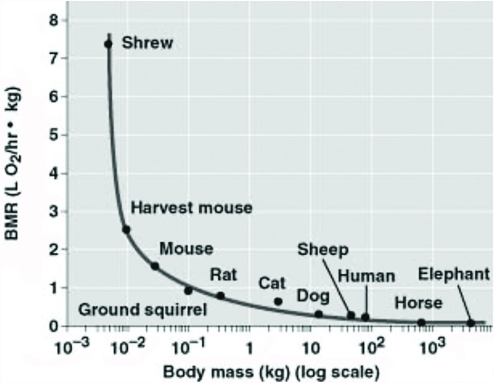 Which of the following statements is most consistent from the data in the graph?
 (Multiple Choice)
4.9/5 (75)
(75) Compared with a smaller cell, a larger cell of the same shape has ________.
(Multiple Choice)
4.8/5 (77)
(77) The use of brown fat to generate metabolic heat is mostly limited to small mammals. Which characteristic of small mammals created the selective pressure that favored the use of brown fat to generate metabolic heat?
(Multiple Choice)
4.9/5 (81)
(81) If a person travels to a time zone that was several hours ahead of their own, they may experience tiredness known as jet lag. Jet lag is due to a disruption of ________.
(Multiple Choice)
4.7/5 (68)
(68) Which type of muscle directly helps move food along the digestive tract?
(Multiple Choice)
4.9/5 (71)
(71) In mammals, growth hormone is an endocrine signaling molecule that stimulates repair and growth of various tissues. Which of the following is required for a tissue to respond to growth hormone?
(Multiple Choice)
4.8/5 (81)
(81) An animal's inputs of energy and materials would exceed its outputs ________.
(Multiple Choice)
4.8/5 (73)
(73) Which of the following changes to the shape of a cube of clay will decrease its surface area relative to its volume?
(Multiple Choice)
4.9/5 (73)
(73) The migratory eel, Anguilla rostrata, lives as a juvenile in fresh water, but then migrates through the ocean as an adult. Which of the following adaptations would facilitate the transition from fresh water to salt water?
(Multiple Choice)
4.8/5 (83)
(83) Which of the following options best describes the structure of bone?
(Multiple Choice)
4.9/5 (81)
(81) The BMR of José, an adult human male, is approximately 1,800 kcal/day. Suppose that José ate 2,400 kcal of food in one day and that walking at a slow pace "burns" approximately 150 kcal per hour. How many hours would José have to walk to have a net zero energy gain for the day?
(Multiple Choice)
4.8/5 (76)
(76) Which of the following statements is true regarding the impact of the environment on snake behavior?
(Multiple Choice)
4.8/5 (78)
(78) Which statement is true about how standard metabolic rate (SMR) and basal metabolic rate (BMR) are measured?
(Multiple Choice)
4.9/5 (83)
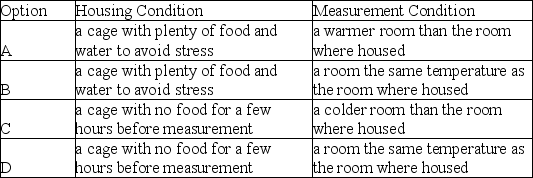
(83) A researcher is setting up an experiment to measure basal metabolic rate in prairie voles (Microtus ochrogaster-a small rodent). Which of the following would be the best set of conditions for the voles immediately before and during the measurement?
(Multiple Choice)
4.8/5 (83)
(83) 
Filters
- Essay(0)
- Multiple Choice(0)
- Short Answer(0)
- True False(0)
- Matching(0)