



 Chat with AI
Exam 40: The Animal Body

Exam 1: Biology and Its Themes46 Questions
Exam 2: Atoms and Molecules61 Questions
Exam 3: The Chemistry of Water55 Questions
Exam 4: Carbon: the Basis of Molecular Diversity52 Questions
Exam 5: Biological Macromolecules and Lipids71 Questions
Exam 6: Energy and Life65 Questions
Exam 7: Cell Structure and Function66 Questions
Exam 8: Cell Membranes67 Questions
Exam 9: Cellular Signaling62 Questions
Exam 10: Cell Respiration68 Questions
Exam 11: Photosynthetic Processes64 Questions
Exam 12: Mitosis63 Questions
Exam 13: Sexual Life Cycles and Meiosis64 Questions
Exam 14: Mendelian Genetics65 Questions
Exam 15: Linkage and Chromosomes54 Questions
Exam 16: Nucleic Acids and Inheritance65 Questions
Exam 17: Expression of Genes70 Questions
Exam 18: Control of Gene Expression66 Questions
Exam 19: Dna Technology56 Questions
Exam 20: The Evolution of Genomes47 Questions
Exam 21: How Evolution Works60 Questions
Exam 22: Phylogenetic Reconstruction66 Questions
Exam 23: Microevolution65 Questions
Exam 24: Species and Speciation65 Questions
Exam 25: Macroevolution58 Questions
Exam 26: Introduction to Viruses54 Questions
Exam 27: Prokaryotes61 Questions
Exam 28: The Origin and Evolution of Eukaryotes66 Questions
Exam 29: Nonvascular and Seedless Vascular Plants72 Questions
Exam 30: Seed Plants64 Questions
Exam 31: Introduction to Fungi56 Questions
Exam 32: An Introduction to Animal Diversity58 Questions
Exam 33: Invertebrates58 Questions
Exam 34: Vertebrates66 Questions
Exam 35: Plant Structure and Growth68 Questions
Exam 36: Transport in Vascular Plants73 Questions
Exam 37: Plant Nutrition51 Questions
Exam 38: Reproduction of Flowering Plants59 Questions
Exam 39: Plant Signals and Behavior60 Questions
Exam 40: The Animal Body58 Questions
Exam 41: Chemical Signals in Animals62 Questions
Exam 42: Animal Digestive Systems58 Questions
Exam 43: Animal Transport Systems58 Questions
Exam 44: Animal Excretory Systems49 Questions
Exam 45: Animal Reproductive Systems64 Questions
Exam 46: Development in Animals68 Questions
Exam 47: Animal Defenses Against Infection65 Questions
Exam 48: Electrical Signals in Animals62 Questions
Exam 49: Neural Regulation in Animals69 Questions
Exam 50: Sensation and Movement in Animals68 Questions
Exam 51: An Overview of Ecology71 Questions
Exam 52: Behavioral Ecology64 Questions
Exam 53: Populations and Life History Traits73 Questions
Exam 54: Biodiversity and Communities71 Questions
Exam 55: Energy Flow and Chemical Cycling in Ecosystems80 Questions
Exam 56: Conservation and Global Ecology75 Questions
Select questions type


The hypothalamus in the brain releases the hormone corticotropin-releasing hormone (CRH) that triggers the release of adrenocorticotropic hormone (ACTH) from the pituitary gland. ACTH travels through the blood to cause the release of cortisol from the cortex of the adrenal glands. If cortisol acts with negative feedback on CRH and ACTH, what would you expect to happen when cortisol is released?
(Multiple Choice)
4.9/5  (81)
(81) In a cool environment, an ectotherm is more likely to survive an extended period of food deprivation than would an equally sized endotherm because the ectotherm ________.
(Multiple Choice)
4.8/5 (81)
(81) Which of the following organisms is most likely to have the highest total annual energy expenditure?
(Multiple Choice)
4.7/5 (68)
(68) You are studying a large tropical reptile that has a high and relatively stable body temperature. Which of the following observations is best for determining if the animal is an endotherm or an ectotherm?
(Multiple Choice)
4.9/5 (87)
(87) Which organ system is responsible for protection against injury, infection, and dehydration?
(Multiple Choice)
4.9/5 (74)
(74) Which of the following characteristics is shared by all types of muscle tissue?
(Multiple Choice)
5.0/5 (89)
(89) The temperature-regulating center of vertebrate animals is located in the ________.
(Multiple Choice)
5.0/5 (72)
(72) Some animals have no gills when young, but then develop gills that grow larger as the animal grows larger. Which of the following statements provides the best explanation for this increase in gill size?
(Multiple Choice)
4.9/5 (86)
(86) Which body system assists with coordination of vertebrate body functions via chemical signals?
(Multiple Choice)
4.9/5 (71)
(71) Which of these provides the best advantage for an animal that conforms to a changing environmental condition, such as temperature?
(Multiple Choice)
5.0/5 (69)
(69) The body's automatic tendency to maintain a constant and optimal internal environment is termed as ________.
(Multiple Choice)
4.8/5 (75)
(75) A body tissue that consists largely of material located outside of cells is ________.
(Multiple Choice)
4.9/5 (79)
(79) In which process is the metabolic breakdown of specialized brown fat deposits in certain animals substantially increased?
(Multiple Choice)
4.9/5 (77)
(77) Which principle of heat exchange best explains why birds fluff their feathers in colder weather?
(Multiple Choice)
4.8/5 (83)
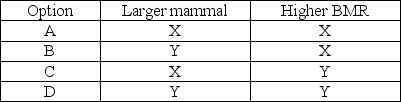
(83) Researchers measure the heart rates, breathing rates, and blood volume (relative to body size) for two mammals (X and Y) and found that all three values were significantly higher in mammal X. Which option in the table best compares mammals X and Y?
(Multiple Choice)
4.7/5 (97)
(97) Consider the energy budgets for a human, an elephant, a penguin, a mouse, and a snake. The ________ would have the highest total annual energy expenditure, and the ________ would have the highest energy expenditure per unit mass.
(Multiple Choice)
4.7/5 (67)
(67) 
Filters
- Essay(0)
- Multiple Choice(0)
- Short Answer(0)
- True False(0)
- Matching(0)