



 Chat with AI
Exam 5: Biological Macromolecules and Lipids

Exam 1: Biology and Its Themes46 Questions
Exam 2: Atoms and Molecules61 Questions
Exam 3: The Chemistry of Water55 Questions
Exam 4: Carbon: the Basis of Molecular Diversity52 Questions
Exam 5: Biological Macromolecules and Lipids71 Questions
Exam 6: Energy and Life65 Questions
Exam 7: Cell Structure and Function66 Questions
Exam 8: Cell Membranes67 Questions
Exam 9: Cellular Signaling62 Questions
Exam 10: Cell Respiration68 Questions
Exam 11: Photosynthetic Processes64 Questions
Exam 12: Mitosis63 Questions
Exam 13: Sexual Life Cycles and Meiosis64 Questions
Exam 14: Mendelian Genetics65 Questions
Exam 15: Linkage and Chromosomes54 Questions
Exam 16: Nucleic Acids and Inheritance65 Questions
Exam 17: Expression of Genes70 Questions
Exam 18: Control of Gene Expression66 Questions
Exam 19: Dna Technology56 Questions
Exam 20: The Evolution of Genomes47 Questions
Exam 21: How Evolution Works60 Questions
Exam 22: Phylogenetic Reconstruction66 Questions
Exam 23: Microevolution65 Questions
Exam 24: Species and Speciation65 Questions
Exam 25: Macroevolution58 Questions
Exam 26: Introduction to Viruses54 Questions
Exam 27: Prokaryotes61 Questions
Exam 28: The Origin and Evolution of Eukaryotes66 Questions
Exam 29: Nonvascular and Seedless Vascular Plants72 Questions
Exam 30: Seed Plants64 Questions
Exam 31: Introduction to Fungi56 Questions
Exam 32: An Introduction to Animal Diversity58 Questions
Exam 33: Invertebrates58 Questions
Exam 34: Vertebrates66 Questions
Exam 35: Plant Structure and Growth68 Questions
Exam 36: Transport in Vascular Plants73 Questions
Exam 37: Plant Nutrition51 Questions
Exam 38: Reproduction of Flowering Plants59 Questions
Exam 39: Plant Signals and Behavior60 Questions
Exam 40: The Animal Body58 Questions
Exam 41: Chemical Signals in Animals62 Questions
Exam 42: Animal Digestive Systems58 Questions
Exam 43: Animal Transport Systems58 Questions
Exam 44: Animal Excretory Systems49 Questions
Exam 45: Animal Reproductive Systems64 Questions
Exam 46: Development in Animals68 Questions
Exam 47: Animal Defenses Against Infection65 Questions
Exam 48: Electrical Signals in Animals62 Questions
Exam 49: Neural Regulation in Animals69 Questions
Exam 50: Sensation and Movement in Animals68 Questions
Exam 51: An Overview of Ecology71 Questions
Exam 52: Behavioral Ecology64 Questions
Exam 53: Populations and Life History Traits73 Questions
Exam 54: Biodiversity and Communities71 Questions
Exam 55: Energy Flow and Chemical Cycling in Ecosystems80 Questions
Exam 56: Conservation and Global Ecology75 Questions
Select questions type


Which of the following is the primary function of RNA molecule?

Free
(Multiple Choice)
4.8/5  (78)
(78) Correct Answer: Verified
B
Why can humans digest starch but not cellulose?
Free
(Multiple Choice)
4.8/5 (88)
(88) Correct Answer:Verified
VerifiedA
Which of the following has been associated with atherosclerosis and should be eliminated from one's diet for health reasons?
Free
(Multiple Choice)
4.8/5 (67)
(67) Correct Answer:Verified
VerifiedD
Which of the following categories includes all others in the list?
(Multiple Choice)
4.9/5 (80)
(80) Which of the following is not analogous to a biological polymer?
(Multiple Choice)
4.9/5 (78)
(78) The structural level of a protein least affected by a disruption in hydrogen bonding is the ________.
(Multiple Choice)
4.7/5 (86)
(86) Which of the following are possible base compositions for double-stranded DNA?
%A %G %C %T %U
(Multiple Choice)
4.7/5 (65)
(65) Maltose is a disaccharide that can easily be digested into glucose molecules. Which type of glycosidic linkage connects glucose molecules in maltose?
(Multiple Choice)
4.8/5 (62)
(62) The difference between an aldose sugar and a ketose sugar is ________.
(Multiple Choice)
4.9/5 (85)
(85) Which of the following pairs of base sequences could form a short stretch of a normal double helix of DNA?
(Multiple Choice)
4.7/5 (80)
(80) The molecular formula of a carbohydrate molecule is C24H42O21. The maximum number of glucose and water molecules that will be consumed by complete hydrolysis of the carbohydrate is ________.
(Multiple Choice)
4.9/5 (65)
(65) How many amino acids and peptide bonds does a tetrapeptide have?
(Multiple Choice)
4.8/5 (92)
(92) Which of the following statements is correct regarding starch and cellulose?
(Multiple Choice)
4.7/5 (72)
(72) Which of the following statements describes the interaction of water molecules with phospholipids?
(Multiple Choice)
4.9/5 (71)
(71) The following question is based on the 15 molecules illustrated in the figures. 


 Which of the following molecules is a purine nitrogenous base?
 (Multiple Choice)
4.8/5 (87)
(87) In sickle-cell disease, as a result of a single amino acid change, the mutant hemoglobin tetramers associate with each other and assemble into large fibers. Based on this information alone, what does the sickle-cell hemoglobin exhibit?
(Multiple Choice)
4.8/5 (79)
(79) You have just sequenced a new protein isolated from mice and observe that sulfur-containing cysteine residues occur at regular intervals. "This finding is most consistent with which of the following claims about the protein?
(Multiple Choice)
4.9/5 (80)
(80) The following question is based on the 15 molecules illustrated in the figures. 


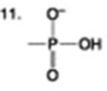


 A fat (or triacylglycerol) would be formed as a result of a dehydration reaction between ________.
 (Multiple Choice)
4.9/5 (82)
(82) 
Filters
- Essay(0)
- Multiple Choice(0)
- Short Answer(0)
- True False(0)
- Matching(0)