



 Chat with AI
Exam 29: Nonvascular and Seedless Vascular Plants

Exam 1: Biology and Its Themes46 Questions
Exam 2: Atoms and Molecules61 Questions
Exam 3: The Chemistry of Water55 Questions
Exam 4: Carbon: the Basis of Molecular Diversity52 Questions
Exam 5: Biological Macromolecules and Lipids71 Questions
Exam 6: Energy and Life65 Questions
Exam 7: Cell Structure and Function66 Questions
Exam 8: Cell Membranes67 Questions
Exam 9: Cellular Signaling62 Questions
Exam 10: Cell Respiration68 Questions
Exam 11: Photosynthetic Processes64 Questions
Exam 12: Mitosis63 Questions
Exam 13: Sexual Life Cycles and Meiosis64 Questions
Exam 14: Mendelian Genetics65 Questions
Exam 15: Linkage and Chromosomes54 Questions
Exam 16: Nucleic Acids and Inheritance65 Questions
Exam 17: Expression of Genes70 Questions
Exam 18: Control of Gene Expression66 Questions
Exam 19: Dna Technology56 Questions
Exam 20: The Evolution of Genomes47 Questions
Exam 21: How Evolution Works60 Questions
Exam 22: Phylogenetic Reconstruction66 Questions
Exam 23: Microevolution65 Questions
Exam 24: Species and Speciation65 Questions
Exam 25: Macroevolution58 Questions
Exam 26: Introduction to Viruses54 Questions
Exam 27: Prokaryotes61 Questions
Exam 28: The Origin and Evolution of Eukaryotes66 Questions
Exam 29: Nonvascular and Seedless Vascular Plants72 Questions
Exam 30: Seed Plants64 Questions
Exam 31: Introduction to Fungi56 Questions
Exam 32: An Introduction to Animal Diversity58 Questions
Exam 33: Invertebrates58 Questions
Exam 34: Vertebrates66 Questions
Exam 35: Plant Structure and Growth68 Questions
Exam 36: Transport in Vascular Plants73 Questions
Exam 37: Plant Nutrition51 Questions
Exam 38: Reproduction of Flowering Plants59 Questions
Exam 39: Plant Signals and Behavior60 Questions
Exam 40: The Animal Body58 Questions
Exam 41: Chemical Signals in Animals62 Questions
Exam 42: Animal Digestive Systems58 Questions
Exam 43: Animal Transport Systems58 Questions
Exam 44: Animal Excretory Systems49 Questions
Exam 45: Animal Reproductive Systems64 Questions
Exam 46: Development in Animals68 Questions
Exam 47: Animal Defenses Against Infection65 Questions
Exam 48: Electrical Signals in Animals62 Questions
Exam 49: Neural Regulation in Animals69 Questions
Exam 50: Sensation and Movement in Animals68 Questions
Exam 51: An Overview of Ecology71 Questions
Exam 52: Behavioral Ecology64 Questions
Exam 53: Populations and Life History Traits73 Questions
Exam 54: Biodiversity and Communities71 Questions
Exam 55: Energy Flow and Chemical Cycling in Ecosystems80 Questions
Exam 56: Conservation and Global Ecology75 Questions
Select questions type


The evolution of a vascular system in plants allowed which of the following characteristics and process to occur?
(Multiple Choice)
4.9/5  (67)
(67) Based on the plant fossil record, which of these events likely occurred most recently?
(Multiple Choice)
4.9/5 (70)
(70) Which of the following statements is correct regarding stomata?
(Multiple Choice)
4.7/5 (75)
(75) Which of the following statements about the transition from ocean to land by plants is most likely to be accurate?
(Multiple Choice)
4.8/5 (80)
(80) Which of the following statements correctly describes the haploid gametophytes of bryophytes?
(Multiple Choice)
4.7/5 (92)
(92) Which of the following factors most likely helped early plants colonize land?
(Multiple Choice)
4.8/5 (72)
(72) Which of the following statements correctly describes a characteristic of bryophytes (nonvascular plants)?
(Multiple Choice)
4.8/5 (88)
(88) Which of the following biological molecules contributes to the structural integrity of plant spores?
(Multiple Choice)
4.9/5 (62)
(62) Many types of plants increase the number of stomata per unit surface area of a leaf when atmospheric carbon dioxide levels decline. Which of the following is an analogous response in humans?
(Multiple Choice)
5.0/5 (95)
(95) Which of the following assumptions led to the hypothesis that the first plants exhibited low, sprawling growth?
(Multiple Choice)
4.9/5 (71)
(71) The following question refers to the generalized life cycle for plants shown in the figure. Each number within a circle or square represents a specific plant or plant part, and each number over an arrow represents meiosis, mitosis, or fertilization. 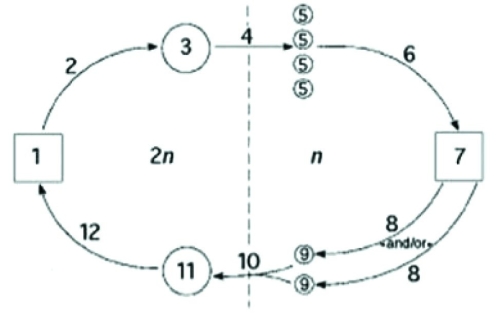 In the figure, meiosis is most likely to be represented by which number(s)?
 (Multiple Choice)
4.9/5 (88)
(88) 
Filters
- Essay(0)
- Multiple Choice(0)
- Short Answer(0)
- True False(0)
- Matching(0)