



 Chat with AI
Exam 22: Phylogenetic Reconstruction

Exam 1: Biology and Its Themes46 Questions
Exam 2: Atoms and Molecules61 Questions
Exam 3: The Chemistry of Water55 Questions
Exam 4: Carbon: the Basis of Molecular Diversity52 Questions
Exam 5: Biological Macromolecules and Lipids71 Questions
Exam 6: Energy and Life65 Questions
Exam 7: Cell Structure and Function66 Questions
Exam 8: Cell Membranes67 Questions
Exam 9: Cellular Signaling62 Questions
Exam 10: Cell Respiration68 Questions
Exam 11: Photosynthetic Processes64 Questions
Exam 12: Mitosis63 Questions
Exam 13: Sexual Life Cycles and Meiosis64 Questions
Exam 14: Mendelian Genetics65 Questions
Exam 15: Linkage and Chromosomes54 Questions
Exam 16: Nucleic Acids and Inheritance65 Questions
Exam 17: Expression of Genes70 Questions
Exam 18: Control of Gene Expression66 Questions
Exam 19: Dna Technology56 Questions
Exam 20: The Evolution of Genomes47 Questions
Exam 21: How Evolution Works60 Questions
Exam 22: Phylogenetic Reconstruction66 Questions
Exam 23: Microevolution65 Questions
Exam 24: Species and Speciation65 Questions
Exam 25: Macroevolution58 Questions
Exam 26: Introduction to Viruses54 Questions
Exam 27: Prokaryotes61 Questions
Exam 28: The Origin and Evolution of Eukaryotes66 Questions
Exam 29: Nonvascular and Seedless Vascular Plants72 Questions
Exam 30: Seed Plants64 Questions
Exam 31: Introduction to Fungi56 Questions
Exam 32: An Introduction to Animal Diversity58 Questions
Exam 33: Invertebrates58 Questions
Exam 34: Vertebrates66 Questions
Exam 35: Plant Structure and Growth68 Questions
Exam 36: Transport in Vascular Plants73 Questions
Exam 37: Plant Nutrition51 Questions
Exam 38: Reproduction of Flowering Plants59 Questions
Exam 39: Plant Signals and Behavior60 Questions
Exam 40: The Animal Body58 Questions
Exam 41: Chemical Signals in Animals62 Questions
Exam 42: Animal Digestive Systems58 Questions
Exam 43: Animal Transport Systems58 Questions
Exam 44: Animal Excretory Systems49 Questions
Exam 45: Animal Reproductive Systems64 Questions
Exam 46: Development in Animals68 Questions
Exam 47: Animal Defenses Against Infection65 Questions
Exam 48: Electrical Signals in Animals62 Questions
Exam 49: Neural Regulation in Animals69 Questions
Exam 50: Sensation and Movement in Animals68 Questions
Exam 51: An Overview of Ecology71 Questions
Exam 52: Behavioral Ecology64 Questions
Exam 53: Populations and Life History Traits73 Questions
Exam 54: Biodiversity and Communities71 Questions
Exam 55: Energy Flow and Chemical Cycling in Ecosystems80 Questions
Exam 56: Conservation and Global Ecology75 Questions
Select questions type


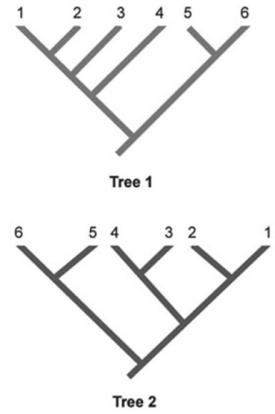 In the phylogenetic trees shown, each number represents a unique species of organisms. Which two species are represented as sister species in Tree 2 but are not represented as sister species in Tree 1?
 (Multiple Choice)
4.8/5  (81)
(81) Three living species X, Y, and Z share a common ancestor T, as do extinct species U and V. A grouping that consists of species T, X, Y, and Z (but not U or V) makes up ________.
(Multiple Choice)
4.7/5 (85)
(85) Which of the following statements is accurate, at least according to our present knowledge?
(Multiple Choice)
4.8/5 (78)
(78) Which of the following processes would, if it had acted upon a gene, prevent this gene from acting as a reliable molecular clock?
(Multiple Choice)
4.9/5 (75)
(75) What kind of evidence has recently made it necessary to assign the prokaryotes to either of two different domains, rather than assigning all prokaryotes to the same kingdom?
(Multiple Choice)
4.8/5 (88)
(88) Some molecular data place the giant panda in the bear family (Ursidae) but place the lesser panda in the raccoon family (Procyonidae). If the molecular data best reflect the evolutionary history of these two groups, then the morphological similarities of these two species is most likely due to which of the following processes?
(Multiple Choice)
4.8/5 (62)
(62) Scientists have hypothesized that the common ancestors of birds and mammals, possessed three-chambered hearts (two atria, one ventricle). Birds and mammals, however, are alike in having four-chambered hearts (two atria, two ventricles). Which of the following statements best describes the four-chambered hearts of birds and mammals?
(Multiple Choice)
4.9/5 (91)
(91) Use the following information to answer the question. 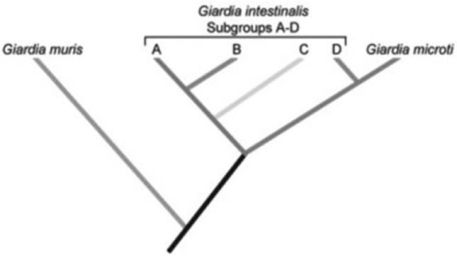 According to the phylogenetic tree in the figure above, what type of evolutionary group does G. intestinalis constitute?
 (Multiple Choice)
4.8/5 (88)
(88) In which type of classification system are names assigned only to groups that include a common ancestor and all of its descendants?
(Multiple Choice)
4.8/5 (79)
(79) The kingdom Monera was dismantled because of which of the following reasons?
(Multiple Choice)
4.9/5 (81)
(81) The question refers to the table, which compares the percent sequence homology of four different parts of a gene (two introns and two exons) that is found in five different eukaryotic species. The data show the percentage of sequence homology of each intron and exon in comparison to the sequences in species A.
Percentage of Sequence Homology
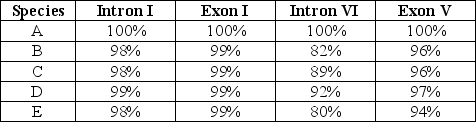 Which of these four gene parts should allow the construction of the most accurate phylogenetic tree, assuming that this is the only part of the gene that has acted as a reliable molecular clock?
 (Multiple Choice)
4.8/5 (69)
(69) Which of the following statements is most consistent with the model of evolutionary relatedness represented in the phylogenetic tree? 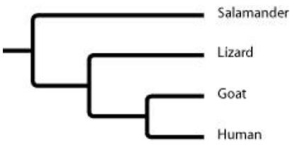
(Multiple Choice)
4.8/5 (91)
(91) In which phylogenetic tree are the chytrids and ascomycetes shown as being more distantly related than in the other phylogenetic trees?
(Multiple Choice)
4.7/5 (77)
(77) The question refers to the table, which compares the percent sequence homology of four different parts of a gene (two introns and two exons) that is found in five different eukaryotic species. The data show the percentage of sequence homology of each intron and exon in comparison to the sequences in species A.
% Sequence Homology
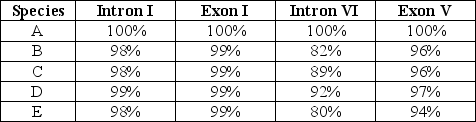 Based on the data in the table, which phylogenetic tree is the most likely depiction of the evolutionary relationships among these five species?
 (Multiple Choice)
4.8/5 (86)
(86) 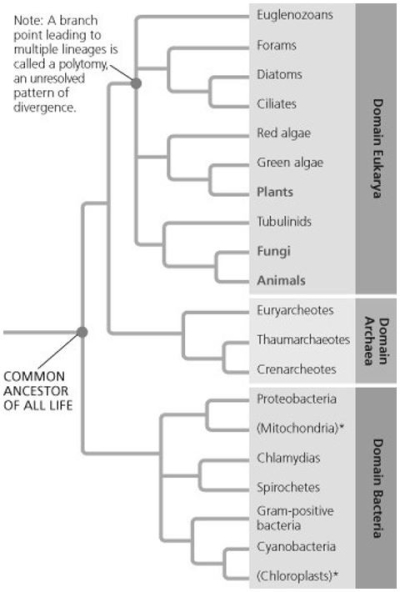 Which of the following statements most accurately describes the evolution of chloroplasts?
 (Multiple Choice)
4.9/5 (69)
(69) 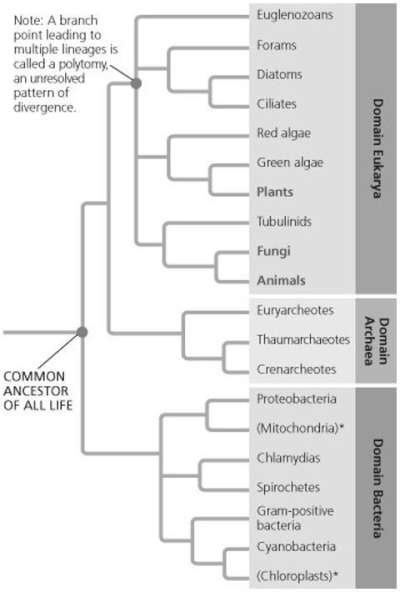 From which taxon did mitochondria evolve?
The figure represents a phylogenetic tree of birds and their closest relatives. Which group of organisms represents the outgroup in the clade that includes only crocodilians, ornithischian dinosaurs, saurischian dinosaurs, and birds? 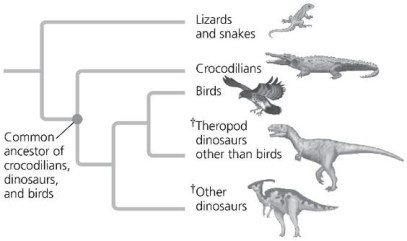
(Multiple Choice)
4.9/5 (78)
(78) Eukaryotes that are not closely related and that do not share many anatomical similarities can still be placed together on the same phylogenetic tree. Which of the following approaches would be most appropriate for doing this?
(Multiple Choice)
4.9/5 (94)
(94) Use the figure to answer the following question. Gymnosperms and angiosperms are both types of plants that produce seeds. 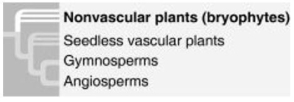 Which of the following claims is best supported by this phylogenetic tree?
 (Multiple Choice)
4.9/5 (79)
(79) The following phylogeny shows six living species (a-f) and five ancestral (now extinct) species (1-5). If the phylogeny had been developed on the basis of similarities in bone structure, which of the following predictions would you make in terms of the structure of a particular enzyme? 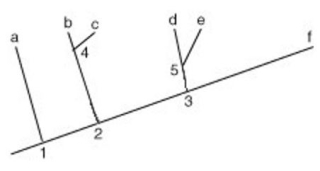
(Multiple Choice)
4.8/5 (82)
(82) 
Filters
- Essay(0)
- Multiple Choice(0)
- Short Answer(0)
- True False(0)
- Matching(0)