



 Chat with AI
Exam 15: Linkage and Chromosomes

Exam 1: Biology and Its Themes46 Questions
Exam 2: Atoms and Molecules61 Questions
Exam 3: The Chemistry of Water55 Questions
Exam 4: Carbon: the Basis of Molecular Diversity52 Questions
Exam 5: Biological Macromolecules and Lipids71 Questions
Exam 6: Energy and Life65 Questions
Exam 7: Cell Structure and Function66 Questions
Exam 8: Cell Membranes67 Questions
Exam 9: Cellular Signaling62 Questions
Exam 10: Cell Respiration68 Questions
Exam 11: Photosynthetic Processes64 Questions
Exam 12: Mitosis63 Questions
Exam 13: Sexual Life Cycles and Meiosis64 Questions
Exam 14: Mendelian Genetics65 Questions
Exam 15: Linkage and Chromosomes54 Questions
Exam 16: Nucleic Acids and Inheritance65 Questions
Exam 17: Expression of Genes70 Questions
Exam 18: Control of Gene Expression66 Questions
Exam 19: Dna Technology56 Questions
Exam 20: The Evolution of Genomes47 Questions
Exam 21: How Evolution Works60 Questions
Exam 22: Phylogenetic Reconstruction66 Questions
Exam 23: Microevolution65 Questions
Exam 24: Species and Speciation65 Questions
Exam 25: Macroevolution58 Questions
Exam 26: Introduction to Viruses54 Questions
Exam 27: Prokaryotes61 Questions
Exam 28: The Origin and Evolution of Eukaryotes66 Questions
Exam 29: Nonvascular and Seedless Vascular Plants72 Questions
Exam 30: Seed Plants64 Questions
Exam 31: Introduction to Fungi56 Questions
Exam 32: An Introduction to Animal Diversity58 Questions
Exam 33: Invertebrates58 Questions
Exam 34: Vertebrates66 Questions
Exam 35: Plant Structure and Growth68 Questions
Exam 36: Transport in Vascular Plants73 Questions
Exam 37: Plant Nutrition51 Questions
Exam 38: Reproduction of Flowering Plants59 Questions
Exam 39: Plant Signals and Behavior60 Questions
Exam 40: The Animal Body58 Questions
Exam 41: Chemical Signals in Animals62 Questions
Exam 42: Animal Digestive Systems58 Questions
Exam 43: Animal Transport Systems58 Questions
Exam 44: Animal Excretory Systems49 Questions
Exam 45: Animal Reproductive Systems64 Questions
Exam 46: Development in Animals68 Questions
Exam 47: Animal Defenses Against Infection65 Questions
Exam 48: Electrical Signals in Animals62 Questions
Exam 49: Neural Regulation in Animals69 Questions
Exam 50: Sensation and Movement in Animals68 Questions
Exam 51: An Overview of Ecology71 Questions
Exam 52: Behavioral Ecology64 Questions
Exam 53: Populations and Life History Traits73 Questions
Exam 54: Biodiversity and Communities71 Questions
Exam 55: Energy Flow and Chemical Cycling in Ecosystems80 Questions
Exam 56: Conservation and Global Ecology75 Questions
Select questions type


A homozygous tomato plant with red fruit and yellow flowers was crossed with a homozygous tomato plant with golden fruit and white flowers. The F1 had red fruit and yellow flowers. F1 plants were testcrossed (crossing them to homozygous recessive individuals), and the following offspring were obtained:
Red fruit and yellow flowers-41
Red fruit and white flowers-7
Golden fruit and yellow flowers-8
Golden fruit and white flowers-44
How many map units separate these genes?
(Multiple Choice)
4.9/5  (74)
(74) In birds, sex is determined by ZW chromosome inheritance. Males are ZZ and females are ZW. Within pigeon populations there is a recessive, Z-linked allele that is lethal in embryos. What is the expected sex ratio in the offspring of a cross between a male that is heterozygous for the lethal allele and a wildtype female?
(Multiple Choice)
4.9/5 (86)
(86) Male sex determination in mammals is in large part due to the SRY gene found on the Y chromosome. Which of the following scenarios will result in a person with an XX karyotype developing a male phenotype?
(Multiple Choice)
4.9/5 (85)
(85) Which of the following statements regarding gene linkage is correct?
(Multiple Choice)
5.0/5 (76)
(76) Which of the following statements correctly describes what happens to a chromosome after a nonreciprocal translocation?
(Multiple Choice)
4.7/5 (76)
(76) German scientist Carl Correns found that the inheritance of variegated color on the leaves of certain plants was determined only by the maternal parent. Which of the following phenomena best explains this pattern of inheritance?
(Multiple Choice)
4.8/5 (61)
(61) Which of the following statements correctly describes the chromosome theory of inheritance as it was understood in the early 20th century?
(Multiple Choice)
5.0/5 (66)
(66) Use the following information to answer the question.
A plantlike organism on the hypothetical planet Pandora has three genetic traits: leaf color, controlled by gene L; a stem texture, controlled by gene S; and root length controlled by gene R. The three genes are linked and recombine.
A geneticist performed a testcross with a strain of the organism that is heterozygous for the three traits. She recorded progeny with the following phenotypic distribution:
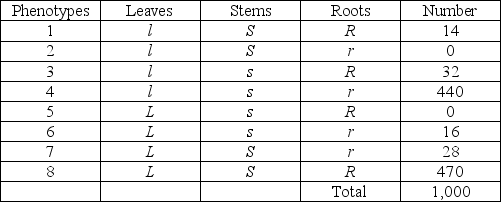 Which of the progeny phenotypes will require recombination between genes L and S?
 (Multiple Choice)
4.9/5 (74)
(74) If cell Q enters meiosis, and nondisjunction of one chromosome occurs in one of its daughter cells during meiosis II, how will this affect the gametes at the completion of meiosis?
(Multiple Choice)
4.8/5 (81)
(81) Use the following information to answer the question.
A plantlike organism on the hypothetical planet Pandora has three genetic traits: leaf color, controlled by gene L; a stem texture, controlled by gene S; and root length controlled by gene R. The three genes are linked and recombine.
A geneticist performed a testcross with a strain of the organism that is heterozygous for the three traits. She recorded progeny with the following phenotypic distribution:
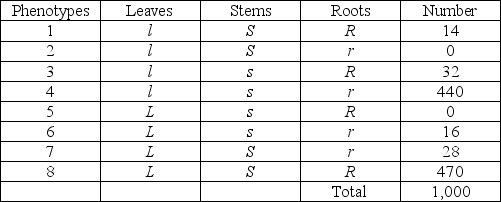 What is the approximate distance between genes L and S?
 (Multiple Choice)
5.0/5 (77)
(77) A phenotypically normal couple seeks genetic counseling because the man's karyotype showed that his chromosomes had a reciprocal translocation between chromosomes 4 and 12. Because the translocation is reciprocal there was no genetic information lost and he is healthy; however, he and his wife want to know the probability that his sperm cells will be abnormal. Which fraction of his sperm cells is predicted to carry at least one chromosome with a translocation?
(Multiple Choice)
4.9/5 (89)
(89) In humans, clear sex differentiation does not occur at fertilization. It becomes evident after the second month of gestation. Which of the following statements describes the first event of sex differentiation in human embryos?
(Multiple Choice)
4.8/5 (71)
(71) Which of the following correctly describes a Philadelphia chromosome?
(Multiple Choice)
4.7/5 (77)
(77) Males are more often affected by X-linked traits than are females because ________.
(Multiple Choice)
4.9/5 (83)
(83) Which of the following individuals will inherit an X-linked allele from a male parent who carries the allele?
(Multiple Choice)
4.8/5 (77)
(77) A patient has 47 chromosomes, including three X chromosomes. Which of the following statements describes her expected phenotype?
(Multiple Choice)
4.8/5 (82)
(82) Use the diagram of six loci on a chromosome to answer the question. 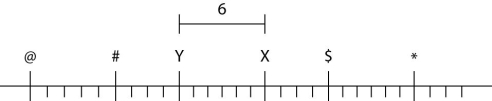 Locus Y is six map units from Locus X.
When attempting to map the location of Gene Q, relative to Locus Y and Locus Y, two testcrosses were performed and the following data collected.
Number of offspring
 These data narrow the possible location of Gene Q to which of the following choices?
Locus Y is six map units from Locus X.
When attempting to map the location of Gene Q, relative to Locus Y and Locus Y, two testcrosses were performed and the following data collected.
Number of offspring
These data narrow the possible location of Gene Q to which of the following choices? (Multiple Choice)
4.8/5 (81)
(81) In cats, an X-linked locus is responsible for fur color. There are two known alleles at this locus. One results in black fur color; the other results in orange color. A heterozygote animal has patches of orange and black fur (tortoiseshell). Which of the following outcomes represents all of the possible offspring from the cross provided. Assume all cats have two sex chromosomes.
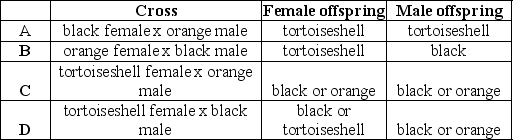
(Multiple Choice)
4.9/5 (83)
(83) When Thomas Hunt Morgan crossed red-eyed F1 generation flies to each other, the F2 generation included both red- and white-eyed flies, but all the white-eyed flies were male. Which of these best explains Morgan's result?
(Multiple Choice)
4.8/5 (88)
(88) Duchenne muscular dystrophy is a serious condition caused by a recessive allele of a gene on the human X chromosome. The patients' muscles weaken over time because they have a lack or decreased levels of dystrophin, a muscle protein. Which of the following correctly predicts the probability of muscular dystrophy in female children?
(Multiple Choice)
4.8/5 (88)
(88) 
Filters
- Essay(0)
- Multiple Choice(0)
- Short Answer(0)
- True False(0)
- Matching(0)