



 Chat with AI
Exam 35: Plant Structure and Growth

Exam 1: Biology and Its Themes46 Questions
Exam 2: Atoms and Molecules61 Questions
Exam 3: The Chemistry of Water55 Questions
Exam 4: Carbon: the Basis of Molecular Diversity52 Questions
Exam 5: Biological Macromolecules and Lipids71 Questions
Exam 6: Energy and Life65 Questions
Exam 7: Cell Structure and Function66 Questions
Exam 8: Cell Membranes67 Questions
Exam 9: Cellular Signaling62 Questions
Exam 10: Cell Respiration68 Questions
Exam 11: Photosynthetic Processes64 Questions
Exam 12: Mitosis63 Questions
Exam 13: Sexual Life Cycles and Meiosis64 Questions
Exam 14: Mendelian Genetics65 Questions
Exam 15: Linkage and Chromosomes54 Questions
Exam 16: Nucleic Acids and Inheritance65 Questions
Exam 17: Expression of Genes70 Questions
Exam 18: Control of Gene Expression66 Questions
Exam 19: Dna Technology56 Questions
Exam 20: The Evolution of Genomes47 Questions
Exam 21: How Evolution Works60 Questions
Exam 22: Phylogenetic Reconstruction66 Questions
Exam 23: Microevolution65 Questions
Exam 24: Species and Speciation65 Questions
Exam 25: Macroevolution58 Questions
Exam 26: Introduction to Viruses54 Questions
Exam 27: Prokaryotes61 Questions
Exam 28: The Origin and Evolution of Eukaryotes66 Questions
Exam 29: Nonvascular and Seedless Vascular Plants72 Questions
Exam 30: Seed Plants64 Questions
Exam 31: Introduction to Fungi56 Questions
Exam 32: An Introduction to Animal Diversity58 Questions
Exam 33: Invertebrates58 Questions
Exam 34: Vertebrates66 Questions
Exam 35: Plant Structure and Growth68 Questions
Exam 36: Transport in Vascular Plants73 Questions
Exam 37: Plant Nutrition51 Questions
Exam 38: Reproduction of Flowering Plants59 Questions
Exam 39: Plant Signals and Behavior60 Questions
Exam 40: The Animal Body58 Questions
Exam 41: Chemical Signals in Animals62 Questions
Exam 42: Animal Digestive Systems58 Questions
Exam 43: Animal Transport Systems58 Questions
Exam 44: Animal Excretory Systems49 Questions
Exam 45: Animal Reproductive Systems64 Questions
Exam 46: Development in Animals68 Questions
Exam 47: Animal Defenses Against Infection65 Questions
Exam 48: Electrical Signals in Animals62 Questions
Exam 49: Neural Regulation in Animals69 Questions
Exam 50: Sensation and Movement in Animals68 Questions
Exam 51: An Overview of Ecology71 Questions
Exam 52: Behavioral Ecology64 Questions
Exam 53: Populations and Life History Traits73 Questions
Exam 54: Biodiversity and Communities71 Questions
Exam 55: Energy Flow and Chemical Cycling in Ecosystems80 Questions
Exam 56: Conservation and Global Ecology75 Questions
Select questions type


Which of the following modified roots has a similar function as prop roots?
(Multiple Choice)
4.9/5  (78)
(78) The following question is based on the drawings of root or stem cross sections shown in the figure. 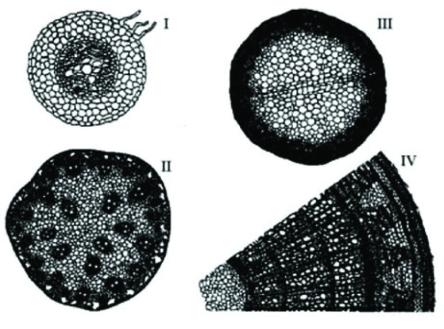 Refer to the figure. Which of the following represents a plant at least three years old?
 (Multiple Choice)
5.0/5 (74)
(74) Which of the following cell types have unevenly thickened primary walls that support young, growing parts of the plant?
(Multiple Choice)
4.8/5 (76)
(76) Which of the following arise(s), directly or indirectly, from meristematic activity?
(Multiple Choice)
4.8/5 (73)
(73) A strawberry plant mutant that fails to make stolons would suffer from ________.
(Multiple Choice)
4.8/5 (78)
(78) A plant that grows one year, without flowering, and then grows again the following year and produces flowers before it dies is described as which of the following?
(Multiple Choice)
4.8/5 (81)
(81) Apical meristems of dicots are at the tips of stems and the leaves have determinate growth. Apical meristems of grasses are at ground level, or slightly below, and the leaves have indeterminate growth from meristems at the base of each leaf. What does this mean when considering care of a lawn or soccer field?
(Multiple Choice)
5.0/5 (84)
(84) Which of the following can be used to determine a twig's age?
(Multiple Choice)
4.8/5 (76)
(76) The image below is a cross section through a young root tip with a layer of root cap cells surrounding the developing epidermis and interior tissues. The darker epidermal cells are stained to express the homeotic gene GLABRA-2. Which of the following best predicts what will be the appearance of this part of the mature root? 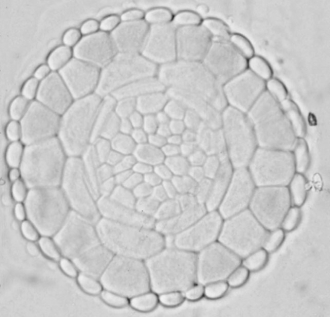
(Multiple Choice)
4.8/5 (89)
(89) Which of the following structures is a modified horizontal shoot growing along the soil surface?
(Multiple Choice)
5.0/5 (82)
(82) Additional vascular tissue produced as secondary growth in a root originates from which cells?
(Multiple Choice)
4.9/5 (86)
(86) You find a plant unfamiliar to you and observe that it has vascular bundles scattered throughout the stem cross section. What should you conclude about the plant?
(Multiple Choice)
4.8/5 (94)
(94) The following diagram is of a cross section of a plant leaf. Use the diagram to answer the question. 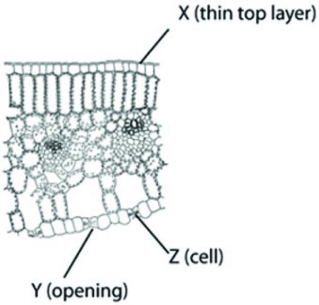 Which of the following is the main function associated with structure Y?
 (Multiple Choice)
5.0/5 (73)
(73) The following question is based on the figure below. 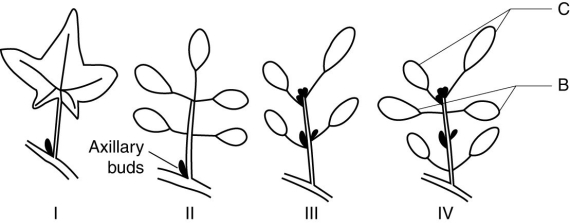 In the diagram above, the dark "dots" represent axillary buds. Which diagram illustrates a compound leaf?
 (Multiple Choice)
4.9/5 (77)
(77) Which of the following tissues or cell types are always present in a monocot stem?
(Multiple Choice)
5.0/5 (90)
(90) What is a consequence of monocot vascular bundles not having a vascular cambium between the xylem and phloem?
(Multiple Choice)
4.7/5 (80)
(80) 
Filters
- Essay(0)
- Multiple Choice(0)
- Short Answer(0)
- True False(0)
- Matching(0)