



 Chat with AI
Exam 13: Sexual Life Cycles and Meiosis

Exam 1: Biology and Its Themes46 Questions
Exam 2: Atoms and Molecules61 Questions
Exam 3: The Chemistry of Water55 Questions
Exam 4: Carbon: the Basis of Molecular Diversity52 Questions
Exam 5: Biological Macromolecules and Lipids71 Questions
Exam 6: Energy and Life65 Questions
Exam 7: Cell Structure and Function66 Questions
Exam 8: Cell Membranes67 Questions
Exam 9: Cellular Signaling62 Questions
Exam 10: Cell Respiration68 Questions
Exam 11: Photosynthetic Processes64 Questions
Exam 12: Mitosis63 Questions
Exam 13: Sexual Life Cycles and Meiosis64 Questions
Exam 14: Mendelian Genetics65 Questions
Exam 15: Linkage and Chromosomes54 Questions
Exam 16: Nucleic Acids and Inheritance65 Questions
Exam 17: Expression of Genes70 Questions
Exam 18: Control of Gene Expression66 Questions
Exam 19: Dna Technology56 Questions
Exam 20: The Evolution of Genomes47 Questions
Exam 21: How Evolution Works60 Questions
Exam 22: Phylogenetic Reconstruction66 Questions
Exam 23: Microevolution65 Questions
Exam 24: Species and Speciation65 Questions
Exam 25: Macroevolution58 Questions
Exam 26: Introduction to Viruses54 Questions
Exam 27: Prokaryotes61 Questions
Exam 28: The Origin and Evolution of Eukaryotes66 Questions
Exam 29: Nonvascular and Seedless Vascular Plants72 Questions
Exam 30: Seed Plants64 Questions
Exam 31: Introduction to Fungi56 Questions
Exam 32: An Introduction to Animal Diversity58 Questions
Exam 33: Invertebrates58 Questions
Exam 34: Vertebrates66 Questions
Exam 35: Plant Structure and Growth68 Questions
Exam 36: Transport in Vascular Plants73 Questions
Exam 37: Plant Nutrition51 Questions
Exam 38: Reproduction of Flowering Plants59 Questions
Exam 39: Plant Signals and Behavior60 Questions
Exam 40: The Animal Body58 Questions
Exam 41: Chemical Signals in Animals62 Questions
Exam 42: Animal Digestive Systems58 Questions
Exam 43: Animal Transport Systems58 Questions
Exam 44: Animal Excretory Systems49 Questions
Exam 45: Animal Reproductive Systems64 Questions
Exam 46: Development in Animals68 Questions
Exam 47: Animal Defenses Against Infection65 Questions
Exam 48: Electrical Signals in Animals62 Questions
Exam 49: Neural Regulation in Animals69 Questions
Exam 50: Sensation and Movement in Animals68 Questions
Exam 51: An Overview of Ecology71 Questions
Exam 52: Behavioral Ecology64 Questions
Exam 53: Populations and Life History Traits73 Questions
Exam 54: Biodiversity and Communities71 Questions
Exam 55: Energy Flow and Chemical Cycling in Ecosystems80 Questions
Exam 56: Conservation and Global Ecology75 Questions
Select questions type


For a species with a haploid number of 23 chromosomes, how many different combinations of maternal and paternal chromosomes are possible for the gametes based on the independent assortment of chromosomes during meiosis?
(Multiple Choice)
4.8/5  (87)
(87) How does natural selection apply to sexual reproduction as opposed to asexual reproduction?
(Multiple Choice)
4.8/5 (67)
(67) Which of the following results when homologous chromosomes cross over in meiosis?
(Multiple Choice)
4.7/5 (76)
(76) Many diploid organisms produce haploid gametes for reproduction. Which of the following best describes how the diploid number of chromosomes is restored in the offspring of these organisms?
(Multiple Choice)
4.7/5 (79)
(79) For the following question, match the key event of meiosis with the stages listed below.
I. Prophase I V. Prophase II
II. Metaphase I VI. Metaphase II
III. Anaphase I VII. Anaphase II
IV. Telophase I VIII. Telophase II
Cohesins at centromeres of sister chromatids breakdown.
(Multiple Choice)
4.9/5 (73)
(73) Multiple cells from the same species were isolated, the relative cohesion protein content for each type was determined, and the results were plotted on the graph. Refer to the graph to answer the following question. 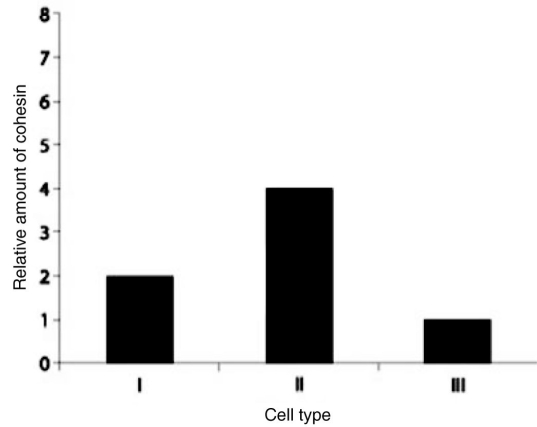 Which sample is consistent with a cell that has completed mitosis?
 (Multiple Choice)
4.9/5 (66)
(66) Which of the following explanations correctly describes a reproductive approach?
(Multiple Choice)
4.8/5 (85)
(85) Which of the following statements about the human X chromosomes is correct?
(Multiple Choice)
4.9/5 (86)
(86) Which of the following processes will most likely produce a human zygote with 45 chromosomes?
(Multiple Choice)
4.8/5 (77)
(77) Multiple cells from the same species were isolated, the relative cohesion protein content for each type was determined, and the results were plotted on the graph. Refer to the graph to answer the following question. 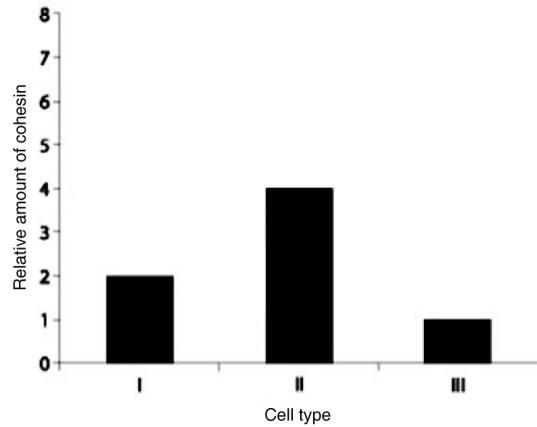 Which sample is consistent with a cell that is entering mitosis?
 (Multiple Choice)
4.8/5 (71)
(71) Which of the following statements describes the chromosomal makeup of each daughter cell after telophase of meiosis I?
(Multiple Choice)
5.0/5 (82)
(82) A human cell containing 22 autosomes and a Y chromosome is ________.
(Multiple Choice)
4.7/5 (81)
(81) Cells from a diploid protist with n=1 are followed through mitosis and meiosis. The drawings in the figure below represent the chromosomes. Refer to the drawings and answer the following question(s). 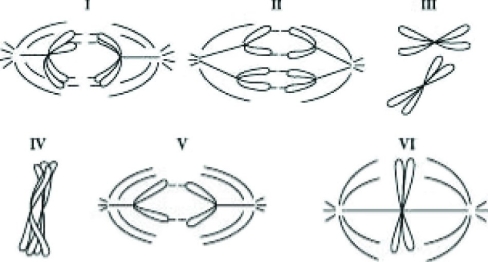 Which diagram represents anaphase I of meiosis?
 (Multiple Choice)
4.9/5 (81)
(81) In a human karyotype, chromosomes are arranged in 23 pairs. If one of the autosomal pairs is examined, which of the following characteristics will the two chromosomes of the pair have in common?
(Multiple Choice)
4.7/5 (80)
(80) A cell has completed meiosis I and the first cytokinesis, and is just beginning meiosis II. Which of the following statements describes its genetic contents?
(Multiple Choice)
4.8/5 (86)
(86) Which of the following processes occur during meiosis but not mitosis?
(Multiple Choice)
4.9/5 (89)
(89) If we continue to follow the cell lineage from question 4, then the DNA content of a single cell at metaphase of meiosis II will be ________.
(Multiple Choice)
4.8/5 (84)
(84) The two homologs of a pair move toward opposite poles of dividing cell during ________.
(Multiple Choice)
4.8/5 (73)
(73) 
Filters
- Essay(0)
- Multiple Choice(0)
- Short Answer(0)
- True False(0)
- Matching(0)