Multiple Choice
Use the following information to answer the question.
Brown et al. and Morwood et al. reported in 2004 that they had found skeletal remains of a previously unknown type of hominin, now dubbed Homo floresiensis, on the Indonesian island of Flores. These hominins were small (approximately 1 m tall) with small braincases (approximately 380 cm3) as compared with other hominins. The remains of H.floresiensis were found alongside handmade stone tools and the remains of dwarf elephants that also inhabited the island, suggesting that H. floresiensis was able both to make tools and to coordinate the hunting of animals much larger than itself. H. floresiensis is estimated to have lived at the site where the remains were found from 700,000 years ago to 60,000 years ago.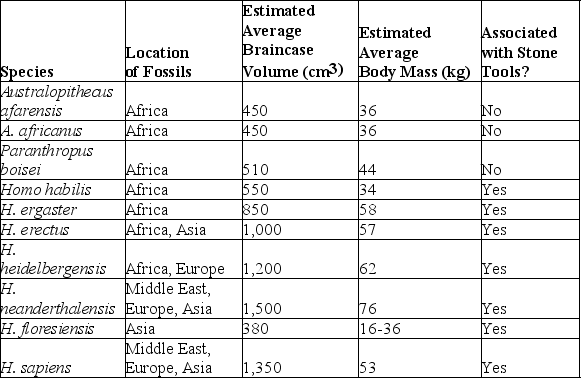
The table is a comparison of several characteristics of H. floresiensis to those of nine other hominin species (arranged roughly from oldest to most recent) . What do these data suggest?
A) A large brain is not necessarily required for toolmaking.
B) Body mass and braincase volume are completely unrelated.
C) Hominins first evolved in and then radiated out from Asia.
D) Homo floresiensis is most closely related to Australopithecus afarensis or A. africanus.
Correct Answer:

Verified
Correct Answer:
Verified
Q12: The evolution of similar insulating skin coverings
Q13: Which of these statements accurately describes a
Q14: While hiking in a tropical rainforest, you
Q15: Arrange the following taxonomic terms in order
Q16: As hominins diverged from other primates, which
Q18: Female birds lay their eggs, thereby facilitating
Q19: Which of these structures would most likely
Q20: Living vertebrates can be divided into two
Q21: Which of the following statements about human
Q22: Which of the following is most likely