



 Chat with AI
Exam 52: Behavioral Ecology

Exam 1: Biology and Its Themes46 Questions
Exam 2: Atoms and Molecules61 Questions
Exam 3: The Chemistry of Water55 Questions
Exam 4: Carbon: the Basis of Molecular Diversity52 Questions
Exam 5: Biological Macromolecules and Lipids71 Questions
Exam 6: Energy and Life65 Questions
Exam 7: Cell Structure and Function66 Questions
Exam 8: Cell Membranes67 Questions
Exam 9: Cellular Signaling62 Questions
Exam 10: Cell Respiration68 Questions
Exam 11: Photosynthetic Processes64 Questions
Exam 12: Mitosis63 Questions
Exam 13: Sexual Life Cycles and Meiosis64 Questions
Exam 14: Mendelian Genetics65 Questions
Exam 15: Linkage and Chromosomes54 Questions
Exam 16: Nucleic Acids and Inheritance65 Questions
Exam 17: Expression of Genes70 Questions
Exam 18: Control of Gene Expression66 Questions
Exam 19: Dna Technology56 Questions
Exam 20: The Evolution of Genomes47 Questions
Exam 21: How Evolution Works60 Questions
Exam 22: Phylogenetic Reconstruction66 Questions
Exam 23: Microevolution65 Questions
Exam 24: Species and Speciation65 Questions
Exam 25: Macroevolution58 Questions
Exam 26: Introduction to Viruses54 Questions
Exam 27: Prokaryotes61 Questions
Exam 28: The Origin and Evolution of Eukaryotes66 Questions
Exam 29: Nonvascular and Seedless Vascular Plants72 Questions
Exam 30: Seed Plants64 Questions
Exam 31: Introduction to Fungi56 Questions
Exam 32: An Introduction to Animal Diversity58 Questions
Exam 33: Invertebrates58 Questions
Exam 34: Vertebrates66 Questions
Exam 35: Plant Structure and Growth68 Questions
Exam 36: Transport in Vascular Plants73 Questions
Exam 37: Plant Nutrition51 Questions
Exam 38: Reproduction of Flowering Plants59 Questions
Exam 39: Plant Signals and Behavior60 Questions
Exam 40: The Animal Body58 Questions
Exam 41: Chemical Signals in Animals62 Questions
Exam 42: Animal Digestive Systems58 Questions
Exam 43: Animal Transport Systems58 Questions
Exam 44: Animal Excretory Systems49 Questions
Exam 45: Animal Reproductive Systems64 Questions
Exam 46: Development in Animals68 Questions
Exam 47: Animal Defenses Against Infection65 Questions
Exam 48: Electrical Signals in Animals62 Questions
Exam 49: Neural Regulation in Animals69 Questions
Exam 50: Sensation and Movement in Animals68 Questions
Exam 51: An Overview of Ecology71 Questions
Exam 52: Behavioral Ecology64 Questions
Exam 53: Populations and Life History Traits73 Questions
Exam 54: Biodiversity and Communities71 Questions
Exam 55: Energy Flow and Chemical Cycling in Ecosystems80 Questions
Exam 56: Conservation and Global Ecology75 Questions
Select questions type


Which of the following has a coefficient of relatedness of 0.25?
(Multiple Choice)
4.9/5  (77)
(77) You discover a rare new bird species, but you are unable to observe its mating behavior. You see that the male is large and ornamental compared with the female. Which of the following is most likely true about this species?
(Multiple Choice)
4.9/5 (81)
(81) What type of communication is used by nocturnal and diurnal birds and mammals?
(Multiple Choice)
4.9/5 (82)
(82) A cage containing male mosquitoes has a small earphone placed on top, through which the sound of a female mosquito is played. All the males immediately fly near the earphone and display behaviors associated with copulation. What is the best explanation for this behavior?
(Multiple Choice)
4.7/5 (83)
(83) Which of the following describes a way that some birds can navigate on an overcast night with solid cloud cover?
(Multiple Choice)
4.8/5 (80)
(80) The head-butting behavior of male bighorn sheep helps to establish a mating hierarchy. Which of the following is illustrated by this behavior?
(Multiple Choice)
4.7/5 (82)
(82) Use the following figure to answer the question. 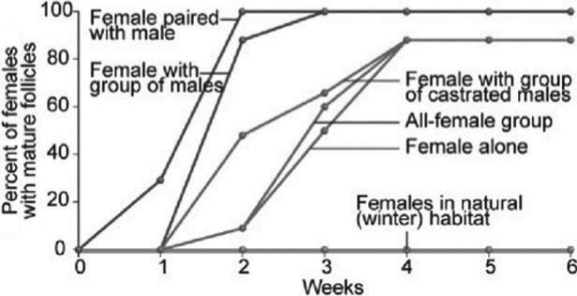 Based only on the information in the figure, which of the following claims is most consistent with the data?
 (Multiple Choice)
4.9/5 (86)
(86) Which of the following types of sensory signals is brief and can work at night amongst physical obstructions?
(Multiple Choice)
4.7/5 (77)
(77) Which of the following best describes an important function of the vasopressin receptor gene?
(Multiple Choice)
4.7/5 (73)
(73) Listed below are four types of animal behavior. Choose the letter of the word or phrase (A-D) that is most associated with the following example.
A. operant conditioning
B. classical conditioning
C. innate behavior
D. imprinting
A human baby performs a sucking behavior very well when it is in the presence of the nipple of its mother's breast. Which of the following mechanisms results in this behavior?
(Multiple Choice)
4.8/5 (89)
(89) Listed below are four types of animal behavior. Choose the letter of the phrase (A-D) that is most associated with the following example.
A. operant conditioning
B. classical conditioning
C. innate behavior
D. imprinting
A cat runs to its food dish when it hears the sound of a can opener. Which of the following mechanisms results in this behavior?
(Multiple Choice)
4.7/5 (75)
(75) Listed below are four types of animal behavior. Choose the letter of the word or phrase (A-D) that is most associated with the following example.
A. operant conditioning
B. classical conditioning
C. innate behavior
D. imprinting
Every morning at the same time, John went into the den to feed his new tropical fish. After a few weeks, he noticed that the fish swam to the top of the tank when he entered the room. Which of the following mechanisms results in this behavior?
(Multiple Choice)
4.9/5 (82)
(82) One way to understand how early environment influences behaviors in similar species is through the "cross-fostering" experimental technique. Suppose that the curly-whiskered mud rat differs from the bald mud rat in several ways, including being much more aggressive. Which of the following would be the best cross-fostering experiment to determine, if environment plays a role in the curly-whiskered mud rat's aggression?
(Multiple Choice)
4.9/5 (76)
(76) You observe scrub jays hiding food and notice that one particular individual only pretends to hide food. Your experiments associate the presence of other scrub jays with the frequency of pretending to cache food. A colleague shows you groups of scrub jays that do not engage in pretend caching. Considering this new information, which of the following is the best hypothesis?
(Multiple Choice)
4.7/5 (76)
(76) Which of the following types of sensory signals is fast and can be detected only in daylight in environments with no physical obstructions?
(Multiple Choice)
4.7/5 (74)
(74) Natural selection favors altruism when the benefit to the recipient multiplied by the coefficient of relatedness exceeds the cost to the altruist. Which of the following best describes the coefficient of relatedness?
(Multiple Choice)
4.8/5 (87)
(87) During a field trip, an instructor touched a moth resting on a tree trunk. The moth raised its forewings to reveal large eyespots on its hind wings. The instructor asked the students why the moth lifted its wings. One student answered that sensory receptors had fired and triggered a neuronal reflex culminating in the contraction of certain muscles. A second student responded that the behavior might frighten predators. Which of the following best characterizes these hypotheses?
(Multiple Choice)
4.9/5 (76)
(76) Which of the following types of displays are most effective for communication among nocturnal mammals?
(Multiple Choice)
4.9/5 (77)
(77) You wake up in the middle of the night to use the restroom. You cannot see a thing in the dark and do not want to turn on lights, disturbing others sleeping near you. You have navigated your way to the restroom from your bed many times, and try to do so again. Which of the following most likely helped you remember your way?
(Multiple Choice)
4.8/5 (86)
(86) 
Filters
- Essay(0)
- Multiple Choice(0)
- Short Answer(0)
- True False(0)
- Matching(0)