



 Chat with AI
Exam 55: Energy Flow and Chemical Cycling in Ecosystems

Exam 1: Biology and Its Themes46 Questions
Exam 2: Atoms and Molecules61 Questions
Exam 3: The Chemistry of Water55 Questions
Exam 4: Carbon: the Basis of Molecular Diversity52 Questions
Exam 5: Biological Macromolecules and Lipids71 Questions
Exam 6: Energy and Life65 Questions
Exam 7: Cell Structure and Function66 Questions
Exam 8: Cell Membranes67 Questions
Exam 9: Cellular Signaling62 Questions
Exam 10: Cell Respiration68 Questions
Exam 11: Photosynthetic Processes64 Questions
Exam 12: Mitosis63 Questions
Exam 13: Sexual Life Cycles and Meiosis64 Questions
Exam 14: Mendelian Genetics65 Questions
Exam 15: Linkage and Chromosomes54 Questions
Exam 16: Nucleic Acids and Inheritance65 Questions
Exam 17: Expression of Genes70 Questions
Exam 18: Control of Gene Expression66 Questions
Exam 19: Dna Technology56 Questions
Exam 20: The Evolution of Genomes47 Questions
Exam 21: How Evolution Works60 Questions
Exam 22: Phylogenetic Reconstruction66 Questions
Exam 23: Microevolution65 Questions
Exam 24: Species and Speciation65 Questions
Exam 25: Macroevolution58 Questions
Exam 26: Introduction to Viruses54 Questions
Exam 27: Prokaryotes61 Questions
Exam 28: The Origin and Evolution of Eukaryotes66 Questions
Exam 29: Nonvascular and Seedless Vascular Plants72 Questions
Exam 30: Seed Plants64 Questions
Exam 31: Introduction to Fungi56 Questions
Exam 32: An Introduction to Animal Diversity58 Questions
Exam 33: Invertebrates58 Questions
Exam 34: Vertebrates66 Questions
Exam 35: Plant Structure and Growth68 Questions
Exam 36: Transport in Vascular Plants73 Questions
Exam 37: Plant Nutrition51 Questions
Exam 38: Reproduction of Flowering Plants59 Questions
Exam 39: Plant Signals and Behavior60 Questions
Exam 40: The Animal Body58 Questions
Exam 41: Chemical Signals in Animals62 Questions
Exam 42: Animal Digestive Systems58 Questions
Exam 43: Animal Transport Systems58 Questions
Exam 44: Animal Excretory Systems49 Questions
Exam 45: Animal Reproductive Systems64 Questions
Exam 46: Development in Animals68 Questions
Exam 47: Animal Defenses Against Infection65 Questions
Exam 48: Electrical Signals in Animals62 Questions
Exam 49: Neural Regulation in Animals69 Questions
Exam 50: Sensation and Movement in Animals68 Questions
Exam 51: An Overview of Ecology71 Questions
Exam 52: Behavioral Ecology64 Questions
Exam 53: Populations and Life History Traits73 Questions
Exam 54: Biodiversity and Communities71 Questions
Exam 55: Energy Flow and Chemical Cycling in Ecosystems80 Questions
Exam 56: Conservation and Global Ecology75 Questions
Select questions type


Use the following figure to answer the question. 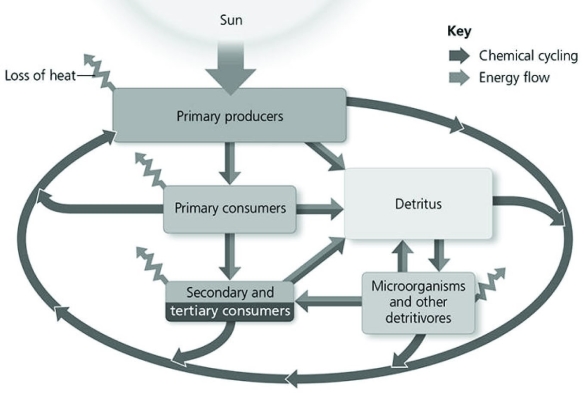 In the ecosystem figure, which component of the food web has the potential to lose the most energy as heat?
 (Multiple Choice)
4.8/5  (61)
(61) Which of the following statements about energy is most accurate?
(Multiple Choice)
4.8/5 (84)
(84) As part of the carbon cycle, which of the following reservoirs of carbon is the largest?
(Multiple Choice)
4.8/5 (76)
(76) Use the following figure to answer the question. 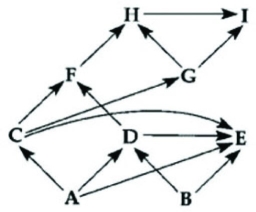 Diagram of a food web (arrows represent energy flow and letters represent species)
If the figure represents a marine food web, tertiary consumers are most likely ________.
Diagram of a food web (arrows represent energy flow and letters represent species)
If the figure represents a marine food web, tertiary consumers are most likely ________. (Multiple Choice)
4.9/5 (93)
(93) Use the following figure to answer the question. 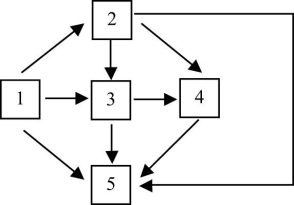 Food web for a particular terrestrial ecosystem (arrows represent energy flow and numbers represent species)
In the food web, if species 3 is toxic to predators, then which species is most likely to benefit from being a mimic of species 3?
Food web for a particular terrestrial ecosystem (arrows represent energy flow and numbers represent species)
In the food web, if species 3 is toxic to predators, then which species is most likely to benefit from being a mimic of species 3? (Multiple Choice)
4.8/5 (77)
(77) Which of the following is an example of biological augmentation?
(Multiple Choice)
4.8/5 (75)
(75) Use the following figure to answer the question. 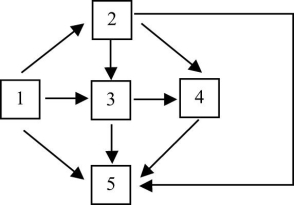 Food web for a particular terrestrial ecosystem (arrows represent energy flow and numbers represent species)
Based on this food web, which species is most likely a decomposer?
Food web for a particular terrestrial ecosystem (arrows represent energy flow and numbers represent species)
Based on this food web, which species is most likely a decomposer? (Multiple Choice)
4.9/5 (84)
(84) Use the figure to answer the question: 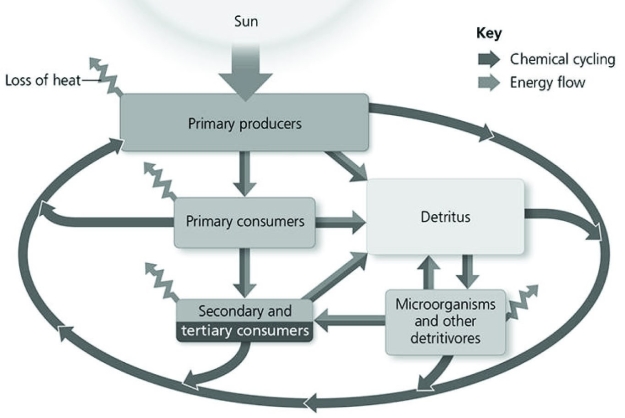 Which arrow, if representing magnitude, should show the largest biomass exiting primary producers?
 (Multiple Choice)
4.8/5 (85)
(85) Use the figure to answer the question: 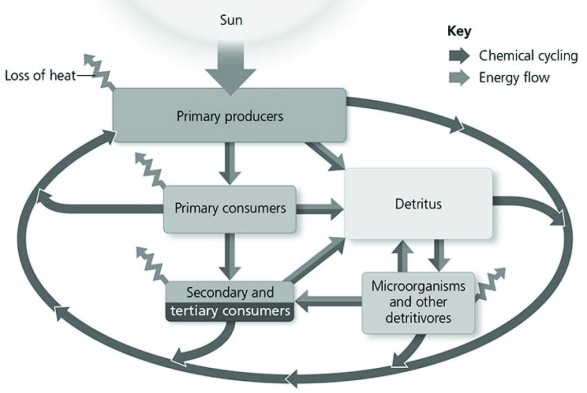 The blue arrow exiting the left side of the "Primary consumers" box could best be described as which of the following examples of a nutrient transfer?
 (Multiple Choice)
4.9/5 (88)
(88) What advantage would there be for an ecosystem ecologist to measure net ecosystem production (NEP) instead of net primary production (NPP)?
(Multiple Choice)
4.8/5 (69)
(69) How is net ecosystem production (NEP) typically estimated in ecosystems?
(Multiple Choice)
4.9/5 (80)
(80) Which one of the following correctly ranks these organisms in order from lowest to highest percent in production efficiency?
(Multiple Choice)
4.7/5 (77)
(77) Many of the organisms in the ocean are nutrient-limited. Which of the following would be the most reasonable approach if you wanted to investigate this phenomenon?
(Multiple Choice)
4.9/5 (74)
(74) A group of students walking through a coastal rainforest in Vietnam observe a large, beautiful tree towering above. The tree is full of orchids, mosses, birds, insects, arachnids, and millions of bacteria, all interacting with the abiotic environment, including the air, soil, and water of the forest. Which of the following terms bests describe this in the entirety of what they are observing?
(Multiple Choice)
4.8/5 (82)
(82) Use the following figure to answer the question. 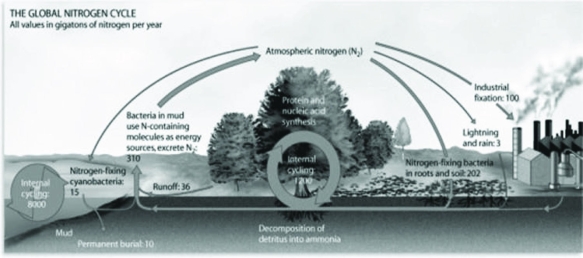 Based on the information provided, which of the following contains the largest source or pool of nitrogen?
 (Multiple Choice)
5.0/5 (74)
(74) Use the following figure to answer the question. 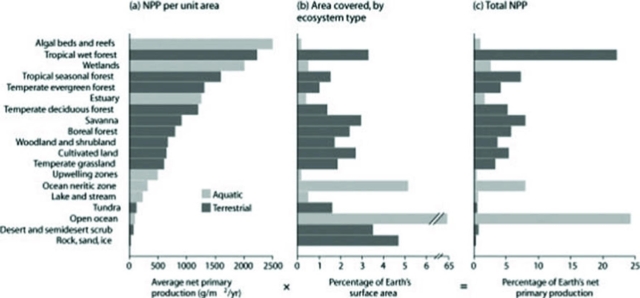 Which habitat type in the figure covers the largest area?
 (Multiple Choice)
4.9/5 (80)
(80) Which of the following are the main forms of chemical inputs and outputs that are recycled within an ecosystem?
(Multiple Choice)
4.9/5 (84)
(84) Use the following figure to answer the question. 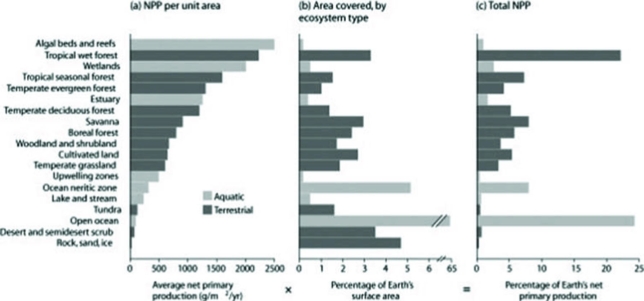 Which ecosystem, if completely converted by humans to cultivated land, would have the largest negative impact on total NPP?
 (Multiple Choice)
4.8/5 (82)
(82) Use the following figure to answer the question. 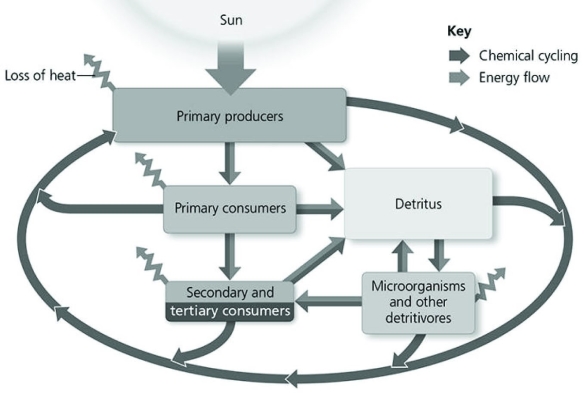 In the figure, the jagged arrow leaving microorganisms and other detritivores represents which process?
 (Multiple Choice)
4.9/5 (79)
(79) Which of the following is a reason that a diet consisting primarily of fruits and vegetables results in a smaller ecological footprint than a diet high in meat content?
(Multiple Choice)
4.8/5 (73)
(73) 
Filters
- Essay(0)
- Multiple Choice(0)
- Short Answer(0)
- True False(0)
- Matching(0)