



 Chat with AI
Exam 55: Energy Flow and Chemical Cycling in Ecosystems

Exam 1: Biology and Its Themes46 Questions
Exam 2: Atoms and Molecules61 Questions
Exam 3: The Chemistry of Water55 Questions
Exam 4: Carbon: the Basis of Molecular Diversity52 Questions
Exam 5: Biological Macromolecules and Lipids71 Questions
Exam 6: Energy and Life65 Questions
Exam 7: Cell Structure and Function66 Questions
Exam 8: Cell Membranes67 Questions
Exam 9: Cellular Signaling62 Questions
Exam 10: Cell Respiration68 Questions
Exam 11: Photosynthetic Processes64 Questions
Exam 12: Mitosis63 Questions
Exam 13: Sexual Life Cycles and Meiosis64 Questions
Exam 14: Mendelian Genetics65 Questions
Exam 15: Linkage and Chromosomes54 Questions
Exam 16: Nucleic Acids and Inheritance65 Questions
Exam 17: Expression of Genes70 Questions
Exam 18: Control of Gene Expression66 Questions
Exam 19: Dna Technology56 Questions
Exam 20: The Evolution of Genomes47 Questions
Exam 21: How Evolution Works60 Questions
Exam 22: Phylogenetic Reconstruction66 Questions
Exam 23: Microevolution65 Questions
Exam 24: Species and Speciation65 Questions
Exam 25: Macroevolution58 Questions
Exam 26: Introduction to Viruses54 Questions
Exam 27: Prokaryotes61 Questions
Exam 28: The Origin and Evolution of Eukaryotes66 Questions
Exam 29: Nonvascular and Seedless Vascular Plants72 Questions
Exam 30: Seed Plants64 Questions
Exam 31: Introduction to Fungi56 Questions
Exam 32: An Introduction to Animal Diversity58 Questions
Exam 33: Invertebrates58 Questions
Exam 34: Vertebrates66 Questions
Exam 35: Plant Structure and Growth68 Questions
Exam 36: Transport in Vascular Plants73 Questions
Exam 37: Plant Nutrition51 Questions
Exam 38: Reproduction of Flowering Plants59 Questions
Exam 39: Plant Signals and Behavior60 Questions
Exam 40: The Animal Body58 Questions
Exam 41: Chemical Signals in Animals62 Questions
Exam 42: Animal Digestive Systems58 Questions
Exam 43: Animal Transport Systems58 Questions
Exam 44: Animal Excretory Systems49 Questions
Exam 45: Animal Reproductive Systems64 Questions
Exam 46: Development in Animals68 Questions
Exam 47: Animal Defenses Against Infection65 Questions
Exam 48: Electrical Signals in Animals62 Questions
Exam 49: Neural Regulation in Animals69 Questions
Exam 50: Sensation and Movement in Animals68 Questions
Exam 51: An Overview of Ecology71 Questions
Exam 52: Behavioral Ecology64 Questions
Exam 53: Populations and Life History Traits73 Questions
Exam 54: Biodiversity and Communities71 Questions
Exam 55: Energy Flow and Chemical Cycling in Ecosystems80 Questions
Exam 56: Conservation and Global Ecology75 Questions
Select questions type


Which of the following most accurately describes the fate of incoming solar radiation from the sun?
(Multiple Choice)
4.8/5  (79)
(79) Which of the following is a reason that logged tropical rain forest soils typically have nutrient-poor soils?
(Multiple Choice)
4.9/5 (74)
(74) Use the following figure to answer the question. 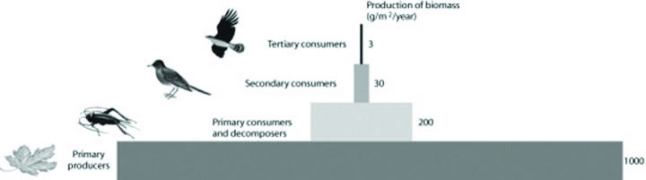 Which of the following claims is most consistent with the figure regarding productivity in this ecosystem?
 (Multiple Choice)
4.9/5 (79)
(79) Which of the following best describes the role of nitrifying bacteria in the nitrogen cycle?
(Multiple Choice)
4.8/5 (83)
(83) Which of the following was a conclusion of the Hubbard Brook watershed deforestation experiment?
(Multiple Choice)
4.9/5 (90)
(90) Owls eat rats, mice, shrews, and small birds. Assume that, over a period of time, an owl consumes 5,000 J of animal material. The owl loses 2,300 J in feces and owl pellets and uses 2,500 J for cellular respiration. Which of the following best estimates the production efficiency of this owl?
(Multiple Choice)
4.9/5 (80)
(80) Which of the following is an accurate statement regarding mineral nutrients in soils and their implication for primary productivity?
(Multiple Choice)
4.9/5 (89)
(89) Which of the following is primarily responsible for limiting the number of trophic levels in most ecosystems?
(Multiple Choice)
4.8/5 (97)
(97) During a year, plants never use 100% of the incoming solar radiation for photosynthesis. Which of the following is the most reasonable explanation for this?
(Multiple Choice)
4.9/5 (85)
(85) If you applied a fungicide to a cornfield, what would you expect to happen to the rate of decomposition and net ecosystem production (NEP)?
(Multiple Choice)
4.7/5 (70)
(70) Which of the following best explains why an ecosystem that exhibits very low net primary production [NPP, measured as J/(m2 x year)] could still represent one of the ecosystems that contributes the most to global net primary production?
(Multiple Choice)
4.9/5 (79)
(79) Which of the following are the two key emergent properties of an ecosystem?
(Multiple Choice)
4.8/5 (76)
(76) Which of the following claims about marine ecosystem productivity is the most accurate?
(Multiple Choice)
4.7/5 (81)
(81) For most terrestrial ecosystems, pyramids composed of species abundances, biomass, and energy are similar in that they have a broad base and a narrow top. The primary reason for this pattern is that ________.
(Multiple Choice)
5.0/5 (86)
(86) Acid precipitation lowered the pH of soil in a terrestrial ecosystem that supported a diverse community of plants and animals. The decrease in pH eliminated all nitrogen-fixing bacteria populations in the area. Which prediction most accurately reflects the impact this will have on the community?
(Multiple Choice)
4.8/5 (70)
(70) A porcupine eats 3,000 J of plant material. Of this, 2,100 J is indigestible and is eliminated as feces, 800 J are used in cellular respiration, and 100 J are used for growth and reproduction. What is the approximate production efficiency of this animal?
(Multiple Choice)
4.9/5 (68)
(68) Use the following figure to answer the question. 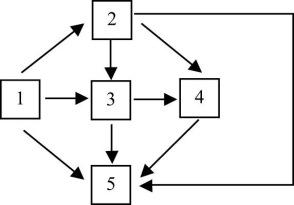 Food web for a particular terrestrial ecosystem (arrows represent energy flow and numbers represent species)
Which species in the food web most likely represents both a primary and secondary consumer?
Food web for a particular terrestrial ecosystem (arrows represent energy flow and numbers represent species)
Which species in the food web most likely represents both a primary and secondary consumer? (Multiple Choice)
4.9/5 (76)
(76) Assuming it were technologically feasible, a scientist could hypothetically track the long-term fate (for example, 100 years) of every atom in a single molecule of carbon dioxide that initially moves from the air into a plant. This fact is a manifestation of which of the following physical laws?
(Multiple Choice)
4.7/5 (92)
(92) Which of the following statements is correct about biogeochemical cycling?
(Multiple Choice)
4.9/5 (78)
(78) 
Filters
- Essay(0)
- Multiple Choice(0)
- Short Answer(0)
- True False(0)
- Matching(0)