



 Chat with AI
Exam 54: Biodiversity and Communities

Exam 1: Biology and Its Themes46 Questions
Exam 2: Atoms and Molecules61 Questions
Exam 3: The Chemistry of Water55 Questions
Exam 4: Carbon: the Basis of Molecular Diversity52 Questions
Exam 5: Biological Macromolecules and Lipids71 Questions
Exam 6: Energy and Life65 Questions
Exam 7: Cell Structure and Function66 Questions
Exam 8: Cell Membranes67 Questions
Exam 9: Cellular Signaling62 Questions
Exam 10: Cell Respiration68 Questions
Exam 11: Photosynthetic Processes64 Questions
Exam 12: Mitosis63 Questions
Exam 13: Sexual Life Cycles and Meiosis64 Questions
Exam 14: Mendelian Genetics65 Questions
Exam 15: Linkage and Chromosomes54 Questions
Exam 16: Nucleic Acids and Inheritance65 Questions
Exam 17: Expression of Genes70 Questions
Exam 18: Control of Gene Expression66 Questions
Exam 19: Dna Technology56 Questions
Exam 20: The Evolution of Genomes47 Questions
Exam 21: How Evolution Works60 Questions
Exam 22: Phylogenetic Reconstruction66 Questions
Exam 23: Microevolution65 Questions
Exam 24: Species and Speciation65 Questions
Exam 25: Macroevolution58 Questions
Exam 26: Introduction to Viruses54 Questions
Exam 27: Prokaryotes61 Questions
Exam 28: The Origin and Evolution of Eukaryotes66 Questions
Exam 29: Nonvascular and Seedless Vascular Plants72 Questions
Exam 30: Seed Plants64 Questions
Exam 31: Introduction to Fungi56 Questions
Exam 32: An Introduction to Animal Diversity58 Questions
Exam 33: Invertebrates58 Questions
Exam 34: Vertebrates66 Questions
Exam 35: Plant Structure and Growth68 Questions
Exam 36: Transport in Vascular Plants73 Questions
Exam 37: Plant Nutrition51 Questions
Exam 38: Reproduction of Flowering Plants59 Questions
Exam 39: Plant Signals and Behavior60 Questions
Exam 40: The Animal Body58 Questions
Exam 41: Chemical Signals in Animals62 Questions
Exam 42: Animal Digestive Systems58 Questions
Exam 43: Animal Transport Systems58 Questions
Exam 44: Animal Excretory Systems49 Questions
Exam 45: Animal Reproductive Systems64 Questions
Exam 46: Development in Animals68 Questions
Exam 47: Animal Defenses Against Infection65 Questions
Exam 48: Electrical Signals in Animals62 Questions
Exam 49: Neural Regulation in Animals69 Questions
Exam 50: Sensation and Movement in Animals68 Questions
Exam 51: An Overview of Ecology71 Questions
Exam 52: Behavioral Ecology64 Questions
Exam 53: Populations and Life History Traits73 Questions
Exam 54: Biodiversity and Communities71 Questions
Exam 55: Energy Flow and Chemical Cycling in Ecosystems80 Questions
Exam 56: Conservation and Global Ecology75 Questions
Select questions type


Scientists interested in how populations interact within communities are attempting to determine the species diversity of an island under study. Which of the following data would be most helpful to the scientists in determining diversity?
(Multiple Choice)
4.9/5  (86)
(86) Predators that are keystone species can maintain species diversity in a community if they ________.
(Multiple Choice)
4.9/5 (88)
(88) Use the figure to answer the following question. 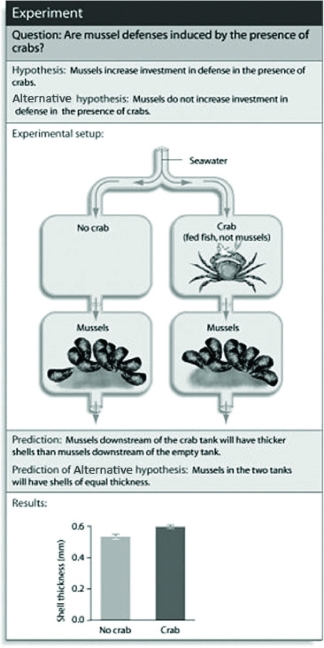 Which of the following conclusions is best supported from the experimental evidence in the figure?
 (Multiple Choice)
4.9/5 (76)
(76) Using the symbols +, −, and 0 to indicate interspecific species interactions, where the first symbol refers to the first organism mentioned, what interactions exist between cellulose-digesting organisms in the gut of a termite and the termite?
(Multiple Choice)
4.8/5 (92)
(92) Dwarf mistletoes are flowering plants that grow on certain forest trees. They obtain nutrients and water from the vascular tissues of the trees. The trees derive no known benefits from the dwarf mistletoes, yet they are sometimes negatively affected by this interaction. Which of the following best describes the interactions between dwarf mistletoes and trees?
(Multiple Choice)
4.7/5 (69)
(69) Biological communities may show a highly predictable and interrelated structure, or alternatively, the individual species may appear to operate independently. If a researcher were to set up many identical sterilized ponds in the same area and allowed them to be colonized, which result would support the idea that species operate independently?
(Multiple Choice)
4.9/5 (77)
(77) Some birds follow moving swarms of army ants in the tropics. As the ants march along the forest floor hunting insects and small vertebrates, birds follow behind and eat any insects or small vertebrates that had flown jumped away from the moving swarm. Which of the following species interactions does this example demonstrate between the birds and the ants?
(Multiple Choice)
5.0/5 (85)
(85) Which of the following best explains why there are more species in tropical regions than in locations more distant from the equator?
(Multiple Choice)
4.9/5 (85)
(85) Elephants are not the most abundant species in African grasslands, yet they influence community structure. The grasslands contain scattered woody plants, but these woody plants remain relatively uncommon because of the uprooting activities of the elephants. If elephants were removed, the grasslands eventually are converted to forests or to shrublands. These newly growing forests support fewer species than the previous, more biodiverse grasslands. Which of the following statements best supports the elephants' role as a keystone species in this scenario?
(Multiple Choice)
4.9/5 (70)
(70) Approximately how many kilograms (kg) of carnivore (secondary consumer) biomass can be supported by an area of a field containing 1,000 kg of plant material (assuming 10% efficiency in energy transfer)?
(Multiple Choice)
4.8/5 (69)
(69) Which of the following statements is consistent with the principle of competitive exclusion?
(Multiple Choice)
4.9/5 (80)
(80) 
Filters
- Essay(0)
- Multiple Choice(0)
- Short Answer(0)
- True False(0)
- Matching(0)