



 Chat with AI
Exam 54: Biodiversity and Communities

Exam 1: Biology and Its Themes46 Questions
Exam 2: Atoms and Molecules61 Questions
Exam 3: The Chemistry of Water55 Questions
Exam 4: Carbon: the Basis of Molecular Diversity52 Questions
Exam 5: Biological Macromolecules and Lipids71 Questions
Exam 6: Energy and Life65 Questions
Exam 7: Cell Structure and Function66 Questions
Exam 8: Cell Membranes67 Questions
Exam 9: Cellular Signaling62 Questions
Exam 10: Cell Respiration68 Questions
Exam 11: Photosynthetic Processes64 Questions
Exam 12: Mitosis63 Questions
Exam 13: Sexual Life Cycles and Meiosis64 Questions
Exam 14: Mendelian Genetics65 Questions
Exam 15: Linkage and Chromosomes54 Questions
Exam 16: Nucleic Acids and Inheritance65 Questions
Exam 17: Expression of Genes70 Questions
Exam 18: Control of Gene Expression66 Questions
Exam 19: Dna Technology56 Questions
Exam 20: The Evolution of Genomes47 Questions
Exam 21: How Evolution Works60 Questions
Exam 22: Phylogenetic Reconstruction66 Questions
Exam 23: Microevolution65 Questions
Exam 24: Species and Speciation65 Questions
Exam 25: Macroevolution58 Questions
Exam 26: Introduction to Viruses54 Questions
Exam 27: Prokaryotes61 Questions
Exam 28: The Origin and Evolution of Eukaryotes66 Questions
Exam 29: Nonvascular and Seedless Vascular Plants72 Questions
Exam 30: Seed Plants64 Questions
Exam 31: Introduction to Fungi56 Questions
Exam 32: An Introduction to Animal Diversity58 Questions
Exam 33: Invertebrates58 Questions
Exam 34: Vertebrates66 Questions
Exam 35: Plant Structure and Growth68 Questions
Exam 36: Transport in Vascular Plants73 Questions
Exam 37: Plant Nutrition51 Questions
Exam 38: Reproduction of Flowering Plants59 Questions
Exam 39: Plant Signals and Behavior60 Questions
Exam 40: The Animal Body58 Questions
Exam 41: Chemical Signals in Animals62 Questions
Exam 42: Animal Digestive Systems58 Questions
Exam 43: Animal Transport Systems58 Questions
Exam 44: Animal Excretory Systems49 Questions
Exam 45: Animal Reproductive Systems64 Questions
Exam 46: Development in Animals68 Questions
Exam 47: Animal Defenses Against Infection65 Questions
Exam 48: Electrical Signals in Animals62 Questions
Exam 49: Neural Regulation in Animals69 Questions
Exam 50: Sensation and Movement in Animals68 Questions
Exam 51: An Overview of Ecology71 Questions
Exam 52: Behavioral Ecology64 Questions
Exam 53: Populations and Life History Traits73 Questions
Exam 54: Biodiversity and Communities71 Questions
Exam 55: Energy Flow and Chemical Cycling in Ecosystems80 Questions
Exam 56: Conservation and Global Ecology75 Questions
Select questions type


If two species are close competitors, and one species is experimentally removed from the community, the remaining species would be expected to ________.
(Multiple Choice)
4.8/5  (88)
(88) Use the figures to answer the following question. 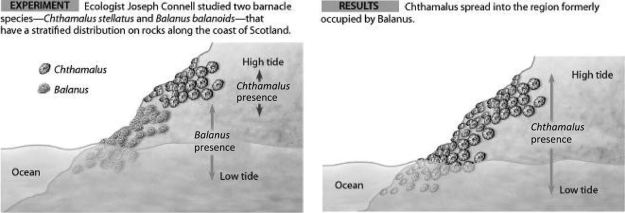 This experiment by Connell was best designed to investigate which of the following?
 (Multiple Choice)
4.8/5 (77)
(77) Use the following diagram of a hypothetical food web to answer the question. In this particular scenario, the arrows represent the transfer of energy between the various organisms and decomposers are included in the diagram. 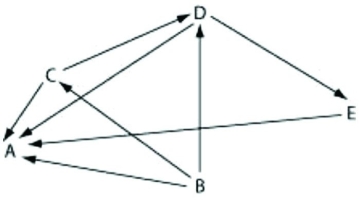 Which letter best represents a producer in the community?
 (Multiple Choice)
4.7/5 (91)
(91) Which description below is most consistent with the nonequilibrium model of community diversity?
(Multiple Choice)
4.9/5 (75)
(75) Based on the intermediate disturbance hypothesis, a community's species diversity is increased by ________.
(Multiple Choice)
4.8/5 (71)
(71) Use the figures to answer the following question. 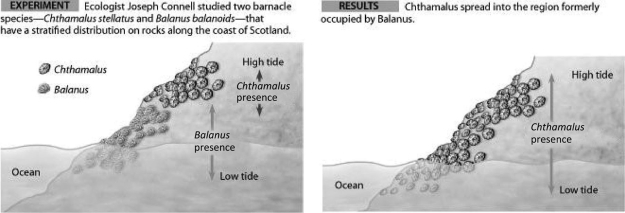 In this experiment, Balanus balanoids was removed from the habitat shown on the left, obtaining the results shown on the right.
Which of the following statements is supported by the results of this experiment?
In this experiment, Balanus balanoids was removed from the habitat shown on the left, obtaining the results shown on the right.
Which of the following statements is supported by the results of this experiment? (Multiple Choice)
4.8/5 (81)
(81) Using the symbols +, −, and 0 to indicate interspecific species interactions, where the first symbol refers to the first organism mentioned, what interactions exist between mycorrhizae and evergreen tree roots?
(Multiple Choice)
4.8/5 (74)
(74) Use the figure to answer the following question. 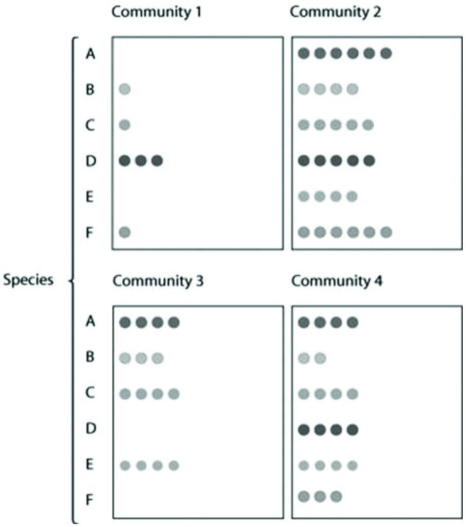 In the figure, species A through F are found among four communities, with the number of circles representing their abundance. Which community has the highest diversity?
 (Multiple Choice)
4.9/5 (86)
(86) Which of the following could qualify as a top-down control on a grassland community?
(Multiple Choice)
4.9/5 (82)
(82) Use the following diagram of five tropical islands formed at around the same time near a particular mainland, as well as the principles of MacArthur and Wilson's island equilibrium model, to answer the question. 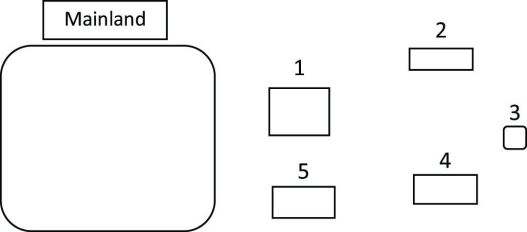 Which island would likely encounter the highest rate of species extinction if these islands were subject to unregulated, commercial logging in the rainforest?
 (Multiple Choice)
4.9/5 (88)
(88) The most plausible hypothesis to explain why species richness is higher in tropical than in temperate regions is that ________.
(Multiple Choice)
4.8/5 (78)
(78) Which of the following is an example of aposematic coloration?
(Multiple Choice)
4.8/5 (74)
(74) According to the island equilibrium model, species richness would be greatest on an island that is ________.
(Multiple Choice)
4.9/5 (77)
(77) Which of the following statements is a well-supported hypothesis for why some introduced species become highly abundant and may take over communities into which they have been introduced, but meanwhile do not exhibit this outcome in their original ranges?
(Multiple Choice)
4.9/5 (70)
(70) The feeding relationships among the species in a community determine the community's ________.
(Multiple Choice)
4.8/5 (88)
(88) Which of the following increases community diversity, based on the intermediate disturbance hypothesis?
(Multiple Choice)
4.8/5 (73)
(73) If there are 25 African elephants (primary consumer) living together in a given area, with an average weight of 4,000 kg each, approximately how much biomass of plant material would hypothetically be necessary as a harvestable food supply to support all of them on an ongoing basis? (Assume a 10% efficiency in energy transfer.)
(Multiple Choice)
4.8/5 (66)
(66) Using the symbols +, −, and 0 to indicate interspecific species interactions, where the first symbol refers to the first organism mentioned, which interactions of the following would exist between a lion pride and African wild dogs, if the dogs are the lions' prey and are found to typically avoid areas with lions?
(Multiple Choice)
4.9/5 (75)
(75) 
Filters
- Essay(0)
- Multiple Choice(0)
- Short Answer(0)
- True False(0)
- Matching(0)