



 Chat with AI
Exam 54: Biodiversity and Communities

Exam 1: Biology and Its Themes46 Questions
Exam 2: Atoms and Molecules61 Questions
Exam 3: The Chemistry of Water55 Questions
Exam 4: Carbon: the Basis of Molecular Diversity52 Questions
Exam 5: Biological Macromolecules and Lipids71 Questions
Exam 6: Energy and Life65 Questions
Exam 7: Cell Structure and Function66 Questions
Exam 8: Cell Membranes67 Questions
Exam 9: Cellular Signaling62 Questions
Exam 10: Cell Respiration68 Questions
Exam 11: Photosynthetic Processes64 Questions
Exam 12: Mitosis63 Questions
Exam 13: Sexual Life Cycles and Meiosis64 Questions
Exam 14: Mendelian Genetics65 Questions
Exam 15: Linkage and Chromosomes54 Questions
Exam 16: Nucleic Acids and Inheritance65 Questions
Exam 17: Expression of Genes70 Questions
Exam 18: Control of Gene Expression66 Questions
Exam 19: Dna Technology56 Questions
Exam 20: The Evolution of Genomes47 Questions
Exam 21: How Evolution Works60 Questions
Exam 22: Phylogenetic Reconstruction66 Questions
Exam 23: Microevolution65 Questions
Exam 24: Species and Speciation65 Questions
Exam 25: Macroevolution58 Questions
Exam 26: Introduction to Viruses54 Questions
Exam 27: Prokaryotes61 Questions
Exam 28: The Origin and Evolution of Eukaryotes66 Questions
Exam 29: Nonvascular and Seedless Vascular Plants72 Questions
Exam 30: Seed Plants64 Questions
Exam 31: Introduction to Fungi56 Questions
Exam 32: An Introduction to Animal Diversity58 Questions
Exam 33: Invertebrates58 Questions
Exam 34: Vertebrates66 Questions
Exam 35: Plant Structure and Growth68 Questions
Exam 36: Transport in Vascular Plants73 Questions
Exam 37: Plant Nutrition51 Questions
Exam 38: Reproduction of Flowering Plants59 Questions
Exam 39: Plant Signals and Behavior60 Questions
Exam 40: The Animal Body58 Questions
Exam 41: Chemical Signals in Animals62 Questions
Exam 42: Animal Digestive Systems58 Questions
Exam 43: Animal Transport Systems58 Questions
Exam 44: Animal Excretory Systems49 Questions
Exam 45: Animal Reproductive Systems64 Questions
Exam 46: Development in Animals68 Questions
Exam 47: Animal Defenses Against Infection65 Questions
Exam 48: Electrical Signals in Animals62 Questions
Exam 49: Neural Regulation in Animals69 Questions
Exam 50: Sensation and Movement in Animals68 Questions
Exam 51: An Overview of Ecology71 Questions
Exam 52: Behavioral Ecology64 Questions
Exam 53: Populations and Life History Traits73 Questions
Exam 54: Biodiversity and Communities71 Questions
Exam 55: Energy Flow and Chemical Cycling in Ecosystems80 Questions
Exam 56: Conservation and Global Ecology75 Questions
Select questions type


In a particular case of secondary succession, three species of wild grass all invaded a field. By the second season, a single species dominated the field and the other two species had a lower relative abundance. A possible factor contributing to the abundances of these species in this example of secondary succession is ________.
(Multiple Choice)
4.7/5  (95)
(95) Which of the following is a widely supported explanation for the tendency of tropical communities to have greater species diversity than temperate or polar communities?
(Multiple Choice)
4.8/5 (90)
(90) The principle of competitive exclusion states that ________.
(Multiple Choice)
4.7/5 (93)
(93) Using the symbols +, −, and 0 to indicate interspecific species interactions, where the first symbol refers to the first organism mentioned, which of the following claims/statements is correct?
(Multiple Choice)
4.8/5 (78)
(78) Use the figure to answer the following question. 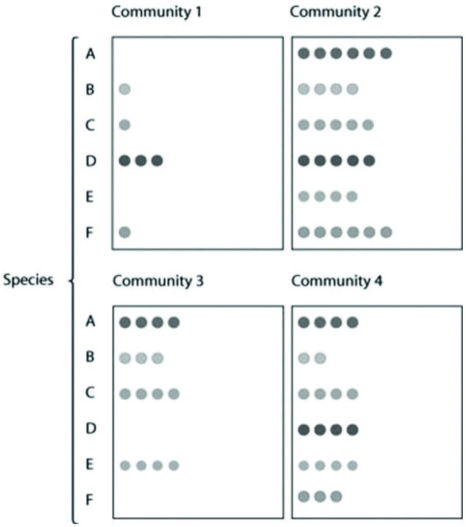 In the figure, species A through F are found among four communities, with the number of circles representing their abundance. Which community has the highest diversity?
 (Multiple Choice)
4.9/5 (80)
(80) Approximately how much total biomass of plant material would hypothetically be necessary to support six carnivorous lions (whose diet consists only of herbivorous prey), each weighing 50 kg, living in a given area along with their prey, on an ongoing basis? (Assume a 10% efficiency in energy transfer.)
(Multiple Choice)
4.8/5 (73)
(73) Which claim best explains the observation that species richness is higher in tropical regions than in temperate regions?
(Multiple Choice)
4.9/5 (86)
(86) Use the following diagram of a hypothetical food web to answer the question. In this particular scenario, the arrows represent the transfer of energy between the various organisms and decomposers are included in the diagram. 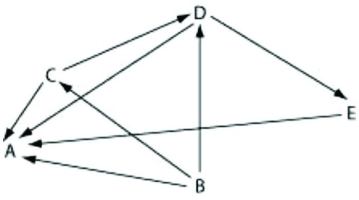 Which letter best represents a primary consumer in the community?
 (Multiple Choice)
4.9/5 (89)
(89) Use the figures to answer the following question. 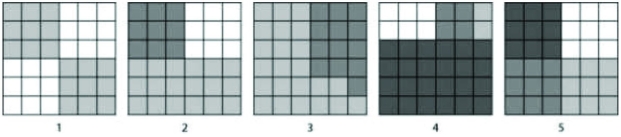 The different shaded squares in the figure, from white to darker gray, represent different species, and more squares of a shade correspond to a higher abundance. According to the Shannon Diversity Index, which of the five blocks above, with each containing 36 squares, represents the greatest diversity?
 (Multiple Choice)
4.8/5 (93)
(93) The oak tree pathogen that causes sudden oak death, Phytophthora ramorum, has dispersed 800 kilometers in 15 years. West Nile virus spread from New York State to 46 other states in 5 years. Which of the following best explains the difference in the rate of spread of these two pathogens?
(Multiple Choice)
4.9/5 (88)
(88) Five hypothetical forest communities, each have one hundred individuals distributed among four different tree species (W, X, Y, and Z). Which of the following combinations of species in a forest community would make it the most diverse?
(Multiple Choice)
4.8/5 (79)
(79) Which of the following is a correct statement about MacArthur and Wilson's island equilibrium model?
(Multiple Choice)
4.8/5 (85)
(85) Use the following diagram of five islands formed at around the same time near a particular mainland, as well as the principles of MacArthur and Wilson's island equilibrium model, to answer the question. 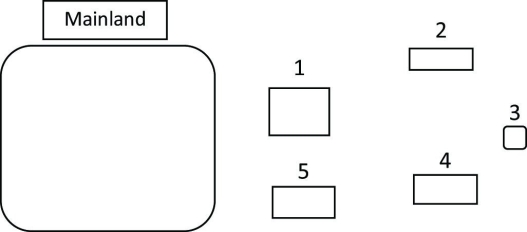 Which region would likely have the greatest species diversity?
 (Multiple Choice)
4.7/5 (80)
(80) Which of the following best explains why moderate levels of disturbance result in an increase in community diversity?
(Multiple Choice)
4.8/5 (79)
(79) In terms of community ecology, which of the following best explains why pathogens are often more virulent now than in the past?
(Multiple Choice)
4.7/5 (85)
(85) As you study two closely related predatory insect species, the two-spot and the three-spot avenger beetles, you notice that each species seeks prey at night when present in an area where the other beetle species is absent. However, where their ranges overlap, the two-spot avenger beetle hunts at night and the three-spot hunts in the morning. When you bring them into the laboratory and isolate the two different species, you discover that the offspring of both species are nocturnal. The observations above indicate that the two species most likely demonstrate which of following ecological processes? You have discovered an example of ________.
(Multiple Choice)
4.8/5 (79)
(79) Which of the following best describes the consequences of white-band disease in Caribbean coral reefs?
(Multiple Choice)
4.8/5 (76)
(76) Use the figure to answer the following question. 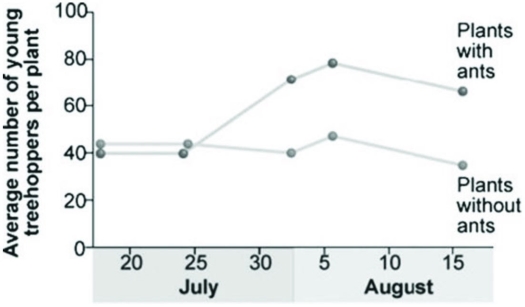 Treehoppers (a type of insect) produce honeydew, which ants use for food. Treehoppers have a major predator, the jumping spider. Researchers hypothesized that the ants would protect the treehoppers from the spiders. In an experiment, researchers followed study plots with ants removed from the system and compared them to a control plot. Which of the following conclusions is best supported by the data provided in the figure?
 (Multiple Choice)
4.7/5 (83)
(83) Which of the following best explains why a pathogen is generally more virulent in a new habitat?
(Multiple Choice)
4.8/5 (87)
(87) 
Filters
- Essay(0)
- Multiple Choice(0)
- Short Answer(0)
- True False(0)
- Matching(0)