



 Chat with AI
Exam 21: Reconstructing and Using Phylogenies

Exam 1: Studying Life246 Questions
Exam 2: Small Molecules and the Chemistry of Life246 Questions
Exam 3: Proteins, Carbohydrates, and Lipids246 Questions
Exam 4: Nucleic Acids and the Origin of Life246 Questions
Exam 5: Cells: the Working Units of Life248 Questions
Exam 6: Cell Membranes246 Questions
Exam 7: Cell Communication and Multicellularity246 Questions
Exam 8: Energy, Enzymes, and Metabolism246 Questions
Exam 9: Pathways That Harvest Chemical Energy246 Questions
Exam 10: Photosynthesis: Energy From Sunlight242 Questions
Exam 11: The Cell Cycle and Cell Division260 Questions
Exam 12: Inheritance, Genes, and Chromosomes250 Questions
Exam 13: Dna and Its Role in Heredity257 Questions
Exam 14: From Dna to Protein: Gene Expression252 Questions
Exam 15: Gene Mutation and Molecular Medicine251 Questions
Exam 16: Regulation of Gene Expression245 Questions
Exam 17: Genomes249 Questions
Exam 18: Recombinant Dna and Biotechnology243 Questions
Exam 20: Mechanisms of Evolution243 Questions
Exam 21: Reconstructing and Using Phylogenies246 Questions
Exam 22: Speciation247 Questions
Exam 23: Evolution of Genes and Genomes252 Questions
Exam 24: The History of Life on Earth246 Questions
Exam 25: Bacteria, Archaea, and Viruses262 Questions
Exam 26: The Origin and Diversification of Eukaryotes252 Questions
Exam 27: Plants Without Seeds: From Water to Land251 Questions
Exam 28: The Evolution of Seed Plants259 Questions
Exam 29: The Evolution and Diversity of Fungi261 Questions
Exam 30: Animal Origins and the Evolution of Body Plans248 Questions
Exam 31: Protostome Animals244 Questions
Exam 32: Deuterostome Animals246 Questions
Exam 33: The Plant Body243 Questions
Exam 34: Transport in Plants248 Questions
Exam 35: Plant Nutrition247 Questions
Exam 36: Regulation of Plant Growth246 Questions
Exam 37: Reproduction in Flowering Plants247 Questions
Exam 38: Plant Responses to Environmental Challenges246 Questions
Exam 39: Physiology, Homeostasis, and Temperature Regulation258 Questions
Exam 40: Animal Hormones249 Questions
Exam 41: Immunology: Animal Defense Systems265 Questions
Exam 42: Animal Reproduction261 Questions
Exam 43: Animal Development261 Questions
Exam 44: Neurons, Glia, and Nervous Systems250 Questions
Exam 45: Sensory Systems249 Questions
Exam 46: The Mammalian Nervous System: Structure and Higher Functions254 Questions
Exam 47: Musculoskeletal Systems259 Questions
Exam 48: Gas Exchange247 Questions
Exam 49: Circulatory Systems252 Questions
Exam 50: Nutrition, Digestion, and Absorption259 Questions
Exam 51: Salt and Water Balance and Nitrogen Excretion251 Questions
Exam 52: Animal Behavior249 Questions
Exam 53: The Physical Environment and Biogeography of Life248 Questions
Exam 54: Populations259 Questions
Exam 55: Species Interactions254 Questions
Exam 56: Communities247 Questions
Exam 57: Ecosystems238 Questions
Exam 58: A Changing Biosphere222 Questions
Select questions type


Suppose that mice and humans differ by 20 substitutions in their globin genes, and rats and mice differ by 5 substitutions.On the basis of other evidence, we know that the ancestor to humans and mice lived 80 million years ago.Assuming the molecular clock is operating, rats and mice split from each other _______ million years ago.
(Multiple Choice)
4.9/5  (93)
(93) When constructing phylogenetic trees, biologists often rely on the principle of _______, which states that the preferred phylogeny is the one that requires the fewest homoplasies.
(Short Answer)
4.8/5 (84)
(84) Maximum likelihood methods are most likely to be an improvement over parsimony methods when
(Multiple Choice)
4.7/5 (79)
(79) Assume DNA from samples of a virus in 2018 diverged, on average, 9 percent from a virus found in a person from 1988.If the total amount of divergence among contemporary samples were 27 percent, then the virus most likely would have entered the human population in the year _______, assuming a molecular clock.
(Multiple Choice)
4.7/5 (94)
(94) Biologists have described well over a million species of eukaryotes.Most species that have been described are known primarily by their
(Multiple Choice)
4.8/5 (89)
(89) Some species of Drosophila have elaborate "picture wings," whereas most others do not.Which type of evidence would most likely suggest that the elaborate picture wings evolved via convergent evolution?
(Multiple Choice)
4.9/5 (79)
(79) A taxon of flies can be removed from a phylogenetic tree by a single cut.Thus, this taxon is
(Multiple Choice)
4.9/5 (82)
(82) A skeptic argues that because phylogenetic methods can be flawed, the results from such methods are questionable.What result or analysis provides the best validation of the accuracy of the methods used to reconstruct phylogenetic relationships?
(Multiple Choice)
4.8/5 (75)
(75) Gibbons are more distantly related to humans, chimpanzees, and gorillas than these three are related to one another.Thus, gibbons are considered to be a(n) _______ in relation to the other three.
(Short Answer)
4.9/5 (70)
(70) Species A and B are sister species.Species C and D are also sister species.The lineage leading to species A and B diverged from the lineage leading to species C and D at node 1.Prior to node 1, the lineage leading to species E diverged from the lineage leading to species A, B, C, and D at node 2.Suppose a newly discovered species (species F) was determined to be the sister species of species E.Which would then be monophyletic groups?
(Multiple Choice)
4.9/5 (80)
(80) Which sequence represents a correct size ranking of taxonomic categories, from smallest to largest?
(Multiple Choice)
4.8/5 (79)
(79) Whales and pigs diverged about 80 million years ago.If a DNA sequence has had 24 changes between whales and pigs, the rate of change for this sequence would be _______ changes per million years.
(Multiple Choice)
4.8/5 (87)
(87) The ancestral archosaur had an opsin that was shifted to _______, suggesting that the animal was most likely active _______.
(Multiple Choice)
4.9/5 (71)
(71) Two clades of beetles split off from a node more recently than these clades diverged from other clades.Thus, these clades are _______ clades.
(Multiple Choice)
4.8/5 (68)
(68) Which concept adds a dimension of time to a phylogenetic analysis?
(Multiple Choice)
4.8/5 (72)
(72) Two species of damselflies that are not sister species independently evolve a new mating behavior.This pattern is an example of _______, which is a(n)______.
(Multiple Choice)
4.7/5 (91)
(91) Refer to the figure. 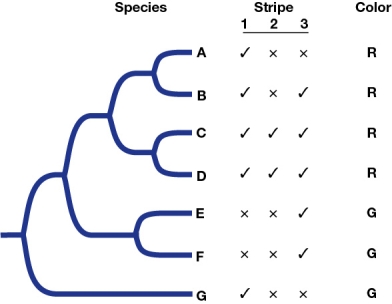 The figure shows the phylogeny of seven species of beetles (A through G).The figure also shows whether the beetles have (marked with check) or do not have (marked with an x) one of three stripes.It also states the color of the beetle (R for red and G for green). The loss of stripe 3 in species _______ is an example of a homoplasy.
 (Short Answer)
4.9/5 (82)
(82) 
Filters
- Essay(0)
- Multiple Choice(0)
- Short Answer(0)
- True False(0)
- Matching(0)