



 Chat with AI
Exam 21: Reconstructing and Using Phylogenies

Exam 1: Studying Life246 Questions
Exam 2: Small Molecules and the Chemistry of Life246 Questions
Exam 3: Proteins, Carbohydrates, and Lipids246 Questions
Exam 4: Nucleic Acids and the Origin of Life246 Questions
Exam 5: Cells: the Working Units of Life248 Questions
Exam 6: Cell Membranes246 Questions
Exam 7: Cell Communication and Multicellularity246 Questions
Exam 8: Energy, Enzymes, and Metabolism246 Questions
Exam 9: Pathways That Harvest Chemical Energy246 Questions
Exam 10: Photosynthesis: Energy From Sunlight242 Questions
Exam 11: The Cell Cycle and Cell Division260 Questions
Exam 12: Inheritance, Genes, and Chromosomes250 Questions
Exam 13: Dna and Its Role in Heredity257 Questions
Exam 14: From Dna to Protein: Gene Expression252 Questions
Exam 15: Gene Mutation and Molecular Medicine251 Questions
Exam 16: Regulation of Gene Expression245 Questions
Exam 17: Genomes249 Questions
Exam 18: Recombinant Dna and Biotechnology243 Questions
Exam 20: Mechanisms of Evolution243 Questions
Exam 21: Reconstructing and Using Phylogenies246 Questions
Exam 22: Speciation247 Questions
Exam 23: Evolution of Genes and Genomes252 Questions
Exam 24: The History of Life on Earth246 Questions
Exam 25: Bacteria, Archaea, and Viruses262 Questions
Exam 26: The Origin and Diversification of Eukaryotes252 Questions
Exam 27: Plants Without Seeds: From Water to Land251 Questions
Exam 28: The Evolution of Seed Plants259 Questions
Exam 29: The Evolution and Diversity of Fungi261 Questions
Exam 30: Animal Origins and the Evolution of Body Plans248 Questions
Exam 31: Protostome Animals244 Questions
Exam 32: Deuterostome Animals246 Questions
Exam 33: The Plant Body243 Questions
Exam 34: Transport in Plants248 Questions
Exam 35: Plant Nutrition247 Questions
Exam 36: Regulation of Plant Growth246 Questions
Exam 37: Reproduction in Flowering Plants247 Questions
Exam 38: Plant Responses to Environmental Challenges246 Questions
Exam 39: Physiology, Homeostasis, and Temperature Regulation258 Questions
Exam 40: Animal Hormones249 Questions
Exam 41: Immunology: Animal Defense Systems265 Questions
Exam 42: Animal Reproduction261 Questions
Exam 43: Animal Development261 Questions
Exam 44: Neurons, Glia, and Nervous Systems250 Questions
Exam 45: Sensory Systems249 Questions
Exam 46: The Mammalian Nervous System: Structure and Higher Functions254 Questions
Exam 47: Musculoskeletal Systems259 Questions
Exam 48: Gas Exchange247 Questions
Exam 49: Circulatory Systems252 Questions
Exam 50: Nutrition, Digestion, and Absorption259 Questions
Exam 51: Salt and Water Balance and Nitrogen Excretion251 Questions
Exam 52: Animal Behavior249 Questions
Exam 53: The Physical Environment and Biogeography of Life248 Questions
Exam 54: Populations259 Questions
Exam 55: Species Interactions254 Questions
Exam 56: Communities247 Questions
Exam 57: Ecosystems238 Questions
Exam 58: A Changing Biosphere222 Questions
Select questions type


The suffix "-idae" (as in "Sciuridae") refers to organisms of which kingdom?
(Multiple Choice)
5.0/5  (97)
(97) Four different phylogenetic trees of a group of salamanders have been proposed.Trees A and B each require 12 homoplasies, but tree A requires 14 synapomorphies and tree B requires 13 synapomorphies.Tree C requires 15 homoplasies and 13 synapomorphies.Finally, tree D requires 10 homoplasies and 15 synapomorphies.According to the principle of parsimony, which tree is the best?
(Multiple Choice)
4.7/5 (81)
(81) Which application of phylogenetic trees cannot be done without assuming a molecular clock?
(Multiple Choice)
4.8/5 (70)
(70) Consider a phylogeny of metazoans.Snakes, which lack limbs, evolved from vertebrates that had legs.The limbs of snakes disappeared by _______, and the backbones of snakes are a _______.
(Multiple Choice)
4.9/5 (77)
(77) In the case where phylogenetic analysis of HIV was used to convict a physician of purposely injecting blood from his HIV-positive patient into his former girlfriend, which would be evidence that would most likely exonerate the physician?
(Multiple Choice)
4.9/5 (76)
(76) Which event or situation would violate an assumption of the molecular clock?
(Multiple Choice)
4.9/5 (81)
(81) Why are fossils useful for determining whether a trait is ancestral or derived?
(Multiple Choice)
4.9/5 (83)
(83) Refer to the figure. 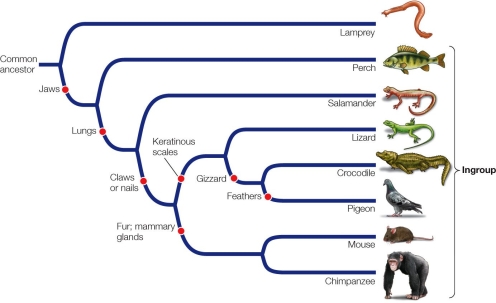 Which synapomorphies are shared by lizards and salamanders?
 (Multiple Choice)
4.8/5 (87)
(87) Drosophila mauritiana and D.melanogaster diverged 2 million years ago.Between these species, 40 nucleotide differences have accumulated at a gene.At that same gene, D.mauritiana and D.simulans have accumulated 8 nucleotide differences.Assuming that a molecular clock is operating, the best estimate for the divergence time between D.mauritiana and D.simulans is _______ years ago.
(Multiple Choice)
4.7/5 (86)
(86) Which trait would be least useful in a phylogenetic analysis?
(Multiple Choice)
4.8/5 (68)
(68) Males of a species of grasshoppers sing very rapid songs.Experimental evidence shows that females of this species prefer these fast songs over slowed-down songs.Related species have males that do not sing as fast, but interestingly, the females from these other species also prefer very fast songs over songs of males from their own species.These results are consistent with the _______ hypothesis.
(Short Answer)
4.8/5 (97)
(97) Refer to the phylogenetic tree below showing the phylogenetic relationships among eight species.Red dots indicate the appearance of derived traits.  The positions of which two taxa could be reversed without changing the meaning of the tree?
 (Multiple Choice)
4.8/5 (88)
(88) Several unrelated species of spiders have evolved social behaviors presumably in response to selective pressures brought on by high density.The closest relatives of these spiders lack these behaviors.These social behaviors are likely examples of _______ evolution, which is a form of _______.
(Short Answer)
4.7/5 (72)
(72) Biologists are interested in determining the phylogenetic relationships of a group of beetles.Information about which of the following types of behavior would be least useful in reconstructing phylogenies?
(Multiple Choice)
4.9/5 (94)
(94) Experimental evolution studies using bacteriophages have been most useful in showing that
(Multiple Choice)
4.8/5 (84)
(84) In the experimental tests of phylogenetic reconstruction methods done by Hillis et al, the experimenters mimicked the levels of homoplasy commonly seen in real organisms by
(Multiple Choice)
4.8/5 (77)
(77) The ratites are a group of flightless birds comprising ostrich, emu, cassowary, rhea, and kiwi.All share certain morphological similarities (such as a breastbone without a keel) not found in other birds, but they live on different continents.In the past, some ornithologists regarded their similarities as homoplasies, but they are now thought to be synapomorphies.Based on this information, you would conclude that the ratites were once regarded as a _______ group but are now believed to be _______.
(Multiple Choice)
4.7/5 (69)
(69) 
Filters
- Essay(0)
- Multiple Choice(0)
- Short Answer(0)
- True False(0)
- Matching(0)