



 Chat with AI
Exam 21: Reconstructing and Using Phylogenies

Exam 1: Studying Life246 Questions
Exam 2: Small Molecules and the Chemistry of Life246 Questions
Exam 3: Proteins, Carbohydrates, and Lipids246 Questions
Exam 4: Nucleic Acids and the Origin of Life246 Questions
Exam 5: Cells: the Working Units of Life248 Questions
Exam 6: Cell Membranes246 Questions
Exam 7: Cell Communication and Multicellularity246 Questions
Exam 8: Energy, Enzymes, and Metabolism246 Questions
Exam 9: Pathways That Harvest Chemical Energy246 Questions
Exam 10: Photosynthesis: Energy From Sunlight242 Questions
Exam 11: The Cell Cycle and Cell Division260 Questions
Exam 12: Inheritance, Genes, and Chromosomes250 Questions
Exam 13: Dna and Its Role in Heredity257 Questions
Exam 14: From Dna to Protein: Gene Expression252 Questions
Exam 15: Gene Mutation and Molecular Medicine251 Questions
Exam 16: Regulation of Gene Expression245 Questions
Exam 17: Genomes249 Questions
Exam 18: Recombinant Dna and Biotechnology243 Questions
Exam 20: Mechanisms of Evolution243 Questions
Exam 21: Reconstructing and Using Phylogenies246 Questions
Exam 22: Speciation247 Questions
Exam 23: Evolution of Genes and Genomes252 Questions
Exam 24: The History of Life on Earth246 Questions
Exam 25: Bacteria, Archaea, and Viruses262 Questions
Exam 26: The Origin and Diversification of Eukaryotes252 Questions
Exam 27: Plants Without Seeds: From Water to Land251 Questions
Exam 28: The Evolution of Seed Plants259 Questions
Exam 29: The Evolution and Diversity of Fungi261 Questions
Exam 30: Animal Origins and the Evolution of Body Plans248 Questions
Exam 31: Protostome Animals244 Questions
Exam 32: Deuterostome Animals246 Questions
Exam 33: The Plant Body243 Questions
Exam 34: Transport in Plants248 Questions
Exam 35: Plant Nutrition247 Questions
Exam 36: Regulation of Plant Growth246 Questions
Exam 37: Reproduction in Flowering Plants247 Questions
Exam 38: Plant Responses to Environmental Challenges246 Questions
Exam 39: Physiology, Homeostasis, and Temperature Regulation258 Questions
Exam 40: Animal Hormones249 Questions
Exam 41: Immunology: Animal Defense Systems265 Questions
Exam 42: Animal Reproduction261 Questions
Exam 43: Animal Development261 Questions
Exam 44: Neurons, Glia, and Nervous Systems250 Questions
Exam 45: Sensory Systems249 Questions
Exam 46: The Mammalian Nervous System: Structure and Higher Functions254 Questions
Exam 47: Musculoskeletal Systems259 Questions
Exam 48: Gas Exchange247 Questions
Exam 49: Circulatory Systems252 Questions
Exam 50: Nutrition, Digestion, and Absorption259 Questions
Exam 51: Salt and Water Balance and Nitrogen Excretion251 Questions
Exam 52: Animal Behavior249 Questions
Exam 53: The Physical Environment and Biogeography of Life248 Questions
Exam 54: Populations259 Questions
Exam 55: Species Interactions254 Questions
Exam 56: Communities247 Questions
Exam 57: Ecosystems238 Questions
Exam 58: A Changing Biosphere222 Questions
Select questions type


Some species in a hypothetical family of beetles are winged, and others are wingless.Which would be most useful in determining whether having wings or being wingless was the ancestral trait?
(Multiple Choice)
5.0/5  (91)
(91) From a survey of Martian life, three hypothetical species are found.These are nicknamed krons, furs, and pars.If krons and furs are sister species, the resulting phylogenetic tree will have 45 homoplasies.If krons and pars are sister species, the tree will have 52 homoplasies.Krons and pars have red body patches, whereas krons and furs have striped bodies.Based on the principles of parsimony, krons and _______ are sister species, _______ a synapomorphy.
(Multiple Choice)
4.9/5 (78)
(78) Refer to the figure showing a single viral plaque that was split every 400 generations and grown in the presence of a mutagen.  Based on this tree, which lineage should share the most synapomorphies with the E lineage?
 (Multiple Choice)
4.9/5 (84)
(84) Two species of flies share traits, such as head morphology and the shape of their genitalia, traits that other related species do not have.These shared characteristics are called
(Multiple Choice)
4.9/5 (63)
(63) Humans and chimpanzees diverged about 6 million years ago.If 20 nucleotide substitutions have occurred between human and chimpanzee lineages in a sequence of mitochondrial DNA, and 30 have occurred between humans and gorillas, then, according to the molecular clock hypothesis, humans and gorillas separated _______ million years ago.
(Multiple Choice)
4.9/5 (75)
(75) In studies involving the molecular clock,the fossil record
(Multiple Choice)
4.8/5 (81)
(81) Consider five species of toads (A-E).Species A and B are sister species.Species C and D are also sister species.The clade containing species A and B is a sister to the clade containing species C and D.Which species groups would be a clade?
(Multiple Choice)
4.8/5 (95)
(95) Which is not an advantage of fossil evidence in phylogenetic systematics?
(Multiple Choice)
4.8/5 (78)
(78) Some species in a hypothetical family of plants are hermaphrodites, and others have flowers with separate sexes.What would be most useful in determining which condition was the derived one?
(Multiple Choice)
4.7/5 (70)
(70) Suppose a particular amino acid variant in a protein appeared several times in the phylogeny of a group of yeasts.Species with the variant were often sister to species without the change.The species with the variant generally lived in conditions with higher concentrations of ethanol.What would be the most plausible explanation for this variant?
(Multiple Choice)
4.9/5 (88)
(88) Tribolium castaneum is a beetle found in flour and other stored products.Tribolium is the name of the _______ to which this beetle belongs.This taxonomic category includes many species, and is the least inclusive standard taxonomic category.
(Short Answer)
4.8/5 (74)
(74) The common ancestor of all of the species displayed in a phylogenetic tree lies at the _______ of the tree.
(Multiple Choice)
4.9/5 (87)
(87) A trait that evolved by convergent evolution in more than one clade is
(Multiple Choice)
4.7/5 (77)
(77) The common ancestor of humans and chimpanzees lived about 7 million years ago.Based on a molecular clock, if a slowly evolving gene shows 3 percent divergence between humans and chimpanzees and 12 percent divergence between humans and gibbons, then humans and gibbons diverged from each other _______ years ago.
(Short Answer)
4.7/5 (75)
(75) Species A and species B have long wings, whereas species C has short wings.Which piece of evidence would best support the hypothesis that long wings are a synapomorphy?
(Multiple Choice)
4.8/5 (72)
(72) Refer to the figure. 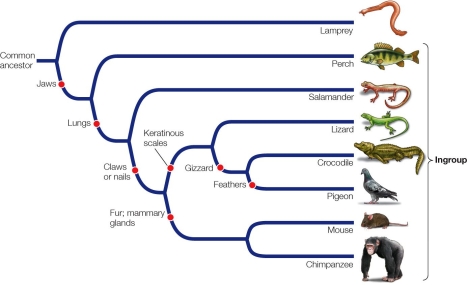 Which statement about the phylogenetic tree (shown) is true?
 (Multiple Choice)
4.7/5 (72)
(72) Refer to the phylogenetic tree below showing the phylogenetic relationships among eight species.Red dots indicate the appearance of derived traits.  According to the phylogenetic tree, which synapomorphies unite the pigeon and the lizard?
 (Multiple Choice)
4.9/5 (66)
(66) Stickleback fish evolve changes in body armor whenever they move from freshwater to marine settings (and vice versa).Such changes occur often and repeatedly and are due to changes at a few genes.Would the body armor changes be useful in constructing phylogenies of sticklebacks? Explain.
(Essay)
4.8/5 (72)
(72) 
Filters
- Essay(0)
- Multiple Choice(0)
- Short Answer(0)
- True False(0)
- Matching(0)