



 Chat with AI
Exam 18: Recombinant Dna and Biotechnology

Exam 1: Studying Life246 Questions
Exam 2: Small Molecules and the Chemistry of Life246 Questions
Exam 3: Proteins, Carbohydrates, and Lipids246 Questions
Exam 4: Nucleic Acids and the Origin of Life246 Questions
Exam 5: Cells: the Working Units of Life248 Questions
Exam 6: Cell Membranes246 Questions
Exam 7: Cell Communication and Multicellularity246 Questions
Exam 8: Energy, Enzymes, and Metabolism246 Questions
Exam 9: Pathways That Harvest Chemical Energy246 Questions
Exam 10: Photosynthesis: Energy From Sunlight242 Questions
Exam 11: The Cell Cycle and Cell Division260 Questions
Exam 12: Inheritance, Genes, and Chromosomes250 Questions
Exam 13: Dna and Its Role in Heredity257 Questions
Exam 14: From Dna to Protein: Gene Expression252 Questions
Exam 15: Gene Mutation and Molecular Medicine251 Questions
Exam 16: Regulation of Gene Expression245 Questions
Exam 17: Genomes249 Questions
Exam 18: Recombinant Dna and Biotechnology243 Questions
Exam 20: Mechanisms of Evolution243 Questions
Exam 21: Reconstructing and Using Phylogenies246 Questions
Exam 22: Speciation247 Questions
Exam 23: Evolution of Genes and Genomes252 Questions
Exam 24: The History of Life on Earth246 Questions
Exam 25: Bacteria, Archaea, and Viruses262 Questions
Exam 26: The Origin and Diversification of Eukaryotes252 Questions
Exam 27: Plants Without Seeds: From Water to Land251 Questions
Exam 28: The Evolution of Seed Plants259 Questions
Exam 29: The Evolution and Diversity of Fungi261 Questions
Exam 30: Animal Origins and the Evolution of Body Plans248 Questions
Exam 31: Protostome Animals244 Questions
Exam 32: Deuterostome Animals246 Questions
Exam 33: The Plant Body243 Questions
Exam 34: Transport in Plants248 Questions
Exam 35: Plant Nutrition247 Questions
Exam 36: Regulation of Plant Growth246 Questions
Exam 37: Reproduction in Flowering Plants247 Questions
Exam 38: Plant Responses to Environmental Challenges246 Questions
Exam 39: Physiology, Homeostasis, and Temperature Regulation258 Questions
Exam 40: Animal Hormones249 Questions
Exam 41: Immunology: Animal Defense Systems265 Questions
Exam 42: Animal Reproduction261 Questions
Exam 43: Animal Development261 Questions
Exam 44: Neurons, Glia, and Nervous Systems250 Questions
Exam 45: Sensory Systems249 Questions
Exam 46: The Mammalian Nervous System: Structure and Higher Functions254 Questions
Exam 47: Musculoskeletal Systems259 Questions
Exam 48: Gas Exchange247 Questions
Exam 49: Circulatory Systems252 Questions
Exam 50: Nutrition, Digestion, and Absorption259 Questions
Exam 51: Salt and Water Balance and Nitrogen Excretion251 Questions
Exam 52: Animal Behavior249 Questions
Exam 53: The Physical Environment and Biogeography of Life248 Questions
Exam 54: Populations259 Questions
Exam 55: Species Interactions254 Questions
Exam 56: Communities247 Questions
Exam 57: Ecosystems238 Questions
Exam 58: A Changing Biosphere222 Questions
Select questions type


Which is not a major concern regarding the use of biotechnological approaches for the improvement of crop plants?
(Multiple Choice)
4.8/5  (85)
(85) People who rely on rice as their major source of food often become susceptible to infections and blindness.One way to alleviate these problems is to engineer rice to make more -carotene.What would be a different way to address this need?
(Multiple Choice)
4.7/5 (85)
(85) Refer to the table showing results from an experiment in which researchers used CRISPR technology to knock out various genes from a plant.They then examined plant stem height (in centimeters, with calculated means) and seed production (number of seeds, with calculated means) with each treatment.(Note: The "x" marks genes that have been knocked out.) 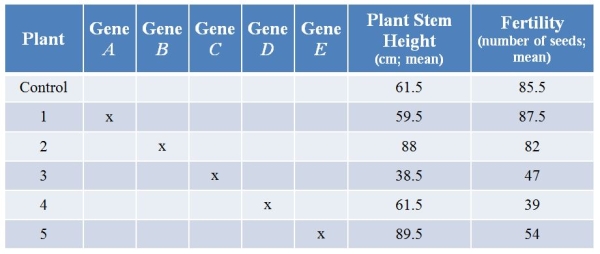 What is the most likely role of the product of gene C?
 (Multiple Choice)
4.8/5 (71)
(71) Microarray technology relies on the production of small, specified DNA segments called _______.
(Short Answer)
4.8/5 (92)
(92) One important biotechnology advance is the mass production of the enzyme tissue plasminogen activator.What is its normal function?
(Multiple Choice)
4.9/5 (81)
(81) Why are plant cells, as opposed to animal cells, particularly useful as hosts for recombinant DNA?
(Multiple Choice)
4.8/5 (90)
(90) An miRNA has the sequence 5ʹ-CUGAUCAGUUACCG-3ʹ.Which motif on mRNA would most likely be a target of this miRNA?
(Multiple Choice)
4.9/5 (71)
(71) Biologists generally favor using _______ over antisense RNA to block translation, because its RNA molecules are more stable than antisense RNA.
(Short Answer)
4.7/5 (77)
(77) Which property distinguishes an expression vector from a typical vector?
(Multiple Choice)
4.9/5 (95)
(95) In Cohen and Boyer's pioneering studies of recombinant DNA, how did they know they had produced recombinant DNA?
(Multiple Choice)
4.8/5 (93)
(93) Refer to the figure showing the recognition sequence for EcoRI. 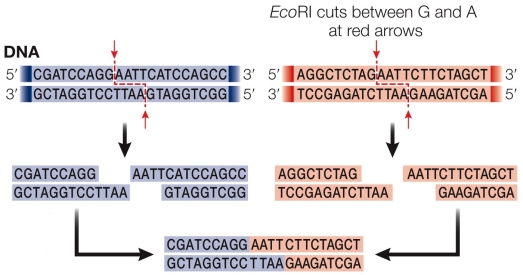 Why is this restriction enzyme more suited for use in recombinant DNA technology than one that cuts only once at the restriction site?
 (Essay)
4.9/5 (79)
(79) A copy of the coding region of a gene is inserted downstream from a different, stronger promoter, and cells are transformed with the recombinant DNA.What is the most likely reason for the insertion?
(Multiple Choice)
4.8/5 (87)
(87) Libraries constructed from only those genes that are transcribed in a given tissue are known as _______ libraries.
(Short Answer)
4.9/5 (67)
(67) Refer to the table.In this experiment researchers used CRISPR technology to knock out various genes from a fly.They then examined the developmental time (in days, with calculated means) and larval survival (percent, with calculated means) for each treatment.The "x" marks genes that have been knocked out. 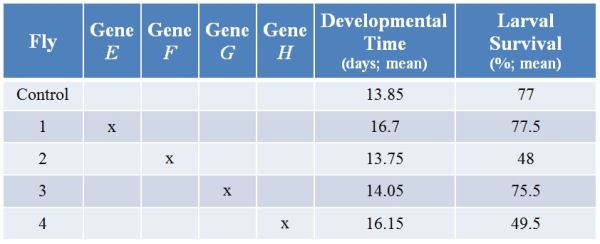 Knocking out gene _______ would have the least effect on either trait.
 (Short Answer)
4.8/5 (77)
(77) Confirmation that the S gene was responsible for self-incompatibility came from
(Multiple Choice)
4.8/5 (90)
(90) Refer to the figure showing the steps used in microarray analysis to detect differences in expression between tumor tissue and normal tissue.The spots in the bottom panel represent individual genes for patients who have good prognoses (left) as well as for patients who have poor ones (right).The colors of those spots represent levels of expression: red = high expression, yellow = intermediate expression, green = low expression. 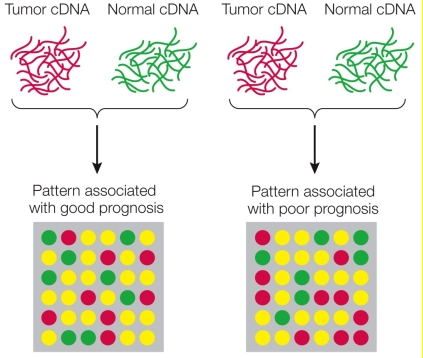 Look at the lowest, left-most gene in both patterns.Does expression of this gene correlate with the prognoses? Explain your answer.
 (Essay)
4.9/5 (77)
(77) Refer to the figure showing an experiment using selectable marker (reporter) genes. 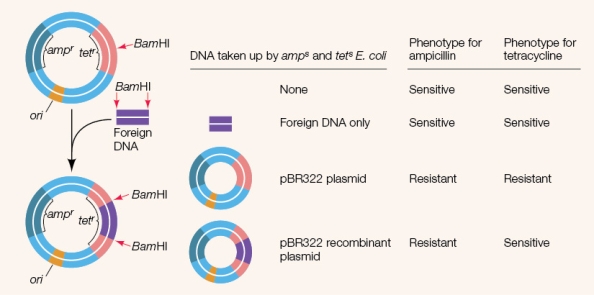 Some cells are resistant to ampicillin and sensitive to tetracycline, some are sensitive to both antibiotics, and some are resistant to both.Which of these cell types should be the lowest in proportion in this experiment, and why?
 (Essay)
4.8/5 (82)
(82) Which is not a property of yeast cells that makes them useful as eukaryotic hosts for recombinant DNA studies?
(Multiple Choice)
5.0/5 (85)
(85) Which activity would be considered cloning of recombinant DNA?
(Multiple Choice)
4.8/5 (86)
(86) 
Filters
- Essay(0)
- Multiple Choice(0)
- Short Answer(0)
- True False(0)
- Matching(0)