



 Chat with AI
Exam 18: Recombinant Dna and Biotechnology

Exam 1: Studying Life246 Questions
Exam 2: Small Molecules and the Chemistry of Life246 Questions
Exam 3: Proteins, Carbohydrates, and Lipids246 Questions
Exam 4: Nucleic Acids and the Origin of Life246 Questions
Exam 5: Cells: the Working Units of Life248 Questions
Exam 6: Cell Membranes246 Questions
Exam 7: Cell Communication and Multicellularity246 Questions
Exam 8: Energy, Enzymes, and Metabolism246 Questions
Exam 9: Pathways That Harvest Chemical Energy246 Questions
Exam 10: Photosynthesis: Energy From Sunlight242 Questions
Exam 11: The Cell Cycle and Cell Division260 Questions
Exam 12: Inheritance, Genes, and Chromosomes250 Questions
Exam 13: Dna and Its Role in Heredity257 Questions
Exam 14: From Dna to Protein: Gene Expression252 Questions
Exam 15: Gene Mutation and Molecular Medicine251 Questions
Exam 16: Regulation of Gene Expression245 Questions
Exam 17: Genomes249 Questions
Exam 18: Recombinant Dna and Biotechnology243 Questions
Exam 20: Mechanisms of Evolution243 Questions
Exam 21: Reconstructing and Using Phylogenies246 Questions
Exam 22: Speciation247 Questions
Exam 23: Evolution of Genes and Genomes252 Questions
Exam 24: The History of Life on Earth246 Questions
Exam 25: Bacteria, Archaea, and Viruses262 Questions
Exam 26: The Origin and Diversification of Eukaryotes252 Questions
Exam 27: Plants Without Seeds: From Water to Land251 Questions
Exam 28: The Evolution of Seed Plants259 Questions
Exam 29: The Evolution and Diversity of Fungi261 Questions
Exam 30: Animal Origins and the Evolution of Body Plans248 Questions
Exam 31: Protostome Animals244 Questions
Exam 32: Deuterostome Animals246 Questions
Exam 33: The Plant Body243 Questions
Exam 34: Transport in Plants248 Questions
Exam 35: Plant Nutrition247 Questions
Exam 36: Regulation of Plant Growth246 Questions
Exam 37: Reproduction in Flowering Plants247 Questions
Exam 38: Plant Responses to Environmental Challenges246 Questions
Exam 39: Physiology, Homeostasis, and Temperature Regulation258 Questions
Exam 40: Animal Hormones249 Questions
Exam 41: Immunology: Animal Defense Systems265 Questions
Exam 42: Animal Reproduction261 Questions
Exam 43: Animal Development261 Questions
Exam 44: Neurons, Glia, and Nervous Systems250 Questions
Exam 45: Sensory Systems249 Questions
Exam 46: The Mammalian Nervous System: Structure and Higher Functions254 Questions
Exam 47: Musculoskeletal Systems259 Questions
Exam 48: Gas Exchange247 Questions
Exam 49: Circulatory Systems252 Questions
Exam 50: Nutrition, Digestion, and Absorption259 Questions
Exam 51: Salt and Water Balance and Nitrogen Excretion251 Questions
Exam 52: Animal Behavior249 Questions
Exam 53: The Physical Environment and Biogeography of Life248 Questions
Exam 54: Populations259 Questions
Exam 55: Species Interactions254 Questions
Exam 56: Communities247 Questions
Exam 57: Ecosystems238 Questions
Exam 58: A Changing Biosphere222 Questions
Select questions type


Which technology is used to examine the patterns of gene expression for a large number of genes simultaneously?
(Multiple Choice)
5.0/5  (90)
(90) A(n) _______ vector contains all the characteristics of cloning vectors, as well as the extra sequences needed for producing the transgene.
(Short Answer)
4.9/5 (73)
(73) Which example would not be considered a form of biotechnology?
(Multiple Choice)
4.8/5 (84)
(84) Refer to the table showing results from an experiment in which researchers used CRISPR technology to knock out various genes from a fly.They then examined the developmental time (in days, with calculated means) and larval survival (percent, with calculated means) for each treatment.(Note: The "x" marks genes that have been knocked out.) 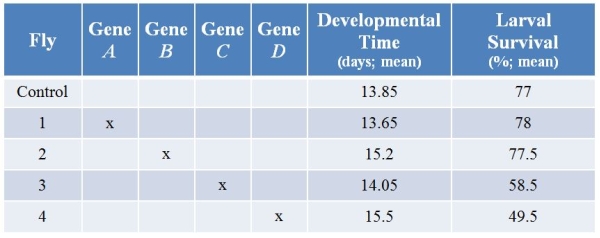 Which gene(s) affect(s) developmental time? Explain your answer.
 (Essay)
4.9/5 (72)
(72) The sequence 5ʹ-TCATGT-3ʹ is not a restriction enzyme palindromic recognition sequence.What mutational change would most likely make it into one?
(Multiple Choice)
5.0/5 (80)
(80) A plasmid contains the gene for tetracycline resistance and a lacZ gene that has a restriction site in it.Foreign DNA has the same restriction site at its ends.Host bacteria are transformed with the recombinant DNA and grown on medium with tetracycline and X-Gal.The host bacteria already contained a ciprofloxacin resistance gene prior to the transformation event.Which gene or substance is acting as a reporter gene?
(Multiple Choice)
4.8/5 (93)
(93) A biologist would most likely use the technique of electroporation to
(Multiple Choice)
4.8/5 (82)
(82) Which would a biologist generate to get a "snapshot" that captures the transcription pattern of a set of cells at a given point in time?
(Multiple Choice)
4.7/5 (85)
(85) A cow transgene is to be expressed in a bacterial cell.What else needs to be included in the expression vector?
(Multiple Choice)
4.8/5 (89)
(89) In an experiment in recombinant DNA, the colonies that contain the correct recombinant DNA have turned blue.The most likely selective marker being used is
(Multiple Choice)
4.7/5 (96)
(96) Why might cultured plant cells be more useful than animal cells as host cells, even for animal transgenes?
(Multiple Choice)
4.7/5 (74)
(74) In comparison with selective breeding, recombinant DNA technology
(Multiple Choice)
4.8/5 (64)
(64) Recombinant DNA involves the joining of two distinct DNA molecules.The enzyme that catalyzes this reaction is known as _______.
(Short Answer)
4.8/5 (73)
(73) Which feature is an advantage that viruses (and phages) have over plasmids, with respect to their ability to be vectors?
(Multiple Choice)
4.8/5 (79)
(79) A biologist used microarrays to examine how gene expression in a fish changes with temperature.Refer to the table showing the expression levels of four (of several thousand) genes at varying temperatures.Values for expression have been normalized such that the expression at 15°C for any particular gene is always 100. 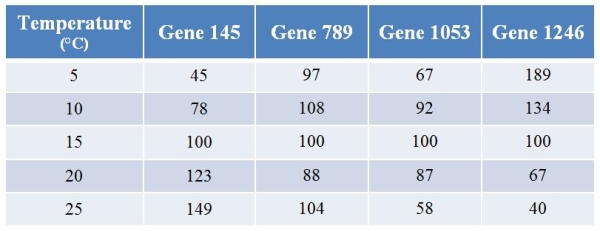 The expression of gene(s) _______ steadily increase(s) as temperature increases.
 (Short Answer)
4.8/5 (66)
(66) cDNA and genomic libraries are created from a mouse at different times in development.You would expect the cDNA libraries taken at different times to have _______ information and be _______ variable than genomic libraries taken from the same samples.
(Multiple Choice)
4.9/5 (78)
(78) Suppose you are a researcher who is expressing a human transgene in yeast cells.You want to be able to easily control when the gene is expressed.Which tool or technique will give you that type of control?
(Multiple Choice)
4.9/5 (68)
(68) Refer to the figure showing the steps used in microarray analysis to detect differences in expression between tumor tissue and normal tissue.The spots in the bottom panel represent individual genes for patients who have good prognoses (left) as well as for patients who have poor ones (right).The colors of those spots represent levels of expression: red = high expression, yellow = intermediate expression, green = low expression. 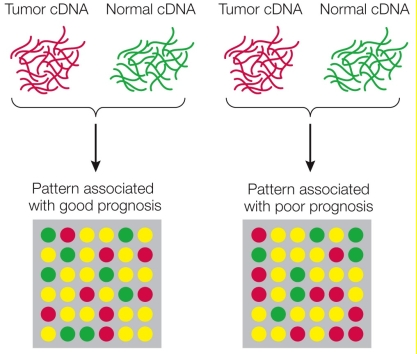 Look at the top leftmost spot.At this gene, patients with poor prognoses have _______ expression than patients with good prognoses.
 (Short Answer)
4.8/5 (90)
(90) 
Filters
- Essay(0)
- Multiple Choice(0)
- Short Answer(0)
- True False(0)
- Matching(0)