



 Chat with AI
Exam 2: Foundations of Independent Practice

Exam 1: Advanced Clinical Medicine1 k+ Questions
Exam 2: Foundations of Independent Practice597 Questions
Select questions type


A 79-year-old woman with acute-onset shortness of breath is brought to the emergency department by her husband and adult son. The patient has had 2 recent hospitalizations for aspiration pneumonia over the previous 6 months. Her medical issues include Alzheimer disease, hypertension, type 2 diabetes mellitus, and severe chronic obstructive pulmonary disease. Medications include lisinopril, glipizide, galantamine, albuterol, and metered-dosed inhaler ipratropium bromide. Temperature is 37.8 C (100 F), blood pressure is 85/60 mm Hg, pulse is 114/min, and respirations are 28/min. Pulse oximetry is 70% on room air and 85% on 100% nonrebreather mask. Examination shows dry mucous membranes, right lung base crackles, and tachycardic heart sounds. She is stuporous and minimally responsive. Intravenous fluids and antibiotics are administered, but her respiratory status continues to deteriorate. The patient's son, who has a durable power of attorney for health care, states that his mother would not want to be intubated and requests that she be made comfortable. A review of the previous medical chart shows no advance directives. The patient's husband agrees with the patient's son, but when the patient's daughter arrives, she insists that "everything should be done" and that "Mom would not want to die like this." Which of the following is the most appropriate next step in management of this patient?
(Multiple Choice)
4.8/5  (84)
(84) A 56-year-old man comes to the physician due to several months of difficulty in swallowing. At first, meat would stick in his throat, and now he has difficulty swallowing all solid food and occasionally liquids. The patient coughs and sometimes aspirates food particles when eating. He has no shortness of breath, chest pain, or heartburn and has lost several pounds in the last 2 months. The patient was evaluated for persistent right ear pain 4 weeks ago, but no diagnosis could be made. His past medical history is significant for hypertension. He smokes 2 packs of cigarettes daily and consumes 6-8 bottles of beer on weekends. The patient is not sexually active. Lungs are clear to auscultation. Neck palpation shows no lymph node enlargement or thyromegaly. Which of the following is the best initial step in management of this patient?
(Multiple Choice)
4.7/5 (88)
(88) A 2-year-old girl is brought to the office for evaluation of persistent watery diarrhea. Five days ago, the patient began having watery diarrhea and vomiting multiple times throughout the day. The vomiting resolved within 24 hours, but the patient has since refused to eat her normal meals because of nausea, preferring to drink apple and pear juice throughout the day. She has had large, watery stools 4 or 5 times a day with no visible blood and she passes gas frequently, but she has no diarrhea overnight. The patient takes no medications and has no allergies. Immunizations are up to date. Family history is significant for celiac disease in her mother and maternal grandmother. Temperature is 36.7 C (98 F), blood pressure is 100/70 mm Hg, and pulse is 120/min. Height is 85 cm (33.5 in, 50th percentile) and weight is 10.8 kg (23.8 lb, 40th percentile), down 1 kg (2.2 lb) from her well-child visit a month ago. The lips appear dry but the oral mucosa is moist and has no oral lesions. Auscultation reveals hyperactive bowel sounds. The abdomen is mildly tender to palpation in all quadrants, but there is no rebound or guarding. Skin examination shows perianal erythema and irritation but no jaundice or other abnormalities. Capillary refill is brisk. Which of the following is the best next step in management of this patient?
(Multiple Choice)
4.9/5 (81)
(81) A 25-year-old man is brought to the emergency department after a syncopal episode. The episode occurred during a power lifting competition. The patient suddenly collapsed after he straightened up from lowering the barbell from over his head to the floor. He was unconscious for about a minute. He reported feeling lightheaded prior to collapsing but states he frequently feels lightheaded after he stands or raises up during his competitive power lifting matches. The patient does not report similar symptoms at other times. He does not have any known medical conditions. Family history is significant for hypertension. Temperature is 36.7 C (98 F), blood pressure is 110/60 mm Hg, pulse is 72/min, and respirations are 16/min. He is awake, alert, and oriented with normal speech. Dry mucous membranes are noted on oropharyngeal examination. Heart and lung examinations are normal. Strength is 5/5 in the upper and lower extremities, and gait is normal. An ECG is normal. Laboratory results reveal the following: 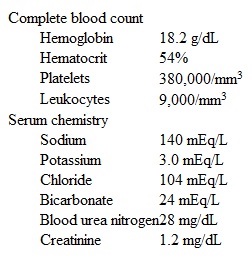 What is the best next step in management?
 (Multiple Choice)
4.8/5 (82)
(82) A study was conducted to assess the relationship between the use of an over-the-counter pain reliever during pregnancy and the development of a neural tube defect in the offspring. Mothers whose children have neural tube defects, as well as age-matched controls (mothers whose children do not have such abnormalities), were interviewed using a standard questionnaire. The study showed that the use of the pain reliever during pregnancy increases the odds of a neural tube defect, even after adjusting for race, other medication use, comorbidities, family history of congenital abnormalities, and serum folate levels. The odds ratio is 1.5 (p = 0.03). Which of the following should be the major concern when interpreting the results of this study?
(Multiple Choice)
4.8/5 (73)
(73) A 32-year-old business executive comes to the psychiatrist for treatment of depression. He has a 4-month history of increasing sadness, sleep disturbance, low energy and motivation, and impaired concentration, and states that he is on the verge of losing his job. He responds well to antidepressant medication and continues on the medication for a year without complication; the last chart entry documents that his depression is in remission. Three months later, the patient phones the psychiatrist to inform her that he is doing well, has decided to discontinue the medication, and no longer feels the need for follow-up. A year later, the patient, who is single, meets the psychiatrist at a local gathering and invites her for a dinner date. The psychiatrist is likewise single and interested in dating. Which of the following is the most appropriate course of action?
(Multiple Choice)
5.0/5 (76)
(76) A 32-year-old woman is hospitalized with left leg pain and swelling two weeks after an uneventful vaginal delivery of a healthy baby girl. She is diagnosed with a left lower extremity deep venous thrombosis and is started on intravenous heparin. On the second day of her hospitalization, she develops left-sided weakness and a facial droop. A non-contrast CT scan of the head reveals no intracranial bleeding but suggests an ischemic infarction in the territory of the right middle cerebral artery. Which of the following is most likely to reveal the cause of this patient's symptoms?
(Multiple Choice)
4.9/5 (83)
(83) An 81-year-old woman is brought to the emergency department by her nephew. The patient says that she fell on an outstretched arm while trying to get to the bathroom. The patient's medical history includes systemic lupus erythematosus, chronic kidney disease, and remitted breast cancer. The patient's medications include hydroxychloroquine and prednisone. She lives with her nephew, who is her primary caregiver. Physical examination reveals a thin and disheveled woman with bruising over her left bicep. Lung fields are clear and she has normal S1 and S2. The abdomen is soft and nontender. X-ray reveals a mid-shaft spiral fracture of her left humerus. Which of the following is the most likely cause of the patient's condition?
(Multiple Choice)
4.7/5 (68)
(68) Several tests have been developed to measure the serologic markers of breast cancer. These tests have different specificities and sensitivities for the early stage of breast cancer. If positive, which of the following tests will have the highest positive predictive value for the disease, assuming a prevalence of 10%?
(Multiple Choice)
4.8/5 (79)
(79) A 53-year-old Caucasian man comes to the office for intermittent generalized headaches 8 months after deceased donor kidney transplantation. The patient's post-transplantation course was complicated by an episode of acute rejection at 2 months that was treated effectively with high-dose corticosteroids. He has diabetes mellitus and hypertension. His medications include insulin, atenolol, cyclosporine, mycophenolate mofetil, and vitamin D. No changes were made to his medications recently and his immunosuppressants are at therapeutic levels. The kidney donor had no personal or family history of hypertension. The patient's temperature is 36.1 C (97 F), blood pressure is 180/110 mm Hg, and heart rate is 90/min. Examination shows no abnormalities. His serum laboratory values are: 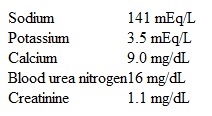 The patient is started on sodium restriction, amlodipine, and enalapril to control the hypertension. One week later, he returns with a blood pressure of 138/86 mm Hg. His serum creatinine level is 2.4 mg/dL. Which of the following is the most likely underlying cause of this patient's hypertension?
 (Multiple Choice)
4.8/5 (87)
(87) A 28-year-old man comes to the emergency department with palpitations. For the past 6 months, he has had palpitations that were intermittent and short-lived but seem persistent today. Past medical history is unremarkable. His BMI is 24 kg/m2. Cardiac auscultation reveals a II/VI mid-systolic murmur at the left upper sternal border. Electrocardiogram (ECG) shows atrial fibrillation with rapid ventricular response. Echocardiogram shows normal left ventricular size and function and right atrial and ventricular dilation. Which of the following is the most likely diagnosis?
(Multiple Choice)
4.9/5 (87)
(87) A randomized controlled trial investigated the effect of body awareness therapy (BAT) and aerobic exercises on pain and quality of life in patients with tension-type headache. Participants were randomly assigned to 1 of 3 groups: BAT group, aerobic exercise (AE) group, and control group. Main outcomes were pain severity evaluated by a Visual Analog Scale (VAS); pain-related disability measured by the Pain Disability Index (PDI); impact of headaches measured by the Headache Impact Tests (HIT); and quality of life measured by the Short Form Health Survey (SF-36). Baseline characteristics concerning age, weight, height, BMI, VAS, and HIT were not statistically different among the groups (p > 0.05). However, there was a statistically significant difference among the groups (p < 0.05) in mean baseline PDI values. Further evaluation of baseline PDI values revealed the following: Which of the following is likely to be the most valid measure of central tendency for baseline PDI data?
(Multiple Choice)
4.9/5 (87)
(87) A 60-year-old man has experienced progressive shortness of breath over the last 6 months that is occasionally accompanied by chest pain. He was diagnosed with hypertension 10 years ago. Twenty years ago, he suffered from advanced-stage Hodgkin lymphoma that was treated with combination chemotherapy and radiation therapy. He is a lifetime nonsmoker. Blood pressure is 138/90 mm Hg and pulse is 78/min and regular. Physical examination shows a 2/4 early diastolic murmur at the left sternal border. Echocardiogram shows an enlarged left atrium, a normal-size left ventricle with an ejection fraction of 60%, and moderate diastolic dysfunction. Both the mitral and aortic valves appear sclerotic and calcified. The aortic root is normal-size but is echo bright. There is moderate aortic regurgitation. Cardiac catheterization shows ostial narrowing of the right and left main coronary arteries. Which of the following is the most likely diagnosis?
(Multiple Choice)
4.9/5 (81)
(81) A 63-year-old man comes to the emergency department due to chest pain that occurred 2 hours ago when he was shopping for groceries. The patient experienced left-sided chest discomfort that was dull in nature and lasted 15 minutes. He had no shortness of breath, diaphoresis, palpitations, or lightheadedness. He has had no previous chest pain other than a similar episode 2 days ago when he was at home washing dishes. The pain at that time lasted 10 minutes and resolved spontaneously. The patient has hypertension and takes valsartan and amlodipine. Medical history also includes gout, peptic ulcer disease, kidney stones, and severe osteoarthritis of the right knee. He was offered knee replacement 2 years ago but refused. The patient walks with a cane. He has no known drug allergies. He is a lifetime nonsmoker. His father had a myocardial infarction at age 53 and his younger brother is healthy. The patient appears comfortable and has no complaints. Blood pressure is 147/90 mm Hg, and pulse is 82/min and regular. He has no heart murmurs or additional sounds. There are no carotid bruits. The lungs are clear on auscultation. There is no peripheral edema. ECG shows normal sinus rhythm without repolarization changes. Complete blood count and basic metabolic panel are unremarkable. Chest x-ray is normal. Two sets of cardiac troponin I drawn 4 hours apart are undetectable. Which of the following is the best next step in management of this patient?
(Multiple Choice)
4.7/5 (87)
(87) A 55-year-old man with a history of hypertension and obesity is evaluated in the recovery room for hypoxemia after undergoing a sleeve gastrectomy several hours ago. Although the endotracheal intubation was difficult, the procedure was completed without intraoperative complications. The patient was then extubated and transferred to the postanesthesia recovery unit. He was initially stable on ambient air but soon became hypoxemic. Despite the use of oxygen by nasal cannula, his condition has not improved. Other issues include gastroesophageal reflux and generalized anxiety disorder. The patient's medications include omeprazole, paroxetine, chlorthalidone, and lisinopril. He drinks 3 or 4 beers on most days but does not use tobacco or illicit drugs. His last alcoholic drink was the night prior to surgery. The patient's preoperative testing was significant only for a mildly elevated serum bicarbonate at 30 mEq/L. Temperature is 37.2 C (99 F), blood pressure is 140/80 mm Hg, pulse is 108/min, and respirations are 12/min. The patient's pulse oximetry shows 84% on room air. BMI is 39 kg/m2. Examination shows an obtunded patient who is minimally responsive to stimuli. Physical findings include 3-mm reactive pupils, moist mucous membranes, normal jugular venous pressure, coarse breath sounds over the lung fields without stridor or wheezing, and normal S1 and S2. The abdomen is soft and nontender. Examination shows no edema. Laboratory results are as follows: 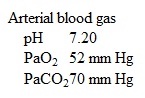 ECG shows sinus tachycardia, and chest x-ray reveals bibasilar atelectasis. Which of the following is the most likely cause of this patient's clinical deterioration?
 (Multiple Choice)
4.8/5 (79)
(79) A 3-hour-old girl is evaluated in the newborn nursery due to fussiness. The patient breastfed immediately after birth but afterward has been difficult to console. The father says, "Every time I pick her up she screams." The neonate was born at 41 weeks gestation via spontaneous vaginal delivery to a 30-year-old primigravida. The mother has type 1 diabetes mellitus, which was diagnosed at age 11 and is well controlled. She had unremarkable serologic testing in the first trimester and a negative rectovaginal culture for group B Streptococcus at 35 weeks gestation. The delivery was complicated by prolonged rupture of membranes of 21 hours. The neonate was vigorous at birth with Apgar scores of 8 and 9 at 1 and 5 minutes, respectively. She weighs 3.6 kg (7 lb 15 oz). Vital signs are within normal limits. Physical examination shows a quiet, alert girl in no distress. Auscultation of the chest is normal. Palmar grasp reflex is present and symmetric. The patient cries with passive movement of the left arm, and there is crepitus with edema over the left mid-clavicle. The presumed diagnosis is discussed with the parents. The mother says, "I can't believe this happened. I'm so worried. What is the next step?" Which of the following is the most appropriate response regarding management of this patient?
(Multiple Choice)
4.8/5 (91)
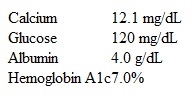
(91) A 61-year-old man comes to the office for follow-up of long-standing type 2 diabetes mellitus. Treatment currently consists of metformin, dietary modification, and regular exercise. On his current regimen, the patient's weight has been mostly stable over the last 2 years, but he has noticed some weight loss in the last 6 weeks. He also has mild constipation but no abdominal pain, nausea, or excessive urination. Medical history is significant for hyperlipidemia and hypertension, for which he takes atorvastatin, amlodipine, and valsartan. He also takes low-dose aspirin and a daily multivitamin. The patient does not drink alcohol but has a 45-pack-year smoking history. His father had type 2 diabetes mellitus and died of a stroke, and his mother had thyroid cancer that required surgery. Blood pressure is 134/80 mm Hg and pulse is 88/min. BMI is 30 kg/m2. Neck examination is normal. Lungs are clear to auscultation. Abdominal examination reveals no masses or tenderness. Laboratory results are as follows:
 Six months ago, his chemistry profile was normal.
The patient is scheduled for additional testing but is unable to return for evaluation. About 2 weeks after his visit, he is brought to the emergency department due to weakness, nausea, increased urination, and progressive constipation. Blood pressure is 90/70 mm Hg and pulse is 110/min. Mucous membranes are dry. Laboratory results show a serum parathyroid hormone level of 9 pg/mL, serum calcium of 14.1 mg/dL, and serum creatinine of 2.6 mg/dL. Which of the following is the most likely cause of this patient's hypercalcemia?
Six months ago, his chemistry profile was normal.
The patient is scheduled for additional testing but is unable to return for evaluation. About 2 weeks after his visit, he is brought to the emergency department due to weakness, nausea, increased urination, and progressive constipation. Blood pressure is 90/70 mm Hg and pulse is 110/min. Mucous membranes are dry. Laboratory results show a serum parathyroid hormone level of 9 pg/mL, serum calcium of 14.1 mg/dL, and serum creatinine of 2.6 mg/dL. Which of the following is the most likely cause of this patient's hypercalcemia? (Multiple Choice)
4.8/5 (74)
(74) The following advertisement is focused on LDL particle number (LDL-P) testing, a novel new screening method used for assessing LDL.
A 54-year-old man comes to the physician for a routine health examination. He has no complaints and feels well. He has a history of hypertension and his current medications include aspirin, hydrochlorothiazide, and lisinopril. The patient has smoked 1 pack of cigarettes a day for the past 35 years but denies alcohol or illicit drug use. He exercises twice a week and eats a low-fat diet. His father died of a myocardial infarction at age 52. His vital signs are within normal limits. Physical examination shows a BMI of 26 kg/m2 but is otherwise unremarkable. The patient is concerned about having a heart attack because of his family history. The physician considers obtaining the patient's LDL-P levels. Based on the advertisement, 95% of patients will most likely have LDL-P levels that lie between which of the following limits?
(Multiple Choice)
4.7/5 (84)
(84) A 15-month-old boy is brought to the clinic due to fatigue. His father states that the patient used to nap for 2 hours in the afternoon but for the last 2 weeks has taken a 2-hour nap in the morning as well. The child is a picky eater and drinks 960 mL (32 oz) of cow's milk each day. He takes no daily medications, and his immunizations are up to date. Physical examination reveals a tired-appearing boy. Conjunctivae are pale and anicteric. Cardiac examination reveals normal heart tones. The abdomen is soft with no hepatomegaly. Capillary refill is <2 seconds; nail beds have pallor. Hemoglobin is 8.1 g/dL, and a capillary lead level is undetectable. A presumptive diagnosis of iron deficiency anemia is made. The boy is prescribed ferrous sulfate, which he takes with orange juice between meals. His cow's milk intake is restricted to 480 mL (16 oz) per day. Which of the following changes is expected to occur first in response to treatment?
(Multiple Choice)
4.8/5 (82)
(82) A 53-year-old man comes to the emergency department due to sudden onset of nausea, vomiting, and severe epigastric pain radiating to the back. He has no constipation, diarrhea, or black stools. His medical history includes epilepsy, hypertension, and depression. The patient was recently treated for cellulitis. He does not use tobacco, alcohol, or illicit drugs. Temperature is 37.8 C (100 F), blood pressure is 130/80 mm Hg, pulse is 118/min, and respirations are 20/min. The abdomen is tender in the epigastric region. Laboratory results are as follows: 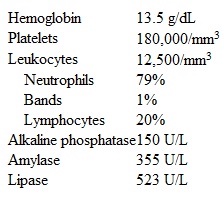 Which of the following is the most likely cause of this patient's symptoms?
 (Multiple Choice)
4.7/5 (75)
(75) 
Filters
- Essay(0)
- Multiple Choice(0)
- Short Answer(0)
- True False(0)
- Matching(0)