



 Chat with AI
Exam 2: Foundations of Independent Practice

Exam 1: Advanced Clinical Medicine1 k+ Questions
Exam 2: Foundations of Independent Practice597 Questions
Select questions type


An 8-year-old boy is brought to the emergency department after 3 days of vomiting, diarrhea, and high fevers. He has had no changes in weight, urine output, or oral intake. The patient has mild persistent asthma for which he takes inhaled fluticasone twice daily and inhaled albuterol as needed. His family history includes a maternal grandmother with type 2 diabetes mellitus. Temperature is 39.4 C (103 F), blood pressure is 70/30 mm Hg, pulse is 176/min, and respirations are 34/min. BMI is 20 kg/m2. Examination shows a sleepy-appearing child with dry mucous membranes, prolonged capillary refill, hyperactive bowel sounds, and soft and nontender abdomen. Initial laboratory results are as follows: 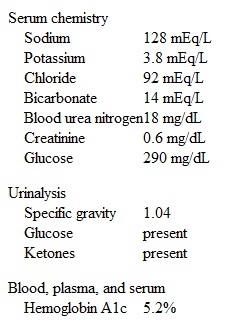 Which of the following is the most likely explanation for this patient's hyperglycemia?
 (Multiple Choice)
4.9/5  (81)
(81) A 34-year-old previously healthy man was admitted to the intensive care unit after a motor vehicle collision 3 days ago in which he was the unrestrained driver. The patient sustained traumatic brain injury and blunt chest trauma, which are being managed nonoperatively. He has had episodes of hypotension, which improved after fluid resuscitation and packed red blood cell transfusion. He is mechanically ventilated and is receiving enteral feeding via the nasogastric tube. Today, the patient is noted to have black liquid stool that is heme-positive. He has had no fever or high gastric residuals. The abdomen is nondistended and soft with normal bowel sounds. Laboratory results are as follows: 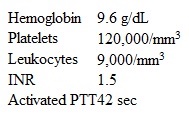 Which of the following would have been most effective at preventing this patient's current condition?
 (Multiple Choice)
4.8/5 (73)
(73) A 66-year-old man comes to the office for evaluation of progressive shortness of breath for the past 2 months. The patient used to walk nearly a mile a day without difficulty. More recently, however, he feels "out of breath" and tires easily after walking a few blocks. The patient has gained 4 kg (8.8 lb) over a similar period. He has also had a persistent, dry cough that is worse at night when he is lying in bed. The patient has had no fever, chills, or night sweats. He has a history of hypertension. He is a former smoker who quit 5 years ago. Until 4 years ago, the patient worked as an engineer at a local steel mill. Temperature is 36.1 C (97 F), blood pressure is 154/90 mm Hg, pulse is 92/min and regular, and respirations are 20/min. Pulse oximetry is 94% on room air. BMI is 47.4 kg/m2. The lungs are clear on auscultation. S1 and S2 are normal, and the point of maximal impulse is not palpable due to the patient's body habitus. The abdomen is soft and nontender. There is 1+ pretibial edema bilaterally. Initial complete blood count and complete metabolic panel are unremarkable. B-type natriuretic peptide is 95 pg/mL (normal: 100-400). ECG shows normal sinus rhythm with evidence of left atrial enlargement. Chest x-ray is shown in the exhibit. 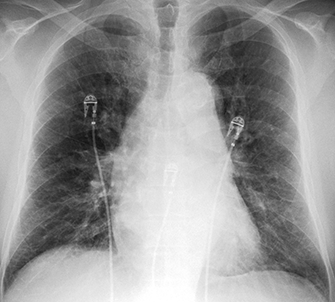 Echocardiography reveals concentric left ventricular hypertrophy, left atrial enlargement, and a left ventricular ejection fraction of 60%. Which of the following is the most likely cause of this patient's current symptoms?
 (Multiple Choice)
4.9/5 (70)
(70) A 57-year-old woman comes to the physician at the insistence of her husband; he reports that for quite some time, she has been extremely agitated when sitting, resting, or lying down at night. She has trouble falling asleep in bed, which in turn keeps him awake. The patient's discomfort occurs every night; she describes it as an "internal itch that creeps up my lower legs and is often so uncomfortable that I could cry." This strange sensation compels her to stand and pace the floor, and worsens when she feels fatigued. Her medical history is significant for well-controlled hypertension, gastroesophageal reflux disease, allergic rhinitis, and tension headaches. The patient has been on amlodipine, omeprazole, and ibuprofen for 3 years with no recent changes in dosage. She does not smoke or use illicit drugs but consumes 1-2 alcoholic drinks on weekends. There is no family history of similar problems. Physical examination is unremarkable. The appropriate study was ordered and the results are within normal limits. Which of the following medications should be prescribed at this time?
(Multiple Choice)
4.9/5 (71)
(71) A 65-year-old man was admitted to the intensive care unit after going into cardiac arrest when alone at home. Cardiopulmonary resuscitation and advanced cardiac life support were performed extensively in the field, and return of spontaneous circulation was eventually achieved. Two days later, he remains intubated and is on full ventilator support. The patient is unresponsive to verbal and tactile stimuli. His temperature is 37.2 C (99 F), blood pressure is 110/70 mm Hg, and pulse is 70/min. The treating physician discusses with the patient's family the possibility of brain death.
Which of the following is most consistent with the criteria for brain death?
(Multiple Choice)
5.0/5 (76)
(76) A 32-year-old woman comes to the emergency department for double vision that started several hours ago. Objects appear blurry, which she has never experienced before. Four weeks ago, the patient had a sore throat with enlarged, tender glands and was treated with azithromycin. She ate home-canned fish yesterday at a friend's house. The patient does not use tobacco, alcohol, or illicit drugs. Her family history is insignificant. Temperature is 36.6 C (98 F), blood pressure is 132/73 mm Hg, and heart rate is 59/min. Oral mucosa is dry. She has mild bilateral ptosis and facial muscle weakness, but no sensory loss or muscle weakness of the extremities. Pupils are dilated with sluggish reactivity to light, and mild dysarthria is seen. Which of the following is the most likely diagnosis?
(Multiple Choice)
4.9/5 (78)
(78) The drug advertisement suggests the addition of Zettiga (extended-release niacin) to low-dose simvastatin for the treatment of high-risk patients with type 2 hyperlipidemia or mixed dyslipidemia.
A 56-year-old man with exertional chest pain comes to the office because his exercise stress echocardiogram showed evidence of mild ischemia in the posterior wall. He was recently diagnosed with type 2 diabetes mellitus and hypertension. He is a current smoker but is willing to quit. His father died of a heart attack at age 51. Physical examination is unremarkable.
Laboratory results are as follows:
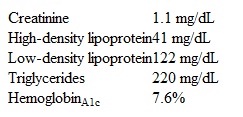 Based on the information in the drug advertisement, which of the following changes in HDL and LDL cholesterol would be expected if this patient was started on combined Zettiga and simvastatin compared to simvastatin alone?
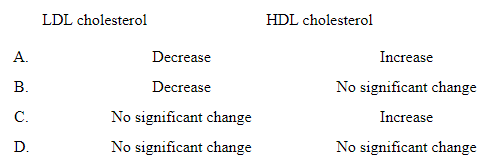
Based on the information in the drug advertisement, which of the following changes in HDL and LDL cholesterol would be expected if this patient was started on combined Zettiga and simvastatin compared to simvastatin alone?
(Multiple Choice)
4.8/5 (73)
(73) A 42-year-old man comes to the office for follow up. He was diagnosed with diabetes mellitus 5 years ago. A few months ago, he began an insulin regimen that allowed for excellent glycemic control. Recently, however, he missed his follow-up appointments despite frequent reminders from the office staff; his last clinic visit was 4 months ago. Temperature is 37.1 C (98.8 F). BMI is 29 kg/m2. Fasting blood glucose is 142 mg/dL and glycosylated hemoglobin level is 8.1%. Both tests were within normal limits previously. On further review, the patient says that he began to use the herbal preparation ginkgo biloba. He decided to use herbal remedies because "it's always better to use natural medicines." Use of this supplement is most associated with which of the following side effects?
(Multiple Choice)
4.9/5 (64)
(64) A physician is beginning a cardiology fellowship that strongly encourages research. One of the attending physicians is conducting a new clinical research trial on immunotherapy in patients with heart failure, with the goal of reducing hospitalizations and mortality. Participants will receive regular follow-up and be offered small monetary compensation for their time, but recruitment of patients admitted through the emergency department or referred from community hospitals has been slow. However, there is a large incarcerated population that also uses the hospital. The attending suggests that these patients may be a good source for recruitment of study subjects. Which of the following is the most appropriate response to the attending's suggestion?
(Multiple Choice)
4.9/5 (77)
(77) A 10-year-old boy is brought to the office by his mother after being bitten on his leg by a tick. The mother noticed a tick behind the boy's knee after a day trip to a nearby state park yesterday. The tick was not present when the mother applied sunscreen to the boy at the park earlier that morning. She was able to pull off the tick easily using household tweezers. This morning, the patient had a red rash at the site of the bite but has no other symptoms. The mother shows the small, non-engorged, brown tick wrapped in a tissue. The patient has no prior medical problems and is up to date with recommended vaccines. He has no known drug allergies. The family recently moved to Massachusetts. Vital signs are within normal limits. There is a 0.5-cm erythematous macule in the left popliteal area with no lymphadenopathy. The patient's mother is concerned that the patient may have contracted Lyme disease. Which of the following is the best response?
(Multiple Choice)
4.8/5 (82)
(82) A 52-year-old woman is hospitalized because of shortness of breath on exertion, abdominal distention, and a 25-pound weight loss in the past three months. The symptoms have been progressively getting worse over the past four weeks. Her other medical problems include chronic obstructive pulmonary disease, coronary artery disease, cholelithiasis, and hepatitis-C. She has smoked two packs of cigarettes daily for 30 years. She has drunk four to six 12-ounce beers daily for >20 years. Her mother has a history of breast cancer. Her vital signs are within normal limits. Physical examination is unremarkable except for the presence of massive ascites on abdominal examination. Diagnostic paracentesis and serum chemistries reveal: 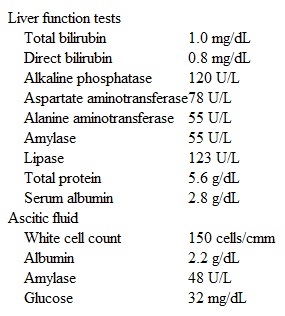 Which of the following is the most likely cause of the ascites?
 (Multiple Choice)
4.9/5 (92)
(92) Glycine (Gly) has been implicated in several neurological disorders, including malignant brain tumors. However, the precise measurement of Gly has been difficult, primarily due to the spectral overlap with myo-inositol (mI). A novel approach to measuring Gly and mI in healthy and tumorous human brains provides more reliable spectral differentiation between Gly and mI, such that alterations of Gly in brain tumors can now be evaluated more precisely. A group of researchers plans to conduct 2 parallel studies to measure and compare Gly levels among healthy and tumorous brains. Study A will use the current approach to measure Gly in the brain, whereas study B will use the novel approach. All other factors being equal, which of the following statements is most likely true concerning these 2 studies?
(Multiple Choice)
5.0/5 (74)
(74) A 78-year-old woman is brought to the emergency department by her family after they noticed her bumping into objects and talking nonsensically. Evaluation found fluent speech but with frequent word substitutions and neologisms and a visual field deficit predominantly affecting the right upper field. Brain imaging revealed an acute infarction in the territory of the inferior division of the left middle cerebral artery. The patient was admitted to the hospital for further evaluation and treatment. Her extended family is quite large and very involved in her care. Several relatives are constantly at the bedside. Family members often approach the physician and nurses to ask questions or make requests, and it is difficult for family members to restrict their time to the hospital's visitation hours. Although the patient's son is the legal surrogate decision-maker, the family prefers to arrive at all decisions by consensus. Which of the following is the most effective approach to ensuring appropriate communication with the patient's family?
(Multiple Choice)
5.0/5 (91)
(91) A 39-year-old woman comes to the office due to persistent sadness since her father died suddenly 8 months ago. She is accompanied by her husband, who says, "Of course it was a shock when it happened, but I thought she would be over his death by now." The patient says, "I feel badly. I thought I would feel better by now too, but it has been a struggle." Since her father's death, the patient has been easily distracted and her work performance has declined, forcing her to take a leave of absence. She says, "Now I have more time to spend with the kids, but I find myself wanting to stay home and be by myself. I used to enjoy reading mystery novels and playing tennis, but lately these things don't interest me and I feel tired all the time." The patient sleeps reasonably well but has gained 6.8 kg (15 lb) over the past year. She has no thoughts of suicide and no history of psychiatric illness. Physical examination and routine laboratory evaluation are noncontributory. The patient requests that her husband be present to discuss the evaluation and treatment recommendations. He says, "It has been frustrating because she seems to want to be stuck in the past, and I worry about how it is affecting our marriage and children. She has been completely uninterested in sex since her father died. I don't understand why this has been going on for so long. Why can't she snap out of it?" Which of the following is the most appropriate response to the husband's concerns?
(Multiple Choice)
4.8/5 (87)
(87) A 28-year-old man comes to the clinic due to a nonproductive cough and chest tightness for the past 3 months. The cough is most prominent in the early morning when he jogs but also occurs at night. He has had no recent nasal symptoms, fever, malaise, or weight loss. He stopped smoking 3 years ago but had smoked half a pack a day for 5 years. He lives with his wife and 2 children and exercises regularly. He works as a technician for an air conditioning-repair company in Philadelphia. Temperature is 36.7 C (98.1 F), blood pressure is 130/80 mm Hg, pulse is 84/min, and respirations are 14/min. Oxygen saturation is 97% on room air. BMI is 26 kg/m2. There is no jugular venous distension and no pharyngeal erythema or exudates. No wheezes or rhonchi are heard in either lung. During the examination, coughing was induced when the patient was asked to do a forced expiration. Cardiac examination reveals normal heart sounds. The abdomen is soft and nontender; no masses are felt. There is no peripheral edema. What is the cause of this patient's persistent cough?
(Multiple Choice)
4.9/5 (86)
(86) A 35 year-old female comes to your office complaining of a sore throat. She has two children who were recently diagnosed at a separate clinic with Streptococcal pharyngitis. Her temperature is 100.8 F (38.2 C), blood pressure is 120/74 mmHg, pulse is 72/min, and respirations are 16/min. A rapid strep test performed in your office is positive. The patient is allergic to penicillin. You are participating in a clinical trial testing the effectiveness and tolerability of a new, low dose, extended release form of azithromycin. You are aware that azithromycin has been approved by the Food and Drug Administration for several years and that the clinical trial is using the same drug but with a slightly different cap around the pill and a lower dose. Given the small changes in the drug, what is your responsibility in notifying the patient?
(Multiple Choice)
4.9/5 (87)
(87) A 49-year-old woman comes to the urgent care clinic due to flu-like symptoms. For the last 3 days, the patient has had nasal congestion, coughing, and a low-grade fever. Medical history is negative for underlying cardiopulmonary disease, but she has a history of chronic back pain due to a work-related injury 5 years ago. Her only medication is hydrocodone-acetaminophen, which she takes on a regular schedule 3 times daily. The patient does not use tobacco, alcohol, or recreational drugs. Temperature is 37.2 C (99 F); vital signs are otherwise normal. Examination shows boggy, erythematous nasal mucosae. Lung examination is normal. Moderately exaggerated lumbar lordosis is present with bilateral lumbar paraspinal tenderness. The patient ambulates with the assistance of a walker, but lower extremity motor strength, sensation, and reflexes are normal. Straight-leg raising test is negative. Bedside influenza screening is negative, and she is counseled in over-the-counter medications for her acute illness. Prior to release from the clinic, the patient reports that she has a regularly scheduled pain management follow-up appointment the next day but says, "I'm worried that I might miss my appointment because I'm sick. As long as I'm here, can you give me my hydrocodone prescription?" Which of the following is the most appropriate response to the patient's request?
(Multiple Choice)
4.8/5 (63)
(63) A 45-year-old woman comes to the office for an initial visit. She has no medical issues. The patient has a family history of colon cancer and has indicated on her information form that she would like to discuss when to get a screening colonoscopy. Her father recently died of colon cancer. The physician is running 2 hours behind schedule due to an emergency at the hospital and is feeling stressed. The office staff alerts the physician that the patient had threatened to leave if she was not seen immediately and then started pacing in the waiting room when informed she would have to wait another 10 minutes. When the physician enters the examination room, the patient exclaims loudly, "It's about time, doctor. How do you get away with running a practice like this?!" Which of the following is the most appropriate response by the physician?
(Multiple Choice)
5.0/5 (83)
(83) A 39-month-old boy is brought to the office due to fever. He has had fever spikes the past 5 days that have not improved with oral acetaminophen. He has been very cranky and his appetite has decreased. The patient has had a slightly stuffy nose but no cough, emesis, or diarrhea. He has also developed a bad diaper rash that has not improved with topical barrier ointments. The patient does not attend day care, and there are no sick contacts at home. Medical history is significant for an episode of otitis media last year and occasional upper respiratory infections, but he has had no chronic medical illnesses. Immunizations are up to date, and the patient takes no medications. Temperature is 40 C (104 F), blood pressure is 100/70 mm Hg, pulse is 120/min, and respirations are 18/min. On physical examination, the child is awake and alert but very cranky. The head is normocephalic and atraumatic. The conjunctivae are injected without discharge bilaterally, and the pupils are equal and reactive to light and accommodation. There is scant nasal congestion. The lips, tongue, and oral mucosa are erythematous, but there is no pharyngeal erythema or exudate. Neck is supple without lymphadenopathy. S1 and S2 are normal without murmurs; lungs are clear to auscultation bilaterally. Abdomen is soft, nontender, and nondistended, without organomegaly. There is nontender erythema and peeling of the skin in the perineum and inguinal folds and several erythematous, blanching macules on the trunk; there are no other skin lesions. The patient is sent home but returns to the office a day later due to worsening symptoms. His fever has persisted and he remains extremely cranky. His mother states that his rash has worsened and he now looks "swollen." Temperature is 39.4 C (103 F), blood pressure is 102/74 mm Hg, pulse is 118/min, and respirations are 18/min. On physical examination, he remains awake and alert but irritable. The lips now appear cracked. The neck is supple without lymphadenopathy. S1 and S2 are normal without murmurs, lungs are clear to auscultation bilaterally, and there is no abdominal tenderness or organomegaly. There is a diffuse erythematous, blanching, maculopapular rash on the patient's trunk, abdomen, and extremities, with increased peeling in the perianal and inguinal areas. Edema is present in the hands and feet. Peripheral pulses are present and symmetrical bilaterally; capillary refill is normal. What is the most important next step in the management of this patient?
(Multiple Choice)
4.8/5 (92)
(92) A 78-year-old Caucasian man with stage 3 chronic kidney disease and nonischemic cardiomyopathy is admitted to the hospital with pulmonary edema. A recent study used intravenous hydralazine and oral isosorbide dinitrate (ISDN) in patients with pulmonary edema. The study randomized 310 African American patients admitted with pulmonary edema into an intervention group (ISDN + hydralazine) and a usual care group. The mean left ventricular ejection fraction was 24%, and all patients had normal renal function. The study results showed the following: Which of the following study features is most limiting in applying the study intervention to this patient?
(Multiple Choice)
5.0/5 (64)
(64) 
Filters
- Essay(0)
- Multiple Choice(0)
- Short Answer(0)
- True False(0)
- Matching(0)