



 Chat with AI
Exam 2: Foundations of Independent Practice

Exam 1: Advanced Clinical Medicine1 k+ Questions
Exam 2: Foundations of Independent Practice597 Questions
Select questions type


A 57-year-old man comes to the office for a follow-up visit two weeks after an emergency department (ED) visit during which a sudden rise in his blood pressure to 190/110 mmHg was noted. He has had essential hypertension for approximately twelve years, optimally controlled by hydrochlorothiazide and amlodipine, until this past month when his blood pressure readings were consistently higher than before. He has been extremely compliant with his diet and medications. He does not have any other medical problems. He has smoked one pack of cigarettes daily for 20 years. He denies any recent use of alcohol or illicit drugs. In the office, his blood pressure is 160/94 mmHg in the right arm and 162/96 mmHg in the left arm. His BMI is 28 kg/m2. Cardiovascular examination reveals regular heart sounds and a 1/6 systolic murmur at the apex. There is a faint right-sided carotid bruit. Left-sided popliteal and posterior tibialis pulses are barely palpable. His serum creatinine level is 1.1 mg/dL. Which of the following is most helpful in establishing this patient's diagnosis?
(Multiple Choice)
4.7/5  (67)
(67) A 52-year-old man comes to the office accompanied by his wife to discuss the results of a routine screening colonoscopy in which several polyps were removed. He has a history of knee pain for which he takes glucosamine and chondroitin and multiple food allergies managed with dietary modifications. He does not use tobacco, alcohol, or illicit drugs. The patient adheres to a vegetarian diet and exercises regularly. Family history is not significant and he takes no medications. Physical examination is normal. His mood is good and he is looking forward to his eldest son's upcoming graduation from college. The physician informs the patient that biopsy of a polyp showed cancerous cells, and stage 1 colorectal cancer is diagnosed. Surgical resection is recommended, and the physician explains that surgery is considered curative for localized colon cancer. The patient prefers to treat his condition nonsurgically and says, "Positive energy from natural light and foods can cure me. I will be fine." He shows the physician results of his Internet research on natural fruit therapy and believes that "the fruit enzymes will eat the cancer cells." The patient's wife disagrees with his decision and is in favor of surgery. Which of the following is the most appropriate course of action?
(Multiple Choice)
4.8/5 (68)
(68) A 6-month-old girl is brought to the office in January for well-child care. The patient is formula-feeding exclusively and has not yet started solid foods. She is voiding and stooling normally, and her growth and developmental milestones are appropriate for age. Today, she is due for the third dose of diphtheria-tetanus-pertussis, inactivated polio, Haemophilus influenzae type b, pneumococcal, and hepatitis B vaccines. The patient has not received an influenza vaccine, but she has received all previous immunizations with no adverse reactions. Her mother states, "I have several concerns about vaccinations. Is it safe to give my daughter shots if she had fever last week? The fever lasted only a day, but she is still coughing and congested. I also read that the flu shot contains egg, and I'm worried about an allergic reaction because my husband is allergic to eggs, and I don't know how my daughter will react. Finally, I just found out that I'm pregnant, and I am afraid of exposure to germs from the vaccines." Temperature is 36.7 C (98 F), pulse is 118/min, and respirations are 28/min. Physical examination shows nasal congestion, clear rhinorrhea, and clear postnasal drip. The lungs are clear to auscultation and the rest of the examination is normal. Which of the following is the most appropriate recommendation for this patient?
(Multiple Choice)
4.9/5 (67)
(67) Several tests have been developed to measure the serologic markers of breast cancer. These tests have different specificities and sensitivities for the early stage of breast cancer. Which of the following tests could be the best screening test for the early detection of breast carcinoma if applied to a population with a stable incidence of the disease?
(Multiple Choice)
4.9/5 (92)
(92) A 22-year-old man comes to the office due to an intermittent cough for the past 6 months. He experiences slight wheezing and difficulty breathing, especially in the nighttime and early morning. The patient has no recent history of fever, chills, rigors, sputum production, or upper respiratory tract infections. During a basketball game last week, he had an episode of wheezing for which he went to the emergency department; after 2 nebulizer treatments, the wheezing resolved. He has been otherwise healthy and takes no medications. The patient does not use tobacco, alcohol, or illicit drugs. He has lived in the same house for several years and has no pets. There is no family history of lung disease. Vital signs are within normal limits. Lung examination reveals normal tactile fremitus and percussion on both sides. There are no crackles, wheezing, or other adventitious sounds heard on lung auscultation. Cardiac examination reveals regular heart sounds with no murmurs. The posteroanterior and lateral chest radiographs reveal no abnormalities. What will be the most likely finding on pulmonary function tests?
(Multiple Choice)
4.7/5 (97)
(97) A 34-year-old woman comes to the emergency department due to a 12-hour history of sudden-onset, upper abdominal pain. She describes the pain as intense, constant, and radiating to the back. The pain is relieved by leaning forward and worsens with eating. The patient also reports nausea and has vomited several times. She has no previous episodes of abdominal pain, fever, chills, weight loss, fatigue, or night sweats. The patient has no known medical conditions and takes no prescription or over-the-counter medications. She does not use alcohol, tobacco, or illicit drugs. Her last menstrual period was 2 weeks ago and was normal. The patient is sexually active with a male partner and uses condoms. Temperature is 36.7 C (98.1 F), blood pressure is 134/72 mm Hg, pulse is 72/min, and respirations are 14/min. BMI is 24 kg/m2. Physical examination shows moist mucous membranes and anicteric sclera. Lung fields are clear, and S1 and S2 are normal. The abdomen is soft and tender in the upper abdomen but without rebound, involuntary guarding, or rigidity. Bowel sounds are normal. Neither hepatomegaly nor splenomegaly is present. Bimanual examination reveals no adnexal masses or tenderness. Neurologic examination is within normal limits.
The patient is diagnosed with hypertriglyceridemia-induced acute pancreatitis, and intravenous insulin is started. Although the triglyceride levels improve in response to therapy, her abdominal pain remains unchanged by day 8 of hospitalization. The patient tolerates minimal nutritional intake despite the use of a nasogastric tube. Temperature is 38.6 C (101.5 F), blood pressure is 90/50 mm Hg, pulse is 107/min, and respirations are 22/min. Oxygen saturation is 98% on room air. Physical examination reveals tenderness in the upper abdomen to deep palpation without involuntary guarding, rebound, or rigidity. Repeat laboratory analysis reveals leukocytosis with a left shift, whereas hemoglobin and liver function tests remain unchanged. Which of the following would be the best next step in management of this patient?
(Multiple Choice)
4.8/5 (67)
(67) A 2-year-old boy is brought to the clinic by his parents due to worsening right ear pain. His mother states, "He started tugging at his ear 3 days ago and had a fever, but I could not take time off from work to bring him in." This morning, the pain increased, and his father notes that "his ear seems more prominent, like it's sticking out from his head." The patient has been less active than normal but has had no vomiting, diarrhea, or rash. He had an episode of acute otitis media 2 months ago that resolved with oral antibiotics. Immunizations are up to date, and he takes no daily medications. Temperature is 40 C (104 F), blood pressure is 100/40 mm Hg, pulse is 132/min, and respirations are 30/min. Examination shows a tired, irritable boy who screams with any attempt to examine his ear. Swelling, erythema, and tenderness to palpation are noted posterior to the right ear. Otoscopy reveals an erythematous and bulging tympanic membrane with loss of normal landmarks and light reflex.
Involvement of which of the following structures is most likely responsible for this patient's presentation?
(Multiple Choice)
4.7/5 (88)
(88) A 39-year-old African-American woman comes to see you in the office with complaints of left shoulder pain for the past two months. She describes the pain as a dull constant ache which gets worse whenever she reaches over her head with her left arm. She denies any recent or remote history of trauma or falls. There is no weakness or loss in the range of motion of the shoulder joint. You do a thorough musculoskeletal examination of both her shoulder joints, and conclude that she is suffering from rotator cuff tendonitis. Which of the following pain patterns will most likely support your clinical diagnosis of rotator cuff tendonitis?
(Multiple Choice)
5.0/5 (78)
(78) A 39-month-old boy is brought to the office due to fever. He has had fever spikes the past 5 days that have not improved with oral acetaminophen. He has been very cranky and his appetite has decreased. The patient has had a slightly stuffy nose but no cough, emesis, or diarrhea. He has also developed a bad diaper rash that has not improved with topical barrier ointments. The patient does not attend day care, and there are no sick contacts at home. Medical history is significant for an episode of otitis media last year and occasional upper respiratory infections, but he has had no chronic medical illnesses. Immunizations are up to date, and the patient takes no medications. Temperature is 40 C (104 F), blood pressure is 100/70 mm Hg, pulse is 120/min, and respirations are 18/min. On physical examination, the child is awake and alert but very cranky. The head is normocephalic and atraumatic. The conjunctivae are injected without discharge bilaterally, and the pupils are equal and reactive to light and accommodation. There is scant nasal congestion. The lips, tongue, and oral mucosa are erythematous, but there is no pharyngeal erythema or exudate. Neck is supple without lymphadenopathy. S1 and S2 are normal without murmurs; lungs are clear to auscultation bilaterally. Abdomen is soft, nontender, and nondistended, without organomegaly. There is nontender erythema and peeling of the skin in the perineum and inguinal folds and several erythematous, blanching macules on the trunk; there are no other skin lesions. The appropriate study is performed and demonstrates no abnormalities. After treatment is initiated, the patient improves and remains afebrile for 48 hours. He is awake, alert, and active without crankiness. Physical examination demonstrates superficial desquamation of his rash and no other abnormality. Preparations are made for discharge with appropriate follow-up. The patient's mother has concerns about his long-term prognosis. Which of the following is the most appropriate response to her question?
(Multiple Choice)
4.9/5 (73)
(73) A 62-year-old Caucasian male complains of occasional episodes of double vision over the last two months. He also has intermittent difficulty swallowing. The symptoms typically occur at the end of the day and go away after a short nap. He denies any headaches, nausea, vomiting, imbalance, or falls. Past medical history is significant for hypertension, hyperlipidemia, type 2 diabetes mellitus, and mild intermittent asthma. He also had a transient ischemic attack five years ago and underwent a left carotid endarterectomy. Current medications include metformin, glipizide, lisinopril, atorvastatin, hydrochlorothiazide, and aspirin. He also uses an albuterol inhaler as needed for wheezing and shortness of breath. He is a current smoker with a 35 pack-year smoking history. His blood pressure is 134/78 mmHg and heart rate is 86/min. On examination, there is mild left ptosis. Which of the following is the most likely cause of this patient's complaints?
(Multiple Choice)
4.8/5 (64)
(64) A 24-year-old man is brought to the emergency department by police after breaking into the house of a famous singer. The singer was not home at the time, and the patient was found taking a bubble bath when police arrived. During the psychiatric evaluation, he speaks rapidly and says loudly, "I didn't realize that it was a crime to take a bath! I'm famous, you know!" The patient has not slept for days and says he has heard the singer's voice telling him that he will be "a star." He has no medical symptoms or illnesses. He has a 5-pack-year smoking history but does not use alcohol or illicit drugs. The patient takes no prescription medications. Physical examination shows no abnormalities. Laboratory results and vital signs are within normal limits, and toxicology screen is negative. The patient's mother arrives and reports that her son was fine until 4 years ago when he went into a deep depression after breaking up with his college girlfriend. During that time, he became convinced that the campus police was following him and he heard voices telling him that he was a loser. His mother says he has not been the same since. The patient was unable to return to college and has since been hospitalized at least 5 times for mood and psychotic symptoms. His mother says, "Even when he is out of the hospital and his mood is completely stable, he continues to hear multiple voices." Which of the following is the most likely diagnosis?
(Multiple Choice)
4.9/5 (84)
(84) A 78-year-old man comes to the emergency department due to palpitations, dizziness, and shortness of breath. He has had intermittent palpitations over the past 3-4 weeks, with constant symptoms for the last 2 days. In addition, the patient has had dyspnea with mild exertion and feels fatigued "all the time." He has also experienced unexpected weight loss over the last few months, but has had no neck pain, fever, nausea, abdominal pain, chest pain, motor weakness, or loss of consciousness. Medical history is significant for hypertension, which has been treated with valsartan and hydrochlorothiazide for the past 12 years. The patient also takes a fish oil capsule daily "to support my heart health," although he has had difficulty lately swallowing the large capsules. He is married and does not use tobacco or alcohol. Blood pressure is 130/80 mm Hg and pulse is 120/min and irregular. Thyroid examination shows a 3-cm nodule in the right thyroid lobe. Eye examination reveals no lid lag or proptosis. The heart has an irregular tachycardia with no murmurs. ECG shows atrial fibrillation with rapid ventricular response and nonspecific T-wave abnormalities. Laboratory results are as follows:  Thyroid ultrasound reveals a 2.8-cm right-sided hyperechoic nodule. Radioactive iodine uptake is 55% at 24 hours (normal: 5%-30%), and scan shows increased uptake in the right thyroid nodule, with the rest of the gland showing reduced uptake. The patient is started on metoprolol and an oral anticoagulant and reports improvement in his palpitations. Which of the following is the most appropriate next step in management of this patient's thyroid condition?
 (Multiple Choice)
4.8/5 (97)
(97) A 41-year-old woman comes to the office due to a pruritic rash on her legs for the past 2 weeks. The rash started after she returned from a hiking trip. The patient lives with her husband, who does not have a similar rash. She has no medical conditions and takes no medications. Vital signs are normal. Skin examination findings are shown in the exhibit. 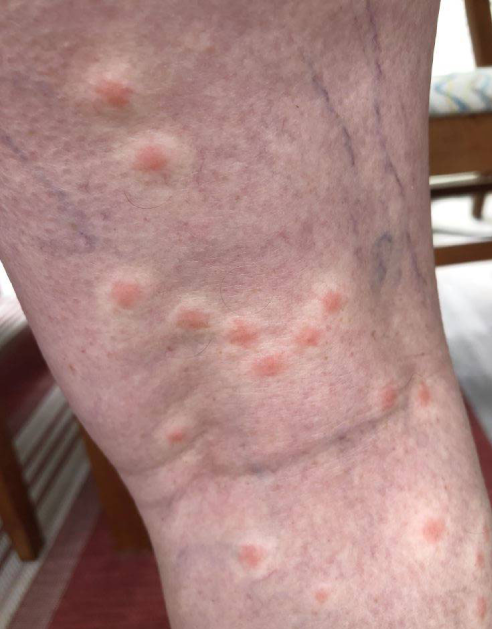 Which of the following is the most likely diagnosis of this patient's condition?
 (Multiple Choice)
4.8/5 (83)
(83) A 60-year-old male with hypertension and hypercholesterolemia comes for a follow-up visit. His blood pressure in the office is 160/100 mmHg, and his readings are consistently elevated when he checks his blood pressure at home. An antihypertensive agent is added to his current regimen. He takes a brief vacation in Florida, and calls after a few days because he has developed an erythematous rash on the exposed parts of his body. Which of the following agents is most likely responsible for his rash?
(Multiple Choice)
4.9/5 (87)
(87) The abstract applies to the next 2 items.Over the course of 5 years, a pediatric endocrinologist has seen a marked increase in the prevalence of depression among patients with obesity in her practice. She partners with a pediatric psychiatrist to devise a short screening test for depression for this specific population. The new screening test is found to be 90% sensitive and 84% specific. If this test is used on a sample of patients with obesity in which 35% are known to have depression
Based on the data, which of the following statements is most accurate concerning exposure to vinyl chloride in the cohort of 10,250 workers?
(Multiple Choice)
4.8/5 (65)
(65) A 65-year-old woman comes to the emergency department due to the sudden onset of severe periumbilical pain, nausea, and vomiting. She has no fever, diarrhea, constipation, or urinary complaints. Her last menstrual period was 14 years ago. The patient has a history of coronary artery disease, a recent acute anterior myocardial infarction, hypertension, and hyperlipidemia. She had an appendectomy at age 18. She has a 20-pack-year smoking history. The patient drinks alcohol occasionally. Her temperature is 36.7 C (98 F), blood pressure is 120/76 mm Hg, pulse is 120/min and irregular, and respirations are 16/min. The abdomen is soft, nondistended, nontender, and has normoactive bowel sounds. There is no rebound tenderness or rigidity. Pelvic examination is within normal limits. ECG shows atrial fibrillation without other abnormal findings. Laboratory results are as follows: 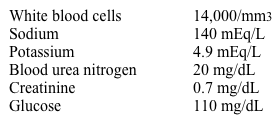 The other studies show normal serum lipase, slightly elevated serum amylase, and normal liver function tests. Urinalysis is normal. Fecal occult blood test is negative. Plain abdominal x-ray shows no abnormalities. Which of the following is the most likely diagnosis in this patient?
 (Multiple Choice)
4.9/5 (87)
(87) A 67-year-old man comes to the physician for fatigue and lower-extremity edema. Seven months ago, he underwent coronary artery bypass graft surgery and mitral valve repair. His postoperative course has been complicated by paroxysmal atrial fibrillation that is treated with amiodarone and anticoagulation. He also has diet-controlled type 2 diabetes mellitus. The patient is a former smoker with a 35-pack-year history. His blood pressure is 132/77 mm Hg and pulse is 102/min. Jugular venous pressure is estimated at 16 cm H2O. Cardiac auscultation shows a mid-diastolic murmur. Lungs are clear to auscultation. There is significant ascites and bilateral lower-extremity edema. Electrocardiogram shows sinus tachycardia. Echocardiogram shows enlarged atria, normal left ventricular wall thickness and right ventricular size, and left ventricular ejection fraction of 65%. There is mild mitral regurgitation. Chest x-ray shows normal heart size, clear lung fields, and spotty calcifications along the left heart border. Which of the following is the most likely cause of this patient's symptoms?
(Multiple Choice)
4.8/5 (84)
(84) A 58-year-old, obese, Caucasian male presents to the emergency department immediately after a motor vehicle accident in which he was a restrained passenger. His medical history is significant for diabetes mellitus type 2, hypertension, gastroesophageal reflux disease, erectile dysfunction, and gout. His current medications include metformin, rosiglitazone, lisinopril, and omeprazole. He drinks 1-2 beers daily and denies the use of tobacco or recreational drugs. His temperature is 36.9 C (98.4 F), blood pressure is 134/88 mmHg, pulse is 86/min, and respirations are 15/min. Normal S1 and S2 heart sounds are present, with no murmurs or rubs. The lung fields are clear. The abdomen is obese, nontender and nondistended; bowel sounds are present. Brown stool in the rectal vault is guaiac negative. The rectal sphincter tone is normal. There is no evidence of clubbing, cyanosis, or edema in the extremities. Dorsalis pedis and posterior tibial pulses are present and equal bilaterally. On neurologic exam, the patient is awake, alert, and oriented. Cranial nerves II-XII are intact. Motor strength is 5/5 in all extremities. Finger to nose cerebellar exam is well done. Reflexes are 1+ at the ankles and 2+ at the knees, biceps, and triceps. The cremasteric reflex is absent. Sensation is intact throughout, except for a bilateral symmetric reduction in perception of vibration, pain, and temperature in both feet and hands. Plantar flexion and dorsiflexion are normal. Ambulation is normal, and the Romberg sign is negative. What is the most likely etiology of this individual's absent cremasteric reflex?
(Multiple Choice)
4.8/5 (92)
(92) A 28-year-old Caucasian woman presents to the primary care physician complaining of a painless blistering on the backs of her hands. The blisters appeared one week ago after she spent some time gardening outdoors, and are accompanied by an increased fragility of the surrounding skin. The woman states that she has never before had such symptoms, though she suspects her mother may occasionally have had a similar presentation that eventually resolved without treatment. Past medical history is significant for chronic infection with Hepatitis C virus. Current medications include oral contraceptives, which were begun last month. Physical examination also reveals mild hyperpigmentation of the face. What is the most likely diagnosis?
(Multiple Choice)
4.8/5 (71)
(71) A 28-year-old woman comes to the office with 2 days of vaginal spotting. The patient has no fever, chills, nausea, vomiting, or cramping. Her last menstrual period was 6 weeks ago, and she had a positive home pregnancy test yesterday. The patient has no chronic medical conditions or previous surgeries. She is sexually active with a new male partner and uses condoms for contraception. The patient previously used a copper intrauterine device for contraception but had it removed due to increased pain and heavy menstrual bleeding. Recent nucleic acid amplification testing for chlamydia and gonorrhea was negative. The patient does not use tobacco, alcohol, or illicit drugs. Temperature is 37.2 C (99 F), blood pressure is 108/68 mm Hg, and pulse is 81/min. The abdomen is soft and nontender with no guarding or rebound. Pelvic examination reveals dark red blood in the posterior vaginal fornix and a closed cervix. On bimanual examination, there is mild left adnexal tenderness with fullness but no cervical motion tenderness. The uterus is small and nontender. Quantitative β-hCG is 3,700 IU/L. Transvaginal ultrasound reveals a 4.6-cm left adnexal complex mass and a thickened endometrium. Which of the following is the most likely diagnosis in this patient?
(Multiple Choice)
4.8/5 (79)
(79) 
Filters
- Essay(0)
- Multiple Choice(0)
- Short Answer(0)
- True False(0)
- Matching(0)