



 Chat with AI
Exam 2: Foundations of Independent Practice

Exam 1: Advanced Clinical Medicine1 k+ Questions
Exam 2: Foundations of Independent Practice597 Questions
Select questions type


A 62-year-old Caucasian man comes to the office with complaints of a dull, non-throbbing headache, hearing loss on the left side, and persistent tinnitus. His symptoms have been getting progressively worse for the last two weeks. He has a history of small cell cancer of the lung, which was treated with a combination of chemotherapy and radiotherapy four months ago. His lung mass has reduced considerably in size after its treatment. A contrast-enhanced magnetic resonance imaging scan shows a 1 x 2 cm circumscribed mass in the left cerebellopontine angle compressing the eighth cranial nerve. There is another small 0.5 x 1 cm mass in the left frontal lobe cortex with significant edema surrounding the lesion. Which of the following is the most likely cause of this patient's symptoms?
(Multiple Choice)
4.9/5  (79)
(79) A 70-year-old man comes to the hospital with acute-onset chest pain. He has stabbing pain and pressure that radiates down his arm and started an hour ago during a bicycle ride. The patient's medical history is significant for generalized anxiety disorder, mild dementia, hyperlipidemia, and metabolic syndrome. Initial electrocardiogram indicates no abnormalities. He is admitted to the hospital for observation, with serial troponins and telemetry monitoring. On hospital day 2, the patient's physician mistakenly orders a dose of valproate for him that was intended for another patient with a seizure disorder. The patient's nurse does not double check the order and administers the medication with the patient's other medications. Later that day, the patient tells the physician of feeling sedated and "mental fogginess" but attributes this to being awakened frequently the night before for vital signs. The patient's daughter feels certain that a good night's sleep will improve her father's symptoms. On realizing the error, the physician's next step should be which of the following?
(Multiple Choice)
4.9/5 (86)
(86) A study compares the detection of colon polyps in 50 subjects by using both CT colonography and conventional colonoscopy (gold standard). As a part of the study, 2 independent radiologists assess the CT images to diagnose polyps. Each radiologist is blinded to the other radiologist's reading. The kappa statistic for these raters is 0.73. Which of the following does the kappa statistic best describe?
(Multiple Choice)
4.9/5 (79)
(79) A 31-year-old woman, gravida 5 para 3, comes to the office to discuss contraception methods. The patient has 3 children delivered vaginally at term and 2 elective first-trimester pregnancy terminations. Her last delivery was a year ago and she does not currently use contraception. She has just finished breastfeeding. The patient is worried about unintended pregnancy and says that she has completed childbearing. She has no history of thromboembolism, migraines, or liver disease. Her regular monthly menses typically have 4-5 days of moderate bleeding. The last menstrual period was a week ago. Her last Pap test was a year ago, and all testing has been normal. The patient had acute cervicitis at age 19 with negative sexually transmitted infection screening since then. Her maternal aunt was diagnosed with breast cancer at age 54 and died from complications of pulmonary embolism. The patient does not use tobacco, alcohol, or illicit drugs. Blood pressure is 128/70 mm Hg and pulse is 70/min. BMI is 27 kg/m2. Physical examination is normal. Which of the following is the best contraception option for this patient?
(Multiple Choice)
4.9/5 (83)
(83) A large study evaluated a rapid toxin-based stool assay for diagnosing Clostridium difficile colitis. It evaluated the test against polymerase chain reaction, which served as the gold standard. The following values of the new test were obtained from a hospitalized symptomatic patient population with 50% prevalence of Clostridium difficile colitis: 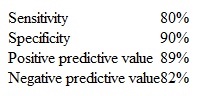 Which of the following is the positive likelihood ratio for the new test?
 (Multiple Choice)
4.8/5 (82)
(82) A large longitudinal study examined the association between obesity (defined as BMI >30 kg/m2) and risk of ischemic stroke in a cohort of patients. After assessing participant baseline characteristics, researchers followed 2,300 patients for a mean of 2.7 years and determined the incidence of major cardiovascular events. Within the entire cohort, the crude relative risk (RR) of ischemic stroke was 2.4 in obese patients as compared to nonobese patients, with a 95% confidence interval (CI) of 1.8-2.6. When the cohort patients were divided into those with diabetes mellitus and those without, among patients with diabetes, the RR of ischemic stroke was 1.1 in obese as compared to nonobese patients (CI, 0.9-1.6) whereas among patients without diabetes, the RR was 1.0 (CI, 0.7-1.5). Which of the following is the best interpretation of this study's findings?
(Multiple Choice)
4.9/5 (67)
(67) A 53-year-old man complains of acute onset of vomiting during a Caribbean cruise. He has had multiple episodes of vomiting since the morning and feels "dehydrated." The patient also reports an episode of watery diarrhea, mild headache, and muscle pains. His temperature is 38.1 C (100.6 F) and the remainder of the physical examination is unremarkable. He traveled to Mexico for business a month ago. Ten other passengers on the cruise report similar symptoms. Stool cultures are negative. Which of the following is the most likely cause of this patient's condition?
(Multiple Choice)
4.8/5 (93)
(93) An 18-year-old man comes to the emergency department due to sudden-onset left-sided weakness. The patient has a seizure disorder but reports no seizures prior to current symptom onset. Neurological examination shows left-sided hemiparesis and hemianopia. On further questioning, the patient says that several of his family members also have a history of epilepsy and stroke, as shown in the pedigree diagram below (red arrow represents the patient). 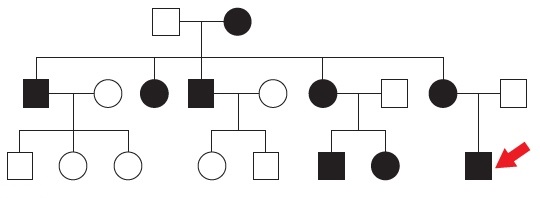 Which of the following is the most likely inheritance pattern of this patient's condition?
 (Multiple Choice)
4.8/5 (77)
(77) A 25-year-old male is brought to the emergency room after a fight in a bar. He was attacked with a knife, and in an attempt to save himself, he grabbed the knife in his right hand. On examination, a deep lacerated wound is found on the palmar surface of the right hand, extending from the index finger at the metacarpophalangeal (MCP) joint through the proximal phalanges of the middle and ring fingers to the middle phalanx of the little finger. He is unable to flex the distal phalanges of these fingers. Which of the following structures is most likely to be injured in his hand?
(Multiple Choice)
4.8/5 (58)
(58) A 34-year-old man comes to the office to establish care and receive an opioid prescription. His medical concerns include a history of disc atrophy with likely thecal sac entrapment at C2, C3, and C4 that is associated with severe shooting pain with neck extension. He also has a large skin graft on his left upper thigh from a water heater burn. The patient, a general contractor, recently moved to the area and has not yet established a relationship with a new primary care physician. He reports "my previous physician put me on high-dose oxycodone that enabled me to continue working." Physical examination reveals numbness and weakness of both arms, which the patient reports has been getting worse for some time. The physician recommends surgical consultation to discuss surgical options. The patient is reluctant to consider surgery and requests a refill of his opioid pain medication. He explains, "Without the medication, I am unable to work. My family is relying on me. I only have a 1-week supply left." Which of the following is the most appropriate course of action?
(Multiple Choice)
4.9/5 (81)
(81) A 55-year-old woman comes to the physician for a routine preventive examination. Her only symptoms are minor aches and pains in various muscles. She has been diagnosed with irritable bowel syndrome, fibromyalgia, depression, and rheumatic heart disease. Current medications include fluoxetine and ibuprofen. Temperature is 37.0 C (98.6 F), blood pressure is 128/86 mm Hg, pulse is 80/min, and respirations are 14/min. Heart auscultation shows a low-pitched, rumbling diastolic murmur preceded by an opening snap. The affected cardiac valve is best auscultated at which of the following regions?
(Multiple Choice)
4.8/5 (83)
(83) A 6-month-old boy is brought to the emergency department due to poor feeding. His mother says, "My son normally nurses every 3 hours, but for the past 24 hours, he hasn't been latching or sucking when I offer him the breast. A few days ago, his eyelids started to appear droopy, and they don't open fully today. He also was previously able to roll and sit by himself, but today he is only lying down and not doing anything." The infant normally stools 2-3 times per day but has not stooled for 7 days, despite the family giving him small amounts of prune juice. He was born at 40 weeks gestation by vaginal delivery after an uncomplicated pregnancy. Immunizations are up to date, and he takes no medications. He lives on a large rural farm with his parents and grandfather. Temperature is 36.7 C (98 F), pulse is 128/min, respirations are 30/min, and pulse oximetry is 99% on room air. Physical examination demonstrates a hypotonic infant lying with arms and legs splayed outward on the examination table. He has bilateral ptosis and poor suck. Gag reflex is intact.
Which of the following is the most likely mechanism of this patient's condition?
(Multiple Choice)
4.9/5 (73)
(73) A 43-year-old man is brought to the emergency department after suffering serious injuries during a fight at a local bar. The patient smells heavily of alcohol, slurs his words, and has difficulty standing and walking. It is unclear if he experienced a loss of consciousness. Physical examination reveals numerous contusions and lacerations on his face that will require suturing. The patient has unilateral pupil dilation in the right eye and appears sleepy. When he is told that a head CT scan is needed for further evaluation, he rouses and becomes belligerent. The patient begins to shout and curse, claiming that the staff is harassing him and that he will sue the hospital for violation of his civil rights. Which of the following is the most appropriate course of action?
(Multiple Choice)
4.8/5 (70)
(70) A 54-year-old man comes to the emergency department due to worsening epigastric and retrosternal chest pain, nausea, and vomiting. The patient started having severe nausea, retching, and forceful vomiting after eating some spicy food and consuming a small amount of alcohol with dinner several hours ago. The vomitus contained ingested food particles, but the most recent episode included a small amount of bright red blood. The pain has progressively worsened, and he now has pain while swallowing and mild shortness of breath. The patient has had dyspeptic symptoms in the past, which he self-treated with over-the-counter antacids. He does not use tobacco or illicit drugs. He appears pale, diaphoretic, and in moderate distress. Temperature is 38 C (100.4 F), blood pressure is 140/90 mm Hg, pulse is 120/min, and respirations are 24/min. Neck veins are flat. Dullness to percussion and decreased breath sounds are present over the left basal area. Abdominal examination reveals epigastric tenderness and decreased bowel sounds. Stool occult blood is positive. Upright chest x-ray reveals a small pleural effusion of the left lung, and ECG shows sinus tachycardia; the imaging results are otherwise unremarkable.
Which of the following is the most likely cause of this patient's current condition?
(Multiple Choice)
4.8/5 (79)
(79) A 6-month-old boy is brought to the emergency department due to poor feeding. His mother says, "My son normally nurses every 3 hours, but for the past 24 hours, he hasn't been latching or sucking when I offer him the breast. A few days ago, his eyelids started to appear droopy, and they don't open fully today. He also was previously able to roll and sit by himself, but today he is only lying down and not doing anything." The infant normally stools 2-3 times per day but has not stooled for 7 days, despite the family giving him small amounts of prune juice. He was born at 40 weeks gestation by vaginal delivery after an uncomplicated pregnancy. Immunizations are up to date, and he takes no medications. He lives on a large rural farm with his parents and grandfather. Temperature is 36.7 C (98 F), pulse is 128/min, respirations are 30/min, and pulse oximetry is 99% on room air. Physical examination demonstrates a hypotonic infant lying with arms and legs splayed outward on the examination table. He has bilateral ptosis and poor suck. Gag reflex is intact. The patient is admitted to the intensive care unit for close observation. On admission, his temperature is 36.8 C (98.2 F), blood pressure is 88/45 mm Hg, pulse is 135/min, respirations are 28/min, and pulse oximetry is 99% on room air. His examination is otherwise unchanged from initial evaluation. Arterial blood gas on room air is as follows:
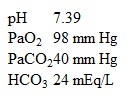 Which of the following is the most appropriate immediate step in management of this patient?
 (Multiple Choice)
4.8/5 (87)
(87) A 24-year-old man comes to the office following 1-2 days of worsening right scrotal pain. He has had no trauma, fever, chills, dysuria, or urethral discharge. The patient has no history of similar symptoms or prior medical conditions and takes no medications. He has been sexually active with a female partner over the past several months; she takes an oral contraceptive for birth control. The patient drinks 1 or 2 cans of beer daily and occasionally smokes marijuana, but he does not use tobacco or intravenous drugs. Temperature is 37.2 C (99 F), blood pressure is 120/70 mm Hg, pulse is 80/min, and respirations are 14/min. Examination of the external genitalia shows no penile ulcers or lesions. There is mild, right-sided scrotal erythema, swelling, and tenderness. Light stroking of the upper-inner thigh elicits normal cremaster muscle contraction on both sides. There are no enlarged inguinal lymph nodes. The patient inquires about the next course of action. Which of the following is the most appropriate response to this patient?
(Multiple Choice)
4.9/5 (73)
(73) A 64-year-old woman comes to the office due to insomnia, fatigue, and a 9.1-kg (20-lb) weight loss. Thorough medical and laboratory evaluations show normal results. The patient is frequently tearful and increasingly socially isolated. She no longer returns phone calls from her friends and says, "I can't be around anybody because I just burst into tears." Although previously a regular churchgoer, she has recently stopped attending because she feels hopeless and that "God has abandoned me." The patient has had thoughts of suicide but no specific plan. She has no history of suicide attempts. Her medical problems include coronary artery disease, hypertension, basal cell carcinoma, and osteoarthritis. She does not use tobacco, alcohol, or illicit drugs. There is no family history of suicide. The patient is married and lives with her husband, adult daughter, and 3 young grandchildren. She says, "Taking care of my grandchildren is truly the only thing that keeps me going anymore." A diagnosis of major depression is made, and the patient is started on an antidepressant and referred for psychotherapy. Which of the following would be considered the best protective factor against suicide in this patient?
(Multiple Choice)
4.9/5 (80)
(80) A newborn boy is being evaluated in the nursery. He was born via normal spontaneous vaginal delivery with no complications. His mother did not receive prenatal care during pregnancy, and the estimated gestational age by her last menstrual period is 39 weeks. The infant has a weight of 2.4 kg (5 lb, 3 oz, 1st percentile), length of 46 cm (18 in, 2nd percentile), and head circumference of 32 cm (12.6 in, 2nd percentile). Physical examination shows a nondysmorphic, small for gestational age infant with several nonblanching, purpuric lesions over his trunk, face, and extremities. Red reflex is absent bilaterally. Cardiac examination reveals a continuous murmur that is loudest over the left infraclavicular region, and an enlarged spleen and liver are palpated in the abdomen. The patient fails the newborn hearing test bilaterally. Head ultrasound is normal. Which of the following is the most likely diagnosis for this patient?
(Multiple Choice)
4.9/5 (82)
(82) A 63-year-old woman, gravida 3 para 3, comes to the office for urinary incontinence. The patient has been experiencing involuntary leakage of urine that occurs after a strong sensation "that I really have to go." After the sensation occurs, "I can never get to the bathroom in time." The patient reports that her symptoms started over 2 years ago. The leakage was initially occasional but now occurs 2 or 3 times a day and soaks an entire pad. The patient's symptoms occur randomly and she now avoids leaving the house. She has hypertension controlled on an ACE inhibitor. She has had no surgery. The patient's deliveries were all vaginal; her Pap tests have been normal. She drinks 8 ounces of water 3 or 4 times a day but limits water intake in the evening; on weekends she drinks a cup of caffeinated coffee with breakfast. The patient does not use tobacco, alcohol, or illicit drugs. Blood pressure is 130/80 mm Hg and pulse is 72/min. BMI is 23 kg/m2. Speculum examination shows a pale vagina without rugae. Bimanual examination reveals a small, mobile uterus and no adnexal masses. No leakage of urine occurs when the patient coughs with a full bladder. After voiding, the patient is catheterized and 30 mL of urine are drained from the bladder. Urinalysis is within normal limits.
Which of the following is the best next step in management of this patient?
(Multiple Choice)
5.0/5 (85)
(85) A 15-year-old girl comes to the office for a routine examination. Over the past few months, her parents have been in a high-conflict divorce proceeding during which she has been living with her paternal aunt. The patient was diagnosed with type 1 diabetes mellitus at age 12 and prescribed insulin therapy. She also has attention-deficit hyperactivity disorder for which she takes methylphenidate. The patient is currently a sophomore in high school and has won awards in competitive gymnastics and dance. Her BMI is 16.5 kg/m2; her weight is 9.1 kg (20 lb) less than at her last visit 6 months ago. She initially says that she has no concerns but then begins to cry, saying, "I am under so much stress. I have to look perfect to fit in with the other dancers and I can't talk to my parents about it at all. They don't even know I exist." The patient discloses that she has been avoiding insulin to lose weight and frequently doubles the dose of the methylphenidate to decrease her appetite. She has no symptoms of depression, suicidal ideation, or homicidal ideation. She says, "I promise I will stop misusing my medication. You can talk to my aunt; she is much more understanding. Just don't tell my parents. They will freak out and it will just make my life worse than it already is." Which of the following is the most appropriate course of action?
(Multiple Choice)
4.8/5 (76)
(76) 
Filters
- Essay(0)
- Multiple Choice(0)
- Short Answer(0)
- True False(0)
- Matching(0)