



 Chat with AI
Exam 2: Foundations of Independent Practice

Exam 1: Advanced Clinical Medicine1 k+ Questions
Exam 2: Foundations of Independent Practice597 Questions
Select questions type


A 45-year-old woman comes to the physician due to a 4-month history of vague abdominal pain that is unrelated to food intake. The pain occasionally occurs in the middle of the night. She has had loss of appetite during this period but no nausea, vomiting, weight loss, or blood in the stool. Three years ago, the patient had aortic valve replacement with a mechanical valve for bicuspid aortic valve and aortic root repair. Her only medication is daily warfarin. Recent laboratory results showed hemoglobin of 11.2 g/dL and an INR of 2.5. Echocardiography 4 weeks ago revealed normal left ventricular function and a normally functioning prosthetic aortic valve. She is scheduled for upper gastrointestinal endoscopy to evaluate her abdominal pain. The decision is made not to interrupt her anticoagulation. Which of the following is the best additional recommendation before this patient's procedure?
(Multiple Choice)
4.9/5  (77)
(77) A 25-year-old woman comes to the physician with 2 months of progressively increasing pain in both lower extremities. The pain is localized over both shins and is worse with ambulation. She reports a 2-kg (4.5-lb) weight loss, but no fever, night sweats, chest pain, or abdominal pain. Her past medical history is unremarkable and she is currently on no medications. Family history is significant for a mother and sister with hypothyroidism. The patient has a 5-pack-year smoking history and drinks 2 glasses of beer on weekends. She has a nutritious diet with regular intake of vegetables, meats, whole-grain foods, and dairy products. Examination shows tenderness at both shins and vitiligo over her back. Laboratory results are as follows:
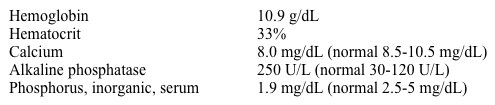 The red blood cells are hypochromic and microcytic. Basic metabolic chemistry panel is otherwise normal. The serum ferritin level is low. Plasma 25-hydroxy vitamin D level is undetectable. Which of the following blood tests is likely to indicate the diagnosis?
 (Multiple Choice)
4.8/5 (91)
(91) A 64-year-old man comes to the physician for evaluation prior to right total hip arthroplasty. He has a chronic cough with a modest amount of sputum production, which he attributes to smoking. He otherwise feels well. His chronic medical conditions include hypertension, coronary artery disease, and severe degenerative joint disease. He has an 80-pack-year smoking history and currently smokes one and a half packs of cigarettes daily. A chest x-ray taken about a week ago reveals a 2-cm pulmonary nodule in the left upper lobe. Which of the following clinical or radiographic features suggests a benign cause of the pulmonary nodule?
(Multiple Choice)
4.9/5 (80)
(80) A 5-year-old boy is brought to the physician during his summer vacation with 2 days of sore throat, fatigue, and mild headache. He complains of pain with swallowing and has not eaten much in the past day but is drinking small amounts of fluids. He has no underlying health problems and has no other complaints. He takes no medications and has no allergies. His temperature is 38 C (100.4 F). Examination shows pharyngeal erythema with vesicles on the posterior soft palate and no cervical lymphadenopathy. The cardiovascular, respiratory, and abdominal examinations are within normal limits. What is the most likely diagnosis in this patient?
(Multiple Choice)
4.7/5 (65)
(65) A 46-year-old woman comes to the office for evaluation of chronic fatigue, dizziness, itchy skin, and headache. She says, "I can barely clean the house anymore. I get so tired, and every cleaner I use makes me break out in a rash." The patient's symptoms began 3 years ago when her home was remodeled and she was exposed to various chemicals. Exposure to even small amounts of smoke or perfume significantly exacerbates her symptoms. The patient has a history of depression, tension headaches, and hypothyroidism treated with levothyroxine. She does not use tobacco, alcohol, or illicit drugs and follows an organic, vegetarian diet. She previously worked as a lawyer but has stopped due to her symptoms. During the visit, she pulls out a large folder with several Internet articles on multiple chemical sensitivity syndrome and insists that the physician read them. She says the last 2 doctors she consulted were "totally incompetent" and that "if you know anything at all about medicine, you must know that environmental challenge testing is needed to confirm my diagnosis." Which of the following is the most appropriate response to the patient's request?
(Multiple Choice)
4.9/5 (91)
(91) A 43-year-old male presents to your office with several months history of progressive fatigue and occasional palpitations. He had three episodes of acute respiratory infections over the last year; otherwise, his past medical history is insignificant. He smokes two packs of cigarettes daily and consumes alcohol occasionally. He is not taking any medications and denies drug abuse. He has been sexually active with several partners recently. The physical examination is insignificant. His laboratory values are: 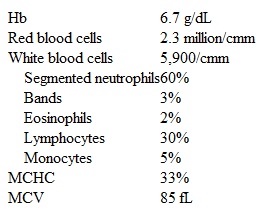 His HIV test results are negative. Which of the following is the best next step in the management of this patient?
 (Multiple Choice)
4.8/5 (70)
(70) A 72-year-old Caucasian female is brought to the emergency room because of a sudden onset of confusion and clumsiness. Her daughter tells you that she was watching television when the symptoms started. She has a past history of hypertension and atrial fibrillation. On physical examination, there is no evidence of any focal weakness of her extremities. Her speech is clear, and she is able to repeat the sentences after you. She is able to engage in an intelligent conversation, and provide her own past medical history. When you ask her to copy a picture of a matchstick, she is unable to do it. Which of the lobes of the brain is most likely affected in this patient?
(Multiple Choice)
4.9/5 (95)
(95) A 34-year-old woman comes to the office for treatment of infertility. The patient has been trying to become pregnant with her current partner for the past year but has not yet conceived. Since menarche, she has had irregular menses, occurring every 3-6 months, with 7-14 days of bleeding. The patient's last menstrual period was 2 months ago. Over the last 6 months, she has tried to lose weight with exercise and diet but has been unsuccessful. The patient has no chronic medical conditions or prior surgeries. She takes a daily prenatal vitamin and has no medication allergies. The patient does not use tobacco, alcohol, or illicit drugs. BMI is 33 kg/m2. On skin examination, there is moderate acne on the chest and back and terminal hairs on the upper lip. Pelvic examination shows a nulliparous cervix, a normal uterus, and bilateral enlarged ovaries. The remainder of the physical examination is unremarkable. Hysterosalpingography reveals a normal uterine cavity with bilateral tubal patency, and her partner's semen analysis is normal. A urine pregnancy test is negative. Which of the following is the best treatment option for this patient's infertility?
(Multiple Choice)
4.8/5 (69)
(69) A 62-year-old man with a history of dyslipidemia and type 2 diabetes mellitus comes to the emergency department due to severe substernal chest pain and diaphoresis that began 2 hours ago. His ECG shows ST- segment elevation in leads V1 to V4. He is taken to the cardiac catheterization lab and a complete occlusion of the mid-left anterior descending artery (LAD) is diagnosed. A drug-eluting stent is placed in the LAD with complete restoration of flow, and the patient is started on aspirin and clopidogrel. On the third day of hospitalization, the option of adding rivaroxaban is discussed with the patient. He asks about the benefits and risks of the added therapy. Based on the research abstract, After a pharmaceutical drug is approved by the Food and Drug Administration, phase IV or post-marketing surveillance is conducted to detect fatal and serious side effects. The failure to detect such events in earlier phases of clinical testing is most likely due to which of the following?
(Multiple Choice)
4.8/5 (76)
(76) A 38-year-old woman, gravida 3 para 3, comes to the office due to a 2-week history of dysuria and pain on deep penetration during sexual intercourse. Urine dribbling has occurred after voiding for the past few months. The patient has no fever, chills, hematuria, nocturia, or increased urinary frequency. Her medical history is notable for multiple urinary tract infections. The patient has had a bilateral tubal ligation and a laparoscopic appendectomy. Her last menstrual period was 2 weeks ago; menses are regular and last 4 days. The patient's last pregnancy was 4 years ago; all pregnancies resulted in uncomplicated term vaginal deliveries. She does not use tobacco, alcohol, or illicit drugs. The patient has no known drug allergies. Temperature is 36.7 C (98 F), blood pressure is 120/80 mm Hg, and pulse is 78/min. BMI is 23 kg/m2. The abdomen is soft and nontender, with no palpable masses or hepatosplenomegaly. There is no costovertebral angle tenderness. Pelvic examination reveals fullness at the anterior vaginal wall. The uterus is small, mobile, and nontender; there are no adnexal masses. Laboratory results are as follows:
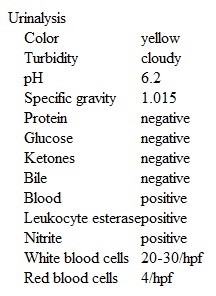 Which of the following is the best next step in diagnosing this patient's condition?
 (Multiple Choice)
4.7/5 (86)
(86) A 15-year-old girl is brought to the office for a routine examination. Her mother is concerned that "she started developing breasts a few years ago but has not yet started menstruating." The patient's breast development began at age 12. She also recently had a "growth spurt" and has grown 8 cm (3.15 in) in the last year. She reports occasional fatigue, which her mother attributes to "staying up late to talk with friends" and multiple afterschool activities. The patient takes no daily medications or supplements and has no known allergies. She is not sexually active and does not use tobacco, alcohol, or illicit drugs. She eats a balanced diet with no restrictions. Vital signs are normal. Weight and height are in the 30th and 80th percentiles, respectively, consistent with growth percentiles from previous visits. Physical examination reveals a well-appearing, cooperative patient. The neck is supple with no thyromegaly. The breasts are sexual maturity rating 4. Cardiac examination reveals a regular rate and rhythm with no murmur. The abdomen is soft and nondistended with no palpable masses. Pubic and axillary hair are absent. Which of the following is the most likely diagnosis in this patient?
(Multiple Choice)
4.9/5 (80)
(80) A 55-year-old man comes to the emergency department due to a 3-day history of abdominal cramps and diarrhea. He has had 5-7 watery stools a day, including at night. Three weeks ago, the patient was hospitalized for a perforated peptic ulcer that was complicated by peritonitis; he received antibiotics and underwent abdominal washout and distal gastrectomy. The initial postoperative course was uncomplicated. Temperature is 38.3 C (100.9 F), blood pressure is 116/74 mm Hg, and pulse is 96/min. Abdominal examination shows mild distension and diffuse tenderness. Bowel sounds are normal. The surgical wounds are clean, intact, and without discharge. Which of the following is the most likely cause of this patient's diarrhea?
(Multiple Choice)
4.8/5 (79)
(79) A 35-year-old Caucasian male with no significant past medical history presents to the emergency department complaining of severe pain in his left eye. Earlier that afternoon he was working on his boat when he dropped a heavy metal crate onto the boat's wooden deck. Immediately after he dropped the crate, he felt one or more small foreign objects enter his left eye. The eye began to water profusely and he was unable to open it sufficiently to examine the cornea. He states that he does not wear contact lenses. Physical examination of the left eye reveals edema of the upper eyelid, conjunctival hyperemia, diffuse corneal inflammation, and corneal abrasion. After a topical anesthetic was applied to the injured eye, irrigation with saline was successful in removing all debris. What organism is most commonly cultured from corneal foreign bodies?
(Multiple Choice)
4.9/5 (88)
(88) A 54-year-old woman is admitted to an outpatient surgical center for arthroplasty of the right knee. She is a former professional tennis player and has struggled with pain and stiffness in her knee for many years after multiple meniscal injuries in her early 30s. She is married to an attorney who has been very involved in her care but has frequently questioned the decision-making of her physicians. In the operating room, the surgeon performs a "time-out" procedure to confirm the details of the surgery. He announces that he will operate on the left knee, which is confirmed by the anesthesiologist. The surgical nurse double checks the patient's chart and corrects the surgeon that the operation is for the right knee, not the left. The surgeon notes this error and proceeds to perform the procedure on the correct side. Which of the following actions should be taken in response to this error?
(Multiple Choice)
4.7/5 (82)
(82) A 4-year-old boy is brought to the office by his parents due to behavioral problems. The parents recently decided to take him out of preschool after receiving numerous complaints from the staff about his hyperactive behavior (running and climbing in the classroom, interrupting the teacher) and inability to listen and follow directions. This is the second school he has attended this year. He was asked to leave the first school for similar behavior. The patient's mother says that at home, he "runs wild" and fights with his older siblings all the time. She says, "He is always bothering or interrupting his older sister and brother. Another difficulty is that we are always running late for school because I can't get him to follow through with getting dressed and eating breakfast." The father had a history of attention-deficit hyperactivity disorder as an adolescent and was treated with amphetamines. He says, "I think I never would have graduated from high school without them." The boy has no medical problems and developmental milestones are within normal range. The parents are reluctant to have their son take medication and are particularly concerned about the risk of weight loss because he is already very thin. Treatment with methylphenidate is initiated at a low dose and gradually titrated to a maximum dose over 4 weeks. The patient is seen for a follow-up visit an additional 2 months later. The mother reports mild improvement in the boy's behavior at home (less talking back and fighting with siblings) but continued difficulty following the morning routine. She is concerned that the patient's recent headaches and moodiness may be due to the medication. Teacher feedback indicates some improvement with sitting in his chair but continued talking out of turn and distractibility. There has been no improvement in his academic performance, and he is in danger of having to repeat first grade. Which of the following is the most appropriate next step in management of this patient?
(Multiple Choice)
4.7/5 (70)
(70) A healthy 75-year-old African-American man comes to the physician because of persistent lower back pain for the past six months. The pain disappears when he sits down, improves when he bends over his knees, and gets worse when he extends his back. A couple of times before, when he was walking, he had a sudden onset of intense pain radiating from his back to his thighs. His other medical problems include hypertension, gastroesophageal reflux disease and rheumatoid arthritis. He does not use tobacco, alcohol, or drugs. He lives in a house with his wife. His medications include aspirin, atenolol, lansoprazole, and naproxen. He has no known drug allergies. On physical examination, straight-leg raising to 90 degrees is negative. Hyperextension of the lumbar spine produces lumbar pain radiating to the gluteal region. His pedal pulses are palpable and full.
Which of the following is the most helpful in establishing the patient's diagnosis?
(Multiple Choice)
4.8/5 (79)
(79) An 80-year-old Caucasian man is hospitalized because of ischemic stroke. He has a history of hypertension, chronic renal failure, chronic obstructive pulmonary disease (COPD), and degenerative joint disease. He has smoked one-and-a-half packs of cigarettes daily for 50 years. He lives at home, alone, on the third floor of a five-story building. After three days in the hospital, he is ready to be discharged home, but he has been left with severe neurologic sequelae. He cannot eat, walk, or move without assistance. His nearest relative is a second-generation nephew who states that he has no time nor resources to take care of him. Where should this patient be referred?
(Multiple Choice)
4.7/5 (88)
(88) A 62-year-old man comes to the community health center due to a "flaky and itchy" scalp. He is uncertain when the symptoms began and believes his brother has a similar problem. The patient has not attempted any specific treatments but washes his hair with a mild shampoo every other day and washes his face with cold water once daily. Medical history is notable for coronary artery disease, type 2 diabetes mellitus, benign prostatic hyperplasia, and diverticulosis. The patient is a recovering alcoholic and has lived in a group home for the last 3 months. Vital signs are normal. Physical examination shows oily skin with faint erythema and scaling of the scalp, eyebrows, and ears, as shown below. During the course of the visit, the patient repeatedly scratches his head and eyebrows, but the remainder of the skin examination is normal. 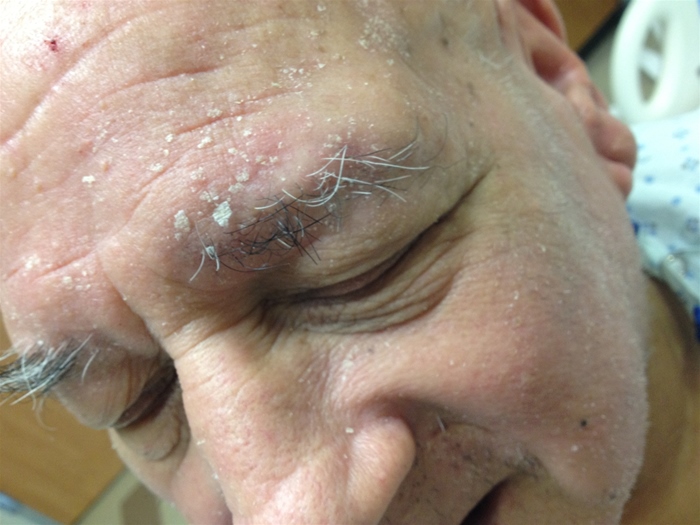 The patient returns to the clinic after 4 weeks of treatment. His rash has nearly resolved, but he is concerned because his brother developed recurrent symptoms after similar treatment. Which of the following is the most appropriate guidance for long-term management of this patient's condition?
 (Multiple Choice)
4.9/5 (73)
(73) The following advertisement is focused on LDL particle number (LDL-P) testing, a novel new screening method used for assessing LDL. The patient's fasting serum lipid profile and LDL-P levels are as follows:
Given these results combined with the patient's risk factors for cardiovascular disease, the physician discusses lifestyle modifications with the patient and decides to start him on a statin. The treatment of his lipids for the prevention of myocardial infarction is an example of which of the following?
(Multiple Choice)
4.9/5 (91)
(91) Researchers are conducting a clinical trial to assess the effect of erythropoietin on the survival of patients with end-stage renal disease receiving dialysis. Statistical analysis of the data shows that, after adjustment for age, sex, and duration of disease, patients who did not receive erythropoietin were at increased risk of mortality compared with those who did; the calculated relative risk (RR) of survival and corresponding p-value for patients treated with erythropoietin were RR = 2.4 with p = 0.005. Among patients with diabetes, erythropoietin use was associated with higher survival rates, with an RR of 6.2 and p < 0.001. Among patients without diabetes, however, the corresponding RR was 0.94 with p = 0.56. The researchers are preparing a manuscript for publication of their findings. Which of the following recommendations is most appropriate for the manuscript?
(Multiple Choice)
4.9/5 (83)
(83) 
Filters
- Essay(0)
- Multiple Choice(0)
- Short Answer(0)
- True False(0)
- Matching(0)