



 Chat with AI
Exam 2: Foundations of Independent Practice

Exam 1: Advanced Clinical Medicine1 k+ Questions
Exam 2: Foundations of Independent Practice597 Questions
Select questions type


A 60-year-old man comes to the physician for preoperative evaluation prior to right total knee replacement. He continues to smoke half a pack of cigarettes daily and has a 25-pack-year history. He reports mild shortness of breath when walking 4 blocks and up 2 flights of stairs and thinks that his dyspnea may have progressed slowly over the past 2 years. He uses a cane and admits to walking slowly due to knee pain. The patient has never been hospitalized but he gets bronchitis every winter that usually responds well to rescue albuterol. He was diagnosed with asthma and mild emphysema 4 years ago and takes tiotropium and fluticasone/salmeterol daily. His other medical problems include hypertension, degenerative joint disease, and anemia. The patient takes hydrochlorothiazide and as-needed tramadol for pain. His temperature is 36.7 C (98 F), blood pressure is 120/76 mm Hg, pulse is 80/min, and respirations are 16/min and unlabored. Oxygen saturation is 95% on room air. General physical examination (including lung examination) is unremarkable. Laboratory study results are as follows:
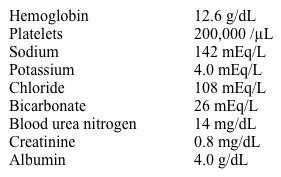 Which of the following additional studies should be performed to make an appropriate risk assessment prior to the planned surgery?
 (Multiple Choice)
4.8/5  (84)
(84) A 44-year-old Caucasian female presents to your office complaining of severe, episodic dizziness for the last year or two. During the episodes, she feels that the room is spinning and she can't walk. The episodes last for one or two hours and resolve spontaneously. She also noticed periodic decreased hearing and ringing sensation in her left ear. She has right knee osteoarthritis, and takes Tylenol and aspirin 2-3 times a day to cope with the pain. She does not smoke or consume alcohol. Her blood pressure is 130/83 mmHg and heart rate is 74/min while standing, and 128/85 mmHg and 76/min, respectively, while supine. What is the most likely diagnosis in this patient?
(Multiple Choice)
4.9/5 (83)
(83) A study is conducted to assess the role of different treatment regimens on cardiovascular outcomes. Two treatment arms are evaluated: high-dose hydrochlorothiazide (100 mg/day) and low-dose hydrochlorothiazide (25 mg/day). After a defined follow-up period, the mean systolic blood pressure (BP) in the high-dose group is 139 mm Hg, with a mean diastolic BP of 88 mm Hg. In the low-dose group, the mean values are 143 mm Hg and 92 mm Hg, respectively. A 2-sample t-test gives p-values of 0.03 for the systolic BP and 0.04 for the diastolic BP differences between the high-dose and low-dose groups. The relative risk of sudden cardiac death in the low-dose as compared to the high-dose group is 0.4 (95% confidence interval 0.25-0.55). Another subset of patients from this sample was given a placebo, and the risk of sudden cardiac death was assessed. When compared to the low-dose hydrochlorothiazide group, the placebo group's relative risk of sudden cardiac death was very close to 1.0. The mean systolic and diastolic blood pressures in the placebo group were higher when compared to the low-dose hydrochlorothiazide group. Which of the following is the best statement concerning the risk of sudden cardiac death in the overall sample of patients?
(Multiple Choice)
4.8/5 (78)
(78) A 39-year-old woman recently diagnosed with systemic lupus erythematosis comes to the office for follow-up accompanied by her husband. The husband says, "I can understand that she's been depressed about having lupus, but for the past week she seems really upset even though her pain is better. She keeps picking fights with me, gets angry, and yells at me. A few minutes later she calms down and starts bawling her eyes out." The patient states "I'm not myself" and reports that for the past week her mood has been "up and down, but mostly depressed." She is able to sleep only 5 hours each night. During the day her energy and motivation are low and she spends most of the time lying on the couch. Her appetite, which was low before, has declined further. Medications include hydroxychloroquine, ibuprofen, and multivitamins. Two weeks ago she began taking prednisone 40 mg daily due to a flare-up with worsening joint pain and fatigue. The patient does not use alcohol or illicit drugs. She has no psychiatric history. There is a family history of bipolar disorder. Temperature is 36.7 C (98 F), blood pressure is 126/80 mm Hg, pulse is 82/min, and respirations are 16/min. Physical examination is unchanged from her last visit. On mental status examination, the patient's mood is "down" and her affect is mildly reactive. Her speech is not pressured and she has no flight of ideas, hallucinations, or delusions. Laboratory results indicate no renal insufficiency or cytopenias, and there is no evidence of nephritis. Which of the following is the most appropriate next step in management of this patient?
(Multiple Choice)
4.9/5 (89)
(89) An 18-month-old boy is brought to the physician for evaluation of a burn. His mother says that he sustained the burn 45 minutes earlier while bathing and that "the water was hotter than I thought." The child has no other medical conditions and takes no medications. He has not been to this clinic before. The mother says that she did not bring him to his regular pediatrician because she wants to switch offices. The boy lives with his mother and 5-year-old sister during the weekdays and stays with his father on the weekend. The patient's weight is at the 5th percentile and his length is at the 50th percentile. The boy appears uncomfortable on examination. He has clearly demarcated areas of uniform erythema on his buttocks, lower back, and lower abdomen but not on the abdomen and groin creases or the center of the buttocks. Distinct uniform erythema is also present on his ankles and heels. There are multiple blisters but no splash marks. During the visit, the mother becomes extremely agitated, demands to know "what is taking so long", and says she has to leave because "I have to pick up my daughter from school." In addition to a detailed history and physical examination, which of the following is the most appropriate next step in the treatment of this child?
(Multiple Choice)
4.9/5 (62)
(62) A 26-year-old woman comes to the office for a health maintenance visit. The patient feels well except for increasing fatigue over the past 3 months. She has a history of hypothyroidism and has been treated with a stable dose of levothyroxine for the past several years. The patient has no other medical conditions and has had no surgeries. She does not use tobacco, alcohol, or illicit drugs, and consumes a balanced diet. The patient is sexually active with her boyfriend and recently began taking a combination oral contraceptive for birth control. Vital signs are normal. The thyroid is normal to palpation. Cardiopulmonary and abdominal examinations show no abnormality. Thyroid function studies reveal significant changes compared to testing performed 6 months ago, and the changes are attributed to the oral contraceptive. This medication most likely altered which of the following aspects of thyroid function in this patient?
(Multiple Choice)
4.8/5 (76)
(76) A 33-year-old man with no prior medical history comes to the emergency department due to abdominal discomfort that began 24 hours ago. He describes the discomfort as a dull ache in his abdomen that is accompanied by nausea and malaise. Approximately 3 weeks ago, he abruptly developed pain in his hands, ankles, and knees. This was quickly followed by a pruritic rash that initially involved only his lower abdomen but then spread to his entire trunk and extremities. He also had low-grade fevers over the same period. He has had no recent travel or insect bites but reports using intravenous heroin over the last year. Temperature is 38.3 C (100.9 F), blood pressure is 120/70 mm Hg, pulse is 92/min, and respirations are 14/min. Examination shows moist mucous membranes and poor dentition with no lesions in the oropharynx. Lung fields are clear with normal S1 and S2. The abdomen is soft and mildly tender in the right upper quadrant with a palpable liver 3 cm below the costal margin. The joints of his hands, ankles, and knees are diffusely tender to palpation but without erythema or edema. Scattered skin lesions that are raised, erythematous, and well-defined are noted over his trunk and extremities. Laboratory results are as follows: 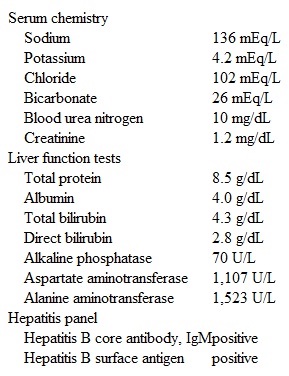 Which of the following has the most similar pathophysiological mechanism to that of this patient's current condition?
 (Multiple Choice)
4.8/5 (77)
(77) A 19-year-old woman comes to the office due to a bothersome rash on her shoulders and upper arms for the last 5 years that is associated with significant itching during cold, dry weather. The patient says, "I had eczema when I was a baby that got better when I got older. I kept thinking this would go away too, but it just gets worse." Medical history is otherwise unremarkable, and she takes no medications. Skin examination findings are shown in the exhibit.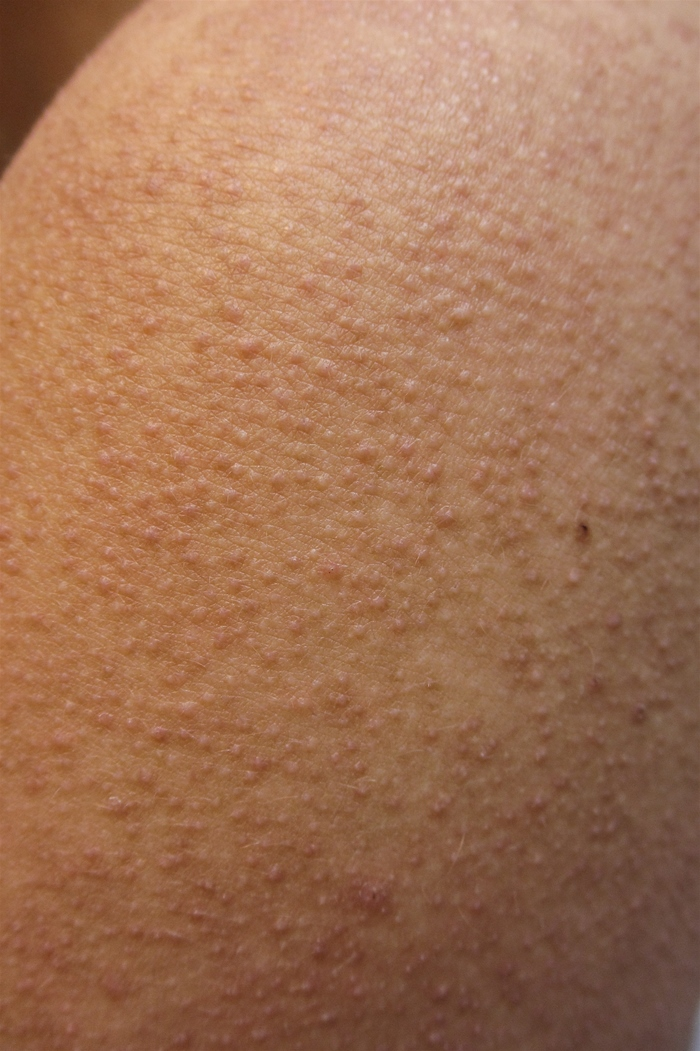 Which of the following is the most appropriate next step in management of this patient's skin condition?
 (Multiple Choice)
4.9/5 (79)
(79) A 53-year-old woman comes to the office for a routine follow-up visit. She has seen the physician for menopausal symptoms for the past 2 years and started medication for worsening hot flashes 6 months ago. She says, "I'm doing pretty well; that medication you gave me seems to have helped my hot flashes somewhat. My sleep isn't great, but it's not that different from usual. At least I'm not waking up 3 times a night anymore." Her medical problems include hypertension and chronic insomnia. Medications include enalapril and venlafaxine that was started at her last visit to target vasomotor symptoms. The patient drinks a glass of wine each day and does not use tobacco. She works as a librarian and is married to her second husband. She exercises regularly and enjoys socializing with her friends when she has the opportunity. When the physician inquires about her home life, she says her marriage is "fine" although she wishes that she and her husband had more time for each other and were more intimate. She says, "Actually, I am a little upset with my husband. He comes home from work exhausted and just wants to watch television. He doesn't understand the changes I'm going through. He doesn't seem interested in anything, including me!"
Which of the following questions would be most helpful to address the patient's concerns?
(Multiple Choice)
4.9/5 (79)
(79) A 74-year-old woman is brought to the emergency department by ambulance due to confusion. Her son reports that the patient has had chills and poor appetite for 3 days and became difficult to arouse today. She was ambulatory before this episode and does not use a walker or cane. The patient has no chronic medical conditions except for mild urinary incontinence. Temperature is 39 C (102.2 F), blood pressure is 74/33 mm Hg, pulse is 134/min, and respirations are 24/min. She is lethargic but opens her eyes with verbal stimuli. Examination reveals erythema, warmth, and swelling of the left anterior leg and foot without fluctuance and a strong dorsalis pedis pulse. The patient is given antibiotics and an intravenous fluid bolus but remains hypotensive. The physician thinks she will benefit from vasopressor therapy. The son, who is the patient's power of attorney, presents copies of her advance directive with a signed do-not-resuscitate (DNR) form. He asks the physician to respect the patient's wishes and hold off any resuscitation efforts. Which of the following is the best next step in management?
(Multiple Choice)
4.8/5 (72)
(72) Case reports indicate that exposure to manganese among miners may lead to central nervous system damage, particularly a Parkinson-like syndrome. This syndrome, thought to be associated with increased mortality, is characterized by cogwheel rigidity, neuropsychiatric and cognitive manifestations, balance and speech changes, dystonia more pronounced than that seen with Parkinson disease, and resting tremors less pronounced than those seen with Parkinson disease. A group of investigators are further investigating the association between exposure to manganese and increased mortality among miners. As part of their statistical analysis, they calculate a standardized mortality ratio of 1.75 among manganese miners compared to the general population. Which of the following statements is most applicable to this study result?
(Multiple Choice)
4.8/5 (86)
(86) A 60-year-old Caucasian man is admitted to the hospital with an episode of bacterial pneumonia. Upon review of his past medical history, you notice that he has had three recent admissions within the past seven months for bacterial pneumonia. All the episodes were successfully treated with intravenous antibiotics. Previous chest x-ray comparisons reveal that the infiltrate always occurs at the right middle lobe and leaves a persistent scar. The scar was not noted on the chest x-ray prior to the episodes of pneumonia. He has a 50-pack year history of smoking. He quit smoking 10 years ago.
Which of the following is the most likely cause of the patient's recurrent pneumonia?
(Multiple Choice)
5.0/5 (88)
(88) A 38-year-old man is brought to the emergency department due to sudden-onset shortness of breath and diaphoresis. He has no fever, chills, cough, or abdominal pain. The patient has no other medical problems and takes no medications. He had surgery for bilateral inguinal hernias at age 16. The patient does not use tobacco, alcohol, or illicit drugs. Blood pressure is 95/60 mm Hg, pulse is 116/min and regular, and respirations are 28/min. He is in marked respiratory distress. Pallor and diaphoresis are noted. His skin is velvety and has many atrophic scars. The apical impulse is hyperdynamic. Cardiac auscultation reveals a soft, early-systolic decrescendo murmur at the cardiac apex. S1 is barely audible; S2 is normal. Lung examination reveals bibasilar crackles. Jugular venous distension is present. The abdomen is soft, nontender, and nondistended. Neurologic examination shows no abnormalities. ECG shows sinus tachycardia with occasional premature ventricular complexes. Chest x-ray reveals no cardiomegaly, but bilateral alveolar infiltrates and hilar prominence are present.
Which of the following is the most likely cause of this patient's condition?
(Multiple Choice)
4.8/5 (84)
(84) A 72-year-old Caucasian man is brought to the emergency department (ED) due to a sudden onset of severe difficulty in breathing. He has chronic obstructive pulmonary disease, and is on 2 liters of oxygen at all times. While in the ED, he develops progressive hypoxic respiratory failure, and is intubated by the ED physician. His son comes to the hospital an hour later, and gets very upset. He pulls you to one side of the room and says, "Please remove the tube. He never wanted to live like this." The patient does not have any advance directives for his health care. He regains consciousness for a few seconds while you were having a discussion with his son, but he was unable to state his wishes regarding life-sustaining treatment.
Which of the following is the most appropriate next step in the management of this patient?
(Multiple Choice)
4.9/5 (75)
(75) A 30-year-old woman comes to the physician after finding a breast mass on self examination. After the appropriate workup, the physician decides to proceed with fine-needle aspiration (FNA). Cytology of the aspirate comes back negative for malignancy. However, the patient is still concerned about the possibility of breast cancer despite her negative FNA result. Which of the following test parameters would be the most helpful for determining this patient's residual risk of breast cancer?
(Multiple Choice)
4.9/5 (74)
(74) A 31-year-old man comes to the physician after experiencing a week of generalized weakness, decreased appetite, and nausea. He is an intravenous drug user enrolled in a methadone program but has relapsed due to family problems. The patient was hospitalized for aspiration pneumonia 2 years ago. He does not use alcohol or prescription or over-the-counter medications. The patient's temperature is 37.2 C (99 F), blood pressure is 114/78 mm Hg, and pulse is 88/min. Examination shows mild tenderness in the right upper quadrant. Laboratory results are as follows: 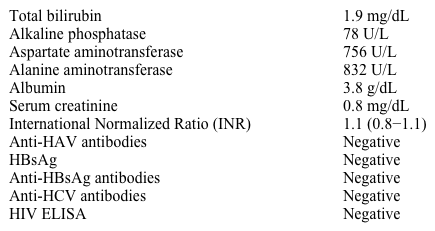 Which of the following is most likely to indicate the diagnosis in this patient?
 (Multiple Choice)
4.8/5 (85)
(85) A 27-year-old woman with no medical history comes to the office due to recent-onset chest pain. She gives a dramatic, vague, and nonspecific description of the pain, which she continues even when pressed for details. The patient is dressed in revealing clothing and mentions having seen the physician several times at a nearby grocery store. Physical examination, including vital signs, is unremarkable. Laboratory evaluation and an ECG are normal and suggest no medical etiology for chest pain. Despite reassurance that more serious causes of chest pain are highly unlikely, the patient insists on scheduling a follow-up appointment. On the day of the second appointment, she arrives as the office is closing and intercepts the physician in the parking lot. The patient reports that the chest pain has disappeared; however, she is very concerned about feeling fatigued. She says, "I frequently have insomnia, but it's been worse than usual lately and I am so tired." The patient insists on calling the physician by first name, apologizes profusely for being late, and requests an after-hours appointment. Later that day, the physician discovers that the patient has questioned an office staff member about the physician's marital status. The following week, the patient calls and invites the physician to have dinner at a nearby restaurant. Which of the following is the most appropriate response?
(Multiple Choice)
4.8/5 (92)
(92) A 39-month-old boy is brought to the office due to fever. He has had fever spikes the past 5 days that have not improved with oral acetaminophen. He has been very cranky and his appetite has decreased. The patient has had a slightly stuffy nose but no cough, emesis, or diarrhea. He has also developed a bad diaper rash that has not improved with topical barrier ointments. The patient does not attend day care, and there are no sick contacts at home. Medical history is significant for an episode of otitis media last year and occasional upper respiratory infections, but he has had no chronic medical illnesses. Immunizations are up to date, and the patient takes no medications. Temperature is 40 C (104 F), blood pressure is 100/70 mm Hg, pulse is 120/min, and respirations are 18/min. On physical examination, the child is awake and alert but very cranky. The head is normocephalic and atraumatic. The conjunctivae are injected without discharge bilaterally, and the pupils are equal and reactive to light and accommodation. There is scant nasal congestion. The lips, tongue, and oral mucosa are erythematous, but there is no pharyngeal erythema or exudate. Neck is supple without lymphadenopathy. S1 and S2 are normal without murmurs; lungs are clear to auscultation bilaterally. Abdomen is soft, nontender, and nondistended, without organomegaly. There is nontender erythema and peeling of the skin in the perineum and inguinal folds and several erythematous, blanching macules on the trunk; there are no other skin lesions. The correct diagnosis is made and the appropriate treatment is initiated. What additional assessment is required in the management of this patient?
(Multiple Choice)
4.7/5 (75)
(75) A 34-year-old woman comes to the physician for evaluation of skin lesions. For the past year, she has noticed darkening and thickening of the skin over her neck and groin areas. These areas occasionally feel itchy. Her blood pressure is 130/80 mm Hg. Skin examination findings are shown in the image below. 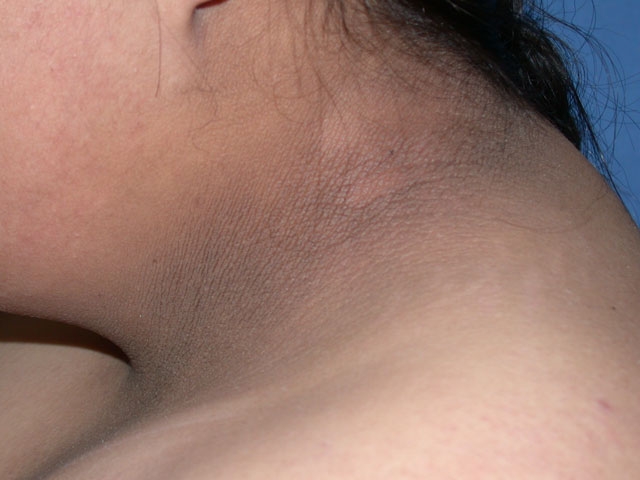 Similar hyperpigmented, velvety lesions are found on the axilla and groin. This patient's condition is most likely associated with which of the following?
 (Multiple Choice)
4.9/5 (77)
(77) A 20-year-old man comes to the office due to penile lesions, which began several months ago. The lesions have not enlarged, and the patient has had no fever, pain, discomfort, dysuria, or urethral discharge. He says, "These spots appeared after I had unprotected sex with a woman I met at a party. I am worried that I may have a sexually transmitted disease." The patient has not had sexual intercourse since then but masturbates regularly. He has no medical problems, takes no medications, and does not use tobacco, alcohol, or illicit drugs. The patient is a college student and works part time as a restaurant server. Vital signs are within normal limits. No lymphadenopathy or other skin rashes are present. External genitalia examination findings are shown below. 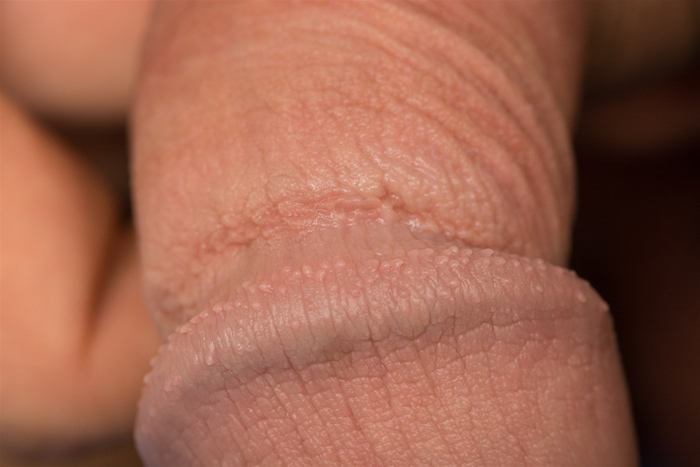 Which of the following is the most appropriate next step in management of this patient's current condition?
 (Multiple Choice)
4.9/5 (70)
(70) 
Filters
- Essay(0)
- Multiple Choice(0)
- Short Answer(0)
- True False(0)
- Matching(0)