



 Chat with AI
Exam 2: Foundations of Independent Practice

Exam 1: Advanced Clinical Medicine1 k+ Questions
Exam 2: Foundations of Independent Practice597 Questions
Select questions type


A 39-month-old boy is brought to the office due to fever. He has had fever spikes the past 5 days that have not improved with oral acetaminophen. He has been very cranky and his appetite has decreased. The patient has had a slightly stuffy nose but no cough, emesis, or diarrhea. He has also developed a bad diaper rash that has not improved with topical barrier ointments. The patient does not attend day care, and there are no sick contacts at home. Medical history is significant for an episode of otitis media last year and occasional upper respiratory infections, but he has had no chronic medical illnesses. Immunizations are up to date, and the patient takes no medications. Temperature is 40 C (104 F), blood pressure is 100/70 mm Hg, pulse is 120/min, and respirations are 18/min. On physical examination, the child is awake and alert but very cranky. The head is normocephalic and atraumatic. The conjunctivae are injected without discharge bilaterally, and the pupils are equal and reactive to light and accommodation. There is scant nasal congestion. The lips, tongue, and oral mucosa are erythematous, but there is no pharyngeal erythema or exudate. Neck is supple without lymphadenopathy. S1 and S2 are normal without murmurs; lungs are clear to auscultation bilaterally. Abdomen is soft, nontender, and nondistended, without organomegaly. There is nontender erythema and peeling of the skin in the perineum and inguinal folds and several erythematous, blanching macules on the trunk; there are no other skin lesions.
Which of the following is the most appropriate next step in the management of this patient?
(Multiple Choice)
4.8/5  (76)
(76) Following an annual review, a local hospital determines that the number of emergency response codes called on the general pediatric unit exceeds the average number for other similar-sized hospitals nationwide. Hospital leadership decides to use a clinical microsystems approach to improve this outcome measure. Which of the following interventions would be most consistent with this approach?
(Multiple Choice)
4.9/5 (88)
(88) A 14-year-old girl is brought to the office for an annual wellness examination. The patient has no medical problems. She is accompanied by her distraught mother, who expresses dismay that the patient started smoking 9 months ago. The mother says, "At first she was just experimenting, like kids do. I had hoped it was a phase that would pass, but it has gotten worse. She comes home smelling of smoke almost every day, and has a close friend who also smokes." The daughter now regularly takes cigarettes from her mother's purse to smoke with this friend at school. When seen alone by the pediatrician, the girl reports that she smokes about half a pack of cigarettes a day and buys them from other kids or takes them from her mother's purse. The patient says she knows smoking is bad for her but that, "It's not a big deal; Mom is just overreacting. I am not doing heavy drugs or anything. The other kids get drunk at parties and use marijuana and stuff, which I don't do. I'll have 1 beer at most. Mom just needs to calm down about it." On returning to the room, the mother asks what she can do to help her daughter stop smoking. Which of the following is the most appropriate response by the physician?
(Multiple Choice)
4.9/5 (71)
(71) A 63-year-old man comes to the emergency department due to sharp, stabbing pain on the right side of the face and hiccups that started 6 hours ago. The patient is right-handed and has been unable to feed himself since his symptoms started. He has a history of stable angina, hypertension, and hyperlipidemia. Medications include atenolol, simvastatin, and aspirin. Vital signs are within normal limits. The patient has horizontal and vertical nystagmus and ptosis of the right eye. Gag reflex is diminished. He reports loss of pain and temperature sensation on the right side of the face and left trunk and limbs, as well as severe dizziness when attempting to stand. Which of the following is the most likely location of this patient's brain lesion?
(Multiple Choice)
4.8/5 (94)
(94) A 26-year-old immigrant from South America comes to the emergency department with palpitations and lightheadedness. He is found to have ventricular tachycardia, which is terminated by intravenous amiodarone. Echocardiogram shows a dyskinetic and thin left ventricular apex consistent with apical aneurysm. Coronary angiogram shows no coronary artery obstruction. Which of the following is the most likely cause of this patient's condition?
(Multiple Choice)
4.9/5 (80)
(80) A 58-year-old man with a 16-year history of type 2 diabetes mellitus comes to the physician with recurrent hypoglycemic episodes. Most of the episodes occur after breakfast and dinner. He also complains of sweating during meals, occasional postural dizziness, postprandial fullness, early satiety, and constipation. He is currently on a basal-bolus insulin regimen with a bedtime dose of insulin glargine and a variable dose of short-acting insulin with meals. The patient has mild chronic renal disease (creatinine 1.6 mg/dL) that has been stable for the last 2 years, bilateral proliferative diabetic retinopathy, and distal sensory peripheral neuropathy. His pre-meal blood glucose levels are 150-250 mg/dL. Which of the following studies is most likely to confirm this patient's condition?
(Multiple Choice)
4.7/5 (80)
(80) A 20-year-old woman comes to the office for follow-up of a head injury. She plays soccer for her college, and yesterday she was treated in the emergency department after a brief episode of loss of consciousness while using her head to redirect the soccer ball. In the emergency department, the patient was unable to remember details of the game, but her neurologic examination was otherwise normal. A noncontrast CT scan of the head was also normal. Today, she reports some pain associated with a bump on the top of her head, but otherwise feels well. The patient has had no dizziness, nausea, or vomiting. Neurologic examination is normal. She would like to know if she can play in a soccer tournament in 2 days. Which of the following is the most appropriate recommendation?
(Multiple Choice)
4.9/5 (82)
(82) A 25-year-old woman, gravida 2 para 1, comes to the office at 28 weeks gestation for her initial prenatal visit. She is known to be Rh(D)-negative, and her husband is Rh(D)-positive. Her previous pregnancy was uncomplicated, with no episodes of bleeding prior to delivery. The patient's labor was complicated by a significant intrapartum abruptio placentae, although she ultimately had a vaginal delivery. She received the same standard dose of anti-D immune globulin at 28 weeks gestation and immediately postpartum. She did not require a blood transfusion and recovered with iron supplementation. Prior to this visit, the patient came to the emergency department due to cramping without bleeding, and a transvaginal ultrasound at that time was consistent with 8 weeks gestation. Today, she has no vaginal bleeding, leakage of fluid, or contractions; fetal movements are occasional. She has no chronic medical problems and no surgical history. Temperature is 36.7 C (98 F), blood pressure is 100/70 mm Hg, and pulse is 80/min. Fundal height is 30 cm. Fetal heart rate is 145/min. Routine blood work shows that anti-D antibody titers are 1:32. Which is the most likely explanation for the positive antibody results in this patient?
(Multiple Choice)
4.9/5 (82)
(82) A 27-year-old woman comes to the emergency department due to several days of aching pain in her right ankle, left wrist, and hand joints. She has also had subjective fever and malaise. The patient took acetaminophen and ibuprofen, which provided some pain relief. She takes no other medications and has no chronic medical problems. The patient smokes a pack of cigarettes daily and drinks 1 or 2 glasses of wine most days. She smokes marijuana occasionally but does not use intravenous drugs. She has been sexually active with 2 partners over the last 6 months and uses condoms inconsistently. The patient works in a retail shop in Massachusetts and has not traveled recently. She has no known allergies. Temperature is 38.1 C (100.6 F), blood pressure is 122/65 mm Hg, pulse is 95/min, and respirations are 16/min. The left hand joints are mildly swollen, and passive extension of the fingers elicits pain. There is tenderness of the left wrist and right ankle with no joint effusion. Skin examination reveals scattered pustules over the patient's distal extremities. The remainder of the physical examination shows no abnormalities.
Which of the following is most likely to yield the diagnosis?
(Multiple Choice)
4.8/5 (88)
(88) A 23-year-old woman comes to the office with worsening fever, chills, and lower abdominal pain for 3 days. The patient has been taking nonsteroidal anti-inflammatories for pain relief. She also has increasing malodorous vaginal discharge. The patient has a history of 2 episodes of pelvic inflammatory disease that required hospitalization and intravenous antibiotic treatment. She has smoked a pack of cigarettes daily for 7 years and consumes 1 or 2 beers daily. The patient has had 6 sexual partners over the last 6 months. She had an intrauterine device (IUD) placed a year ago and inconsistently uses barrier contraception. The patient has no known drug allergies. Temperature is 38.3 C (100.9 F), blood pressure is 110/70 mm Hg, pulse is 100/min, and respirations are 20/min. Weight is 60 kg (132.3 lb) and height is 157.5 cm (5 ft 2 in). Examination shows a soft, nondistended abdomen with mild rigidity and rebound tenderness in the lower abdomen; bowel sounds are present. There is no hepatosplenomegaly. No lesions are present on the vulva or vagina. Pelvic examination reveals cervical motion and bilateral adnexal tenderness as well as purulent discharge from the cervical os. The IUD strings are visible at the external cervical os. Laboratory results are as follows: 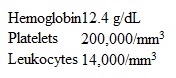 Urinalysis shows 50+/hpf of WBCs. Urine pregnancy test is negative. Nucleic acid amplification testing is positive for Neisseria gonorrhoeae. Pelvic ultrasound reveals a dilated fallopian tube filled with debris. Which of the following is the strongest risk factor for this patient's condition?
 (Multiple Choice)
4.8/5 (78)
(78) An 8-year-old boy with a history of congenital renal dysplasia is admitted to the hospital for fatigue, nausea, and anorexia over the past few days. He has been monitored since birth for renal dysfunction, which has worsened over the past few years. His glomerular filtration rate is 30 mL/min, creatinine is 5.0 mg/dL, and blood urea nitrogen is 100 mg/dL. On the second hospital day, the patient's glomerular filtration rate falls to 15 mL/min and he requires emergency dialysis. The attending physician recommends renal allograft transplantation. After consultation with the nephrologist, the mother says that they would prefer a living donor due to superior outcomes; an older son from her previous marriage has been identified as a match. The patient's half-brother comes to the hospital for a pre-transplant evaluation. He is an 18-year-old high school senior with a history of bipolar disorder treated with lithium in the past, and prior cocaine abuse with 2 years of sustained sobriety following residential substance abuse treatment. He takes no medications. The half-brother appears uninterested in the interview and frequently glances at his watch, but he perks up when discussing a new sports car that his mother has promised him following his donation procedure. He has had a difficult time in school but will be graduating on time and going to college. Which of the following represents a potential contraindication to the half-brother donating his kidney?
(Multiple Choice)
4.9/5 (66)
(66) A 77-year-old woman is brought to the office by her son due to frequent falls and confusion. The patient began to fall without clear provocation 2 years ago. Her family didn't think anything of the falls until she began having episodes of confusion a year ago. The patient's son says, "She has good and bad days. On good days she seems almost like her old self, but on bad days she appears confused and is difficult to understand." He adds that she sometimes appears to be distracted and agitated by people or things that he cannot see. The patient's medical history includes hypertension and coronary artery disease; her mother died of a stroke and her father had several heart attacks. Temperature is 37.2 C (98.9 F), blood pressure is 140/86 mm Hg, pulse is 84/min, and respirations are 16/min. Her movements and speech are slow, she has a short-stepped gait and rigidity in her upper extremities. Montreal Cognitive Assessment is 20 on a scale of 0-30 (normal: ≥26).
Which of the following is the most likely diagnosis?
(Multiple Choice)
4.8/5 (81)
(81) A 13-year-old boy is brought to the office by his mother who is concerned that he has "a round back." She says, "He will not sit up straight," and she is afraid that he will have permanent deformity. The boy has no back pain, lower extremity weakness, or difficulty with bowel and bladder control. He is physically active and plays soccer on the local team. He has had no significant trauma. The patient has no chronic health issues and takes no medications. Vital signs are normal. Physical examination shows an awake and alert adolescent with no dysmorphic features. Pubic hair and genitalia are sexual maturity rating score 3. He has a postural round back that is corrected by voluntary hyperextension. Forward bending indicates no lateral deformity and no angulation. Abdominal reflexes are symmetric. Achilles and patellar deep tendon reflexes are 2/4 with normal strength noted in both lower extremities. Gait is normal. Lateral x-rays of the spine reveal a convex alignment of the thoracic spine at 35 degrees (normal: <20 degrees). Which of the following is the most accurate statement regarding this patient's condition?
(Multiple Choice)
4.9/5 (84)
(84) A 4-year-old boy is brought to the office by his parents due to behavioral problems. The parents recently decided to take him out of preschool after receiving numerous complaints from the staff about his hyperactive behavior (running and climbing in the classroom, interrupting the teacher) and inability to listen and follow directions. This is the second school he has attended this year. He was asked to leave the first school for similar behavior. The patient's mother says that at home, he "runs wild" and fights with his older siblings all the time. She says, "He is always bothering or interrupting his older sister and brother. Another difficulty is that we are always running late for school because I can't get him to follow through with getting dressed and eating breakfast." The father had a history of attention-deficit hyperactivity disorder as an adolescent and was treated with amphetamines. He says, "I think I never would have graduated from high school without them." The boy has no medical problems and developmental milestones are within normal range. The parents are reluctant to have their son take medication and are particularly concerned about the risk of weight loss because he is already very thin. The parents participate in a program on attention-deficit hyperactivity disorder (ADHD) and see some improvement in their son's response to their directions and ability to follow household rules. However, he remains hyperactive, easily distractible, and impulsive. They return 2 years later after receiving multiple phone calls from their son's first grade teacher. The patient has difficulty sitting still for more than a few minutes and frequently disrupts the class by blurting out answers or talking to classmates instead of listening to the teacher. If his behavior does not improve, he may have to repeat first grade. The patient undergoes a comprehensive evaluation for ADHD and no comorbid psychiatric or learning disorder is identified. The parents are now receptive to starting medication. Which of the following is most important to obtain prior to starting stimulant medication?
(Multiple Choice)
4.9/5 (79)
(79) A 27-year-old male presents with progressively worsening headaches for the past three months. For the past two weeks, he has felt that he is losing his balance. He denies any motor weakness or sensory symptoms. He does not have any history suggestive of cranial nerve paralysis. On physical examination, his pupils do not react to light bilaterally. He has an impaired upward gaze and loss of optokinetic nystagmus. The rest of his eye movements are within normal limits. On tandem walking, he tends to fall on both sides. The rest of the physical examination is unremarkable. What is the most likely diagnosis of this patient?
(Multiple Choice)
4.9/5 (72)
(72) Dr. J is a colleague of yours in a large urban multi-specialty group. Dr. J recently was diagnosed with and treated for breast cancer, and since then she has been an aggressive supporter of fundraising for breast cancer research and awareness. As part of her recent efforts, Dr. J has begun asking patients during their medical appointments to support breast cancer research by sponsoring her participation in a walk-a-thon. She has also begun speaking at city council meetings about supporting breast cancer research, and has petitioned a local hospital to establish a special breast cancer screening imaging center. Which of the following statements is true?
(Multiple Choice)
4.8/5 (76)
(76) A 5-year-old boy is brought to an urgent care center due to fatigue. His mother says, "Normally, my son is running and jumping, but for the past week he has been resting on the couch and sleeping more than usual. His eyes also look a bit yellow." He has had no fevers, vomiting, or difficulty breathing. A week ago, the patient had a skin infection that resolved after treatment with oral antibiotics. Review of medical records shows a normal hemoglobin screening at his 1-year well-child visit. Family history is significant for a maternal uncle who had several similar episodes of tiredness and jaundice. Physical examination reveals a tired-appearing boy lying on the examination table watching television. His neck is supple without lymphadenopathy, and scleral icterus and mild jaundice are present. His cardiac and abdominal examinations are normal. Laboratory results are as follows: 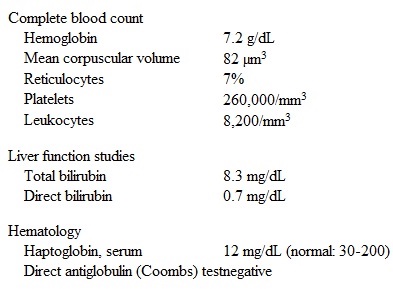 Peripheral blood smear is notable for red blood cell fragments and intracellular deposits of denatured hemoglobin. Which of the following is the next best step in the diagnostic workup for this patient?
 (Multiple Choice)
4.8/5 (74)
(74) A 15-month-old girl is brought to the office by her parents for a routine well-child visit. The girl has been teething lately, and the mother says, "Using a pacifier and giving her a bottle of milk before she sleeps have really helped soothe the teething pain. I also nurse her several times overnight since she wakes up a lot." The patient eats 3 meals daily with 2 snacks and drinks water throughout the day. Her parents brush her teeth twice daily with fluoridated toothpaste, and she had her first dental visit at age 12 months with no follow-up scheduled. The family gets drinking water from a nearby well that was recently tested and has no fluoride. The girl has no chronic health conditions and takes no medications except for a daily multivitamin with fluoride. Her growth is tracking at the 75th percentile for height, weight, and head circumference. Oral examination reveals 4 maxillary incisors and 4 mandibular incisors. There is a small area of brown discoloration on the right central incisor consistent with caries. Several other teeth have white, opaque spots along the gum line that are concerning for early tooth decay as well. Which of the following most likely contributes to this patient's dental findings?
(Multiple Choice)
5.0/5 (85)
(85) A 7-year-old girl is brought to the emergency department by her parents in August due to fever and lethargy. The patient has had intermittent fevers and a headache that has persisted for the last few days. Her headache has worsened in the last 24 hours, and she has vomited twice. She has been sleeping more than usual, and her parents brought her to the hospital after she was difficult to rouse from a nap. She has had no seizures, sore throat, or abdominal pain. The family recently returned from a week-long camping trip. Her 3-year-old sister is recovering from a recent upper respiratory tract infection. The patient has no chronic medical conditions, and her immunizations are up to date. Temperature is 38.9 C (102 F), blood pressure is 100/60 mm Hg, pulse is 118/min, and respirations are 24/min. She is currently disoriented and unable to recognize her parents. There is nuchal rigidity but cranial nerves are intact. Mucous membranes are moist and the oropharynx is clear. Cardiopulmonary examination is normal. The lower extremities have 3+ patellar reflexes and positive Babinski sign. Several excoriated insect bites are seen on the extremities. Which of the following is the most likely etiology of this patient's condition?
(Multiple Choice)
4.9/5 (72)
(72) A 32-year-old woman at 37 weeks gestation is brought to the hospital by her husband. They have recently immigrated to the United States. The patient has not received prior prenatal care but reports no problems during the pregnancy. She has been having regular uterine contractions for the past 4 hours. Examination reveals that she is in active labor. The patient agrees to be admitted for delivery. The physician explains the possible methods of delivery and the complications that can arise from each. The patient and her husband appear to understand everything that has been reviewed. They are given the opportunity to ask questions and the patient agrees to proceed. When the patient is asked to sign the consent form for treatment, she becomes reluctant and explains that women in their culture are not allowed to sign official papers. She asks that her husband sign the consent form for her treatment instead. Which of the following is the most appropriate response to this patient's request?
(Multiple Choice)
4.7/5 (81)
(81) 
Filters
- Essay(0)
- Multiple Choice(0)
- Short Answer(0)
- True False(0)
- Matching(0)