



 Chat with AI
Exam 2: Foundations of Independent Practice

Exam 1: Advanced Clinical Medicine1 k+ Questions
Exam 2: Foundations of Independent Practice597 Questions
Select questions type


A 46-year-old woman comes to the physician for a routine follow-up visit. She has a history of depression treated with fluoxetine but has had only partial improvement. She continues to struggle with mild sadness and weight gain. Her medical history is significant for obesity and hypertension. The patient has a 30-pack-year smoking history and consumes 2 alcoholic drinks daily. Examination shows no abnormalities. She gives the physician a printout of a study posted on the internet about a new herbal preparation said to be very effective for depression. According to the open-label, uncontrolled study, 15 patients took the herb for 6 weeks and 11 were full responders. No dangerous side effects were reported. The patient has purchased the product but wants to consult the physician before taking it. Which of the following is the most appropriate response to the patient's inquiry?
(Multiple Choice)
4.8/5  (73)
(73) A 27-year-old woman comes to the emergency department due to several days of aching pain in her right ankle, left wrist, and hand joints. She has also had subjective fever and malaise. The patient took acetaminophen and ibuprofen, which provided some pain relief. She takes no other medications and has no chronic medical problems. The patient smokes a pack of cigarettes daily and drinks 1 or 2 glasses of wine most days. She smokes marijuana occasionally but does not use intravenous drugs. She has been sexually active with 2 partners over the last 6 months and uses condoms inconsistently. The patient works in a retail shop in Massachusetts and has not traveled recently. She has no known allergies. Temperature is 38.1 C (100.6 F), blood pressure is 122/65 mm Hg, pulse is 95/min, and respirations are 16/min. The left hand joints are mildly swollen, and passive extension of the fingers elicits pain. There is tenderness of the left wrist and right ankle with no joint effusion. Skin examination reveals scattered pustules over the patient's distal extremities. The remainder of the physical examination shows no abnormalities. The diagnosis is established, and the patient is appropriately treated. A week later, she comes to the clinic with her partner so that he can be evaluated. He has had no dysuria, urethral discharge, fever, genital ulcers, or rash. They have not had sexual contact since her hospitalization and treatment. Her partner has no known drug allergies. Nucleic acid amplification testing of his urine is positive for Neisseria gonorrhoeae and negative for Chlamydia trachomatis. Which of the following is the most appropriate management strategy for the partner at this time?
(Multiple Choice)
4.8/5 (86)
(86) A 38-year-old woman, gravida 3 para 3, comes to the office due to a 2-week history of dysuria and pain on deep penetration during sexual intercourse. Urine dribbling has occurred after voiding for the past few months. The patient has no fever, chills, hematuria, nocturia, or increased urinary frequency. Her medical history is notable for multiple urinary tract infections. The patient has had a bilateral tubal ligation and a laparoscopic appendectomy. Her last menstrual period was 2 weeks ago; menses are regular and last 4 days. The patient's last pregnancy was 4 years ago; all pregnancies resulted in uncomplicated term vaginal deliveries. She does not use tobacco, alcohol, or illicit drugs. The patient has no known drug allergies. Temperature is 36.7 C (98 F), blood pressure is 120/80 mm Hg, and pulse is 78/min. BMI is 23 kg/m2. The abdomen is soft and nontender, with no palpable masses or hepatosplenomegaly. There is no costovertebral angle tenderness. Pelvic examination reveals fullness at the anterior vaginal wall. The uterus is small, mobile, and nontender; there are no adnexal masses. Laboratory results are as follows:
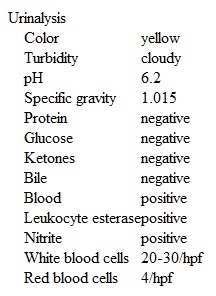 Which of the following is the most likely diagnosis for this patient?
 (Multiple Choice)
4.9/5 (81)
(81) A 46-year-old woman comes to the physician for diarrhea and occasional fecal incontinence. She has had 3-4 loose stools a day and vague rectal discomfort for the last 2 months. The patient says, "I often feel a painful urge to go but only pass a small amount of mucus." She has noticed bright red blood mixed with the stool on several occasions. The patient was treated for cervical cancer with surgery and chemoradiation a year ago. She is afebrile. On examination, there is mild tenderness in left lower quadrant but no guarding or rebound. Rectal examination shows guaiac-positive brown stool. Her stool Clostridium difficile toxin polymerase chain reaction testing is negative. Rectosigmoidoscopy shows pale rectal mucosa, several serpiginous telangiectasias, and small areas of mucosal hemorrhage. Which of the following is the most likely diagnosis?
(Multiple Choice)
4.8/5 (75)
(75) A 38-year-old woman comes to the office due to persistent cough for the past several months. The patient says that at first she was awakened occasionally at night or in the early morning by severe bouts of coughing, but lately this has occurred every 3-4 days. The cough is often accompanied by wheezing and clear sputum; she has no cough during the daytime but has had occasional hoarseness and throat irritation. She has also noticed that her symptoms are worse when she drinks wine with dinner or eats a large meal. The patient began jogging regularly a month ago in an attempt to lose weight and has not noticed any symptom exacerbation or shortness of breath with exercise. She went to the emergency department 2 months ago due to squeezing chest pain, but all workups were normal. The patient has a 2-year history of hypertension, which is well controlled with lisinopril, and also has a history of seasonal allergy. She does not use tobacco or illicit drugs and drinks alcohol socially. Temperature is 36.8 C (98.2 F), blood pressure is 120/70 mm Hg, pulse is 80/min, and respirations are 16/min. Pulse oximetry is 99% on room air. BMI is 30 kg/m2. Nasal and pharyngeal mucosae appear normal and there is no jugular venous distension. The lungs are clear to auscultation, and heart sounds are normal with no murmur. The abdomen is soft and nontender. Which of the following is most likely to improve this patient's cough?
(Multiple Choice)
4.9/5 (60)
(60) A 36-year-old woman with chronic back pain is seen in the emergency department with flank pain radiating to the groin and blood in her urine. "This pain is killing me," she says, "and it is quite different from my usual back pain." She has been taking ibuprofen and Percocet (oxycodone/acetaminophen) daily for the past 10 years. She has no fever or dysuria. Her temperature is 36.7 C (98 F), blood pressure is 152/91 mm Hg, pulse is 100/min, and respirations are 14/min. Her mucous membranes are moist and pale. She appears to be in mild distress due to pain. Examination shows right costovertebral tenderness. Laboratory results are as follows: 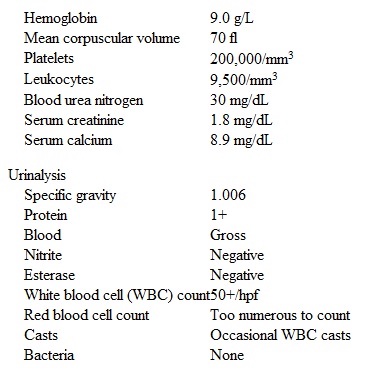 Noncontrast CT of her abdomen and pelvis reveals mild dilation of the right pelvicalyceal system, but no renal calculus is observed. Serum protein electrophoresis and urine Bence Jones proteins are negative. What is the most likely cause of her renal dysfunction?
 (Multiple Choice)
4.9/5 (78)
(78) A study assesses the length of stay in the intensive care unit after common surgical procedures. The following graph is obtained by plotting the number of admissions against length of stay (in days). 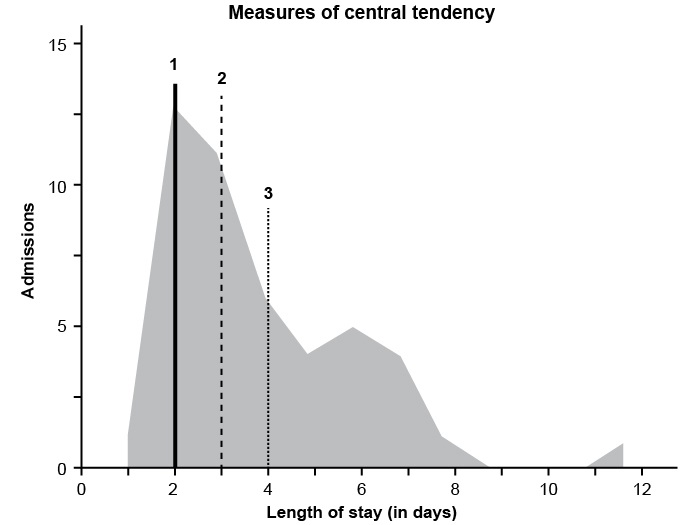 Which of the following corresponds to the measures of central tendency on the graph?
 (Multiple Choice)
4.7/5 (73)
(73) A 32-year-old woman, gravida 1 para 1, comes to the office for preconceptual counseling. A year ago, the patient's pregnancy was complicated by congestive heart failure diagnosed at 36 weeks gestation when she developed fatigue and shortness of breath. Evaluation at that time revealed a left ventricular ejection fraction of 20%. The patient subsequently underwent a preterm induction of labor and had a vaginal delivery. She was started on carvedilol and lisinopril, which she continues to take without side effects. A follow-up echocardiogram at 6 months postpartum showed an improving ejection fraction. The patient tolerates daily activities and has no chest pain, shortness of breath, syncope, or lower extremity swelling. She has no other chronic medical conditions and has had no surgeries. The patient does not use tobacco, alcohol, or illicit drugs. She is considering another pregnancy and would like an assessment of her risk. Which of the following provides the best prognostic information regarding this patient's risk during a future pregnancy?
(Multiple Choice)
4.9/5 (72)
(72) A 33-year-old woman comes to the clinic for a routine health maintenance examination. She has no lower abdominal pain, vaginal bleeding, or vaginal discharge. Her past medical history is remarkable for 1 episode of uncomplicated urinary tract infection treated with a short course of antibiotics. She is currently not taking any medications. She has had 5 sexual partners in her life and has used barrier contraception the majority of the time. Her latest sexual relationship began 3 months ago. Her last cervical cancer screening examination was a Pap smear performed at the age of 23 that showed no abnormalities. She does not use tobacco, alcohol, or illicit drugs. During her visit, she requests screening for cervical cancer and appears extremely concerned as her older sister was recently diagnosed with it.
Based on the study results, which of the following testing sequences would be most effective for ruling out cervical neoplasia in this patient?
(Multiple Choice)
4.9/5 (86)
(86) A 31-year-old man comes to the office for a routine annual examination. The patient mentions that he is engaged to be married, but adds that he is not sure he is ready to make a commitment. He says, "I love my fiancée, but I have recently had some relationships with men. My fiancée wants to have children as soon as we are married, but I feel 'boxed in' by this and want to be absolutely sure that this is what I want." The patient feels conflicted, as he enjoys sex with his fiancée but wonders about other options. He has had sexual intercourse with men in the past and has used condoms most of the time. The patient does not use illicit drugs, except for MDMA occasionally at parties. Examination shows oral thrush and generalized lymphadenopathy. The rest of the physical examination is normal. When the physician recommends that the patient undergo HIV testing, he refuses.
Which of the following would be the most appropriate response to this patient?
(Multiple Choice)
4.8/5 (87)
(87) A 37-year-old man comes to the office for a routine preventive visit. He is healthy and asymptomatic and has no significant medical history. The patient has a 5-pack-year smoking history but quit 10 years ago. He drinks 1 or 2 beers daily. The patient works as a sales manager for a manufacturing company. His father had colon cancer that was diagnosed at age 53, but there is no other family history of cancer. Vital signs are within normal limits. No abnormalities are noted on examination. Which of the following is the most appropriate next step in management of this patient?
(Multiple Choice)
4.7/5 (69)
(69) A 19-year-old man is brought to the emergency department after a major motor vehicle accident. He was an unrestrained driver and confesses to consuming a moderate amount of alcohol several hours earlier. He did not lose consciousness. The patient's blood pressure is 150/95 mm Hg and heart rate is 110/min. His respirations are shallow and rapid. He is able to move his extremities and obey commands. His pupils are equal and reactive to light. Inspection shows anterior chest bruises and peripheral cyanosis. Neck veins are flat and the trachea is midline. Breath sounds are heard symmetrically over both lung fields. Which of the following is the most likely diagnosis in this patient?
(Multiple Choice)
4.7/5 (91)
(91) A 24-year-old woman is admitted to the hospital after a motor vehicle accident resulted in a right humerus fracture, multiple rib fractures, and a contusion over her right leg. The patient receives multiple packed red blood cell transfusions. Chest and abdominal evaluation show a right-sided hemothorax. A chest tube is inserted. Pain is controlled with intravenous morphine. The next morning, she has a crawling and burning sensation and worsening pain in her right leg despite repeated doses of morphine. Temperature is 37.2 C (99 F), blood pressure is 140/82 mm Hg, heart rate is 96/min, and respirations are 18/min. The right leg is swollen and tense. Pulses are palpable in both lower extremities. Which of the following is the most important determinant in this patient's prognosis?
(Multiple Choice)
4.8/5 (77)
(77) A 42-year-old woman comes to the office due to repeated episodes of chest pain, dizziness, and shortness of breath over the past 3 months. She says, "I am worried that I have some kind of heart condition. I can be fine and relaxing at home and then all of a sudden I start sweating, my heart starts pounding, and I feel like I can't get any air. Now I feel anxious all the time because I never know when it will happen again. At work, I'm afraid to give presentations because I had an episode while giving a talk. I even stopped driving to work for fear that it will happen while I'm driving and I'll lose control of the car." The patient has a history of hypertension that is well controlled. Her medications include hydrochlorothiazide and multivitamins. She does not use tobacco, alcohol, or illicit drugs. She lives with her husband. Family history is significant for hypertension and coronary artery disease in her father. She was seen in the emergency department 2 months ago for similar symptoms, and her ECG and cardiac enzymes were normal. Vital signs, physical examination, and routine laboratory results are within normal limits. The patient says, "I am really concerned that I could have heart disease like my father." Which of the following is the most likely explanation for the patient's symptoms?
(Multiple Choice)
4.8/5 (97)
(97) A 64-year-old man comes to the emergency department due to substernal chest pressure for the last 2 hours and associated mild nausea. Two weeks ago, he underwent right coronary artery stenting for stable angina. He also has hypertension and hyperlipidemia. His blood pressure is 92/60 mm Hg and pulse is 48/min. He is diaphoretic, and his extremities are cold. Lungs are clear on auscultation. There are no heart murmurs. ECG shows sinus bradycardia with 2-mm ST-segment elevation in leads II, III, and aVF. Which of the following additional history is most helpful in diagnosing the cause of this patient's condition?
(Multiple Choice)
4.9/5 (89)
(89) A 62-year-old man is brought to the emergency department due to a hand wound and "not feeling very well." He cut his right hand while cleaning a tropical fish tank at his pet shop yesterday. Although he applied topical antiseptics to the wound, it progressively became more painful and swollen. The patient also developed fever and generalized weakness. He has a history of type 2 diabetes mellitus, hypertension, and chronic kidney disease due to diabetic nephropathy. He takes methotrexate and intermittent glucocorticoids for rheumatoid arthritis. The patient drinks 1 or 2 cans of beer daily but does not use tobacco or illicit drugs. Temperature is 38.9 C (102 F), blood pressure is 96/50 mm Hg, pulse is 114/min, and respirations are 22/min. The patient appears ill. The right hand is diffusely erythematous with hemorrhagic bullae surrounding a 3-cm dorsal laceration. Laboratory results are as follows: 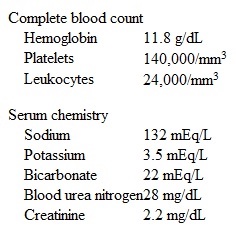 Which of the following is the most likely causative organism of this patient's current condition?
 (Multiple Choice)
4.9/5 (85)
(85) A 48-year-old woman is brought to the emergency department due to chest discomfort. She describes a pressure-like sensation behind the sternum lasting several hours. Yesterday, the patient was brought to the emergency department after a front-end motor vehicle collision in which she was a restrained passenger. She was assessed to have minor injuries and was discharged home. Her husband, who sustained a head injury in the collision, is in the hospital. The patient has hyperlipidemia and her only medication is an estrogen-containing oral contraceptive. Blood pressure is 135/90 mm Hg and pulse is 102/min and regular. Oxygen saturation is 99% on room air. BMI is 31 kg/m2. The lungs are clear on auscultation. ECG shows sinus tachycardia with 1-mm ST-segment elevation in leads V3 to V6. The QTc interval is 509 msec. Cardiac catheterization shows normal coronary arteries. Echocardiography is most likely to demonstrate which of the following?
(Multiple Choice)
4.9/5 (75)
(75) A 52-year-old woman, gravida 3 para 3, comes to the office with irregular vaginal bleeding for the past 8 months. She has had vaginal bleeding for the last 10 days, with passage of large clots on the first 2 days. Today, she has minimal spotting. Previously, menses were regular and occurred every 30 days with 4 days of bleeding. She also has frequent hot flashes, difficulty sleeping, and occasional headaches. The patient was diagnosed with type 2 diabetes mellitus 16 years ago and has good blood glucose control with insulin therapy. She had a tubal ligation after her last pregnancy. The patient's last Pap test was 2 years ago, and there is no history of abnormal results. She has not been sexually active for several years. Family history is significant for breast cancer in her maternal aunt at age 72 but is otherwise noncontributory. She does not use tobacco and has no drug allergies. Blood pressure is 130/80 mm Hg, pulse is 78/min, and respirations are 16/min. BMI is 35 kg/m2. Pelvic examination shows a small amount of dark red blood in the vaginal vault and a multiparous cervix without any visible lesions. On bimanual examination, there is a small, mobile, anteverted uterus with no cervical motion tenderness. There are no adnexal masses. Hemoglobin is 12 g/dL. The patient asks for an explanation of her symptoms and what should be done for evaluation. Which of the following is the most appropriate response?
(Multiple Choice)
4.9/5 (89)
(89) An emergency physician recently began working at a local community hospital. The emergency department is very busy and is part of a larger training program for emergency medicine residents. At times the physician works with residents but is not their direct supervisor. During the third week on the job, the physician meets the emergency medicine chief resident, who comes in infrequently to cover for other residents but is busy primarily with a nonclinical research project. He has an excellent reputation in the program and is near the end of his final year. At the end of the shift the physician sees the chief resident in the locker room; although the physician cannot be sure, it appears that the chief resident is snorting a substance behind his locker door. The following week the physician sees him snorting a white powder in the bathroom. The physician confronts the chief resident and asks if he is using drugs. He initially denies drug use but then says, "Please don't tell anyone about this. They'll kick me out, and I've worked so hard to get here. I'll do anything you say - stop, get help, sign up for treatment." The physician is ethically obligated to do which of the following?
(Multiple Choice)
4.8/5 (70)
(70) A 62-year-old woman is brought to the physician by her son due to progressive forgetfulness over the last year. She has been less active than normal and is having some difficulty walking. The patient has no urinary incontinence. Her past medical history is significant for exertional angina and hypertension. She has recently been depending on her son to manage her medications, which include metoprolol, amlodipine, and aspirin. She does not smoke or consume alcohol. Her father had hypertension and stroke, and her mother had Alzheimer disease. The patient is oriented to person and place, but not time. She has difficulty with 3-word recall. Her gait is slightly unstable and she has problems balancing when she closes her eyes. Examination of the lower extremities show decreased vibratory sensation, spastic paresis, and hyperreflexia bilaterally.
What is the most likely cause of this patient's condition?
(Multiple Choice)
4.8/5 (82)
(82) 
Filters
- Essay(0)
- Multiple Choice(0)
- Short Answer(0)
- True False(0)
- Matching(0)