



 Chat with AI
Exam 2: Foundations of Independent Practice

Exam 1: Advanced Clinical Medicine1 k+ Questions
Exam 2: Foundations of Independent Practice597 Questions
Select questions type


A 24-year-old man comes to the clinic because he "feels terrible and can barely get out of bed." Two days ago, he started feeling feverish and sweaty. He then developed persistent headache, fatigue, sore throat, and aching in his muscles and joints. The patient has no chronic medical issues and takes no medications. He has been sexually active with 2 women over the past few months and rarely uses condoms. The patient smokes a pack of cigarettes and drinks 2-4 alcoholic beverages daily. Temperature is 38.6 C (101.5 F), blood pressure is 130/88 mm Hg, pulse is 94/min, and respirations are 16/min. The patient is ill-appearing with flushed, damp skin. An erythematous maculopapular rash is present on his face, trunk, palms, and soles. Oropharyngeal examination shows a shallow, tender ulcer with white exudate on the posterior oropharynx. Several enlarged, discrete, mobile lymph nodes are present in the cervical, axillary, and occipital regions. Lung auscultation is unremarkable, and heart sounds are normal. The abdomen is soft, nontender, and nondistended with no hepatosplenomegaly. Laboratory results are as follows: 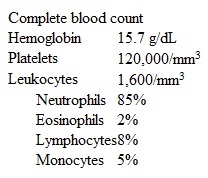 Which of the following is the most likely cause of this patient's current symptoms?
 (Multiple Choice)
4.7/5  (86)
(86) A 75-year-old man is hospitalized with a severe pneumococcal pneumonia. After 48 hours of hospitalization, he begins to recover. On the 3rd day of hospitalization, he suddenly develops chest pain while being prepared for discharge. An emergency CT reveals a pulmonary embolus. After reviewing the patient's chart, it becomes apparent that although he had no contraindications, he was not placed on anticoagulant thromboprophylaxis. The patient's wife arrives and asks if this complication could have been prevented. Which of the following is the best response to her question?
(Multiple Choice)
4.9/5 (79)
(79) A 48-year-old woman complains of persistent fatigue and daytime sleepiness. Her other medical problems include hypertension and rheumatoid arthritis. Her medications include naproxen, enalapril, and a multivitamin supplement with iron. She has no known drug allergies. Vital signs are within normal limits. Examination shows conjunctival pallor and bilateral hand joint deformities with tenderness to palpation at metacarpophalangeal joints. Stool testing for occult blood is negative. Laboratory results are as follows:
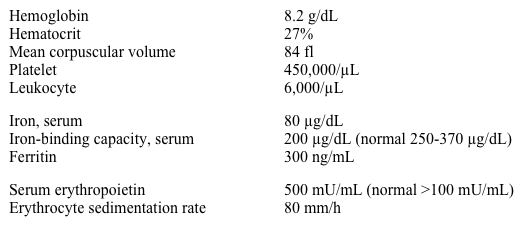 Which of the following would be the most appropriate next step in managing this patient's anemia?
 (Multiple Choice)
4.9/5 (77)
(77) Researchers are evaluating a diagnostic test for Legionella infection that relies on detection of bacterial antigens in the serum. The test is compared to bacterial cultures, which are the gold standard for diagnosis. A sample of 200 patients is selected. Among 100 patients with culture-positive infection, the antigen test was positive in 90 patients. Among 100 patients with negative cultures, the test was positive in 30 patients. What was the positive predictive value of the new serum antigen test in this sample?
(Multiple Choice)
4.9/5 (84)
(84) A 42-year-old man of white ethnicity comes to the office for an annual visit. He has a history of hyperlipidemia, type 2 diabetes mellitus, and hypertension, all of which are well controlled with medication. His 34-year-old sister was recently diagnosed with breast cancer. The patient says, "Luckily they caught it early, and her doctors think she can be cured. I feel strange asking this, but am I also at risk for breast cancer?" The patient has smoked a half pack of cigarettes daily for 20 years but does not use alcohol or illicit drugs. He works as an accountant and is married; he and his wife have 2 healthy teenage daughters. Family history includes ovarian cancer in his mother and Klinefelter syndrome in his brother. Vital signs are within normal limits. BMI is 32 kg/m2, which has increased since his last visit. The chest appears normal and symmetric. There is a rubbery, nontender disk of tissue beneath both areolas. No lymphadenopathy is present. Cardiopulmonary auscultation is normal. The abdomen is soft and nontender with no masses or organomegaly. Which of the following, if present, would confer the highest risk of breast cancer in this patient?
(Multiple Choice)
4.8/5 (73)
(73) A 42-year-old Caucasian woman comes to the physician because of "patchy hair loss" for the past six weeks. Her other medical problems include hypothyroidism, gastroesophageal reflux disease, and bipolar disorder. She has smoked one pack of cigarettes daily for the past 15 years. She drinks 1-2 ounces of alcohol daily, and is a vegetarian. Her mother has thyroid disease, bipolar disorder and breast cancer. The patient's medications include lansoprazole, L-thyroxine and valproic acid. On physical examination, her vital signs are within normal limits. Scalp exam reveals several well-demarcated circular areas of complete hair loss. Fingernail pitting is also present. Which of the following is the most likely cause of her hair loss?
(Multiple Choice)
4.8/5 (84)
(84) A 30-year-old Caucasian male comes to your office and complains of pain and numbness in his right wrist and palmar surface of his first three fingers. These symptoms woke him up last night. He is a baker, and rolls dough using repetitive movements, including hyperextension of the wrist and pronation of the forearm. He remembers having several similar episodes of finger numbness before, which resolved completely after a period of rest. His past medical history is otherwise insignificant. Which of the following is the most likely localization of the pathologic process in this patient?
(Multiple Choice)
4.8/5 (85)
(85) A 65-year-old man is scheduled for hip replacement surgery. He is worried about possible complications of the surgery, particularly the risk of heart attack. A retrospective cohort study identified 98,102 patients who underwent total knee replacement (TKR) or total hip replacement (THR) surgery and compared their rates of myocardial infarction (MI) with those of controls matched by age, sex, and geographic region. The following curves for hazard ratios (HR) were obtained. 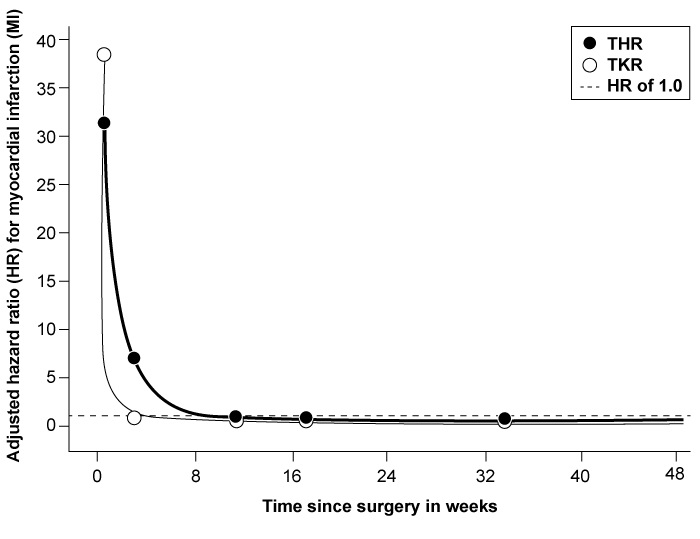 Based on the study results and assuming statistical significance, which of the following provides the best explanation to the patient?
 (Multiple Choice)
4.7/5 (97)
(97) A 16-year-old Caucasian male presents with decreased hearing and several subcutaneous nodules. His past medical history is insignificant. His family history is significant for a father with bilateral deafness that was treated with surgery. Physical examination reveals two hypopigmented spots on his back. MRI scans of the head with gadolinium enhancement show bilateral cerebellopontine angle masses. Which of the following cell types is responsible for these findings?
(Multiple Choice)
4.8/5 (88)
(88) An 84-year-old man is being treated for advanced pharyngeal cancer with radiation and chemotherapy. He complains of mouth ulcers, pain, and difficulty swallowing. His other medical problems include hypertension, osteoporosis, and Parkinson's disease. He had a stroke several years ago. His older son lives with him, and helps with his care. The patient weighs 132 pounds (60 kg), and his BMI is 22 kg/m2. His lab values are as follows: 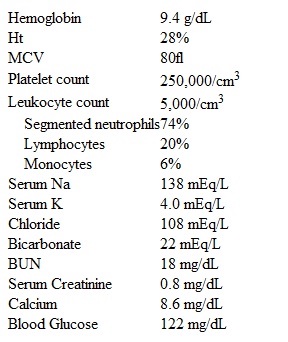 Gastrostomy tube is placed for enteral feeding. Which of the following is the most appropriate nutrition goal for this patient?
 (Multiple Choice)
4.8/5 (87)
(87) A 32-year-old man comes to the emergency department due to a throbbing frontal headache that began during the night and slowly worsened. The patient has also had nausea with lightheadedness. "It's the oddest thing. It seemed like a migraine at first, but when my wife began having similar symptoms, I realized it must be the flu or something." The patient has no medical problems and takes no medications. He does not use tobacco, alcohol, or illicit drugs. He and his wife are renovating their older home. They recently retiled the bathrooms and are now considering replacing some of the major appliances as they are quite old. Temperature is 36.7 C (98.1 F), blood pressure is 120/76 mm Hg, pulse is 90/min, and respirations are 18/min. Pulse oximetry is 97% on ambient air. Mucous membranes are moist, and pupils are equal and reactive to light. Auscultation of the heart and lungs is normal. No neck rigidity or meningeal signs are present. Neurologic examination is normal. Diagnostic tests, including complete blood count, metabolic panel, and arterial blood gas with co-oximetry, are ordered. Which of the following is the most appropriate next step in management of this patient?
(Multiple Choice)
4.8/5 (76)
(76) A team of neurologists and psychologists researching intellectual function is reviewing the results of a study on the association between childhood lead exposure and adult intellectual function. Which of the following is the best approach to further investigate the association between environmental lead exposure in childhood and adult intellectual function?
(Multiple Choice)
4.9/5 (79)
(79) A 20-year-old man develops substernal chest pain and palpitations, followed by brief syncope while playing soccer. The patient is rushed to the emergency department where he reports feeling fine. He describes previous episodes of "chest pressure" while overexerting himself, after which he needs to stop and rest. He has had no previous episodes of syncope. Medical history is unremarkable. The patient does not use tobacco, alcohol, or illicit drugs. There is no family history of coronary heart disease or sudden death. Blood pressure is 122/78 mm Hg and pulse is 78/min. Cardiac examination reveals no murmurs in both the supine and standing positions. ECG shows normal sinus rhythm with a rate of 72/min. No ST-segment or T-wave abnormalities are present. The QTc interval is 410 msec. The patient is recommended to avoid exercise until he can undergo further workup, but 2 days later he collapses and dies while jogging. Which of the following is the most likely diagnosis?
(Multiple Choice)
4.9/5 (88)
(88) A 76-year-old man is brought to the office by his family due to urinary incontinence. The patient has a history of dementia and was placed in a skilled nursing facility a year ago after his family was unable to care for him at home. He can indicate his needs but requires assistance for most activities of daily living. During a recent visit, the patient's daughter noticed frequent episodes of involuntary dribbling of urine. The nursing home staff confirms that the patient has had urinary incontinence for the past several days, but there is no report of fever, chills, vomiting, or blood in the urine. The patient is unable to provide any additional information. Medical history is notable for hypertension and osteoarthritis. Temperature is 37.2 C (99 F), blood pressure is 140/76 mm Hg, and pulse is 88/min. He appears comfortable and is able to recognize his daughter but does not know the date or place. Cardiopulmonary examination shows no abnormalities. Abdominal examination reveals mild tenderness and fullness in the suprapubic region. Application of manual pressure on the lower abdomen causes leakage of a small amount of clear urine. The prostate is nontender but mildly enlarged and rubbery. Which of the following is the most appropriate response to the family regarding this patient's urinary incontinence?
(Multiple Choice)
4.9/5 (86)
(86) A 56-year-old man is hospitalized in the intensive care unit due to community-acquired pneumonia with resultant multiorgan failure. His trachea is intubated and mechanical ventilation is initiated. His family wants to "do everything possible" to make him better and save his life. Based on the study results, which of the following is the best statement concerning the use of glutamine and antioxidants in this patient?
(Multiple Choice)
5.0/5 (81)
(81) A 24-year-old woman comes to the office accompanied by her caseworker. This is the first time that she has been seen in the office, and she appears mildly anxious. However, she quickly relaxes once the female physician enters the room. The caseworker reports that the patient would like to discuss contraceptive options as she has become sexually active with her boyfriend. Medical history is remarkable for moderate intellectual disability and surgical repair of a cardiac defect as an infant. The patient says, "I would like to go on birth control. I want a baby one day but not until I am married." The caseworker reports that the patient's mother, who was unable to attend the appointment, is extremely concerned about the patient's plan. The mother wants the patient to have a tubal ligation as she does not think her daughter would ever be able to care for a child. The patient becomes tearful and says, "My mom doesn't know what's best for me. I know I can be a good mom." Which of the following is the most appropriate next step in assisting the patient with these decisions?
(Multiple Choice)
4.9/5 (64)
(64) A 34-year-old woman, gravida 2 para 1, is evaluated for hospital discharge 8 hours after surgery. She came to the emergency room this morning with hypotension, tachycardia, and vaginal bleeding and was diagnosed with a ruptured ectopic pregnancy for which she underwent a laparoscopic right salpingectomy. The patient's only prior surgery was a cesarean section. Two units of packed red blood cells were transfused in the emergency department and another two in the operating room due to acute blood loss anemia; she also received 2 L of normal saline. A Foley catheter was placed immediately prior to surgery and removed before the patient awakened from anesthesia, after an intraoperative urine output of 200 mL was noted. There were no complications. However, the patient has been unable to pass flatus or void since the procedure. She has mild nausea but no fever, dizziness, weakness, or vomiting. Light vaginal bleeding is present. Blood pressure is 140/90 mm Hg and pulse is 98/min. The abdomen is soft and mildly distended with suprapubic tenderness but no rebound or guarding. Tympany is present under the right costal margin. The incisions are closed and the primary dressings are clean, dry, and intact. Which of the following is the most likely cause of this patient's current condition?
(Multiple Choice)
4.7/5 (77)
(77) An 80-year-old man is admitted to the cardiac care unit after a complicated percutaneous coronary intervention procedure. He has chest discomfort and shortness of breath. The patient's blood pressure is 82/50 mm Hg and pulse is 114/min and regular. Hemodynamic readings from the pulmonary artery catheter are shown below. 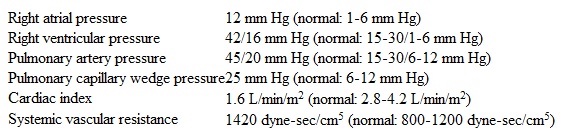 Which of the following is the most likely cause of this patient's hypotension?
 (Multiple Choice)
4.9/5 (84)
(84) A 70-year-old white male with a history of hypertension, hypercholesterolemia, and degenerative joint disease presents to the office because of worsening fatigue, nausea, malaise, and bilateral pedal edema. He also complains of a decreased appetite for the past six weeks. Four weeks ago, he had an upper respiratory tract infection that resolved with over-the-counter medications. He describes his degenerative joint disease as moderately severe, and for which, he has been taking ibuprofen for the past year. His other daily medications for the past six years are metoprolol, hydrochlorothiazide, hydralazine, and simvastatin. He has no known drug allergies. He has a 50-pack-year history of smoking, and occasionally drinks alcohol. His family history is significant for strokes. His labs on this office visit show the following: 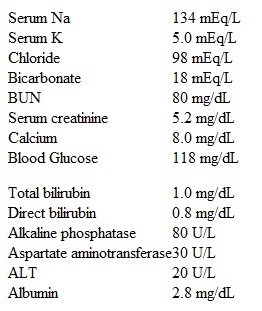 His urine analysis shows: 4+ protein, 0-1 RBC/HPF, 20-25 WBC/HPF, and a few granular casts. His 24-hour urine protein is 7 g. Ultrasound of the kidneys is unremarkable. His antinuclear antibody titers are 1:40. During his previous visit one year ago, the creatinine was 1.2. Which of the following is the most likely cause of his presentation?
 (Multiple Choice)
4.9/5 (70)
(70) A 36-year-old man has had weakness in his right arm and leg as well as difficulty walking over the past 2 weeks. This was preceded for several days by mild headaches and dizziness that have not recurred. He is an ex-smoker with a 10-pack-year history. The patient experimented with cocaine in college although never intravenously, and he has used no illicit drugs in the last 10 years. He has a history of multiple sexual partners and has been treated twice in the past several years for gonococcal urethritis. He also reports an ulcerative lesion on his penis "a while ago," that resolved. The patient has no history of diabetes or hypertension. His family history is negative for stroke or premature coronary artery disease. He is afebrile, his blood pressure is 132/80 mm Hg, and his heart rate is 85/min with a regular rhythm. There is no murmur on cardiac examination. His reflexes are hyperactive on the right side. Electrocardiogram shows normal sinus rhythm. A urine toxicology screen is negative. Brain MRI demonstrates a subacute stroke in the left frontal lobe. HIV test is negative. Cerebrospinal fluid analysis results are as follows: 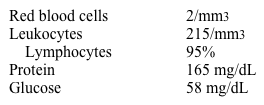 Cerebrospinal fluid Gram stain shows no organisms. Which of the following is most likely to indicate the underlying etiology of this patient's symptoms?
 (Multiple Choice)
4.8/5 (71)
(71) 
Filters
- Essay(0)
- Multiple Choice(0)
- Short Answer(0)
- True False(0)
- Matching(0)