



 Chat with AI
Exam 2: Foundations of Independent Practice

Exam 1: Advanced Clinical Medicine1 k+ Questions
Exam 2: Foundations of Independent Practice597 Questions
Select questions type


A study investigates the prevalence of ischemia in 512 patients with chest pain undergoing stress testing. Only patients with negative cardiac enzymes and nondiagnostic electrocardiogram changes are included. Myocardial perfusion imaging for ischemia and coronary artery calcification (CAC) score are obtained for each participant. The following results are reported: Which of the following best describes the study design?
(Multiple Choice)
4.9/5  (72)
(72) A 55-year-old man comes to the physician with fatigue, polyuria, and polydipsia. He is morbidly obese and has recently lost about 2.27 kg (5 lb) unintentionally. The patient has blurred vision but no abdominal pain, hematuria, melena, or bruising. Vital signs are within normal limits, and physical examination is unremarkable. The patient's blood glucose is 287 mg/dL, measured by a finger-stick. The patient is diagnosed with type 2 diabetes mellitus, is started on medications, and is greatly relieved to receive a diagnosis. He returns 2 weeks later feeling much better and brings a fruit basket for the physician to express his gratitude. Which of the following is the most appropriate response to this patient's gift?
(Multiple Choice)
4.9/5 (76)
(76) A 50-year-old female was found to have abnormal thyroid function on routine blood testing. Her TSH level is 9 μU/ml (0.35 to 5.0 μU/ml is normal) and free T4 is 1.3 ng/dl (normal 0.8 to 1.8 ng/dl). She is currently asymptomatic and is taking no medications. She denies use of tobacco, alcohol, and drugs. Family history is positive for a mother with hypothyroidism. She has four siblings, all are alive and well. Her menstrual cycles are regular. Examination is unremarkable. Her CBC, serum chemistries, and lipid profile are within normal limits. Which of the following will be most useful in guiding her therapy?
(Multiple Choice)
4.7/5 (87)
(87) A 31-year-old woman comes to the emergency department due to 2 days of fever, chills, and cough productive of brown-tinged sputum. She has also had shortness of breath, and her chest hurts when she inhales deeply. She has not had any sick contacts. The patient has a history of HIV, hypertension, and generalized anxiety disorder. She is on antiretroviral therapy, and 2 months ago her CD4 cell count was 325 cells/mm3. The patient smokes a pack of cigarettes daily but does not drink alcohol or use illicit drugs. Temperature is 38.8 C (101.8 F), pulse is 90/min, blood pressure is 120/65 mm Hg, and respirations are 18/min. The patient is in no apparent distress. Mucous membranes are moist. Cardiopulmonary auscultation reveals decreased breath sounds over the right middle lung field and regular heart rate with no murmurs. The remainder of the examination is normal. Laboratory results are as follows: 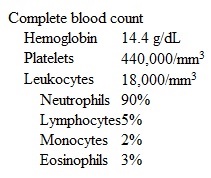 Chest x-ray is shown in the image. The most likely cause of the patient's symptoms is infection with which of the following?
 (Multiple Choice)
4.8/5 (65)
(65) A 70-year-old man presents to the emergency department due to right-sided arm and leg weakness that occurred several hours ago. The episode lasted 15 minutes and resolved spontaneously. He had a similar episode of right arm weakness two days ago. He was diagnosed with hypercholesterolemia on routine check-up three months ago, and has been treated with pravastatin. He does not smoke or consume alcohol. His blood pressure is 140/90 mmHg and his heart rate is 70/min. Doppler studies shows 89% stenosis in his left carotid artery and 40% stenosis in his right carotid artery. He undergoes left carotid endarterectomy. The surgery goes well and he recovers from the anesthesia without any complications. In the recovery room, upon protrusion of the tongue, the tongue deviates to the left. Which of the following structures is most likely damaged?
(Multiple Choice)
4.8/5 (74)
(74) A 22-year-old man is found unresponsive on his bedroom floor. His girlfriend calls emergency medical services, and paramedics arrive within 10 minutes. She says that the patient has been using heroin and points to track marks on his right arm. Temperature is 37.8 C (100 F), blood pressure is 90/40 mm Hg, pulse is 65/min, and respirations are 6/min. The paramedics provide supportive care and administer naloxone on the way to the hospital. The patient's condition stabilizes in the emergency department. The toxicology screen is positive for opiates and cannabis. Once he becomes more alert, additional information, including a substance abuse history, is obtained. The patient says, "I've been using heroin for the last 9 months and drinking since I was 16. I like to use pretty much any drug I can get my hands on; I don't see what the big deal is." He has never tried to stop using and has never been to a drug-detoxification or drug-rehabilitation program. He recently lost his construction job as he was "too high to show up." His girlfriend is considering leaving him if he does not get help.At 1-month follow-up, the patient says that he was recently arrested and charged with driving under the influence. His court date is set for later in the month. The patient confirms that he was intoxicated at the time and is worried about sentencing. He tells the physician that his girlfriend has left him and that it has been a struggle finding work. He says, "I can't blame her for leaving. I stopped for a week but started using again after getting fired from yet another job. I'm a pretty good worker, but I think the boss could tell I was using. It's the people I hang out with; it's hard to stop when they're all getting high."
Which of the following is the best indicator of this patient's motivation to change his behavior?
(Multiple Choice)
4.7/5 (74)
(74) A 35-year-old woman comes to the office due to stiffness of her fingers. The patient also reports that her fingers turn white when she takes food from the freezer. She has had intermittent heartburn and a periodic "sticking sensation" in her chest during meals over the past several months. The patient has no prior medical problems and takes no medications. She does not use tobacco, alcohol, or illicit drugs. Temperature is 37 C (98.6 F), blood pressure is 140/90 mm Hg, and pulse is 80/min. No mucosal lesions or lymphadenopathy is present. The thyroid is normal to palpation and jugular venous pressure is normal. The lungs are clear to auscultation and heart sounds are normal with no murmur. The abdomen is soft and nontender with no hepatosplenomegaly. The digits of both hands appear puffy with loss of skinfolds. No lower extremity edema is present. Laboratory testing is obtained to establish the diagnosis. Which of the following additional studies is currently the most appropriate for this patient?
(Multiple Choice)
4.9/5 (80)
(80) A quality improvement committee based at a primary care clinic wishes to improve screening and follow-up of patients with obesity. Currently, 30% of patient encounters include documentation of BMI, and 10% of patients with BMI ≥30 kg/m2 are scheduled for weight management follow-up appointments. The committee sets a goal to increase BMI documentation to 40% and BMI follow-up to 30% in 3 months. It decides to test the effectiveness of a clinical decision support tool in achieving this goal. The tool is designed for clinical providers and integrated into the electronic medical record; it includes a BMI calculator and a prompt to arrange follow-up when BMI is ≥30 kg/m2. An email introducing the tool and its purpose is circulated to all clinical providers.
After the tool is implemented for 3 months, which of the following is the most appropriate next action according to the Plan-Do-Study-Act paradigm?
(Multiple Choice)
4.9/5 (75)
(75) A 42-year-old woman comes to the office for a routine follow-up. She was diagnosed with multiple sclerosis 3 months ago and has had no relapses since. She had previously preferred not to take any medications for multiple sclerosis, but she is now interested in finding out about different treatments. The patient has no other medical problems. She does not use tobacco, alcohol, or illicit drugs. Examination shows no abnormalities. A new treatment A is available that is apparently highly effective in preventing multiple sclerosis relapses. A randomized trial shows that the incidence of relapses was 20% after 6 months of treatment A. Patients managed with placebo had an incidence of 25% during the same time period. Considering this information, how many patients will need to be treated with treatment A in order to prevent 1 episode of relapse of multiple sclerosis during the first 6 months of therapy?
(Multiple Choice)
4.9/5 (81)
(81) A 44-year-old man comes to the office for an annual physical examination. The patient's history includes hypertension and gastroesophageal reflux disease, for which he takes enalapril and ranitidine. The patient also has a history of depression in his early 20s that responded well to sertraline. He currently has no depressive symptoms. The patient works as a real estate agent and has been employed at the same company for many years. He is married with two children ages 17 and 15. He says, "Things are okay at work and at home, but I'm a little worried about paying for college." The patient has a 15-pack-year smoking history and drinks socially but does not use illicit drugs. There is a family history of hypertension and coronary artery disease, and the patient describes both his father and brother as recovering alcoholics. Blood pressure is 130/80 mm Hg, pulse is 72/min, and respirations are 16/min. Examination shows no abnormalities. Which of the following questions is most appropriate to screen this patient for unhealthy alcohol use?
(Multiple Choice)
4.9/5 (81)
(81) A 65-year-old man is being evaluated by the internal medicine service prior to discharge from the hospital. He was admitted 2 days ago with decompensated heart failure with reduced ejection fraction and has responded well to treatment. He has a history of chronic hepatitis C and chronic obstructive pulmonary disease. The patient continues to smoke a pack of cigarettes a day but is trying to quit. He does not drink alcohol. He recently retired and enrolled in Medicare part A, which he expects to cover his hospital stay. However, the patient is concerned about the cost of the medications that will be needed to manage his chronic conditions. Which of the following health insurance programs should be recommended for this patient?
(Multiple Choice)
4.8/5 (73)
(73) The following advertisement is focused on LDL particle number (LDL-P) testing, a novel new screening method used for assessing LDL. Based on the study shown in the advertisement, initial levels of LDL-C and LDL-P were obtained in 5584 individuals and the cumulative incidence of cardiovascular events was tracked. Which of the following choices best identifies the study design used in the advertisement?
(Multiple Choice)
4.7/5 (66)
(66) A 49-year-old man comes to the office for follow-up. A friend was recently diagnosed with gout, and the patient is anxious that he will also develop gout. The patient states that he had read "something about a diet called DASH that reduces the excess of uric acid in the blood and reduces the risk of gout." He would like to try the diet but asks if a less strict version would nevertheless help to reduce his chances of developing gout. Based on the abstract, which of the following is true about the magnitude of the risk of gout among patients adopting a Western diet in the highest fifth as compared to patients adopting a Western diet in the lowest fifth?
(Multiple Choice)
4.8/5 (75)
(75) Two independent research groups are studying the effect of a new anticoagulant on the incidence of deep-vein thrombosis after hip replacement surgery. The first group designs a 1:1 randomized trial with 1000 patients comparing the new drug with the standard of care (500 patients in each group). The second group designs a similar randomized trial but intends to recruit 500 patients (250 patients in each group). Assuming similar populations for patient recruitment, the small study has a higher chance of which of the following?
(Multiple Choice)
4.8/5 (79)
(79) A 74-year-old man comes to the office due to memory problems over the past several months. He is accompanied by his wife. The patient says, "I am worried about my memory. I feel like I am losing my mind. I can't remember what I've read in the newspaper, and I even have difficulty following the plot on TV shows." His wife says, "He frequently misplaces things like his keys and wallet and can't recall names of individuals he should know. She adds, "He used to like to cook and watch TV, but he doesn't seem to enjoy these things anymore. When he attempted to make a favorite dish recently, he left out half the ingredients and burned the meal." Over the past 2 months, the patient has been involved in 2 minor car accidents in which he was "not paying attention." He recently told his wife that they are "ruined and going bankrupt," despite her multiple assurances that this is not so. She says, "I show him the bank statements, but a few days later, it's as if he doesn't remember and he asks to see them again." They went through a difficult time over the past year due to his suspicions that she had an affair, which were recently confirmed. The patient's medical history is significant for gastroesophageal reflux disease, rheumatoid arthritis, and hypertension. He has increased soreness and pain in his joints and neck that he attributes to "my body breaking down." The patient has a history of thyroid cancer that was successfully treated 15 years earlier. His medications include lisinopril, levothyroxine, hydrochlorothiazide, aspirin, and antacids. Physical examination is unremarkable. Laboratory studies, including vitamin B12 and thyroid function, are normal. The patient is diagnosed with major depressive disorder, and antidepressant medication is started. Three months later, his condition has significantly improved. Examination of memory and concentration demonstrates clear improvement. The patient's wife says that he is "back to his normal self and sharp as a whistle." He has been driving without accidents. They have started socializing again and have attended couples counseling to address issues with infidelity. At a recent clinic visit, the patient and his wife ask about his prognosis, as they are planning their advance directive documents. Which of the following disorders is the patient at increased risk of developing?
(Multiple Choice)
4.7/5 (90)
(90) A 52-year-old woman comes to the emergency department on a Saturday night with severe low back pain. She is very angry because she called her physician's office multiple times before finally reaching the covering physician, who directed her to go to the emergency department. She has had low back pain for many years, and her physician usually prescribes oxycodone. The patient's pain is much worse, and she is unable to sleep at all. She wants the emergency physician to prescribe something stronger so she can sleep through the night. The patient says, "Now that I took all the trouble to come to the emergency department, I better get some relief!" The physician has no records available at the time, but she does not appear to be drug-seeking based on the history. Which of the following is the most appropriate reaction to the patient's request?
(Multiple Choice)
4.8/5 (67)
(67) A 43-year-old man comes to the hospital with 2 days of persistent fever, headache, malaise, and intense muscle and joint pain. He has been taking ibuprofen, which provides only mild relief. The patient frequently travels internationally for business and returned from India a week ago. He received appropriate vaccinations prior to travel, took all advised prophylactic medications, and consumed bottled water during the trip. His temperature is 38.9 C (102 F), blood pressure is 110/70 mm Hg, and pulse is 98/min. After an inflated sphygmomanometer cuff is on his arm for a few minutes, he develops severe petechiae; however, he has no other skin rash. He has mild cervical lymphadenopathy. There are no heart murmurs. Lungs are clear to auscultation. The abdomen is nontender, and the liver is palpated 3 cm below the costal margin. Laboratory results are as follows: 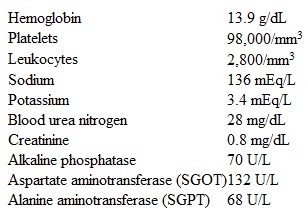 For which of the following is this patient at greatest risk?
 (Multiple Choice)
4.9/5 (72)
(72) A cohort study of 4,000 patients examines the role of vitamin D supplements on the incidence of colon cancer. Relative risk (RR) calculations with their corresponding 95% confidence intervals (CI) are reported for subjects taking vitamin D versus controls after a 5-year follow-up period: A separate double-blind randomized clinical trial assigns 3,900 subjects to vitamin D supplementation or placebo. The following results are reported for subjects taking vitamin D versus placebo after a 5-year follow-up period:
Which of the following best describes the results of both studies?
(Multiple Choice)
4.8/5 (73)
(73) A 48-year-old man comes to the office for his yearly follow-up visit. The patient's medical history includes hypercholesterolemia, hypertension, and alcohol use disorder. He says, "I am going through a divorce, and it has been hard not to drink. It's depressing to come home to an empty house, and I usually end up in a bar on my way home from work." The patient consumes 2 pints of vodka daily and admits that he keeps a bottle of vodka at work so that he can drink during the day. He has a history of blackout episodes during intoxication. Last year, the patient was hospitalized after having a seizure and was treated for alcohol withdrawal. Following discharge, he was referred to an outpatient substance abuse program but did not attend because, "I thought I could stop on my own." The patient has lived alone since his wife moved out of the house and works in insurance sales. His longest period of sobriety is 3 weeks. He does not use illicit drugs but has smoked a pack of cigarettes daily for 20 years. The patient says, "I want to stop drinking, but the cravings are just too strong." In addition to psychosocial interventions, which of the following is the most appropriate pharmacotherapy?
(Multiple Choice)
4.8/5 (77)
(77) A 23-year-old Caucasian male presents to the emergency department with an acute onset of flushing, a throbbing headache, palpitations and abdominal cramps. His symptoms began thirty minutes after eating fish at a local restaurant. He says that his two friends who had the same dinner in the restaurant with him had similar but milder symptoms. The particular fish that he ordered in the restaurant is his favorite, and he eats this dish at least twice a month, but this time it tasted unusually spicy. His past medical history is insignificant. Which of the following is the most likely cause of this patient's symptoms?
(Multiple Choice)
4.8/5 (74)
(74) 
Filters
- Essay(0)
- Multiple Choice(0)
- Short Answer(0)
- True False(0)
- Matching(0)