



 Chat with AI
Exam 2: Foundations of Independent Practice

Exam 1: Advanced Clinical Medicine1 k+ Questions
Exam 2: Foundations of Independent Practice597 Questions
Select questions type


Over the course of 5 years, a pediatric endocrinologist has seen a marked increase in the prevalence of depression among patients with obesity in her practice. She partners with a pediatric psychiatrist to devise a short screening test for depression for this specific population. The new screening test is found to be 90% sensitive and 84% specific. If this test is used on a sample of patients with obesity in which 35% are known to have depression The authors of the study decide to conduct an ancillary statistical analysis in which a second cohort of workers employed in the manufacture of domestic textiles is used as the population of reference. Based on the study results from the first cohort of vinyl chloride workers, which of the following is the most likely reason for the ancillary analysis?
(Multiple Choice)
4.8/5  (68)
(68) A 61-year-old woman comes to the physician due to mild exertional dyspnea. She has difficulty going up the stairs and feels very tired by the end of the day. She has no chest pain, orthopnea, lower extremity swelling, or syncope. The patient is being treated for locally advanced HER2-positive breast cancer. She underwent left-sided mastectomy and received adjuvant chemotherapy with docetaxel and carboplatin in addition to trastuzumab 6 months ago. Preoperative evaluation showed normal cardiac function. Currently, the patient receives periodic trastuzumab infusions. Echocardiogram shows a left ventricular ejection fraction of 30%. The patient wonders if her symptoms are related to cancer therapy and wants to know her long-term prognosis. What is the best response to this patient's concerns?
(Multiple Choice)
4.7/5 (73)
(73) A 56-year-old man is brought to the office by his wife due to increasingly odd behavior. The patient's wife says that her husband started to become emotionally "cold" toward her about a year ago and that he has since received a number of complaints from women at work, who report that he has been making unwanted advances. She says, "He used to be a very loving and caring husband, but lately he doesn't appear to care about anything." Over the past 6 months the patient's sleep has worsened and he has begun to exhibit memory difficulties; he has gotten lost a few times while driving home. His wife also notes that he never used to have a sweet tooth, but she now cannot buy sweets because he will eat the entire box. The patient has a history of hypertension and hyperlipidemia. Which of the following is the most likely diagnosis?
(Multiple Choice)
4.9/5 (78)
(78) A 57-year-old woman comes to the physician at the insistence of her husband; he reports that for quite some time, she has been extremely agitated when sitting, resting, or lying down at night. She has trouble falling asleep in bed, which in turn keeps him awake. The patient's discomfort occurs every night; she describes it as an "internal itch that creeps up my lower legs and is often so uncomfortable that I could cry." This strange sensation compels her to stand and pace the floor, and worsens when she feels fatigued. Her medical history is significant for well-controlled hypertension, gastroesophageal reflux disease, allergic rhinitis, and tension headaches. The patient has been on amlodipine, omeprazole, and ibuprofen for 3 years with no recent changes in dosage. She does not smoke or use illicit drugs but consumes 1-2 alcoholic drinks on weekends. There is no family history of similar problems. Physical examination is unremarkable.
Which of the following studies is most appropriate to order?
(Multiple Choice)
4.7/5 (76)
(76) A 54-year-old female with recently diagnosed diabetes mellitus presents to the office with a skin rash. She states that the rash started three weeks ago on her forearm as a small, elevated red area. It gradually involved the surrounding skin, and became an erythematous, itchy, painful rash that did not respond to topical 1% hydrocortisone. Approximately one week ago, the rash started clearing up from the center. The patient has not been feeling well for the past 1-2 months. She also complains of lethargy, weight loss, diarrhea, abdominal cramps, and occasional facial flushing. On physical examination, a 4 X 5 cm, erythematous, scaly rash, which appears to be clearing from center, is noted. The borders appear slightly elevated and crusty. Angular cheilosis is also noted. What is the most likely diagnosis of this patient?
(Multiple Choice)
4.8/5 (86)
(86) A 60-year-old man is admitted for end-stage heart failure and is being considered for a left ventricular assistance device (LVAD) as a bridge to cardiac transplantation. The patient has a history of 3 myocardial infarctions and a low ejection fraction secondary to ischemic cardiomyopathy. He is informed that when an LVAD is used for this purpose the recipient must meet eligibility criteria for transplantation. He has no other medical conditions and appears to meet the medical criteria for LVAD and heart transplant. The patient has a history of major depressive disorder and attempted suicide in his late 20s. He also has a history of alcohol abuse. He has no current depressive symptoms and states that he has not used alcohol "to excess" in the past 6 months. The patient lives alone and has no close family except for a niece who visits occasionally. He has been homeless in the past but not recently. Mental status examination shows the patient to be cognitively intact; his stated mood is "scared" and his affect is full range and appropriate. His thought process is linear and his thought content shows no delusions. The patient has no hallucinations or suicidal ideation. Based on these findings, which of the following statements is most accurate regarding the determination of this patient's eligibility for heart transplantation?
(Multiple Choice)
4.9/5 (64)
(64) An orthotics and prosthetics company conducts a single-blind, randomized, parallel group trial to investigate the effects of custom foot orthoses with motion control shoes versus the effects of motion control shoes alone in individuals with patellofemoral joint osteoarthritis. Eligible subjects are randomized to receive either custom foot orthoses with motion control shoes or motion control shoes alone, to be worn for 4 months. A significant number of patients are lost to follow-up or are noncompliant to the assigned intervention during the study. However, results for the patients who completed the protocol are encouraging. Which of the following techniques is most appropriate to estimate the real effect of custom foot orthoses in the population?
(Multiple Choice)
4.9/5 (83)
(83) A 7-year-old boy is brought to the office for evaluation of increasing acne and pubic hair. Last month, his mother first noticed "a few bumps" on his nose and forehead. Subsequently, the child developed numerous "bumps and pustules" on his face and back. Over the past month, his mother has also noticed pubic hair growth. The patient has no headache, vision changes, or vomiting. He has atopic dermatitis that is controlled with corticosteroid ointment. He takes a daily multivitamin and no other medications. His mother experienced menarche at age 12 and his father began to shave at age 14. The patient is in first grade, is a good student, and enjoys playing soccer. Temperature is 36.7 C (98 F), blood pressure is 100/60 mm Hg, and pulse is 84/min. Cranial nerves II-XII are intact. Visual fields have no deficits. There is scattered comedonal and inflammatory acne across the face, chest, and shoulders. Cardiac examination shows a regular rate and rhythm without murmur. The abdomen is soft and nontender with no hepatosplenomegaly. Genital examination reveals stage 2 sexual maturity rating for pubic hair. The testes are small and without masses. A bone age radiograph is consistent with age 9. Which of the following is the most likely diagnosis in this patient?
(Multiple Choice)
4.8/5 (79)
(79) A 16-month-old full-term girl is brought to the office to establish well-child care. The patient's family recently moved to the area and they have no concerns about her development. The patient weaned from breastfeeding at age 12 months, and her current diet mainly consists of whole cow's milk. She has no chronic medical conditions and takes no medications. She was born to a 24-year-old primigravida Greek woman and a 30-year-old African American man. The patient's father has sickle cell trait and her first cousin has sickle cell anemia; maternal family history is noncontributory. Physical examination reveals pallor of the conjunctivae but is otherwise unremarkable. Laboratory results are as follows: 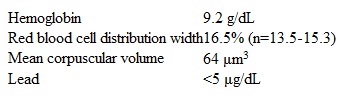 Hemoglobin electrophoresis reveals 40% HbS and 60% HbA. Which of the following is the most likely cause of this patient's anemia?
 (Multiple Choice)
4.7/5 (68)
(68) A 38-year-old African American man comes to the emergency department after experiencing severe back pain for the past 2 days. He has a history of hypertension for the last 5 years. His current medications include hydrochlorothiazide, amlodipine, and valsartan. The patient has a 15-pack-year history and drinks 4-5 bottles of beer daily. His temperature is 36.7 C (98 F), blood pressure is 230/112 mm Hg, and pulse is 84/min. Funduscopic examination shows arteriolar wall thickening and occasional cotton-wool spots. The rest of the examination is within normal limits. Initial laboratory studies show serum blood urea nitrogen of 28 mg/dL, potassium of 5.1 mEq/L, and serum creatinine of 2.3 mg/dL. Transesophageal echocardiogram is consistent with dissection in the descending aorta. The patient is admitted to the coronary care unit and started on intravenous labetalol and nitroprusside infusion. The next morning, the nurse finds him confused and agitated. He then has a generalized tonic-clonic seizure. His temperature is 36.7 C (98 F), blood pressure is 176/99 mm Hg, and pulse is 102/min. Physical examination remains otherwise unchanged. Which of the following is the most likely diagnosis?
(Multiple Choice)
4.9/5 (92)
(92) A 68-year-old man with coronary artery disease is admitted after 4 weeks of shortness of breath and lower-extremity swelling. He has suffered 2 prior myocardial infarctions and has been diagnosed with persistent atrial fibrillation, hypertension, and type 2 diabetes mellitus. The patient's blood pressure is 132/80 mm Hg and his heart rate is 122/min. On physical examination, he has bibasilar crackles, a third heart sound, and 2+ peripheral edema. This patient is most likely to suffer which of the following adverse in-hospital events?
(Multiple Choice)
4.8/5 (80)
(80) A 32-year-old man is evaluated for a murmur, which was found during a preventive examination. He has no symptoms, and his past medical history is insignificant. The patient smokes a pack of cigarettes per day. He has no family history of cardiovascular disease or sudden death. Blood pressure is 132/80 mm Hg and heart rate is 68/min. The patient's height is 178 cm. Body mass index is 31 kg/m2. A 2/6 ejection-type murmur is heard at the right upper sternal border. His physical examination is otherwise unremarkable. Transthoracic echocardiogram shows normal left atrial and left ventricular size, left ventricular ejection fraction of 60%, bicuspid aortic valve, and trivial aortic regurgitation. There is no evidence of aortic stenosis on Doppler echocardiography. For which of the following conditions should this patient be evaluated specifically?
(Multiple Choice)
4.8/5 (79)
(79) A 60-year-old woman comes to the emergency department complaining of a severe, sudden-onset headache accompanied by nausea. She has had mild diplopia for the past 3 months. The patient has a long history of hypertension and diabetes mellitus type 2. Her blood pressure is 160/90 mm Hg and heart rate is 80/min. Physical examination shows right-sided ptosis, mild anisocoria, and nuchal rigidity. There is no ataxia. Which of the following is the most likely diagnosis?
(Multiple Choice)
4.8/5 (78)
(78) A 65-year-old man was admitted to the intensive care unit after going into cardiac arrest when alone at home. Cardiopulmonary resuscitation and advanced cardiac life support were performed extensively in the field, and return of spontaneous circulation was eventually achieved. Two days later, he remains intubated and is on full ventilator support. The patient is unresponsive to verbal and tactile stimuli. His temperature is 37.2 C (99 F), blood pressure is 110/70 mm Hg, and pulse is 70/min. The treating physician discusses with the patient's family the possibility of brain death. The patient is diagnosed with brain death. The physician explains this finding to the patient's family and discusses withdrawing of mechanical ventilator support. Everyone in the family appears to understand and agrees to proceed with withdrawing ventilatory support. A relative then walks into the patient's room and notices some movements in the patient's legs and toes. The relative believes the patient is not dead and gets angry with the treating physician. Which of the following is the most appropriate response to the relative's reaction?
(Multiple Choice)
4.9/5 (84)
(84) A 2-year-old boy is brought to the clinic by his parents due to worsening right ear pain. His mother states, "He started tugging at his ear 3 days ago and had a fever, but I could not take time off from work to bring him in." This morning, the pain increased, and his father notes that "his ear seems more prominent, like it's sticking out from his head." The patient has been less active than normal but has had no vomiting, diarrhea, or rash. He had an episode of acute otitis media 2 months ago that resolved with oral antibiotics. Immunizations are up to date, and he takes no daily medications. Temperature is 40 C (104 F), blood pressure is 100/40 mm Hg, pulse is 132/min, and respirations are 30/min. Examination shows a tired, irritable boy who screams with any attempt to examine his ear. Swelling, erythema, and tenderness to palpation are noted posterior to the right ear. Otoscopy reveals an erythematous and bulging tympanic membrane with loss of normal landmarks and light reflex.
CT scan of the temporal bones is obtained which reveals fluid in the mastoid air cells with erosion of bony septa. Which of the following is the most appropriate step in management?
(Multiple Choice)
4.7/5 (88)
(88) A quality improvement committee based at a primary care clinic wishes to improve screening and follow-up of patients with obesity. Currently, 30% of patient encounters include documentation of BMI, and 10% of patients with BMI ≥30 kg/m2 are scheduled for weight management follow-up appointments. The committee sets a goal to increase BMI documentation to 40% and BMI follow-up to 30% in 3 months. It decides to test the effectiveness of a clinical decision support tool in achieving this goal. The tool is designed for clinical providers and integrated into the electronic medical record; it includes a BMI calculator and a prompt to arrange follow-up when BMI is ≥30 kg/m2. An email introducing the tool and its purpose is circulated to all clinical providers. Three months after implementation of the tool, the committee analyzes patient charts to determine changes in obesity screening and follow-up. They find that obesity documentation now occurs in 32% of patients and that follow-up is arranged for 12% of patients with BMI ≥30 kg/m2. The clinic's providers report that, while the tool functions properly, they often overlook it because patient vital sign measurement, including weight, and arrangement of follow-up appointments are typically part of medical assistant workflow. Which of the following is the most appropriate subsequent action?
(Multiple Choice)
4.9/5 (85)
(85) A 5-year-old boy is brought to the physician by his parents for a routine examination. He and his parents are HIV-positive. The patient is currently taking antiretroviral medication. His HIV viral load is undetectable, and he has not had any AIDS-defining illnesses. The patient's medical history is otherwise unremarkable. He has met all developmental milestones and is up-to-date on his vaccinations. Physical examination is unremarkable. The parents ask what impact their son's HIV-positive status will have on his upcoming enrollment in kindergarten. Which of the following is the most appropriate response?
(Multiple Choice)
4.9/5 (84)
(84) A 27-year-old previously healthy man comes to the office for sexually transmitted infection screening. A month ago, the patient had a sexual encounter with a woman he met at a bar. He used a condom but discovered that it ruptured during intercourse. The woman denied having sexually transmitted infections. The patient has no dysuria, urethral discharge, or genital lesions but wants to be tested for infections. He is a graduate student and occasionally drinks alcohol but does not use tobacco or injection drugs. He has had several female sexual partners and uses condoms consistently. Temperature is 37 C (98.6 F), blood pressure is 120/80 mm Hg, and pulse is 78/min. The patient appears anxious. Oropharyngeal mucosa is normal without any lesions. No enlarged lymph nodes are present. Cardiopulmonary examination is normal. The abdomen is soft and nontender with no hepatosplenomegaly. External genitalia appear normal. Bilateral testes are soft, nontender, and of normal size. Which of the following is the most appropriate diagnostic test for this patient?
(Multiple Choice)
5.0/5 (78)
(78) A 34-year-old woman comes to the emergency department due to a 12-hour history of sudden-onset, upper abdominal pain. She describes the pain as intense, constant, and radiating to the back. The pain is relieved by leaning forward and worsens with eating. The patient also reports nausea and has vomited several times. She has no previous episodes of abdominal pain, fever, chills, weight loss, fatigue, or night sweats. The patient has no known medical conditions and takes no prescription or over-the-counter medications. She does not use alcohol, tobacco, or illicit drugs. Her last menstrual period was 2 weeks ago and was normal. The patient is sexually active with a male partner and uses condoms. Temperature is 36.7 C (98.1 F), blood pressure is 134/72 mm Hg, pulse is 72/min, and respirations are 14/min. BMI is 24 kg/m2. Physical examination shows moist mucous membranes and anicteric sclera. Lung fields are clear, and S1 and S2 are normal. The abdomen is soft and tender in the upper abdomen but without rebound, involuntary guarding, or rigidity. Bowel sounds are normal. Neither hepatomegaly nor splenomegaly is present. Bimanual examination reveals no adnexal masses or tenderness. Neurologic examination is within normal limits.
Which of the following is the most appropriate immediate next step for establishing the diagnosis in this patient?
(Multiple Choice)
5.0/5 (89)
(89) A 63-year-old man admitted for urolithiasis complicated by a urinary tract infection is treated with intravenous antibiotics. The patient is a Russian-speaking immigrant who lives with his son. During the night, the nurse sees that one of his intravenous catheters is infiltrated and cannot be used. The nurse is unable to secure a second peripheral intravenous line and notes that the patient is becoming progressively hypotensive with a blood pressure of 105/50 mm Hg and pulse of 89/min. He calls the medical resident covering the patient for assistance. The resident has little experience placing peripheral intravenous lines but has placed several internal jugular lines, including 5 independently, during his intensive care rotations. The resident asks the patient in English for consent of immediate central line placement. During the attempt to insert the internal jugular line, the patient develops a large pneumothorax. In the root cause analysis of this adverse event, which of the following could be the most important patient-related factor?
(Multiple Choice)
4.9/5 (69)
(69) 
Filters
- Essay(0)
- Multiple Choice(0)
- Short Answer(0)
- True False(0)
- Matching(0)