



 Chat with AI
Exam 2: Foundations of Independent Practice

Exam 1: Advanced Clinical Medicine1 k+ Questions
Exam 2: Foundations of Independent Practice597 Questions
Select questions type


Physician-researchers at a women's health clinic that caters to an underserved population are reviewing the results of a study they conducted regarding the effect of support systems during and after pregnancy on the development of postpartum depression.
Based on the results of the study, what was the approximate incidence of postpartum depression regardless of type of support system?
(Multiple Choice)
4.8/5  (77)
(77) A 13-year-old boy is brought to the office for an itchy rash he developed yesterday during a camping trip with his father. The rash started on his legs and spread to his arm this morning. His father developed a similar rash on his legs and face. They came to the office immediately after returning early from the trip due to the boy's pain and intense itching. The patient's father applied topical diphenhydramine, which did not provide relief. He has no other medical issues and takes no other medications. Other than a family trip to Europe last month, the patient has not traveled out of the United States. Physical examination shows an uncomfortable-appearing boy. Scattered areas of erythematous papules are present on the right arm, with several overlying vesicles filled with clear fluid. Many linear erythematous lesions are also found on the anterior lower extremities, some of which have vesicles oozing a serous fluid. Which of the following is the best recommendation for reducing the spread of this patient's condition?
(Multiple Choice)
4.9/5 (87)
(87) A 22-year-old graduate student comes to the clinic at his mother's urging due to being very tearful, sad, and irritable. Three weeks earlier, he was in a motor vehicle collision in which the other driver lost control of the vehicle and collided with the patient's car, killing his father and sister. The patient was unable to extricate either family member from the vehicle, and they both died before emergency personnel arrived. He remains unable to recall most of the event. Since then, he has felt guilty about his failure to save them and has experienced recurrent nightmares about the collision. The patient says, "I feel like I'm in a daze and everything seems unreal. Last week, while leaving a gas station, I was panicked that my car was spinning out of control and heard screams and sirens although no one was around. Since then, I have stopped driving." The patient insists that his mother avoid the highway where the collision took place. He has been unable to concentrate on his studies and has stopped attending class. His medical history is significant for patellofemoral syndrome and acne vulgaris; family history is significant for depression in a paternal uncle. The patient takes no medications and has no allergies. He does not use alcohol, tobacco, or illicit drugs. Physical examination is unremarkable. Which of the following is the most likely diagnosis?
(Multiple Choice)
4.8/5 (84)
(84) A 28-year-old woman with a diagnosis of glioblastoma multiforme has recently decided to transition to hospice care following intracranial surgery and a course of chemotherapy. She has been informed by her oncologist that her prognosis is poor and that she will likely not live more than 6 months. The physician overseeing the hospice team visits the patient's home for a follow-up. During this visit, the patient mentions that she has been having second thoughts about choosing hospice care and, after speaking with family members and friends, feels that this would be "giving up." Her twin brother will be getting married in 8 months and she wants to attend his wedding. She has consulted 2 other oncologists who are experts in the field of glioblastoma for second opinions; they recommend an experimental life-prolonging chemotherapy regimen. She says, "I feel like I have to give this a try."
Which of the following responses by the hospice physician would be most appropriate?
(Multiple Choice)
4.7/5 (82)
(82) A 45-year-old man comes to the physician because of difficulty walking. Over the last several months, he has had increased falls due to feeling off balance. He also has shooting and burning pains in his legs. He does not have a recent history of fevers/chills, trauma, headache, visual changes, slurred speech, or trouble swallowing. The patient also has no history of insect bites, skin rash, or genital lesions. He works as a truck driver in the Mid-Atlantic region of the United States. His temperature is 36.7 C (98 F), blood pressure is 140/90 mm Hg, and pulse is 92/min. His neurologic examination reveals bilateral small pupils that reduce in size with accommodation but not when exposed to bright light. His muscle bulk and strength are normal. He has reduced sensation to pain, temperature, vibration, and proprioception in the lower extremities. Ankle reflexes are absent bilaterally. He is unstable during the Romberg test. Which of the following is most likely to establish the diagnosis?
(Multiple Choice)
4.9/5 (70)
(70) A 30-year-old woman with type I diabetes mellitus and familial hypercholesterolemia since age 13 is followed by a local practice. Her provider meets her at the emergency department of the local hospital to perform an examination after being notified that the patient was admitted for vaginal bleeding. When interviewed alone, the patient explains that she and her husband were engaging in "rough sex" and the lacerations were accidental. She says, "Sometimes my husband doesn't know his own strength and it can get a little out of control. I'm really fine and the pain is not too bad." The patient's husband and 2 children are also seen in the same practice. Vital signs are normal. Physical examination reveals bruising on the inner thighs and vaginal lacerations with active bright red bleeding. Hemoglobin is 12 g/dL. Blood glucose level is 78 mg/dL. Laceration repair is performed under anesthesia. The provider comes to see the patient following the procedure and informs her that it went well. He also explains that her diabetes mellitus places her at increased risk for poor wound healing. Which of the following is the most appropriate next statement by the provider?
(Multiple Choice)
4.8/5 (62)
(62) A 24-year-old female soccer player comes to the office with right anterior knee pain. The pain has been present for 3-4 months with gradual onset and a persistent course. It is worsened by climbing and descending stairs and prolonged sitting. A trial of over-the-counter ibuprofen was not helpful. The patient reports several previous minor lower-extremity injuries from playing soccer but no significant trauma. Her past medical history is otherwise negative. There is crepitation and pain on extension of the knee with anterior patellar compression. Which of the following is the most likely diagnosis in this patient?
(Multiple Choice)
4.8/5 (76)
(76) A 33-year-old woman comes to your office because she thinks that she is pregnant. A urine pregnancy test in the office is positive. She states that she would like you to be the physician responsible for her prenatal care. You begin taking a thorough history, which reveals that the patient currently has several sexual partners and is not sure who actually fathered the child. You explain to her that HIV testing is a routine part of prenatal screening and that given her sexual history, she is at an increased risk of contracting the virus. She becomes slightly offended and refuses to be tested for HIV. What is the best response to this patient?
(Multiple Choice)
4.9/5 (81)
(81) A 65-year-old male comes to the emergency department with a two week history of progressive shortness of breath. He has been sleeping in a chair for the last three days because he cannot lie flat in bed. His past medical history is significant for hypertension, hyperlipidemia, coronary artery disease, and type 2 diabetes mellitus. He experienced a myocardial infarction two years ago but refused cardiac catheterization. His current medications are metoprolol, metformin, losartan, pioglitazone, atorvastatin, glyburide, and low-dose aspirin. He is a lifelong non-smoker. His blood pressure is 151/82 mmHg and his heart rate is 72/min, regular in rhythm. His oxygen saturation is 92% on room air. An S3 heart sound is present on cardiac auscultation. Bilateral crackles are heard on chest examination. There is 2+ symmetric bilateral pitting edema. EKG shows normal sinus rhythm with no acute ST segment or T wave changes. Cardiac enzymes are negative. Chest X-ray reveals increased interstitial markings with Kerley B lines and small bilateral pleural effusions. Which of the following medications most likely contributed to this patient's current condition?
(Multiple Choice)
4.9/5 (79)
(79) A 35-year-old woman comes to the office due to anorexia and unintentional weight loss of 10 kg (22 lb) over the past 3 months. She has also had occasional cough, subjective fevers, and night sweats. The patient has no prior medical problems and takes no medications. She was previously homeless and used injection drugs but has not done so for 4 years and now has stable housing and employment. The patient does not use tobacco or alcohol. Temperature is 37 C (98.6 F), pulse is 90/min, blood pressure is 120/70 mm Hg, and respiratory rate is 16/min. Physical examination reveals inspiratory crackles over the right upper lung field. Chest x-ray reveals an infiltrate with small cavitation in the apical-posterior segment of the right upper lobe. Rapid HIV testing is negative.
Which of the following is the most appropriate for establishing the diagnosis in this patient?
(Multiple Choice)
4.8/5 (78)
(78) A group of investigators is exploring trends in the incidence of coronary heart disease (CHD) in a large population. The investigators studied several factors in relation to the incidence of the disease. The relationships between cigarette sales in the population (in average number of cigarette packs sold per person per day) and the incidence of CHD (per 1000 people) over time are given on the figure below: 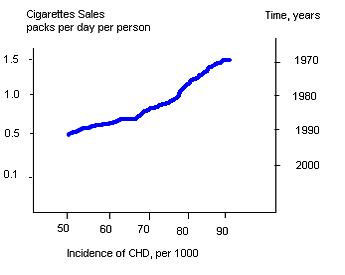 Which of the following is the best statement concerning the results of the study?
 (Multiple Choice)
4.8/5 (72)
(72) A 59-year-old woman is brought to the emergency department by her son. He reports that his mother sounded anxious and confused on the phone. When he arrived at her home, he found her shaking, sweating profusely, and unsteady on her feet. The patient's medical problems include osteoarthritis, seasonal allergies, depression, anxiety, and chronic insomnia. She has a 25-pack-year smoking history but does not use alcohol or illicit drugs. The patient took 40 mg of fluoxetine for years with only partial improvement in her depression. However, this medication was discontinued a month ago. She was recently started on phenelzine. Her other medications include ibuprofen, diphenhydramine, and lorazepam. Temperature is 38.3 C (101 F), blood pressure is 160/90 mm Hg, pulse is 116/min, and respirations are 24/min. On examination, the patient is oriented to person and place but not time. She is agitated, diaphoretic, and tremulous. Oropharyngeal examination reveals no abnormalities; mucous membranes are dry. Cardiopulmonary examination reveals tachycardia but is otherwise normal. The patient's abdomen is soft, nontender, and nondistended with increased bowel sounds. Deep tendon reflexes are increased. Muscular strength is preserved, but there is some muscular rigidity in the lower extremities. Which of the following is the most likely diagnosis?
(Multiple Choice)
4.8/5 (89)
(89) An 82-year-old man comes to the office for an annual follow-up visit. The patient says, "Over the last 2 months I have had several episodes of shortness of breath and dizziness while walking up the stairs. I also don't have energy like I did before and feel fatigued even after a short stroll around the house." The symptoms improve spontaneously after several minutes of rest, and he has had no chest pain, cough, or palpitations. The patient has no leg swelling or difficulty sleeping at night. Medical history is significant for hypertension, hyperlipidemia, osteoarthritis, depression, and diet-controlled type 2 diabetes mellitus. He lives with his daughter and is independent in his activities of daily living. The patient is a former smoker, with a 15-pack-year history, and quit over 20 years ago. Temperature is 37 C (98.6 F), blood pressure is 146/84 mm Hg, pulse is 78/min, and respirations are 14/min. BMI is 27.6 kg/m2. The patient's pulse oximetry shows 98% while resting and breathing ambient air. He is comfortable and engaging and exhibits a full range of affect. Mucous membranes are pink and moist. There is no jugular venous distension or lymphadenopathy. The thyroid is normal to palpation. Bilateral breath sounds are normal with no wheezing or crackles. Cardiac examination reveals that the point of maximal impulse is slightly displaced to the left and that there is an S4 gallop with no murmurs. The abdomen is nondistended, soft, and nontender with normoactive bowel sounds. There is no hepatosplenomegaly. The patient has mild crepitus of the knee joints with no effusion or tenderness. There is no lower extremity edema. Blood cell counts and serum chemistry studies are within normal limits. ECG shows sinus rhythm, evidence of left ventricular hypertrophy, and nonspecific ST-segment and T-wave changes. Which of the following is likely to be most helpful in determining the cause of this patient's symptoms?
(Multiple Choice)
4.9/5 (84)
(84) A 38-year-old man with type 1 diabetes for the past 24 years comes to the physician due to pain in his feet. He describes burning pain in both feet involving the toes and forefoot. On examination, blood pressure is 145/86 mm Hg and pulse is 78/min. His hemoglobin A1c values in the past 2 years have ranged from 9%-10%. Which of the following statements is most accurate regarding this patient's diabetic neuropathy?
(Multiple Choice)
4.8/5 (78)
(78) A 26-year-old Caucasian male presents to the emergency department with a three day history of dull back pain, progressive difficulty in walking, and urinary retention. He had a mild upper respiratory infection one week ago, but he is otherwise healthy. He is not taking any medications and denies drug abuse. His temperature is 36.7 C (98 F), blood pressure is 120/76 mmHg, pulse is 80/min, and respirations are 16/min. Neurologic examination reveals a decreased muscle strength (2/5) bilaterally in the lower extremities, hyporeactive knee and ankle reflexes, and decreased pain sensation up to the umbilical level. Which of the following is the most likely diagnosis of this patient?
(Multiple Choice)
4.9/5 (85)
(85) A healthy 75-year-old African-American man comes to the physician because of persistent lower back pain for the past six months. The pain disappears when he sits down, improves when he bends over his knees, and gets worse when he extends his back. A couple of times before, when he was walking, he had a sudden onset of intense pain radiating from his back to his thighs. His other medical problems include hypertension, gastroesophageal reflux disease and rheumatoid arthritis. He does not use tobacco, alcohol, or drugs. He lives in a house with his wife. His medications include aspirin, atenolol, lansoprazole, and naproxen. He has no known drug allergies. On physical examination, straight-leg raising to 90 degrees is negative. Hyperextension of the lumbar spine produces lumbar pain radiating to the gluteal region. His pedal pulses are palpable and full.
Which of the following is the most likely diagnosis?
(Multiple Choice)
4.9/5 (66)
(66) A 22-year-old Caucasian female is brought to your office by her boyfriend after he found her unconscious on the bed. He says that he is unaware of her past medical history, but remembers one similar episode that resolved completely. Her temperature is 36.7 C (98 F), blood pressure is 130/80 mm Hg, pulse is 90/min, and respirations are 18/min. The patient is unresponsive to verbal and tactile stimuli. Physical examination reveals a symmetric decrease in muscular tone and normal deep tendon reflexes. Pupils are symmetric, 5mm, and reactive to light. Irrigation of the right external auditory canal with cold water reveals a transient, conjugate, slow deviation of gaze to the right, followed by saccadic correction to the midline. Which of the following is the most likely cause of this patient's condition?
(Multiple Choice)
4.7/5 (99)
(99) A 35-year-old woman is being evaluated for uncontrolled hypertension. She was recently diagnosed with diabetes mellitus. Medical history is significant for mood swings. Temperature is 36.7 C (98 F), blood pressure is 150/100 mm Hg, pulse is 88/min, and respirations are 14/min. Lungs are clear on auscultation bilaterally, and the heart rhythm is regular. Abdominal auscultation fails to reveal any bruit. All peripheral pulsations are full. Laboratory results are as follows: 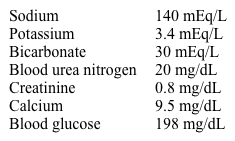 Chest x-ray is suggestive of dorsal vertebral osteopenia. Which of the following is the most appropriate investigation?
 (Multiple Choice)
4.9/5 (87)
(87) A 56-year-old woman comes to the physician with lethargy, weight loss, nausea, vomiting, and constipation for the past 2 months. She is 3 years postmenopausal and has no long-standing medical problems. The patient currently takes no prescription medications and does not use tobacco or alcohol. Her family history is positive for osteoporosis and hypertension. Her blood pressure is 124/66 mm Hg and pulse is 64/min. She weighs 63 kg (138 lb) and is 160 cm (5' 3") tall. Her body mass index is 24.4 kg/m2. The patient appears mildly pale. The thyroid gland is normal to palpation. Heart and lung sounds are normal. Abdominal examination is unremarkable. Neurologic examination shows prolonged relaxation time of the ankle reflexes. Laboratory results are as follows: 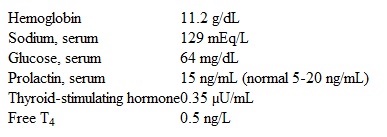 Red blood cells are normochromic and normocytic. The 8:00 AM serum cortisol is 7 µg/dL (normal 5-20 µg/dL). Repeat thyroid function tests show similar results.
Which of the following is the most appropriate next step in evaluation of this patient?
Red blood cells are normochromic and normocytic. The 8:00 AM serum cortisol is 7 µg/dL (normal 5-20 µg/dL). Repeat thyroid function tests show similar results.
Which of the following is the most appropriate next step in evaluation of this patient? (Multiple Choice)
4.9/5 (80)
(80) A 50-hour-old boy is in the nursery with several episodes of bilious emesis. He is unable to tolerate breast or bottle feeds. He has urinated twice but has not passed meconium. The boy was born to a primigravid woman at 39 weeks gestation; birth was by cesarean section due to failure to progress. The pregnancy was uncomplicated and prenatal laboratory results were normal. The mother declined genetic testing during the pregnancy. Membranes ruptured spontaneously 2 hours before delivery and the fluid was clear. Apgar scores were 9 at both 1 and 5 minutes. Weight, length, and head circumference are average for gestational age. Examination shows a non-dysmorphic boy with a markedly distended abdomen. The anus is open and normally positioned. No stool is palpable in the rectal vault. A nasogastric tube is placed for decompression and intravenous fluids are initiated. Abdominal x-ray shows multiple dilated loops of large bowel and no air in the rectum. Contrast enema shows a normal caliber rectosigmoid colon and a dilated descending colon. Which of the following is the best test to confirm the underlying diagnosis?
(Multiple Choice)
4.8/5 (60)
(60) 
Filters
- Essay(0)
- Multiple Choice(0)
- Short Answer(0)
- True False(0)
- Matching(0)