



 Chat with AI
Exam 2: Foundations of Independent Practice

Exam 1: Advanced Clinical Medicine1 k+ Questions
Exam 2: Foundations of Independent Practice597 Questions
Select questions type


A 26-year-old woman with Down syndrome and intellectual disability is brought to the gynecologist by her mother for discussion of contraceptive options. The patient lives with her mother, who is her legal guardian and is responsible for all her health care decisions. The mother is concerned because she recently discovered that her daughter is having sexual intercourse with a man with Down syndrome who attends her day program. The daughter is not currently using contraception. Based on her knowledge of the patient's level of functioning, the mother is very worried that her daughter will be unable to use contraception correctly or consistently. The mother says, "I would really like her to have a tubal ligation. It would be the best for everyone concerned. My daughter struggles to take basic care of herself and could never care for a baby. She has no understanding of what is involved." When questioned, the patient says, "I don't know about babies and birth control. Maybe my mom knows best, but I don't think I want to have an operation because they hurt." Which of the following is the most appropriate course of action?
(Multiple Choice)
4.8/5  (78)
(78) A 41-year-old man comes to the physician with a faint skin rash over his upper body. He first noticed it in the spring season, but it worsened during the summer. The patient has mild itching, but otherwise the rash is asymptomatic. He takes omeprazole for acid reflux but his medical history is otherwise unremarkable. He does not use tobacco, alcohol, or illicit drugs. The patient has been sexually active with 2 partners during the last year, and uses condoms on most occasions. The physical examination findings are shown below. 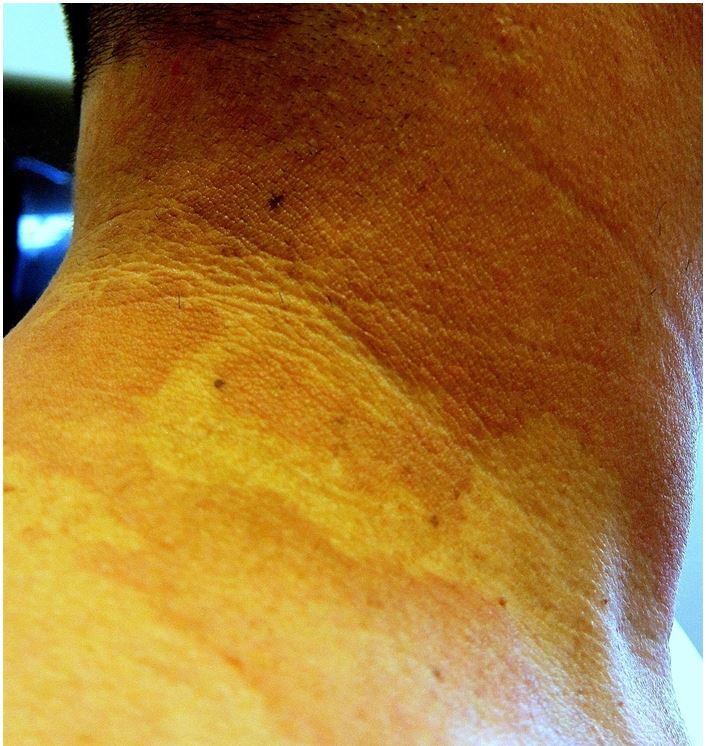 Which of the following is the best treatment for this patient?
 (Multiple Choice)
4.9/5 (76)
(76) A 48-year-old man is brought to the emergency department from a group home due to fever, cough, and lethargy. The group home supervisor says that the patient has had a productive cough for the past several days and since yesterday has become progressively lethargic. The patient has a history of hypertension and bipolar disorder. He takes amlodipine and valproic acid. He does not use tobacco, alcohol, or illicit drugs. Temperature is 38.3 C (101 F), blood pressure is 118/72 mm Hg, pulse is 102/min, and respirations are 20/min. Pulse oximetry shows 96% on ambient air. The patient is somnolent but awakens to touch and follows instructions. He has decreased breath sounds and crackles in the right lower hemithorax. Cardiac examination is normal with the exception of tachycardia. There is no extremity edema. Leukocytes are 17,200/mm3 and chest radiography shows right lower lobe opacity with air bronchograms. Other laboratory results are as follows: 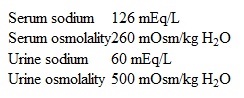 Which of the following is the most likely cause of this patient's observed electrolyte abnormalities?
 (Multiple Choice)
4.9/5 (70)
(70) A 58-year-old homeless man is being evaluated for wrist pain after an injury. He was found lying on the sidewalk by a local shopkeeper, who then called for an ambulance. He does not remember the details of the injury. The patient reports no other focal pain but says that he hurts "all over." On examination in the emergency department, he appears intoxicated and distractible. He has scattered contusions and abrasions in various stages of healing. There is diffuse swelling at the distal forearm with significant tenderness. The patient is uncooperative with further examination of the upper extremity due to pain. X-ray is shown in the image below. 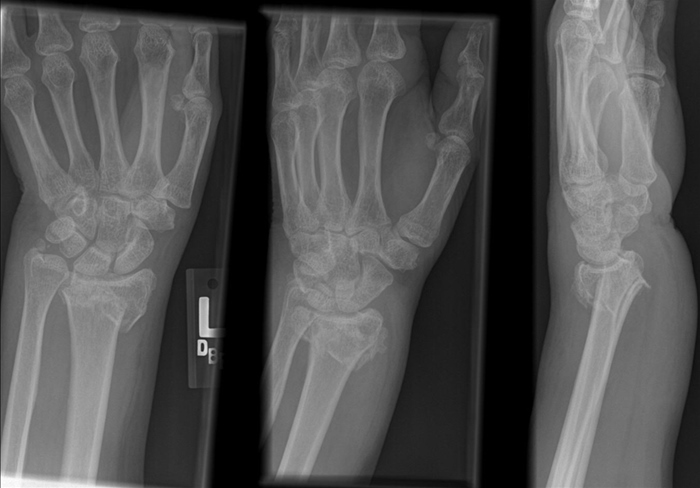 Which of the following is the most likely mechanism of injury?
 (Multiple Choice)
4.9/5 (73)
(73) A 15-year-old girl is brought to the office by her mother to discuss contraception. The patient recently became sexually active with her boyfriend of a year and uses condoms most of the time. She revealed to her mother that she has been sexually active, and they decided that she needs a reliable form of contraception. The patient reports no vaginal spotting or abnormal vaginal discharge. She has no chronic medical conditions or previous surgeries. She started menstruating at age 12; menses occur every 29 days and consist of 2-3 days of light bleeding and no cramping. Family history is noncontributory. The patient takes no medications and does not use tobacco, alcohol, or illicit drugs. She does well in school and is a member of the debate team. Blood pressure is 120/80 mm Hg and pulse is 68/min. BMI is 23 kg/m2. The rest of the physical examination is unremarkable. Sexually transmitted infection screening is performed. Urine pregnancy test is negative. In addition to condom use, which of the following is the best contraception option for this patient?
(Multiple Choice)
4.7/5 (83)
(83) A 55-year-old man comes to the emergency department due to blood-tinged vomiting. The patient was at a party the evening prior to presentation and consumed a large quantity of alcohol. After leaving, he developed symptoms of nausea and retching, followed by vomiting several hours later. The emesis was initially clear but then became intermixed with small amounts of blood. He has no abdominal pain, weight loss, or changes in stool. The patient has a history of alcoholism and was admitted for acute pancreatitis a few months ago. He currently takes no medications or over-the-counter supplements. The patient drinks 4 or 5 beers daily but does not use tobacco or illicit drugs. Temperature is 36.7 C (98.1 F), pulse is 88/min, and respirations are 16/min. Physical examination shows dry mucous membranes, flat jugular veins, clear lung fields, and normal S1 and S2. The abdomen is soft and tender in the midepigastrium with no rebound tenderness or rigidity. Bowel sounds are normal. There is moderate splenomegaly without hepatomegaly. No edema is present. Laboratory results are as follows: 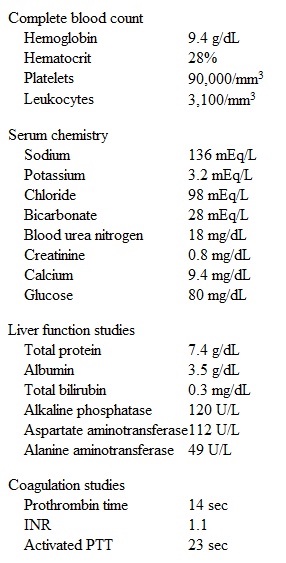 The patient undergoes an esophagogastroduodenoscopy that reveals several small, erythematous erosions at the gastroesophageal junction as well as hyperemia and petechiae throughout the gastric mucosa. Incidentally, varices are seen in the fundus of the stomach but no esophageal varices are seen. Which of the following is the most likely cause of this patient's varices?
 (Multiple Choice)
4.9/5 (75)
(75) A 65-year-old man comes to the office due to multiple hand lesions. Pink, white, and gray spots have been present on his hands for several years and are slowly increasing in number and size. The lesions do not itch or hurt. Medical and family histories are unremarkable. The patient takes no medications. BMI is 27 kg/m2. Skin examination of the right hand is shown in the exhibit, 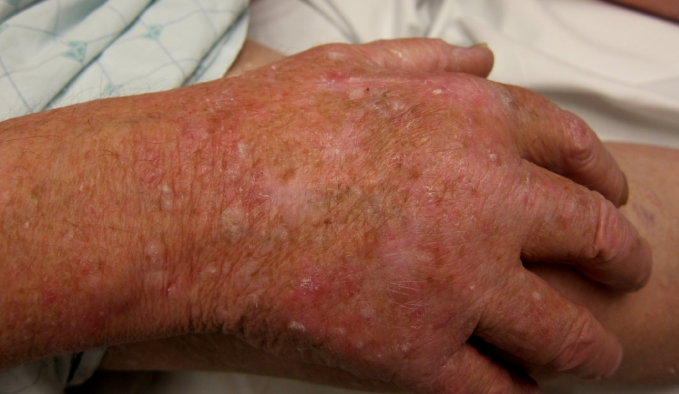 and the left hand has similar lesions. This patient is at greatest risk of developing which of the following?
 (Multiple Choice)
4.9/5 (75)
(75) A 10-year-old boy is brought to the emergency department following an episode of generalized tonic-clonic seizure. Intravenous benzodiazepine was administered, terminating the patient's seizure. He has had no trauma, fever, headache, vomiting, or cough. For the last 2-3 months, the patient has had muscle pain and cramping that is exacerbated by exercise and relieved after a short rest. His mother states that for the past year his school performance has been deteriorating. Physical examination shows a sedated child who is arousable to painful stimuli. There are no dysmorphic features. Eye examination reveals pupils that are 3 mm in diameter and briskly reactive to light; bilateral cataracts are seen. The heart, lungs, and abdomen are normal. The patient moves all extremities on painful stimulation. Deep tendon reflexes are 3+ throughout. Serum calcium is 6 mg/dL, serum albumin is 3.8 g/dL, serum phosphorus is 8.2 mg/dL, and parathyroid hormone level is 150 pg/mL (normal: 10-65). A non-contrast CT scan of the head reveals calcification of the basal ganglia. Which of the following is the most likely cause of this patient's hypocalcemia?
(Multiple Choice)
4.7/5 (84)
(84) 53-year-old woman comes to the office for a routine follow-up visit. She has seen the physician for menopausal symptoms for the past 2 years and started medication for worsening hot flashes 6 months ago. She says, "I'm doing pretty well; that medication you gave me seems to have helped my hot flashes somewhat. My sleep isn't great, but it's not that different from usual. At least I'm not waking up 3 times a night anymore." Her medical problems include hypertension and chronic insomnia. Medications include enalapril and venlafaxine that was started at her last visit to target vasomotor symptoms. The patient drinks a glass of wine each day and does not use tobacco. She works as a librarian and is married to her second husband. She exercises regularly and enjoys socializing with her friends when she has the opportunity. When the physician inquires about her home life, she says her marriage is "fine" although she wishes that she and her husband had more time for each other and were more intimate. She says, "Actually, I am a little upset with my husband. He comes home from work exhausted and just wants to watch television. He doesn't understand the changes I'm going through. He doesn't seem interested in anything, including me!" The patient continues, "I guess it shouldn't matter to me as much anymore, but my sex life has been frustrating for the past 2 years. My husband and I are never in the mood at the same time; when we are, well, let's just say we're not 18 anymore! Although I wish our sex life was better, sometimes I feel like giving up because it's just not that pleasurable. It's become easier not to try." Which of the following is the most likely explanation of this patient's sexual dysfunction?
(Multiple Choice)
4.9/5 (86)
(86) A 14-year-old girl is brought to the office for evaluation of lower abdominal pain. The pain began a year ago and was intermittent, was relieved with ibuprofen, and typically resolved in 3-4 days. However, the patient now has constant, dull, lower abdominal pain that is exacerbated for a few days each month. Over the last 2 months, she has had no appetite and has lost 4 kg (8.8 lb). The patient has had no fever, chills, or diarrhea but does have chronic constipation. She does not use tobacco, alcohol, or illicit drugs. She is not sexually active and has not had a menstrual period. The patient is in high school, where she is an honor roll student and a member of the track team. Blood pressure is 100/60 mm Hg and pulse is 62/min. Height is at the 27th percentile and weight is at the 32nd percentile for age. Breast development is Tanner stage 3. Abdominal examination reveals a tender suprapubic mass; there is no rebound or guarding. Examination of the genitalia shows Tanner stage 3 pubic hair development and a smooth, blue mass protruding from between the labia majora. Which of the following is the most likely diagnosis in this patient?
(Multiple Choice)
4.9/5 (71)
(71) A 26-year-old man comes to the physician for a follow-up visit. One month ago, he came in for genetic counseling and testing because he wanted to know if he could develop Huntington disease. He has no medical problems and does not use tobacco, alcohol, or illicit drugs. His father was diagnosed with Huntington disease at age 33 and died 12 years later after experiencing progressive and disabling neurologic deterioration. The patient has an older sister and a younger brother who are apparently healthy. He has been married for 5 years and is the father of 2 children. His wife is 25 weeks pregnant. As the physician is about to discuss his test results, the patient says, "I've changed my mind, doc. I don't want to know the test results." Which of the following is the most appropriate response to this patient?
(Multiple Choice)
4.8/5 (75)
(75) A 34-year-old woman, gravida 3 para 2, at 12 weeks gestation comes to the office for a routine prenatal visit. The patient reports no nausea, vomiting, abdominal pain, or vaginal bleeding. The patient's 2 previous pregnancies were complicated by poorly controlled type 2 diabetes mellitus and resulted in term cesarean deliveries for fetal macrosomia. Both children are healthy. The patient has no other chronic medical conditions. She takes a prenatal vitamin daily, and her glucose levels are controlled with an insulin regimen. She does not use tobacco, alcohol, or illicit drugs. Family history is noncontributory. Blood pressure is 120/70 mm Hg and pulse is 68/min. BMI is 30 kg/m2. Bedside Doppler examination reveals a fetal heart rate of 164/min. The patient requested a first-trimester combined test, and the results revealed normal-range nuchal translucency thickness, low pregnancy-associated plasma protein A, and an elevated β-hCG level. The results are discussed and the patient desires further management of these results. Which of the following is the best recommendation in management of this patient's laboratory findings?
(Multiple Choice)
4.8/5 (75)
(75) An epidemiologic study is conducted to evaluate the long-term complications of coronary stent placement. 10,000 patients who underwent emergency or elective percutaneous coronary intervention at tertiary care centers around the nation were randomly selected and monitored for the development of adverse events. According to the study results, 2% of patients who received bare metal stents developed stent thrombosis within a year. 40% of the patients who developed stent thrombosis died as a result. The risk of death in a patient who develops stent thrombosis is best described by which of the following epidemiologic parameters?
(Multiple Choice)
4.8/5 (73)
(73) A 19-year-old male presents to the emergency department with acute onset of breathlessness. He was feeling short of breath for the last few weeks, but it was not that severe. He denies any chest pain or cough. He is a non-smoker and non-alcoholic. His father has asthma. His respiratory rate is 22/min and pulse rate is 98/min. There is diffuse wheezing all over the lung fields. PEFR is 230 L/min, and this improves markedly after bronchodilator therapy. Which of the following is the most frequent cause of this disorder?
(Multiple Choice)
4.9/5 (77)
(77) A 55-year-old man is brought to the emergency department due to shortness of breath and weakness. The symptoms have been present for approximately 3 weeks but have rapidly progressed over the last 2 days. He felt too weak to get up to use the bathroom today. The patient was diagnosed with non-small cell lung cancer 2 years ago. At that time, he underwent surgical resection, followed by cisplatin-based combination chemotherapy. Since then, he has had follow-up CT scans every 6 months without evidence of recurrence. His last scan was 5 months ago. Other medical history includes mitral valve prolapse, for which he has been followed with echocardiography every 3 years. The patient used to take antibiotics prior to dental procedures but stopped a few years ago when his cardiologist advised him that it was no longer necessary. He currently takes no medications. His mother died of congestive heart failure at age 80 and his father has emphysema. The patient does not use tobacco, alcohol, or illicit drugs. He formerly worked as a diesel mechanic but retired at the time of his cancer diagnosis. Temperature is 37.8 C (100 F), blood pressure is 85/60 mm Hg, and pulse is 110/min and regular. Cardiac auscultation reveals distant heart sounds. The lungs are clear to auscultation. He has 1+ pitting lower extremity edema bilaterally. Bedside echocardiography shows moderate pericardial effusion. Which of the following best confirms the need for immediate invasive management in this patient?
(Multiple Choice)
5.0/5 (78)
(78) A 36-year-old Caucasian female is seen in the emergency department (ED) for the evaluation of a sudden onset, left lower chest pain and difficulty in breathing. Approximately one year ago, she was diagnosed with left lower extremity deep vein thrombosis secondary to smoking and oral contraceptive pill (OCP) use. At that time, her OCPs were discontinued, she quit smoking, and she was treated with six months of warfarin therapy. She does not have any other medical problems. Her mother and maternal aunt have had "problems with blood clots." After performing the appropriate ancillary procedures, results reveal the presence of multiple, left-sided pulmonary emboli. A diagnosis of an inherited thrombophilia is suspected. Which of the following is most likely to be present in this patient?
(Multiple Choice)
4.8/5 (73)
(73) A 14-year-old boy is brought to the office due to intermittent rhinorrhea, nasal congestion, and nasal itching for the past 2 months. He has also had periodic itchy, watery eyes and an occasional daytime cough. The boy's symptoms occur usually after he plays with a neighbor's cat, and they cause the boy to be more tired than usual and have difficulty sleeping. He has had no fever, headache, weight loss, or sick contacts. The patient has atopic dermatitis and was hospitalized for bronchiolitis at age 2. He uses a topical corticosteroid ointment as needed, and his immunizations are up to date. Family history is significant for a younger brother with asthma. Vital signs are within normal limits. Physical examination shows a well-appearing boy with dark, edematous lower eyelids and pale, boggy turbinates with clear rhinorrhea. Lungs are clear to auscultation. Skin examination shows dry, scaly patches in the antecubital fossae bilaterally with associated excoriations. Which of the following is the most effective long-term strategy for relief of this patient's symptoms?
(Multiple Choice)
4.8/5 (73)
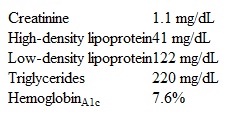
(73) A 56-year-old man with exertional chest pain comes to the office because his exercise stress echocardiogram showed evidence of mild ischemia in the posterior wall. He was recently diagnosed with type 2 diabetes mellitus and hypertension. He is a current smoker but is willing to quit. His father died of a heart attack at age 51. Physical examination is unremarkable. Laboratory results are as follows:
 Based on the information in the drug advertisement,
According to the drug advertisement, the investigators reported the median value and the median percentage change from baseline for triglyceride levels in the study patients. Which of the following best explains the reason for reporting median values as opposed to mean values?
Based on the information in the drug advertisement,
According to the drug advertisement, the investigators reported the median value and the median percentage change from baseline for triglyceride levels in the study patients. Which of the following best explains the reason for reporting median values as opposed to mean values? (Multiple Choice)
4.8/5 (76)
(76) A 72-year-old woman is brought to the emergency department due to lethargy, fever, and confusion. She was found by her family on the floor of her bedroom. The patient is unable to provide further history, but she told her family 2 days ago that she had urinary incontinence and foul-smelling urine. She has a history of hypertension, osteoarthritis, and recurrent urinary tract infections. The patient's medications include lisinopril, amlodipine, and a topical pain medication. She has no known drug allergies. Temperature is 39 C (102.2 F), blood pressure is 74/46 mm Hg, pulse is 133/min, and respirations are 24/min. The patient is lethargic and responds only to simple commands. Cardiopulmonary auscultation reveals clear lung fields and normal heart sounds with no murmurs. The abdomen is soft, nondistended, and nonpainful, but palpation of the right flank causes grimacing. The extremities are warm to the touch with no edema. A chest radiograph is unremarkable. Leukocyte count is 21,000/mm3 with 91% neutrophils. Urinalysis is positive for nitrates and microscopic examination of the urine shows a white blood cell count of 200+/hpf. Intravenous antibiotics are administered. Multiple boluses of isotonic fluid are given peripherally with no improvement in the patient's vital signs. She is prepared for insertion of a central venous catheter. Which of the following is most likely to reduce the risk of catheter-associated infection in this patient?
(Multiple Choice)
5.0/5 (76)
(76) A 32-year-old woman comes to the office accompanied by her sister. The patient says "my sister thinks I'm losing my mind; I don't know what's going to happen to me." Her sister states that for the past few weeks the patient has become convinced that "ballerinas" are visiting her apartment and going through her belongings. The patient says, "At first I wasn't sure, but now I know they've been coming to scare me out of my apartment. I see them sometimes running around at night. The one with the long black hair wants to strangle me. I'm scared for my life." The patient's sister has not noted any intruders. The patient does not appear to be otherwise confused. In review of systems, she acknowledges feeling more tired over the past few months and losing 4.5 kg (10 lb) over the same period. She also reports pain in her knuckles and wrists. Medical history is unremarkable except for episodes of recurrent depression in her 20s. She takes no medications. The patient does not use tobacco, alcohol, or illicit drugs. She has a family history of depression. Temperature is 36.7 C (98.1 F), blood pressure is 148/92 mm Hg, pulse is 82/min, and respirations are 16/min. Examination shows mildly swollen wrists bilaterally and mild edema in both lower extremities but is otherwise normal. Laboratory results show a white blood cell count of 3,900/mm3; serum chemistries are within normal limits. Which of the following is the most appropriate next step in diagnostic evaluation of this patient?
(Multiple Choice)
4.8/5 (81)
(81) 
Filters
- Essay(0)
- Multiple Choice(0)
- Short Answer(0)
- True False(0)
- Matching(0)