



 Chat with AI
Exam 2: Foundations of Independent Practice

Exam 1: Advanced Clinical Medicine1 k+ Questions
Exam 2: Foundations of Independent Practice597 Questions
Select questions type


A 63-year-old Caucasian male is being evaluated for difficulty sleeping and morning headaches. He has been sleeping upright for the last two months because he gets short of breath while lying flat. He has also had mild dysphagia and difficulty walking for the last six months. He denies any chest pain, palpitations, wheezing, cough, or lower extremity swelling. His blood pressure is 127/86 mmHg and heart rate is 96/min, regular in rhythm. His BMI is 27 kg/m2. Physical examination reveals some lower extremity muscle atrophy and tongue fasciculations. There are minimal crackles at the right lung base. His forced vital capacity is 57% of the predicted value while upright and 42% of the predicted value while supine. Which of the following is the most likely cause of this patient's dyspnea?
(Multiple Choice)
4.9/5  (74)
(74) A 64-year-old man comes to the office due to progressive fatigue and weakness over the past several months. The patient says, "I have very little energy and can hardly walk a block without resting." He has had no chest pain, palpitations, or dyspnea at rest but has had mild breathlessness while walking. His wife adds that he has lost his appetite, and she believes that he has lost some weight. The patient was diagnosed with hypertension several years ago but does not take any medications. He drinks a half-pint of whiskey a day. Blood pressure is 148/86 mm Hg, pulse is 80/min, and respirations are 14/min. Oxygen saturation is 98% while breathing ambient air. Lung auscultation is normal and heart sounds are normal with no murmur. The abdomen is nondistended, soft, and nontender on palpation. Rectal examination shows occult blood-positive brown stool. Laboratory results are as follows: 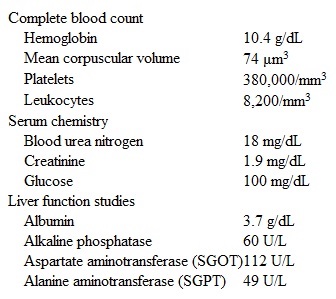 Which of the following is the best initial step in evaluation of this patient's anemia?
 (Multiple Choice)
5.0/5 (87)
(87) A large-scale clinical trial was conducted to assess the effect of carvedilol (a mixed alpha- and beta-blocker) on the clinical course of New York Heart Association class III-IV chronic heart failure. The study reported that serum noradrenaline levels (a marker of the degree of neurohumoral activation) were correlated with serum sodium levels with correlation coefficient r = -0.39 (p = 0.005). Which of the following statements best describes the observed relationship between serum noradrenaline levels and serum sodium levels?
(Multiple Choice)
4.9/5 (80)
(80) A 10-month-old boy is brought to clinic for evaluation of decreased activity. The patient has been progressively tired over the past few weeks. He normally is able to crawl and pull up to a stand, but lately he is so tired that he prefers to sit still. The boy is primarily breastfed and eats some pureed fruits. He has 6 or 7 wet diapers and 3 soft stools per day. He has no known medical conditions or prior hospitalizations. The patient lives with his parents and 3-year-old sister, none of whom have chronic medical conditions. His parents are originally from Ghana and moved to the United States 4 years ago. Temperature is 36.7 C (98 F) and pulse is 100/min. Examination shows mild conjunctival pallor. The lungs are clear to auscultation. A 2/6 systolic murmur is auscultated over the precordium. The abdomen is soft and nontender, and bowel sounds are present. Laboratory results are as follows: 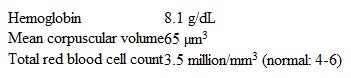 Which of the following is the most likely cause of this child's anemia?
 (Multiple Choice)
4.9/5 (85)
(85) A 25-year-old man is brought to the hospital for admission by his mother. She says, "I feel badly but I couldn't manage him at home anymore. He locks himself in his bedroom and refuses to shower. Yesterday, he started screaming as if he were arguing with someone but no one was there." The patient is very guarded and makes no eye contact. He says, "The world is coming to an end and I am waiting to receive a message through the Internet indicating the exact date." He also claims that family members want to kill him because they believe the world could be saved if he were dead. The patient describes his mood as "anxious and fearful" and does not feel depressed. He has no suicidal or homicidal ideation. The patient was first hospitalized at age 19 and treated with risperidone and clonazepam. In the past 2 years, he was hospitalized 3 times for acute psychosis and treated with olanzapine. In each case he improved while in the hospital but then stopped taking the medication shortly after discharge. The patient has a history of childhood asthma and alcohol abuse. He has no known drug allergies. His sister and father have a history of anxiety disorder. Physical examination shows no abnormalities. The patient is 175 cm (5 ft 9 in) tall and weighs 120 kg (265 lb). His BMI is 39 kg/m2. Urine toxicology screen is negative. His mother worries that his illness is getting worse and asks if anything else can be done. Which of the following is the most appropriate response to the mother's concerns?
(Multiple Choice)
4.9/5 (79)
(79) A 51-year-old executive with a history of cocaine abuse and peptic ulcer disease is scheduled to undergo a routine colonoscopy at an outpatient surgical center. While preparing for the procedure, a staff nurse accidentally suffers a needlestick injury while placing an intravenous peripheral line on the patient. The physician in charge of the case notifies the appropriate administrators and orders immediate laboratory testing for infectious disease, including HIV and hepatitis B and C. When informed, the patient becomes very upset and refuses to give blood for testing as he does not want to be tested for HIV. He insists that he is at very low risk and testing would be unnecessary. Which of the following would be the most appropriate next step?
(Multiple Choice)
4.9/5 (79)
(79) A 52-year-old man is brought to the emergency department by his roommate after threatening to commit suicide. He is angry about being taken to the hospital and says, "I just want to go home and sleep." His roommate says, "I can't take it anymore; I thought he was going to jump out of the car on the way to the hospital." The patient has a history of recurrent major depression, post-traumatic stress disorder, and alcohol abuse. He describes increasing depression since his divorce 5 years ago. He feels hopeless, has difficulty getting out of bed, and eats only one meal a day. The patient ruminates about his failed marriage and blames himself for his heavy drinking and losing contact with his 2 grown children. He has always owned a gun, which he usually keeps in a locked drawer in a bedside table. However, in the last week he has taken the gun out and held it before going to sleep "because it feels like a security blanket, it's reassuring." The patient has suicidal thoughts but does not think he will act on them. He says, "I just need to know I have a way out." His medical record indicates that he tried to overdose 3 months ago by taking a handful of sleeping pills and drinking 2 liters of vodka. Last year, he tried to hang himself in his garage but was discovered by his roommate. The patient has been followed by a psychiatrist in an outpatient clinic. He felt better when taking duloxetine but has not taken the medication for the past few months as he can no longer afford it. He insists that he is not feeling suicidal now and demands to leave. The patient is placed on 1:1 observation, and arrangements are made to hospitalize him. He is upset and tearful and starts to pace. He says angrily, "You can't keep me here against my will. If I wanted to kill myself, I would have done it already. I just want to go home so I can finally get some rest." The nursing staff attempts to calm the patient down and offers him water and a sandwich, which he refuses. The physician approaches the patient to explain the treatment plan. Which of the following is the most appropriate statement?
(Multiple Choice)
4.9/5 (74)
(74) A 14-year-old girl is brought to the clinic due to behavioral changes over the last 2-3 months. She has become increasingly angry and easily annoyed, arguing with teachers at school and her mother at home and refusing to do her chores. The patient was previously an honor roll student, but her grades have dropped significantly and she is now failing most subjects. When asked why her grades have dropped, the patient says, "It's been really hard to focus on what the teacher is saying and I have trouble remembering to turn in my homework." Her mother reports that the girl has gained 18.1 kg (40 lb) in the last 3 months. The patient's father is currently unemployed and abuses alcohol. To help with finances, the family moved in with the girl's aunt and uncle 9 months ago. The patient became sexually active 3 months ago, has had 4 lifetime partners, and uses no birth control. She smokes marijuana several times a week but does not use tobacco or alcohol. BMI is 33 kg/m2. On mental status examination, the patient appears fidgety and avoids eye contact during the examination. She still enjoys playing with her little brother and has no thoughts of death or suicide. Which of the following is the most likely explanation for this patient's change in behavior?
(Multiple Choice)
4.9/5 (91)
(91) A 24-year-old man is evaluated for fatigue and palpitations. He reports good exercise tolerance with only mild dyspnea on exertion. Electrocardiogram shows normal sinus rhythm with a right bundle branch block. Right and left cardiac catheterization is obtained and the following blood oxygen saturation values are reported: Which of the following is the most likely physical examination finding in this patient?
(Multiple Choice)
4.9/5 (83)
(83) A 65-year-old man remains hospitalized on the surgical intensive care unit 3 weeks after a small bowel resection secondary to ischemic bowel disease. The postoperative course was complicated by wound dehiscence and sepsis. The patient is slowly recovering now but still has an open abdominal wound and a tracheostomy. He is alert and oriented and has given the physician permission to speak with family members. The patient's son and daughter are visiting today. They are both very upset and approach the physician to discuss their concerns. The daughter says, "My father should be better by now." The son says, "I can't understand how you allowed him to get an infection. Aren't there precautions to prevent this from happening?" They demand that his abdomen be closed immediately and the patient transferred to a different hospital. Which of the following is the most appropriate response to the patient's family?
(Multiple Choice)
4.7/5 (84)
(84) A 45-year-old man is diagnosed with dilated nonischemic cardiomyopathy. Late gadolinium enhancement cardiac magnetic resonance (CMR) imaging shows a left ventricular ejection fraction (LVEF) of 20% and evidence of extensive midwall myocardial scarring. A recent study determined prognosis in patients with dilated cardiomyopathy using CMR-derived LVEF and evidence of midwall myocardial scarring (fibrosis). Two models were assessed: one model was based on LVEF alone, and the other incorporated the presence or absence of fibrosis. The following 5-year prediction curves were reported: 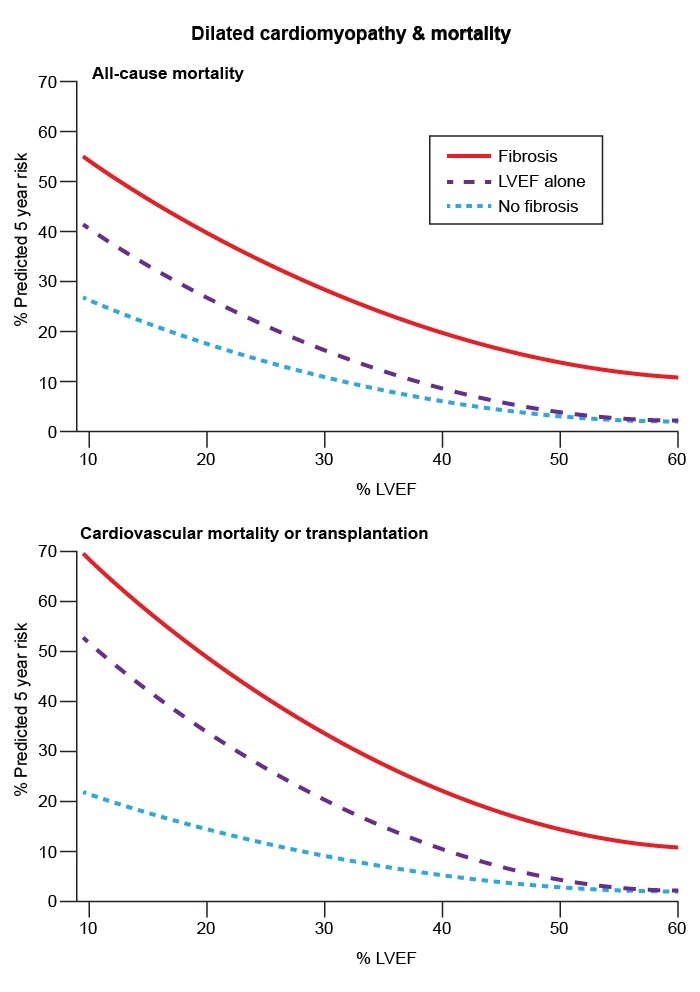 Based on the study results, what is the approximate predicted 5-year all-cause mortality for this patient?
 (Multiple Choice)
4.7/5 (76)
(76) A randomized controlled trial assigned patients with diabetes to a new combination antihypertensive pill or placebo group for blood pressure control. Routine administration of the combination pill was associated with a reduction in the risk for some macrovascular or microvascular events at the end of the trial. The investigators decided to follow-up with patients after the end of the study to see if the benefits of therapy were sustained. They report the following hazard ratio curves comparing the combination pill to placebo from the end of the trial (T1) to 6 years afterward. 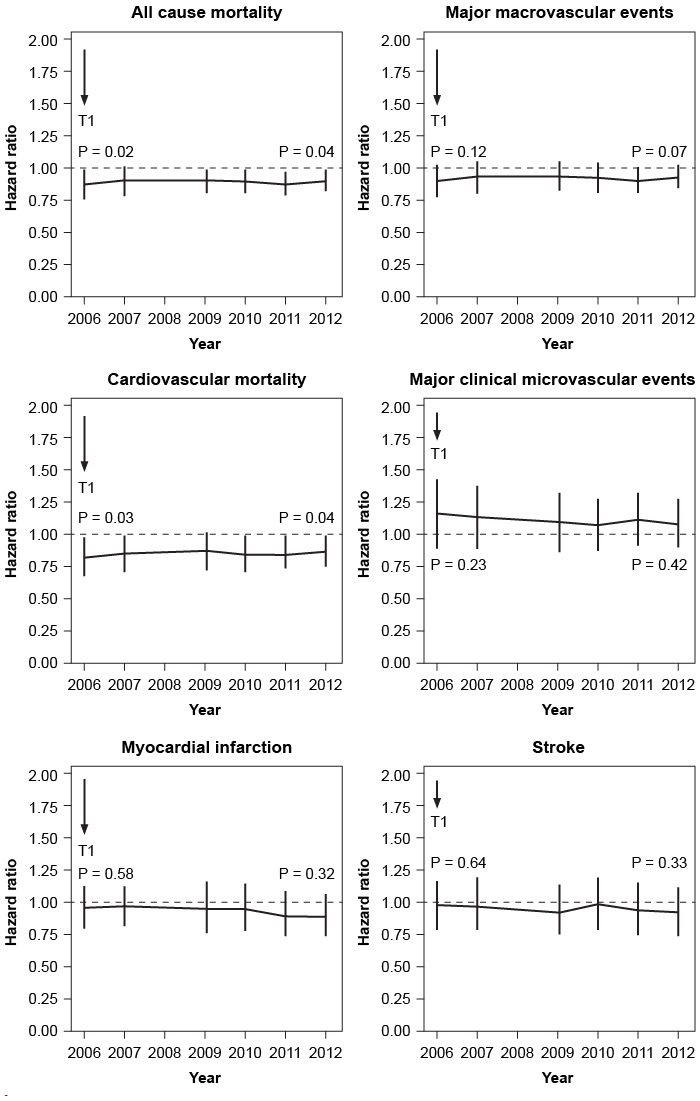 Administration of the combination pill resulted in a statistically significant sustained reduction in events for which of the following outcomes (setting α = 0.05)?
 (Multiple Choice)
5.0/5 (73)
(73) A 3-month-old girl is brought to the emergency department by her mother for increased fussiness over the last 2 days. The mother says, "She is fussier than usual, especially when I change her diaper or pick her up. I'm exhausted and cannot get her to stop crying." The infant has had no fever, runny nose, vomiting, or diarrhea. She breastfeeds every few hours but "less than usual" and has had 2 wet diapers in the last 24 hours. The patient was born via cesarean delivery for breech presentation at 34 weeks gestation. She did not require mechanical ventilation, and her neonatal intensive care unit course was unremarkable. The patient has been "a bit colicky" but is otherwise healthy; she received a set of vaccinations at age 2 months. Temperature is 37.2 C (99 F), pulse is 152/min, and respirations are 40/min. The patient cries throughout the examination and is difficult to console. Cardiopulmonary examination is unremarkable. The abdomen is soft and nondistended. The left leg is flexed and externally rotated and is held very still compared with the right. There is decreased range of motion of the left hip. Laboratory results show a leukocyte count of 16,000/mm3 and a C-reactive protein of 8.5 mg/L. Ultrasound of the left hip shows a small effusion. Which of the following is the most likely diagnosis for this patient?
(Multiple Choice)
4.9/5 (74)
(74) A 14-year-old boy is brought to the office by his mother, who is concerned about his academic performance. The patient has a history of attention-deficit hyperactivity disorder (ADHD) diagnosed at age 6. He responded well to methylphenidate and continued stimulant medication through age 11. Currently, he takes no medication. His mother says, "He is less hyperactive at home and I no longer get phone calls from the school about his behavior, but adjusting to high school has been a challenge. Even though he is very bright, he has difficulty keeping up with his schoolwork. He often hands assignments in late and his work is sloppy. Now that he is in high school and grades are important, I worry that his poor grades will limit his options for college." The boy feels fine but says that "the teachers are boring and treat me unfairly. I know the answer, but then get in trouble for not raising my hand." The patient struggles, particularly in math, and is getting mostly Cs and Ds in his other classes. He has several friends and was excited when he made the soccer team. However, he decided to quit after receiving several warnings for being late to practice and forgetting his equipment. His mother says that he is much less hyperactive at home and hopes that he has "outgrown" his ADHD by now. The physician meets with the boy alone to obtain additional history. The patient says, "I hate high school. The work really isn't that hard; I just always put off my homework until the last minute or hand in assignments late. I know I would have gotten better test grades if I had just caught some stupid mistakes. I'm always the one who gets in trouble for talking, when it's really the kid next to me who gets me started. I also got in trouble with the soccer team for forgetting my uniform and talking back and not listening to the coach. My friends think I'm funny, but when it comes to getting together outside of school, they always say they're busy and can't make it." The boy has tried alcohol and marijuana on 2 occasions, but does not use these regularly. There is a family history of alcohol abuse in the patient's father and grandfather. The boy is interested in restarting medication for attention-deficit hyperactivity disorder. Which of the following is the most appropriate statement regarding treatment for this patient?
(Multiple Choice)
4.9/5 (73)
(73) A 65-year-old man with persistent atrial fibrillation comes to the emergency department with a cold right foot. He has not been compliant with anticoagulation therapy. His other medical problems include type 2 diabetes mellitus, hypertension, and chronic nephropathy with low-grade proteinuria. The patient's blood pressure is 122/70 mm Hg and pulse is 112/min and irregular. Physical examination shows a cold right leg with absent dorsalis pedis and posterior tibial pulses. An emergency arteriogram reveals right popliteal artery occlusion, which is treated with thrombus aspiration with good angiographic results. Two hours later, the patient has intense pain in the right leg, accompanied by an "ant crawling" and burning sensation. Which of the following is the most likely diagnosis?
(Multiple Choice)
4.9/5 (72)
(72) A 42-year-old woman comes to the clinic for a routine physical examination. She has no specific concerns, but on review of systems acknowledges that she has recently been getting tired easily. The patient also informs the physician of occasional palpitations, which she describes as a "fast heartbeat." Family history is significant for hypertension and type 2 diabetes mellitus. She is a lifetime nonsmoker. The patient does not drink alcohol or use illicit drugs. Vital signs are normal. She was told in the past that she has "a heart problem" that she thinks is mitral valve prolapse. The patient was advised to follow-up with a cardiologist, but she says she had been feeling well and did not see a doctor. Which of the following physical findings would be most consistent with this diagnosis?
(Multiple Choice)
4.8/5 (76)
(76) A 62-year-old man with a history of hypertension comes to establish care. He recently moved to the area and states that his prior physician was treating him for high blood pressure. The patient has no current symptoms and feels healthy. He describes his lifestyle as mostly sedentary but reports no limitations with walking at a fast pace. The patient takes chlorthalidone and losartan for hypertension. Five years ago, he was diagnosed with hyperlipidemia and was offered medication but refused. The patient has never smoked and does not drink alcohol. His father had open-heart surgery at age 70, but the patient cannot provide further details. He has 2 siblings, both of whom are healthy. Blood pressure is 162/80 mm Hg and heart rate is 72/min. An ejection-type systolic murmur is heard at the right upper-sternal border. Which of the following findings is most consistent with severe aortic stenosis in this patient?
(Multiple Choice)
5.0/5 (89)
(89) A 50-year-old woman with type 2 diabetes mellitus, hypertension, and obesity comes to the emergency department with left-sided vision loss that started 45 minutes ago. She has no fever, headache, eye pain, or tearing. On examination, she can only see hand motion with her left eye and cannot count fingers. Visual acuity in the right eye is normal. Funduscopic findings are shown below. 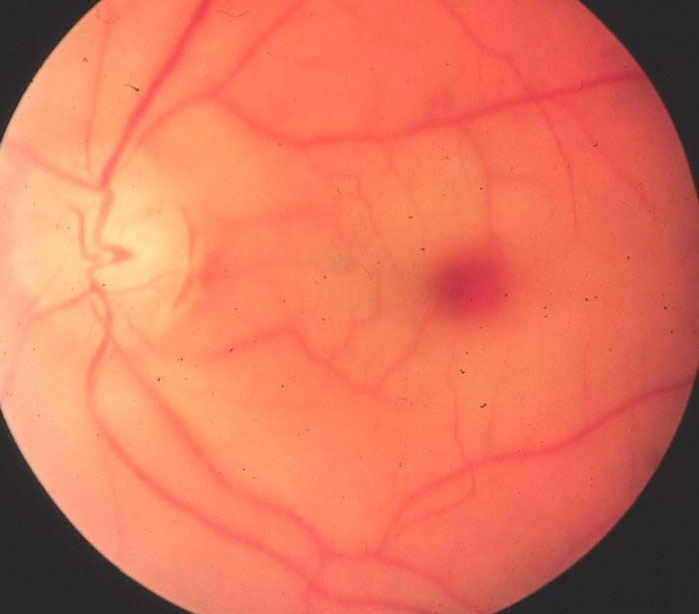 Which of the following is the most likely cause of this patient's condition?
 (Multiple Choice)
4.9/5 (88)
(88) A 69-year-old woman, gravida 5 para 5, comes to the office for leakage of urine. The patient reports that her urine "leaks all the time" and that she is "afraid to leave the house because I constantly smell like urine." She is also "exhausted from waking up every hour to go to the bathroom." Since menopause at age 53, the patient has had occasional leakage of urine after sneezing, but her symptoms have worsened over the last few months. She has type 2 diabetes mellitus and is on an insulin regimen. The patient recently moved to be closer to her grandchildren; since moving, she has been diagnosed with allergic rhinitis and started on a daily antihistamine. She has had no previous surgery. The patient's pregnancies all resulted in spontaneous vaginal deliveries; the largest infant was 4.6 kg (10.2 lb). She does not use tobacco, alcohol, or illicit drugs. The patient does aqua-aerobic exercises at the senior center 5 times a week. Blood pressure is 120/80 mm Hg and pulse is 70/min. BMI is 25 kg/m2. Abdominal examination shows no tenderness or masses. Speculum examination shows a pale vagina but no evidence of pelvic organ prolapse. Bimanual examination shows a small, mobile, nontender uterus and no adnexal masses. Urine dribbling is noted on examination, but no leakage occurs when the patient is asked to cough. There is decreased sensation to pinprick testing over the perineum. Which of the following is the most likely diagnosis in this patient?
(Multiple Choice)
4.9/5 (81)
(81) A 34-year-old man comes to the emergency department due to 2 weeks of abdominal discomfort, nausea, and vomiting. Over the last 2 days, he has not been able "to keep anything down." The patient is experiencing homelessness. He has a history of alcohol use disorder and he has been admitted previously for acute pancreatitis, alcohol-related seizures, and aspiration pneumonia. Blood pressure is 112/78 mm Hg while supine and 94/57 mm Hg while standing. His pulse is 121/min, regular. BMI is 16 kg/m2. He looks disheveled and his mucous membranes are dry. There is mild epigastric tenderness. Initial laboratory values are the following: 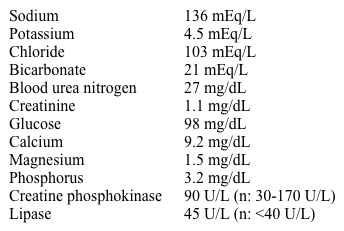 He is treated with intravenous fluids, dextrose and thiamine solution, and folic acid supplementation. On the second day of hospitalization, he develops severe weakness, saying "I can barely raise my arms!" Which of the following most likely accounts for his current symptoms?
 (Multiple Choice)
4.8/5 (84)
(84) 
Filters
- Essay(0)
- Multiple Choice(0)
- Short Answer(0)
- True False(0)
- Matching(0)