



 Chat with AI
Exam 2: Foundations of Independent Practice

Exam 1: Advanced Clinical Medicine1 k+ Questions
Exam 2: Foundations of Independent Practice597 Questions
Select questions type


A 10-year-old Caucasian boy is brought to the emergency department (ED) after a major car accident. He was unresponsive when the ambulance arrived to the site, but regained consciousness soon after arrival to the ED. He is oriented to time and space, and is able to move his extremities and obey commands. Careful inspection reveals several deep scalp lacerations and a horizontal laceration of the right upper lateral eyelid with deep fat tissue in the wound. The right eyelid is swollen. The pupils are symmetric and reactive to light. Which of the following structures is most likely injured as a result of the eyelid laceration in this patient?
(Multiple Choice)
4.9/5  (77)
(77) A 27-year-old woman with no medical history comes to the office due to recent-onset chest pain. She gives a dramatic, vague, and nonspecific description of the pain, which she continues even when pressed for details. The patient is dressed in revealing clothing and mentions having seen the physician several times at a nearby grocery store. Physical examination, including vital signs, is unremarkable. Laboratory evaluation and an ECG are normal and suggest no medical etiology for chest pain. Despite reassurance that more serious causes of chest pain are highly unlikely, the patient insists on scheduling a follow-up appointment. On the day of the second appointment, she arrives as the office is closing and intercepts the physician in the parking lot. The patient reports that the chest pain has disappeared; however, she is very concerned about feeling fatigued. She says, "I frequently have insomnia, but it's been worse than usual lately and I am so tired." The patient insists on calling the physician by first name, apologizes profusely for being late, and requests an after-hours appointment.
Which of the following is the most appropriate response to the patient's request?
(Multiple Choice)
4.8/5 (87)
(87) A 22-year-old man is brought to the emergency department by his family for cough and shortness of breath. The patient was found an hour ago in a barn on the family's property. He was observed to have severe, frequent coughing episodes with copious sputum production. The patient also vomited several times with no visible blood. He reports feeling severely short of breath but has no fever, pain, headache, or confusion. He has a history of major depression treated with paroxetine. Family members reveal that the patient recently ended a long-term relationship with his girlfriend. He does not have a history of using tobacco, alcohol, or illicit drugs, although his younger brother, who lives nearby, uses heroin. The patient and his parents work in agriculture. Temperature is 36.6 C (97.9 F), blood pressure is 105/65 mm Hg, pulse is 48/min, and respirations are 28/min. Pulse oximetry shows 87% while breathing ambient air. Physical examination reveals an alert, diaphoretic patient in respiratory distress. Mucous membranes are moist and pupils are pinpoint bilaterally. Coarse breath sounds with bilateral wheezing are heard on lung auscultation, and heart sounds are normal. The patient's clothes are soiled with stool and urine. He is intubated for progressive respiratory distress, and his soiled clothes are removed. Copious airway secretions are noted as mechanical ventilation is initiated. Laboratory studies and imaging are ordered. Which of the following is the most likely mechanism of this patient's condition?
(Multiple Choice)
4.9/5 (87)
(87) A 24-year-old woman with a history of asthma comes to the emergency department at 32 weeks gestation with a 5-day history of increased dyspnea, wheezing, and cough. Her asthma was previously well-managed with a combination fluticasone-salmeterol inhaler twice daily, but the patient stopped using it when she discovered she was pregnant. She reports no nasal congestion, sore throat, or sinus pain. The patient has no other medical conditions, and her pregnancy has progressed normally. Her only other medication is a prenatal multivitamin. She does not use tobacco, alcohol, or illicit drugs. Her father has a history of asthma. On examination, the patient appears to be in mild respiratory distress. She is afebrile. Blood pressure is 110/68 mm Hg, pulse is 104/min, and respirations are 21/min. Pulse oximetry is 94% on room air. Lung examination reveals inspiratory and expiratory wheezes with a prolonged exhalation phase. Heart sounds are normal. Mild bilateral pitting pedal edema is present; there is no calf tenderness in either leg. Fetal heart rate monitoring is reassuring. Nebulized albuterol and inhaled ipratropium are administered and provide some relief. On repeat assessment shortly afterward, the patient continues to feel short of breath, and wheezing is still present on examination. Arterial blood gas analysis shows a pH of 7.45, PaCO2 of 26 mm Hg, and PaO2 of 100 mm Hg on 2 L of oxygen by nasal cannula. What is the best next step in management of this patient?
(Multiple Choice)
4.9/5 (80)
(80) A 75-year-old man with a recent diagnosis of metastatic pancreatic cancer is admitted to the hospital due to dehydration. The patient admits that he was trying to hasten his death by refusing food and water despite his family's disagreement with this plan. He is a documentary filmmaker who has made multiple films on the subject of bravery, frequently interviewing firemen and wartime pilots. He says that "being brave means not being afraid of death and leaving this suffering behind." The patient's wife recently filed for divorce. She says that she is an observant Buddhist and has been "fed up with his atheism for a long time; it's just so negative. He doesn't believe that anything has a point, when really everything is purposeful if he would only just look. He can't even see the people around him who love and support him." The patient occasionally has pain despite taking morphine regularly. He has experienced severe constipation as a result of the pain medication and has received minimal relief from stool softeners. His wife says that prior to his hunger strike his appetite was poor and that he frequently spends much of the day doing nothing other than lying on the couch watching television due to fatigue. After his wife leaves the room, the patient pleads with the physician to "give me something to end my life in peace with dignity."
Which of the following factors is most closely associated with this type of request?
(Multiple Choice)
4.8/5 (75)
(75) A study examines the role of different biomarkers in the early diagnosis of acute coronary syndrome. The following receiver-operating characteristic (ROC) curves were obtained for different biomarkers upon participants' initial symptom presentation in the emergency department (the X marks the 99th percentile cutoff point for the corresponding biomarker). 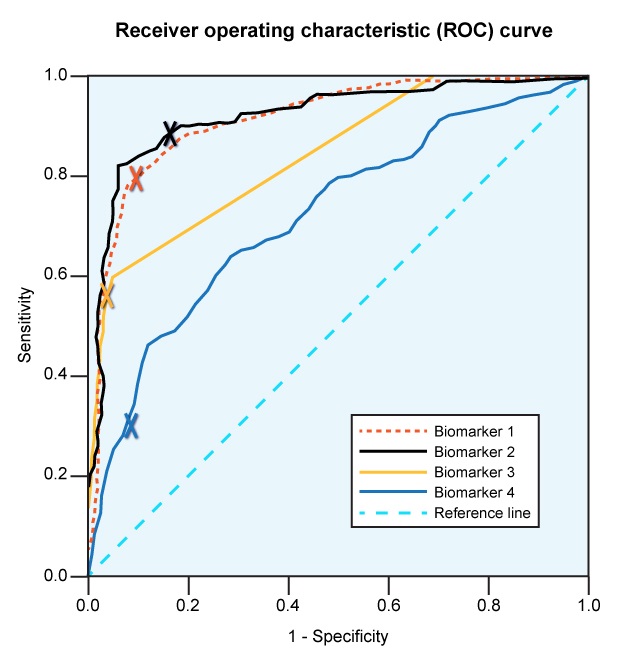 Based on the study results and assuming the differences are statistically significant, which of the following 99th percentile cutoff points can best exclude acute coronary syndrome during initial symptom presentation in the emergency department?
 (Multiple Choice)
5.0/5 (93)
(93) A 42-year-old woman with a recent diagnosis of metastatic breast cancer comes to the office for a follow-up visit. Although the patient is currently stable, she decided to stop working due to the stress of managing her illness and caring for her 7-year-old son, who has multiple behavioral issues and special needs. The patient has a history of depression in her 20s and late 30s. She was previously treated with weekly psychotherapy that she found helpful. She tries to exercise 2 or 3 times per week but often feels too weak. The patient describes her husband as extremely supportive. Her son attends a special school for children with autism. As the physician reviews the chemotherapy regimen, recent imaging, and laboratory results, the patient becomes tearful. She says, "I think I was doing much better when I was distracted by work. Now, I'm so afraid of dying and what's going to happen after I'm gone that it's hard to think of anything else. I know I have to be brave for my son." Which of the following is the most appropriate initial response to the patient's concerns?
(Multiple Choice)
4.8/5 (79)
(79) A 33-year-old woman, gravida 2 para 1 aborta 1, comes to the office for preconception counseling. The patient feels well. Her first pregnancy, approximately 6 years ago, was complicated by diet-controlled gestational diabetes mellitus and by preeclampsia with severe features that required hospitalization at 32 weeks gestation and cesarean delivery at 34 weeks gestation. After delivery, the patient was discharged on antihypertensives, which were discontinued 6 weeks postpartum. She had a normal 2-hour glucose tolerance test at the same visit. Her second pregnancy 4 years ago resulted in a spontaneous abortion at 7 weeks gestation. The patient has no other chronic medical conditions and only takes a daily prenatal vitamin. She practices yoga 4 or 5 times a week. The patient does not use tobacco or illicit drugs but drinks alcohol socially once or twice a month. Blood pressure is 100/70 mm Hg. BMI is 20 kg/m2. Pelvic examination is normal. In addition to continuing prenatal vitamins, which of the following is the best advice for this patient?
(Multiple Choice)
4.7/5 (82)
(82) Two groups of investigators are interested in the problem of esophageal cancer in a population that has a high prevalence of hot beverage consumption. One group conducted study A, which showed that hot beverage consumption is associated with esophageal cancer, with an odds ratio (OR) of 1.51 and a 95% confidence interval of 1.19 to 1.81. The other group conducted study B, which demonstrated an OR of 1.46 and a 95% confidence interval of 0.95 to 1.97. Which of the following statements is most likely true concerning the results of these 2 studies?
(Multiple Choice)
4.9/5 (74)
(74) A 72-year-old man comes to the clinic to establish care. He has a mild, chronic cough that has not changed in quality or severity for many years. The patient has a history of hypertension and hyperlipidemia for which he takes chlorthalidone and atorvastatin. He is a current smoker and has smoked a pack of cigarettes daily for 53 years. The patient has attempted to quit multiple times in the past without success. Today, he states he is reluctant to attempt smoking cessation again given his advanced age and lack of complications from his smoking so far. Which of the following would be the most appropriate response regarding smoking cessation in this patient?
(Multiple Choice)
5.0/5 (76)
(76) A 62-year-old woman comes to the office for a preventive visit. She feels well and reports no active symptoms. Medical history is notable for diet-controlled diabetes mellitus and hypertension. The patient quit smoking 10 years ago and does not use alcohol. She is up to date on age-appropriate cancer screening. Vital signs are normal. Physical examination is notable for moderate obesity and a prolonged expiratory phase of respiration. Hemoglobin A1c is 6.8%. Influenza vaccination is advised, and the patient responds, "I heard that the flu vaccine doesn't really work. I would rather just take vitamin C and try to prevent the flu in a natural way." Which of the following is the most appropriate response to this patient's concerns?
(Multiple Choice)
4.7/5 (72)
(72) A 62-year-old man with a history of dyslipidemia and type 2 diabetes mellitus comes to the emergency department due to severe substernal chest pain and diaphoresis that began 2 hours ago. His ECG shows ST- segment elevation in leads V1 to V4. He is taken to the cardiac catheterization lab and a complete occlusion of the mid-left anterior descending artery (LAD) is diagnosed. A drug-eluting stent is placed in the LAD with complete restoration of flow, and the patient is started on aspirin and clopidogrel. On the third day of hospitalization, the option of adding rivaroxaban is discussed with the patient. He asks about the benefits and risks of the added therapy. Based on the research abstract, The statistical methods section of the full research paper indicates that the analysis was performed using an "intention-to-treat" approach. The primary purpose of such an approach is most likely which of the following?
(Multiple Choice)
4.7/5 (69)
(69) A 22-year-old woman comes to the office due to feeling depressed over the last 10 days. She says, "The other day, I just started crying for no reason. I really should feel good because I work out in the gym every day. But I just don't feel like doing anything else. I can't shake this feeling." The patient has also felt more irritable in the past week. "I almost got into a fight with a woman in the gym. I can be sad one minute and angry the next; it's weird." She has a history of an eating disorder as a teenager as well as attention-deficit/hyperactivity disorder. The patient has no other medical problems except for acne, which recently worsened. She has 4 or 5 alcoholic drinks a week. Her only medication is methylphenidate, and the prescribed dose has remained stable over the past few years. The patient has a family history of depression. Temperature is 36.7 C (98.1 F), blood pressure is 130/80 mm Hg, pulse is 88/min, and respirations are 16/min. Mental status examination shows no abnormalities. Physical examination is notable for facial acne and mild hirsutism. Chemistries and complete blood count are within normal limits except for mildly elevated hematocrit and hemoglobin. Which of the following is the most likely explanation for this patient's symptoms?
(Multiple Choice)
4.8/5 (88)
(88) A 62-year-old man returns for evaluation of hypertension. For the past year, his blood pressure has become increasingly difficult to control despite the addition of several antihypertensive medications. He also has type 2 diabetes mellitus, intermittent claudication, erectile dysfunction, hyperlipidemia, and coronary artery disease. Currently he takes metoprolol, amlodipine, hydrochlorothiazide, lisinopril, and hydralazine for hypertension. The patient smokes cigars daily and drinks alcohol socially. His blood pressure is 165/95 mm Hg, and pulse is 76/min. On examination, the point of maximal impulse is palpated lateral to the midclavicular line on the left. Heart sounds are normal. A bruit is heard on auscultation to the left of the umbilicus. There is trace pedal edema. The distal pulses of the lower extremities are diminished bilaterally. Laboratory results are as follows: 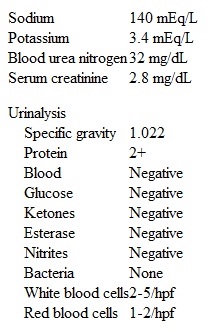 Which of the following is the most appropriate next step in management of this patient?
 (Multiple Choice)
4.9/5 (65)
(65) An 83-year-old Caucasian male with a history of advanced colon carcinoma with metastasis to the lungs develops right-sided hemiplegia and dysarthria while at home. His granddaughter calls you at 8:00 p.m., giving you a history compatible with a cerebrovascular event, probably an ischemic stroke. You know this patient from before. He is not a hospice patient, and he has always firmly expressed his decision to not be resuscitated. He has a current, valid DNR (do not resuscitate) order. Which of the following is the most appropriate next step in the management of this patient?
(Multiple Choice)
4.8/5 (81)
(81) A 25-year-old woman comes to the office due to amenorrhea. The patient has had no changes in vision, cold or heat intolerance, or abnormal vaginal discharge. Her last menstrual period was 2 months ago. Menarche was at age 12; her menstrual cycles are normally 28 days long with 3-4 days of light bleeding. Medical history is significant for type 1 diabetes mellitus and a seizure disorder. Three months ago, the patient was hospitalized for generalized tonic-clonic seizures and phenytoin was added to her medication regimen. She has had no seizure activity since. Blood glucose levels are well controlled with insulin. She is sexually active and uses estrogen/progestin combination oral contraceptives. Four years ago, the patient underwent dilation and curettage for the termination of a pregnancy which was complicated by hemorrhage requiring a blood transfusion. She has no history of sexually transmitted infections and her last Pap test was normal. She does not use tobacco, alcohol, or illicit drugs. Temperature is 36.7 C (98.1 F), blood pressure is 110/60 mm Hg, pulse is 76/min, and respirations are 12/min. BMI is 22 kg/m2. There is minimal facial acne. Visual fields are intact. The thyroid is nonenlarged with no palpable masses. The breasts are mildly tender to palpation; there are no masses or expressed nipple discharge. The abdomen is soft and nontender, with no palpable masses. Pelvic examination shows a mobile uterus with no adnexal masses. Which of the following is the most likely cause of this patient's symptoms?
(Multiple Choice)
4.8/5 (86)
(86) A 26-year-old man with a 5-year history of asthma comes to the office for follow-up after a recent hospital discharge. The patient was admitted due to fever, shortness of breath, trace hemoptysis, and productive cough with brownish mucus; he was treated with oral glucocorticoids, antibiotics, and nebulized bronchodilators. There were 2 similar episodes in the past year which were treated in the emergency department with tapering oral glucocorticoids on each occasion. He has a history of "walking pneumonia." Current medications include fluticasone/salmeterol, montelukast, and as-needed albuterol. He does not smoke cigarettes. His father was a heavy drinker and died from liver cirrhosis. The patient is not in acute distress. Physical examination shows diffuse wheezing with adequate air entry. A high resolution CT scan shows central bronchiectasis and a right lower lobe infiltrate. Review of prior chest x-rays shows a lingular infiltrate and a left lower lobe infiltrate. Which of the following is the most likely cause of this patient's symptoms?
(Multiple Choice)
4.8/5 (83)
(83) A 66-year-old man comes to the office due to 3 months of slowly worsening nonproductive cough and shortness of breath. He has also had night sweats, excessive fatigue, and sharp, episodic right-sided chest pain. The patient has lost approximately 5 kg (11 lb) during this period. He has a history of hypertension and takes chlorthalidone. He has smoked a half-pack of cigarettes daily for the past 50 years. The patient worked in a shipbuilding factory until his early 40s and then began working in the automobile industry. Temperature is 36.7 C (98 F), blood pressure is 130/80 mm Hg, pulse is 84/min, and respirations are 14/min. No jugular venous distension or lymphadenopathy is present. There is dullness to percussion and decreased breath sounds over the right lower chest. Heart sounds are normal with no murmur. The abdomen is soft and nontender with no hepatosplenomegaly. No edema is present. Chest imaging reveals a moderate right-sided pleural effusion with irregular pleural thickening and calcifications, but no lung parenchymal abnormalities. A thoracentesis is performed and yields serosanguineous pleural fluid; pleural fluid analysis reveals the following: 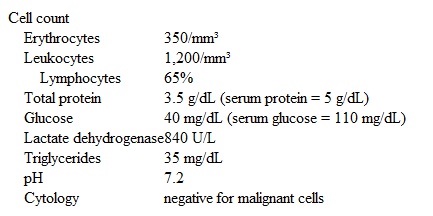 Which of the following is the most likely cause of this patient's pleural effusion?
 (Multiple Choice)
4.9/5 (82)
(82) A 33-year-old Caucasian male presents to your office and complains that solid food 'sticks in the chest.' He says that he has to chew food more carefully, take more liquids with meals, and swallow small portions. He recalls having a similar episode several months ago that got better after 'following a diet', but it was much less severe. He has had periodic chest pain behind the sternum for the last several years. He denies any recent significant weight loss, abdominal pain, nausea, vomiting, diarrhea/constipation, black stools and neck lumps. He smokes one pack of cigarettes daily and consumes alcohol occasionally. He is currently not taking any medications. Which of the following is the most likely diagnosis in this patient?
(Multiple Choice)
4.8/5 (72)
(72) A 63-year-old man comes to the clinic for a new patient visit. He is pleasant and says he "has never felt healthier." The patient presents a list of regularly taken medications, which include atenolol, sildenafil, terbinafine, minoxidil (topical), aspirin, and saw palmetto. He has no known drug allergies and has a remote history of cholecystectomy. He drinks an ounce of bourbon before bed each night. The patient has a remote 15-pack-year smoking history and has never used illicit drugs. He is married, has 3 grown children, and was recently transferred to this city to assume direction of a local factory. Physical examination is remarkable for a soft midsystolic murmur that is loudest in the second right intercostal space. There is some bony enlargement of the distal interphalangeal joints bilaterally. The patient wishes to discuss his medication list in more depth and indicates an increasing interest in alternative medicines.
Which of the following conditions is saw palmetto most commonly used to treat?
(Multiple Choice)
4.7/5 (83)
(83) 
Filters
- Essay(0)
- Multiple Choice(0)
- Short Answer(0)
- True False(0)
- Matching(0)