



 Chat with AI
Exam 2: Foundations of Independent Practice

Exam 1: Advanced Clinical Medicine1 k+ Questions
Exam 2: Foundations of Independent Practice597 Questions
Select questions type


A 34-year-old previously healthy man comes to the office due to severe back pain. Two days ago, the patient was working on the lawn and experienced sudden-onset low back pain while moving a bag of soil. The pain worsens with movement and radiates to his left leg. He also reports weakness of the left leg. He has had some improvement in the pain after taking NSAIDs and resting. Physical examination shows spasm of lower paraspinal muscles. There is weakness of left ankle dorsiflexion and toe extension. Ankle and knee reflexes are normal. Sensory examination shows loss of pinprick sensation over the dorsum of the left foot. Rectal tone is normal, and the remainder of the examination shows no abnormalities. Which of the following is the most likely cause of this patient's current condition?
(Multiple Choice)
4.8/5  (82)
(82) A 2-month-old girl is brought to the office for a well-child checkup. The patient is gaining weight appropriately and has met all developmental milestones. Her mother plans to exclusively breastfeed her until age 6 months. The patient has no medical conditions and is up to date on all recommended vaccinations. She lives with her parents, grandmother, and older brother and will start attending day care next month. No one in the household smokes, and the family has 2 dogs. Family history includes atopic dermatitis in the patient's father and older brother. The mother wants to know if she can do anything to lower the girl's risk for developing atopic dermatitis. Which of the following is the most appropriate recommendation for this patient?
(Multiple Choice)
4.9/5 (71)
(71) A group of rheumatologists wants to study the association between past use of procainamide for the treatment of arrhythmias and drug-induced lupus. The rheumatologists plan to conduct a case-control study to evaluate the association. Which of the following corresponds with the proposed study design?
(Multiple Choice)
4.9/5 (75)
(75) A 26-year-old woman phones after business hours to speak to the on-call provider due to 2 days of burning urination. The patient's urine has also been cloudy, and she has had to urinate every 2 hours. She has had no abdominal or flank pain, fever, chills, or vaginal or urethral discharge. Approximately a year ago, the patient had uncomplicated cystitis that was treated with an antibiotic. She has been sexually active with 1 partner for 6 years. Her last menstrual period was 2 days ago. The patient has a copper-containing intrauterine device for contraception. She has no drug allergies. What is the best next step in management of this patient?
(Multiple Choice)
4.8/5 (93)
(93) A 65-year-old man is hospitalized due to 3 days of shortness of breath that progressively worsened to the point that he was unable to walk up the flight of stairs to his apartment. He is diagnosed with an exacerbation of chronic obstructive pulmonary disease. A chest x-ray reveals a large hilar mass, and a subsequent CT scan confirms the presence of a 4-cm mass in the right hilum, suggestive of lung cancer. Medical history also includes hypertension, depression, and osteoarthritis of the right knee. The patient's sister, who lives nearby and visits him weekly, tells the physician, "My brother has not been taking care of his health. He smokes and eats a lot of junk food. He refuses to exercise and does not take his medications every day. It is no wonder he got sick." The patient responds, "I know I should eat better, but it is hard to break old habits. What is the point of living longer if I can't enjoy anything?" He reports that he usually takes his medication every day but sometimes forgets. When asked for permission to perform a bronchoscopy and biopsy, he says, "Please don't tell me what they find because if it's cancer I don't want to know." Which of the following is the most appropriate response to this patient's request?"
(Multiple Choice)
4.9/5 (74)
(74) A 41-year-old man comes to the physician with a faint skin rash over his upper body. He first noticed it in the spring season, but it worsened during the summer. The patient has mild itching, but otherwise the rash is asymptomatic. He takes omeprazole for acid reflux but his medical history is otherwise unremarkable. He does not use tobacco, alcohol, or illicit drugs. The patient has been sexually active with 2 partners during the last year, and uses condoms on most occasions. The physical examination findings are shown below. 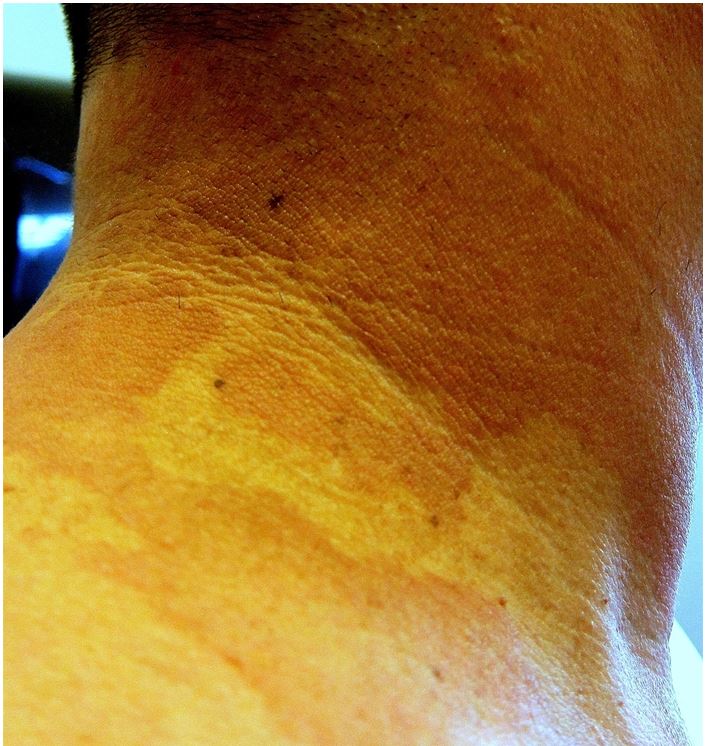 Which of the following is the most likely diagnosis in this patient?
 (Multiple Choice)
4.7/5 (87)
(87) A 35-year-old man comes to the physician with pain in his right knee and ankle for the last 2 weeks. He also has bilateral eye pain, irritation, and blurry vision. On further questioning, he reports burning urination. Last month, the patient developed diarrhea after eating at a local restaurant. The episode resolved spontaneously. On examination, there is bilateral conjunctival injection. He has tenderness in the lumbosacral area. There is swelling and tenderness of the right knee joint and at the calcaneal tuberosity. Urinalysis is normal. Which of the following patients is most likely to develop reactive arthritis?
(Multiple Choice)
4.7/5 (80)
(80) A 55-year-old man comes to the emergency department due to 4 days of worsening fever, cough, and chest pain. The cough is productive of yellow sputum and occasionally streaked with blood. The patient underwent allogeneic hematopoietic stem cell transplantation 6 weeks ago due to aplastic anemia. His recovery was complicated by acute graft-versus-host disease, which is improving with high-dose corticosteroids and modification of immunosuppressive therapy. He has also had prolonged neutropenia and is receiving infection prophylaxis with valganciclovir, fluconazole, trimethoprim-sulfamethoxazole, and levofloxacin. The patient has no other medical problems and does not use tobacco, alcohol, or illicit drugs. Temperature is 38.6 C (101.5 F), blood pressure is 115/70 mm Hg, pulse is 105/min, and respirations are 22/min. Pulse oximetry is 91% on ambient air. Physical examination is notable for left lung crackles. Laboratory testing shows a leukocyte count of 1,500/mm3 with 10% neutrophils. Chest x-ray reveals an infiltrate in the left upper lobe, and subsequent CT scan of the chest shows a cavitary nodule with surrounding ground-glass opacities in the left upper lobe. Which of the following is the most likely cause of this patient's current lung condition?
(Multiple Choice)
4.9/5 (83)
(83) Researchers are evaluating the performance measures of a novel newborn screening test for an autosomal recessive condition that may be performed 24 to 72 hours after birth. An excerpt of the results is presented below: Which of the following is the most accurate statement regarding these data?
(Multiple Choice)
4.8/5 (75)
(75) A 53-year-old woman comes to the emergency department after coughing up blood while at work. She has had no prior episodes but gives a lengthy history of shortness of breath, fatigue, palpitations, and cough while lying down. She has not seen a physician in many years. Her blood pressure is 122/70 mm Hg, pulse is 98/min, and respirations are 23/min. Her body mass index is 20 kg/m2. The patient appears anxious and fatigued. Jugular venous pressure is estimated at 9 cm H2O. Cardiac examination shows normal apical impulse with loud 1st heart sound and short apical low-pitched diastolic rumbling murmur. Bilateral crackles are heard. Electrocardiogram shows a broad-notched P wave in lead II as well as right axis deviation. Chest radiograph shows pulmonary edema, prominent pulmonary arteries at the hilum, elevation of the left mainstem bronchus, and left atrial enlargement with a flattening of the left heart border. Which of the following is the most likely diagnosis?
(Multiple Choice)
4.9/5 (77)
(77) A 62-year-old homeless man comes to the clinic for evaluation after a resident in his shelter was diagnosed with active tuberculosis. The patient says that he is in good health and has no symptoms. He has been homeless for the last 10 years. He regularly drinks alcohol and smokes cigarettes but is unable to quantify the amount. The patient's temperature is 37 C (98.6 F), blood pressure is 110/74 mm Hg, pulse is 84/min, and respirations are 20/min. Examination shows multiple dental caries with the majority of his teeth missing. There are no skin rashes or lymphadenopathy. The chest is clear to auscultation. There is no organomegaly. Purified protein derivative testing shows 16 mm induration at 48 hours. Chest x-ray is unremarkable. HIV test is negative. He agrees to take both isoniazid 300 mg and pyridoxine 50 mg daily for the next 9 months. Which of the following therapeutic side effects is the patient most likely to experience?
(Multiple Choice)
4.8/5 (84)
(84) A 35-year-old man comes to the physician with pain in his right knee and ankle for the last 2 weeks. He also has bilateral eye pain, irritation, and blurry vision. On further questioning, he reports burning urination. Last month, the patient developed diarrhea after eating at a local restaurant. The episode resolved spontaneously. On examination, there is bilateral conjunctival injection. He has tenderness in the lumbosacral area. There is swelling and tenderness of the right knee joint and at the calcaneal tuberosity. Urinalysis is normal.
Which of the following is the most likely finding in this patient?
(Multiple Choice)
4.8/5 (88)
(88) A 59-year-old man comes to the office complaining of a vague upper abdominal discomfort. The pain has been present for most of the past 3 months but has never been severe enough to make him seek immediate medical attention. The discomfort is not associated with eating or performing any activities. He has no other medical problems. His blood pressure is 120/60 mm Hg, pulse is 84/min, and respirations are 14/min. Abdominal examination reveals the presence of multiple scars from previous surgical procedures around the epigastric area. A 3 x 5-cm, oblong-shaped, firm, and deeply seated mass is palpable in the epigastric area. There is no tenderness on direct palpation of the mass and surrounding epigastric area. The patient says that he previously had similar "things" in the same area "but they were taken out." Which of the following is the most likely diagnosis?
(Multiple Choice)
4.8/5 (75)
(75) A 31-year-old man is evaluated for a murmur. He has no other symptoms and his past medical history is unremarkable. He jogs 3 times per week and rides a bicycle on the weekend. His blood pressure is 122/70 mm Hg on the right arm and 125/75 mm Hg in both ankles. On physical examination, a harsh, 4/6 holosystolic murmur is heard at the 4th left intercostal space close to the sternal border accompanied by a thrill. The rest of the physical examination is within normal limits. Which of the following is the most likely diagnosis?
(Multiple Choice)
4.9/5 (61)
(61) A graduate student conducting research on the association between vitamin D3 supplementation and cancer is reviewing the abstract of a recently published journal article.
Which of the following conclusions can be drawn from the results of the study?
(Multiple Choice)
4.9/5 (79)
(79) A large-scale clinical trial was conducted to assess the effect of a multivitamin supplement on the risk of future cardiovascular events. Study outcomes included cardiovascular mortality, nonfatal myocardial infarction, and coronary revascularization procedures. According to the study results, the overall relative risk of a cardiovascular event occurring in the placebo group compared to the treatment group was 1.5 (p = .30). However, when data accrued only during the fifth year of follow-up were examined, the relative risk of a cardiovascular event occurring in the placebo group compared to the treatment group was 2.05 (p = .01). Survival curves for the 2 groups are shown below:
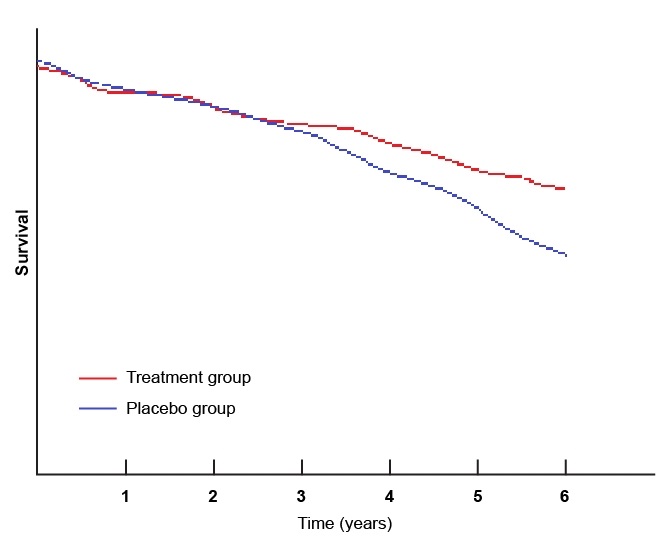 Which of the following best explains the study results?
 (Multiple Choice)
4.9/5 (90)
(90) A 43-year-old woman comes to the emergency department due to midepigastric abdominal pain. The pain is sharp, radiates to her back, and is accompanied by nausea, vomiting, and malaise. Her symptoms started approximately 24 hours earlier. For the past 6 months she has had intermittent, colicky abdominal pain that occurs after meals. The patient's medical problems include hypertension, depression, and recurrent urinary tract infections. Medications include lisinopril, amlodipine, and fluoxetine. She has no known drug allergies and does not use tobacco, alcohol, or illicit drugs. Family history is notable for ovarian cancer in her mother. Temperature is 37.1 C (98.8 F), blood pressure is 146/92 mm Hg, pulse is 85/min, and respirations are 14/min. Physical examination reveals moist mucous membranes, no lymphadenopathy, clear lung fields, and normal S1 and S2. The abdomen is soft and tender in the midepigastrium without rigidity or rebound tenderness. Bowel sounds are normoactive. The remainder of the examination is normal. Laboratory results are as follows: 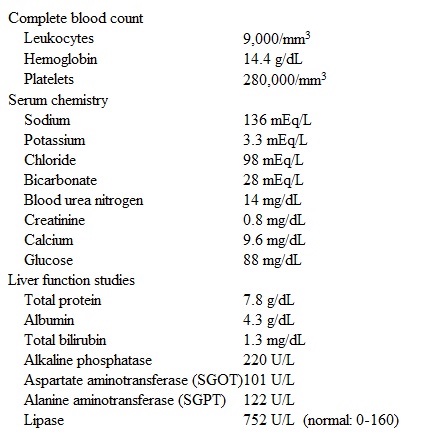 The patient is hospitalized and treated with supportive care. Abdominal ultrasound reveals multiple gallstones that are 3-5 mm in diameter, but no abnormalities are seen in the common bile duct. Lipid panel shows triglycerides of 150 mg/dL. On the third day of hospitalization, the patient is symptom-free, she tolerates oral feeding, and liver enzymes have normalized. Which of the following treatment options is most appropriate to prevent further episodes of pancreatitis?
 (Multiple Choice)
4.9/5 (93)
(93) A physician is approached by a longtime friend who requests a prescription for dextroamphetamine. The physician has known this individual since childhood and is aware that he has attention-deficit hyperactivity disorder, for which he received stimulant medications throughout high school. The physician sees her friend socially several times a year, and the friend has been supportive during some difficult times in her own life. The friend explains that he is under a lot of pressure at work and wants to resume taking stimulants briefly to help him stay focused and meet his deadlines. Which of the following is the most appropriate response?
(Multiple Choice)
4.9/5 (84)
(84) A 45-year-old African-American woman presents to the emergency department with the complaint that "my eye hurts, and it's far too bright in here." She has one hand cupped over her left eye. She denies any history of trauma or the presence of a foreign body sensation in either eye. Physical examination reveals significant redness at the junction between the cornea and sclera of the left eye. The left pupil is irregular and constricted and she recoils when the penlight is shined in either eye. Visual acuity is reduced in the left eye. Slit lamp examination shows the presence of leukocytes in the anterior segment of this eye. What is the cause of this woman's symptoms?
(Multiple Choice)
4.7/5 (78)
(78) A 3-day-old boy is seen in the nursery due to vomiting. He has had 2 episodes of nonprojectile vomiting of green fluid and has developed abdominal distension over the last hour. The patient is breastfed and initially nursed every 2 hours but is now nursing less frequently. The infant passed a small amount of meconium immediately after delivery but has passed no other stool. He is voiding adequately. The patient was delivered vaginally at 38 weeks gestation without complications. Apgars were 8 and 9 at 1 and 5 minutes, respectively. Temperature is 36.7 C (98 F). On examination, the infant is asleep but easily roused. The anterior fontanelle is open and flat, and the mucous membranes are moist. Cardiac examination is normal. The lungs are clear to auscultation bilaterally. The abdomen is distended with hypoactive bowel sounds. The liver and spleen are not palpable. Abdominal x-ray findings include dilated, gas-filled loops of small bowel; absent air-fluid levels; and a "ground-glass" mass in the right side of the abdomen. Further history-taking should focus on which of the following factors?
(Multiple Choice)
4.9/5 (77)
(77) 
Filters
- Essay(0)
- Multiple Choice(0)
- Short Answer(0)
- True False(0)
- Matching(0)