



 Chat with AI
Exam 2: Foundations of Independent Practice

Exam 1: Advanced Clinical Medicine1 k+ Questions
Exam 2: Foundations of Independent Practice597 Questions
Select questions type


Physician-researchers at a women's health clinic that caters to an underserved population are reviewing the results of a study they conducted regarding the effect of support systems during and after pregnancy on the development of postpartum depression. The researchers found that women with a poor support system had a statistically significant greater chance to develop postpartum depression than women with a good support system. If poor support system is the exposure of interest, which of the following represents the most likely measure (ie, odds ratio [OR] or relative risk [RR]) and magnitude of the effect and corresponding 95% confidence interval (CI)?
(Multiple Choice)
4.7/5  (69)
(69) A 79-year-old man with metastatic prostate cancer is brought to the emergency department by his caretaker due to concern about his breathing. The patient takes a short-acting opioid every 4 hours and applies a transdermal fentanyl patch for malignant bone pain; the dose of the patch was increased 3 days ago due to inadequate pain control. The caretaker reports that the patient's breathing "has been strange" since this morning, but he has had no fever or cough. Temperature is 37.4 C (98.6 F), blood pressure is 112/78 mm Hg, pulse is 115/min, and respirations are 24/min. Oxygen saturation is 90% on room air. On physical examination, the patient is chronically ill-appearing and drowsy but arouses easily to voice. Bilateral pupils are small but reactive. The lungs are clear to auscultation with normal tidal air movement bilaterally. The patient continues to have significant pain with any repositioning. Chest x-ray reveals stable appearance of previously known blastic lesions in the thoracic spine and ribs but no acute abnormalities. ECG shows sinus tachycardia. Blood cell counts and urinalysis are normal. Which of the following is the most appropriate next step in management of this patient?
(Multiple Choice)
4.8/5 (75)
(75) A 65-year-old Caucasian male presents to your office and complains of a hearing impairment. He is a manager and runs his own business. He noticed that it is now difficult for him to understand his employees during business meetings. He hears well and speaks fluently while on the phone or when talking to his wife, but he poorly understands 'the people talking on TV shows'. His past medical history is insignificant. He is physically active, and works out in the gym three times a week. He does not smoke or consume alcohol. He is not taking any medications. You perform a speech discrimination test that turns out to be normal. Which of the following actions will most likely reveal an impaired speech discrimination in this patient?
(Multiple Choice)
4.8/5 (86)
(86) A 16-year-old girl comes to the office with her mother for a contraception consultation. The patient recently became sexually active with her boyfriend of 6 months, and they use condoms for contraception. She has regular monthly menses, with 4 days of vaginal bleeding. On the first day of her menstrual period she often has heavier bleeding and mild cramping relieved by nonsteroidal anti-inflammatory drugs. Her last menstrual period was 2 weeks ago. The patient has no chronic medical conditions or previous surgeries. Family history is significant for osteoporosis in her maternal grandmother and an aunt, but is otherwise noncontributory. She does not use tobacco, alcohol, or illicit drugs. She has no known drug allergies. Blood pressure is 118/68 mm Hg and pulse is 72/min. BMI is 23 kg/m2. Physical examination is unremarkable. Urine pregnancy test is negative. Chlamydia and gonorrhea nucleic acid amplification testing are collected. The patient asks about the side effects of different contraception methods. Which of the following is the most appropriate response to the patient?
(Multiple Choice)
4.9/5 (90)
(90) A 52-year-old man is brought to the emergency department by his roommate after threatening to commit suicide. He is angry about being taken to the hospital and says, "I just want to go home and sleep." His roommate says, "I can't take it anymore; I thought he was going to jump out of the car on the way to the hospital." The patient has a history of recurrent major depression, post-traumatic stress disorder, and alcohol abuse. He describes increasing depression since his divorce 5 years ago. He feels hopeless, has difficulty getting out of bed, and eats only one meal a day. The patient ruminates about his failed marriage and blames himself for his heavy drinking and losing contact with his 2 grown children. He has always owned a gun, which he usually keeps in a locked drawer in a bedside table. However, in the last week he has taken the gun out and held it before going to sleep "because it feels like a security blanket, it's reassuring." The patient has suicidal thoughts but does not think he will act on them. He says, "I just need to know I have a way out." His medical record indicates that he tried to overdose 3 months ago by taking a handful of sleeping pills and drinking 2 liters of vodka. Last year, he tried to hang himself in his garage but was discovered by his roommate. The patient has been followed by a psychiatrist in an outpatient clinic. He felt better when taking duloxetine but has not taken the medication for the past few months as he can no longer afford it. He insists that he is not feeling suicidal now and demands to leave. The patient is started on duloxetine in the inpatient psychiatric unit. He is willing to take the medication but remains angry about being hospitalized. He is initially withdrawn and uncommunicative but after several days is more conversant. The patient still wishes he were dead but expresses no desire to hurt himself. After 1:1 observation is discontinued, he is monitored with 15-minute checks. After 2 weeks, the patient is noticeably less depressed and has no suicidal thoughts. His appetite has improved, and he is eating 3 meals a day. Discharge planning is begun and a follow-up appointment is scheduled with his outpatient psychiatrist. Which of the following is most important prior to discharge?
(Multiple Choice)
4.8/5 (85)
(85) Treatments for depression in bipolar disorder (BD) are far less developed than for unipolar major depressive disorder. New experimental approaches have been emerging recently, including use of the dissociative anesthetic ketamine. To study the effectiveness of this new experimental treatment, 2 psychiatrists decide to conduct 2 separate studies to compare treatment outcomes between patients receiving ketamine and patients receiving the standard treatment for BD. Study A, by the first psychiatrist, identifies 25 patients who have been on each of these treatments for BD for at least 6 months. Study B, by the second psychiatrist, randomly assigns 25 patients to each treatment and evaluates treatment outcomes after 6 months. Which of the following best describes each of these 2 studies?
(Multiple Choice)
4.8/5 (76)
(76) A 49-year-old woman comes to the emergency department due to hearing loss. Upon awakening this morning, she was unable to hear out of her right ear. She also hears a loud ringing noise in her right ear. The patient has no ear pain or dizziness. This has never occurred before. She has no other medical conditions and takes no medications. Vital signs are within normal limits. On examination, the ear canals and tympanic membranes are clear. There is no middle ear effusion. Weber tuning fork examination lateralizes to the left. Air conduction is greater than bone conduction bilaterally. The remainder of the neurologic examination is normal. Which of the following is the most appropriate next step in management of this patient?
(Multiple Choice)
4.8/5 (84)
(84) A 24-year-old woman is admitted to the hospital after a motor vehicle accident resulted in a right humerus fracture, multiple rib fractures, and a contusion over her right leg. The patient receives multiple packed red blood cell transfusions. Chest and abdominal evaluation show a right-sided hemothorax. A chest tube is inserted. Pain is controlled with intravenous morphine. The next morning, she has a crawling and burning sensation and worsening pain in her right leg despite repeated doses of morphine. Temperature is 37.2 C (99 F), blood pressure is 140/82 mm Hg, heart rate is 96/min, and respirations are 18/min. The right leg is swollen and tense. Pulses are palpable in both lower extremities.
Which of the following complications is most commonly associated with the condition affecting this patient's right leg?
(Multiple Choice)
4.9/5 (89)
(89) A 22-year-old college student is brought to the emergency department by his roommates, who say that he has been acting bizarrely for the last 2 months and "is only getting worse." He refuses to leave the house and has put aluminum foil over his windows. The only way his friends could get the patient out of the house today was by threatening to call the police if he did not cooperate. They estimate that it has been 2 weeks since his last shower. He will not eat anything that is not prepackaged. The patient has no known medical or psychiatric history. He does not use alcohol or illicit drugs. Physical examination is unremarkable. On mental status examination, the patient is disheveled and malodorous. He sits quietly on the bed, smiles, and periodically laughs inappropriately. He looks down at the floor and avoids eye contact with the physician. During questioning, he says that his professors are trying to prevent him from graduating. He is unsure why they do not want him to graduate but says that they are sending him "telepathic" messages encouraging him not to attend class. The patient now thinks that his professors have convinced his friends to "join in their plot." He whispers, "The nurse at the front desk is in on it too." Which of the following would be the most effective approach to forming an initial therapeutic alliance with this patient?
(Multiple Choice)
4.8/5 (86)
(86) A 38-year-old primigravid woman comes to the physician's office at 20 weeks gestation for prenatal counseling. She is concerned about her baby's risk for Down syndrome and asks about measures to diagnose it early. The physician explains that triple screening may detect up to 60% of cases of chromosomal abnormalities and that amniocentesis may detect approximately 90% of cases. The patient decides not to undergo any testing. When explaining that amniocentesis detected a higher percentage of cases compared to triple screening, the physician was referring to which of the following values?
(Multiple Choice)
4.7/5 (82)
(82) A 35-year-old woman comes to the office due to anorexia and unintentional weight loss of 10 kg (22 lb) over the past 3 months. She has also had occasional cough, subjective fevers, and night sweats. The patient has no prior medical problems and takes no medications. She was previously homeless and used injection drugs but has not done so for 4 years and now has stable housing and employment. The patient does not use tobacco or alcohol. Temperature is 37 C (98.6 F), pulse is 90/min, blood pressure is 120/70 mm Hg, and respiratory rate is 16/min. Physical examination reveals inspiratory crackles over the right upper lung field. Chest x-ray reveals an infiltrate with small cavitation in the apical-posterior segment of the right upper lobe. Rapid HIV testing is negative. Three sputum smears are negative for acid-fast bacilli but tuberculin skin testing shows a 15-mm induration. Which of the following is the most accurate statement about the patient's current condition?
(Multiple Choice)
4.8/5 (89)
(89) A 70-year-old woman comes to the emergency department due to abdominal pain and bloody diarrhea. Last night, the patient experienced mild cramping with abdominal pain and an urgent desire to defecate, but when she went to the bathroom, she did not have a bowel movement. The patient attributed her symptoms to the spicy food she had for lunch and took some antacids, but the pain persisted. This morning she had large-volume diarrhea containing bright red blood. She has had no nausea or vomiting and has never had similar symptoms. The patient was found to have diverticulosis during a colonoscopy 2 years ago, so a high-fiber diet was advised. Other medical problems include hypertension, type 2 diabetes mellitus, coronary artery disease, and end-stage renal disease from diabetic nephropathy. She receives intermittent maintenance hemodialysis (most recently yesterday) and has had several occasions of hypotension during dialysis, requiring intravenous fluid replacement. The patient does not use tobacco, alcohol, or illicit drugs. She has taken no antibiotics or nonsteroidal analgesics recently. The patient lives with her husband and has not recently traveled. Temperature is 37.2 C (99 F), blood pressure is 119/81 mm Hg, pulse is 90/min, and respirations are 16/min. The abdomen is mildly distended and soft with moderate left-sided tenderness. There is no rebound tenderness and bowel sounds are decreased. Rectal examination reveals bloody stool but no tenderness or mass. Laboratory results are as follows: 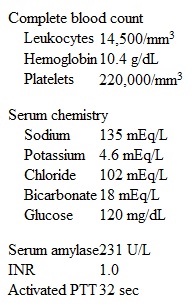 Upright abdominal radiography reveals a dilated transverse colon with no free air. Flexible sigmoidoscopy shows mucosal edema. Which of the following is the most likely cause of this patient's current symptoms?
 (Multiple Choice)
4.9/5 (81)
(81) A 61-year-old man comes to the office for follow-up of long-standing type 2 diabetes mellitus. Treatment currently consists of metformin, dietary modification, and regular exercise. On his current regimen, the patient's weight has been mostly stable over the last 2 years, but he has noticed some weight loss in the last 6 weeks. He also has mild constipation but no abdominal pain, nausea, or excessive urination. Medical history is significant for hyperlipidemia and hypertension, for which he takes atorvastatin, amlodipine, and valsartan. He also takes low-dose aspirin and a daily multivitamin. The patient does not drink alcohol but has a 45-pack-year smoking history. His father had type 2 diabetes mellitus and died of a stroke, and his mother had thyroid cancer that required surgery. Blood pressure is 134/80 mm Hg and pulse is 88/min. BMI is 30 kg/m2. Neck examination is normal. Lungs are clear to auscultation. Abdominal examination reveals no masses or tenderness. Laboratory results are as follows:
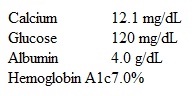 Six months ago, his chemistry profile was normal.
Which of the following is the best next step in evaluation of this patient?
Six months ago, his chemistry profile was normal.
Which of the following is the best next step in evaluation of this patient? (Multiple Choice)
4.8/5 (76)
(76) A 78-year-old woman with a history of metastatic colon cancer, malignant ascites, and congestive heart failure collapses at her son's home. She is escorted by ambulance to the hospital, where she is admitted to the intensive care unit. In the days leading up to her admission she had complained of fever, productive cough, shortness of breath, and malaise. Shortly after admission she develops respiratory distress that requires sedation, intubation, and ventilatory support. Wide-spectrum intravenous antibiotics are begun to treat suspected pneumonia, and her diuretic dosage is increased. Responsible for her care are a number of specialists, including an oncologist, pulmonologist, cardiologist, and critical care hospitalist. Each physician meets separately with the patient's adult children every day to discuss his or her assessment and treatment recommendations. The patient's condition moderately improves, but all attempts to wean her from the ventilator fail. As each day passes, the family members become increasingly irritable when discussing their mother's health problems, and finally accuse you of suggesting unnecessary procedures and treatments. Which of the following is most likely responsible for the family's negative attitude?
(Multiple Choice)
4.8/5 (76)
(76) A 39-year-old woman with a family history of cancer undergoes genetic screening. She tests positive for one of the genes known to cause hereditary nonpolyposis colorectal cancer, also known as Lynch syndrome. The patient is concerned about her diagnosis but is consoled after a detailed discussion with her physician regarding cancer screening. At a follow-up visit, she mentions that she is being considered for a promotion at the large investment firm where she works. The patient fears that she will be passed over for promotion or her medical insurance will be terminated due to her test results. The physician explains that medical information cannot be released without her permission, but she remains worried. Which of the following is the most appropriate response to the patient's concerns?
(Multiple Choice)
4.7/5 (77)
(77) A 16-year-old boy is brought to the emergency department due to severe scrotal pain. The patient had an abrupt onset of scrotal pain 6 hours ago. He tried to treat it with ibuprofen and ice packs, but it continued to worsen. The pain is now severe, making walking difficult. The patient is nauseated and vomited once but has had no fever or abdominal or flank pain. He has had no chronic medical conditions or previous surgeries. The patient attends high school, where he is the captain of the varsity soccer team and has daily afternoon practice. He is sexually active with 2 current partners and uses condoms only intermittently; he last had intercourse a week ago. The patient does not use tobacco, alcohol, or illicit drugs. Temperature is 37.2 C (99 F), blood pressure is 118/72 mm Hg, and pulse is 102/min. The abdomen is soft, nontender, and has no rebound or organomegaly. Bowel sounds are active. Genital examination reveals an exquisitely tender and swollen right testicle approximately 7 cm in its longest axis. Elevation of the testis exacerbates the pain. Which of the following is the most likely additional finding in this patient?
(Multiple Choice)
4.7/5 (69)
(69) A 45-year-old female presents to your office with fever, malaise and facial rash. The symptoms started acutely one day ago, and she took two tablets of ibuprofen to relieve the fever. Her past medical history is insignificant. She works as a clerk at a private office, and is not physically active. She smokes two packs of cigarettes daily, and consumes alcohol occasionally. She denies any recreational drug use. She has no known allergies. She is sexually active in a monogamous relationship with her husband. The rash is shown below.  Other physical findings are within normal limits. Which of the following is the most likely cause of this patient's problem?
 (Multiple Choice)
4.9/5 (79)
(79) A 57-year-old man who just returned from a cruise to the Bahamas comes to the emergency department with fever, nonproductive cough, and shortness of breath for the past 2 days. He has also had a headache, abdominal pain, and diarrhea for a day. The patient has a history of type 2 diabetes mellitus and has smoked a pack of cigarettes daily for 20 years. He does not use alcohol or illicit drugs. His temperature is 39.2 C (102.6 F), blood pressure is 110/65 mm Hg, pulse is 80/min, and respirations are 18/min. The patient's pulse oximetry shows 97% on room air. Lung examination shows crackles bilaterally. The abdomen is soft and nontender. The patient seems confused at times during the examination. His serum glucose is normal; serum sodium is 128 mEq/L. Chest x-ray demonstrates bilateral interstitial infiltrates. He is admitted to the ward. Which of the following antibiotics should be given to this patient?
(Multiple Choice)
4.8/5 (86)
(86) Over the course of 5 years, a pediatric endocrinologist has seen a marked increase in the prevalence of depression among patients with obesity in her practice. She partners with a pediatric psychiatrist to devise a short screening test for depression for this specific population. The new screening test is found to be 90% sensitive and 84% specific. If this test is used on a sample of patients with obesity in which 35% are known to have depression, what is the chance that a patient with obesity who tests negative is actually free from depression?
(Multiple Choice)
4.9/5 (77)
(77) A study examines the association between benzodiazepine use and hip fracture in elderly patients >70 years of age. A total of 180 patients admitted to 20 hospitals with hip fracture were included in the analysis; 10 patients used benzodiazepines in the week before admission. For comparison, the investigators selected 200 patients who were admitted for a different reason; 7 of them used benzodiazepines in the week before admission. Which of the following is the best measure of association to be reported for this study?
(Multiple Choice)
4.8/5 (69)
(69) 
Filters
- Essay(0)
- Multiple Choice(0)
- Short Answer(0)
- True False(0)
- Matching(0)