



 Chat with AI
Exam 2: Foundations of Independent Practice

Exam 1: Advanced Clinical Medicine1 k+ Questions
Exam 2: Foundations of Independent Practice597 Questions
Select questions type


A 32-year-old woman comes to the clinic due to persistent thoughts about killing her 3 children. She says, "This is so upsetting because I love my children and would never harm them. I have had these thoughts for the past 3 months and cannot get them out of my head. It happens when I'm in the kitchen preparing dinner. As I reach for a knife in the drawer, I get this sudden thought about stabbing all three of them. The thoughts are senseless and ridiculous, but I worry that I'm going crazy. I wish I never had these thoughts but can't make them stop." The patient is happily married and says that all 3 children are well behaved. Her medical problems include hypothyroidism and microcytic anemia. She has no previous psychiatric history, but recalls being very anxious as a child. The patient says, "I was always worried that something bad was going to happen to my parents if I didn't do the right thing and would get really upset if anyone touched my possessions." Current medications include levothyroxine and iron. Temperature is 37 C (98.6 F), blood pressure is 131/78 mm Hg, and pulse is 87/min. On examination, the pupils are equal and reactive to light and mucous membranes are moist. There is no thyromegaly. Auscultation of the lungs reveals normal breath sounds. Heart sounds are normal. Neurologic examination reveals no focal deficits. The patient appears tense and her mood is anxious. Which of the following is the most likely diagnosis?
(Multiple Choice)
4.8/5  (80)
(80) A 39-year-old woman has started using the encrypted email within her hospital's electronic health record system to contact her primary care physician about health concerns. She works as an attorney and has a history of sarcoidosis, gastroesophageal reflux disease, and tension headaches. The patient frequently sends long updates on her symptoms to her physician with medical questions referencing articles she finds on the internet, often 5-10 times a day. Her physician, who has treated her over the past 5 years, has been spending increasing amounts of time responding to her concerns. During this time, she has also no-showed for 2 of her scheduled in-person appointments. When the physician is suddenly called out of the office due to a family emergency, the patient becomes frustrated by the lack of response to her emails and sends the physician several messages complaining about lack of availability. On returning, what would be the best response for the physician to give the patient?
(Multiple Choice)
4.8/5 (77)
(77) A study examines participation in cardiac rehabilitation in patients following their first-ever episode of myocardial infarction in Oakland County, Michigan, from 1991-2010. The following graphs are reported: 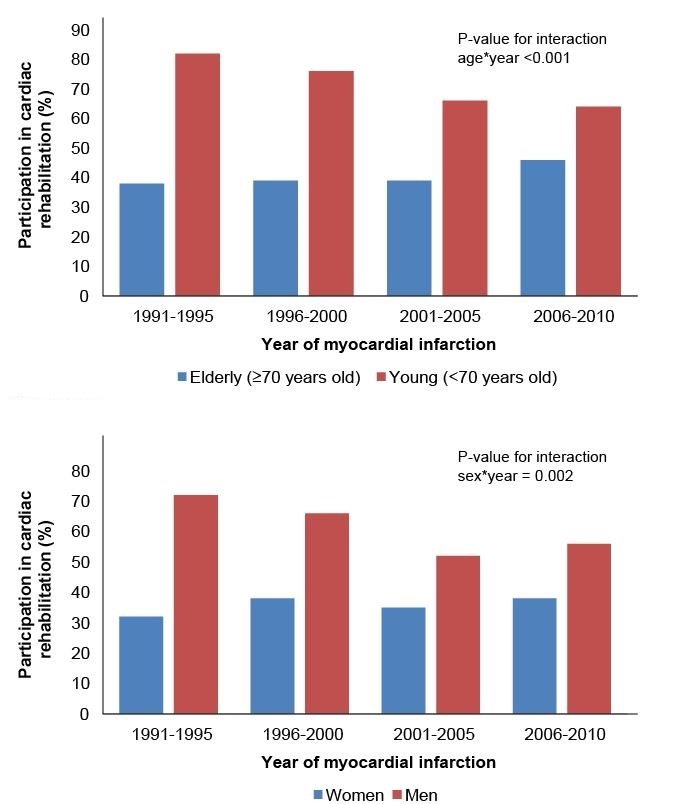 Which of the following is the best statement based on the information presented?
 (Multiple Choice)
4.7/5 (85)
(85) A 4-year-old boy is brought to the office by his parents due to behavioral problems. The parents recently decided to take him out of preschool after receiving numerous complaints from the staff about his hyperactive behavior (running and climbing in the classroom, interrupting the teacher) and inability to listen and follow directions. This is the second school he has attended this year. He was asked to leave the first school for similar behavior. The patient's mother says that at home, he "runs wild" and fights with his older siblings all the time. She says, "He is always bothering or interrupting his older sister and brother. Another difficulty is that we are always running late for school because I can't get him to follow through with getting dressed and eating breakfast." The father had a history of attention-deficit hyperactivity disorder as an adolescent and was treated with amphetamines. He says, "I think I never would have graduated from high school without them." The boy has no medical problems and developmental milestones are within normal range. The parents are reluctant to have their son take medication and are particularly concerned about the risk of weight loss because he is already very thin.
Which of the following is the most appropriate next step in management of this patient?
(Multiple Choice)
4.9/5 (94)
(94) A 60-year-old man comes to the physician complaining of shaking of his right hand. This problem began several months ago and has progressed over time. He says it is worse while watching TV, but that he frequently forgets about it while working or doing his regular daily activities. He is an accountant who works at a bank. His past medical history is significant for left hip osteoarthritis for which he occasionally takes naproxen to relieve the pain. His mother has diabetes mellitus. His father died of a heart attack at age 60. His blood pressure is 125/68 mm Hg in both arms and heart rate is 72/min. His BMI is 27 kg/m2. Physical examination shows a right hand tremor that diminishes with movement, and involuntary resistance to flexion of the right wrist and right arm. No sensory abnormalities are present. Muscle strength is preserved on both sides. Plantar reflexes are flexor bilaterally.
Which of the following is the most accurate tool that can be used to diagnose this patient's disease?
(Multiple Choice)
5.0/5 (81)
(81) A 24-year-old woman comes to the office accompanied by her caseworker. This is the first time that she has been seen in the office, and she appears mildly anxious. However, she quickly relaxes once the female physician enters the room. The caseworker reports that the patient would like to discuss contraceptive options as she has become sexually active with her boyfriend. Medical history is remarkable for moderate intellectual disability and surgical repair of a cardiac defect as an infant. The patient says, "I would like to go on birth control. I want a baby one day but not until I am married." The caseworker reports that the patient's mother, who was unable to attend the appointment, is extremely concerned about the patient's plan. The mother wants the patient to have a tubal ligation as she does not think her daughter would ever be able to care for a child. The patient becomes tearful and says, "My mom doesn't know what's best for me. I know I can be a good mom." The patient reports that she does not have a guardian, and the caseworker confirms that the patient is responsible for her own decision making. The caseworker provides additional information regarding the patient's level of functioning. She states that the patient lives in a group home and has a female roommate. The patient plans to move in with her boyfriend, who has been diagnosed with borderline intellectual functioning. The patient says, "My boyfriend is very nice and helps me a lot. When we live together we can do the shopping ourselves. He has his own job and works in the supermarket 3 days a week. His sister is very nice, too, and she visits him every week. She said that there is an injection I can have so that I don't get pregnant until we are married." The physician educates the patient regarding contraception in simple terms and reviews the various birth control options, including depot progesterone injections. The patient responds, "I don't know. Whatever you recommend, doctor." Which of the following would be the most appropriate response to this patient?
(Multiple Choice)
4.8/5 (77)
(77) A 65-year-old man comes to the clinic for follow-up treatment of hypertension. He is on 2 antihypertensive agents and says he is compliant with his medication regimen. The patient has no other medical problems. Blood pressure is 134/88 mm Hg and pulse is 78/min and regular. BMI is 32 kg/m2. Physical examination is otherwise unremarkable. His fasting blood glucose levels on 2 recent laboratory workups were 108 mg/dL and 111 mg/dL. He is concerned about his risk of dementia because his father suffers from Alzheimer dementia. After excluding from the analysis participants with diabetes who had an unusual clinical course such as high fluctuations in reported glucose levels, the investigators repeat their calculations of the hazard ratio of dementia. This analytical step is best referred to as which of the following?
(Multiple Choice)
4.8/5 (66)
(66) A 14-year-old girl is brought to the office by her mother due to "not yet reaching puberty." The mother reports that her daughter started to have breast development and wear a bra about 2 years ago. However, the patient has not had a growth spurt or reached menarche. Her mother is worried because the girl's 2 older sisters had their first menstrual periods at age 11 and are both over 172.7 cm (5 ft 8 in) tall. The mother states, "Nobody else in our family has been a 'late bloomer'." The patient has had increasing facial acne over the last year for which she uses an over-the-counter topical cream. She has no chronic medical conditions and has had no previous surgeries. The patient was born at term and met all developmental milestones. She recently started high school and is a member of the cheerleading squad. The patient is not sexually active and does not use tobacco, alcohol, or illicit drugs. Blood pressure is 110/60 mm Hg and pulse is 68/min. Weight and height are at the 25th and 55th percentiles, respectively. Breast development is sexual maturity rating stage 3. The external genitalia are normal and pubic hair is Tanner stage 2. Skin examination reveals mild comedonal acne on the nose and forehead. Which of the following is the best next step in management of this patient?
(Multiple Choice)
4.7/5 (81)
(81) A study is conducted to assess the role of different treatment regimens on cardiovascular outcomes. Two treatment arms are evaluated: high-dose hydrochlorothiazide (100 mg/day) and low-dose hydrochlorothiazide (25 mg/day). After a defined follow-up period, the mean systolic blood pressure (BP) in the high-dose group is 139 mm Hg, with a mean diastolic BP of 88 mm Hg. In the low-dose group, the mean values are 143 mm Hg and 92 mm Hg, respectively. A 2-sample t-test gives p-values of 0.03 for the systolic BP and 0.04 for the diastolic BP differences between the high-dose and low-dose groups. The relative risk of sudden cardiac death in the low-dose as compared to the high-dose group is 0.4 (95% confidence interval 0.25-0.55).
Which of the following is the best statement concerning the results of the study with this patient sample?
(Multiple Choice)
4.9/5 (78)
(78) A 55-year-old woman comes to the physician for a follow-up appointment due to problems with low energy, difficulty losing weight, and joint pain. She works in sales and says that it is difficult to be on her feet all day. She has a 10-year history of hypertension, type 2 diabetes mellitus, and hypercholesterolemia. Her current medications include metformin, atorvastatin, lisinopril, and naproxen. The patient has no polyuria, polydipsia, or blurred vision. She has gained 4.5 kg (10 lb) over the past year despite a diabetic diet and repeated counseling about the importance of weight loss and exercise from her physician. She says, "I start off the day eating healthy, but by the afternoon I am so tired and ravenous that I just have to have a snack. No matter what I do, I just can't lose weight. It's depressing." When the importance of exercise is discussed, she says, "I want to exercise, but it's hard when I have pain in my knees and ankles." The patient drinks a glass of wine daily and does not use illicit drugs. She binge eats (a box of cookies or a whole pizza) once a month when stressed. Her blood pressure is 140/90 mm Hg and pulse is 84/min. She weighs 145 kg (319.7 lb). Finger-stick glucose is 210 mg/dL, and she admits that she stopped off at a donut shop prior to this morning's visit. Which of the following is the most appropriate response by the physician?
(Multiple Choice)
4.7/5 (72)
(72) A 58-year-old man comes to the office for follow-up. The patient is under the physician's care for management of diabetes and hypertension and was recently hospitalized for a diabetic foot infection. In the hospital, he received antibiotic therapy and his insulin regimen was adjusted to optimize glycemic control. The patient has been well since hospital discharge and is compliant with his medications. He has returned to work full-time but worries about his health and hopes the physician might be able to see him for a same-day appointment should he experience any discomfort. Physical examination is unremarkable. Toward the end of the visit, the patient presents the physician with a watch as a gift, saying, "It wasn't expensive; it is just a small token of my appreciation for your excellent care." Which of the following is the most appropriate course of action regarding the gift?
(Multiple Choice)
4.8/5 (71)
(71) A 16-year-old girl is brought to the emergency department by her parents after they found razor blades hidden in her room and noted several scratches on her forearms. The girl says, "My parents are always overreacting to stupid things and when I really need them, they're always busy. It wasn't like I was trying to kill myself or anything." The parents note that their daughter is always moody. They have noticed that she frequently wears long sleeves and don't know how long she has been cutting herself. They are also concerned that she frequently binges on junk food and then starves herself for a few days afterward. They suspect that she may be forcing herself to vomit. The girl has no medical problems and no prior psychiatric history. She has tried alcohol and marijuana at parties but does not use them regularly. When interviewed alone and asked about depression, she says, "I just hate everything in my boring life. I wasn't trying to kill myself. I just feel like cutting when I am upset about something. I know a lot of kids who do it." She has no thoughts of suicide currently, although she has previously wished that she were dead after breaking up with her boyfriend and sometimes thinks about how her parents and friends would react if she were dead. Vital signs are stable. Physical examination is normal except for multiple scratches and superficial lacerations in various stages of healing on both forearms. Her parents are very concerned. Which of the following is the most appropriate statement to make to the parents at this time?
(Multiple Choice)
4.9/5 (82)
(82) A 28-year-old woman comes to the office due to chronic diarrhea. She also has osteoporosis and anemia. The diagnosis of celiac sprue is considered. An article reviewing the efficacy of 2 new tests available for celiac sprue diagnosis contains the following 2 tables: After careful analysis of the data from the 2 tables, a decision is made to use these new tests to determine whether the patient has celiac sprue. Which of the following represents the most appropriate testing strategy?
(Multiple Choice)
4.9/5 (84)
(84) A 35-year-old man comes to the emergency department after being involved in a snowmobile accident. He complains of severe pain in his right groin and is unable to extend his right knee. He has no other past medical problems. He is an avid athlete and runs five miles every day. On physical examination, he is unable to extend his right knee against resistance; passive movements are within normal limits. There is a sensory loss over the anterior and medial thigh, medial shin, and the arch of the right foot. The knee jerk is markedly decreased on the right side. Which of the following nerve injuries can most likely explain the physical findings?
(Multiple Choice)
5.0/5 (77)
(77) A 33-year-old woman comes to the clinic for a routine health maintenance examination. She has no lower abdominal pain, vaginal bleeding, or vaginal discharge. Her past medical history is remarkable for 1 episode of uncomplicated urinary tract infection treated with a short course of antibiotics. She is currently not taking any medications. She has had 5 sexual partners in her life and has used barrier contraception the majority of the time. Her latest sexual relationship began 3 months ago. Her last cervical cancer screening examination was a Pap smear performed at the age of 23 that showed no abnormalities. She does not use tobacco, alcohol, or illicit drugs. During her visit, she requests screening for cervical cancer and appears extremely concerned as her older sister was recently diagnosed with it. A national government agency is reviewing data from this paper to decide which screening method to recommend and fund. However, agency officials realize that the prevalence of cervical cancer varies throughout the country. For this reason, a reliable epidemiological parameter is needed to compare the significance of negative and positive results obtained in individual patients, irrespective of prevalence. Which of the following epidemiological parameters would be the most useful in comparing these screening tests when applied to individual patients?
(Multiple Choice)
4.7/5 (71)
(71) A 55-year-old morbidly obese woman comes to the office for a follow-up visit. The patient was recently diagnosed with diabetes mellitus type 2. Her other medical problems include hypertension and hyperlipidemia. She does not use tobacco, alcohol, or illicit drugs. Examination shows no abnormalities. Her weight is 101 kg (223 lb), 4 lb (1.8 kg) more than at her last visit. The patient admits to not following a diabetic diet as she always feels hungry. She also missed her previous appointment 2 months ago. The patient says she recently purchased ma huang (ephedra), a Chinese herb for weight loss, via the Internet after it helped a friend lose 9.1 kg (20 lb). She says, "I am really excited because I think I have already lost 2 lb after taking it for only a week. Nothing else has helped me lose weight." The physician educates the patient about ma huang's safety risks and recommends that she stop taking it, but she insists on continuing. Which of the following is the most appropriate course of action regarding this patient?
(Multiple Choice)
5.0/5 (78)
(78) A 45-year-old woman with cirrhosis due to autoimmune hepatitis comes to her hepatologist for routine follow-up. She has been feeling well and complains only of mild fatigue. Her medical history is otherwise unremarkable. Her medications include lactulose, spironolactone, propranolol, and furosemide. Vital signs are within normal limits. The remainder of her physical examination is consistent with compensated cirrhosis. Laboratory results are as follows: 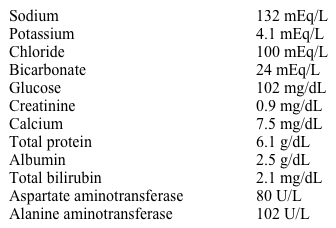 Which of the following is the most appropriate next step in managing this patient's low serum calcium?
 (Multiple Choice)
5.0/5 (62)
(62) A 29-year-old woman, gravida 0 para 0, comes to the office for preconceptual counseling. The patient has been taking oral contraceptives for the past 6 years and would like to become pregnant within the next 6 months. She has no chronic medical conditions or previous surgeries. Her menses occur every 28 days and last for 4 days. Her menstrual flow is light and accompanied by mild cramping. The patient's Pap tests, the last of which was 2 years ago, have been normal. In addition to oral contraceptive pills, she takes a multivitamin daily and uses acetaminophen occasionally. She has no known drug allergies and is up to date on all vaccinations. The patient drinks socially once a week but does not use cigarettes or illicit drugs. She is an aerobics instructor and teaches for 90 minutes 5 days a week. On days the patient does not teach, she exercises with light weights. In addition, she frequently goes scuba diving on weekends. Blood pressure is 100/60 mm Hg and pulse is 62/min. BMI is 22 kg/m2. Pelvic examination reveals a retroverted, normal-size uterus with no adnexal masses or tenderness, a closed cervix, and no vaginal discharge or bleeding. In addition to recommending prenatal vitamins, which of the following is the best advice for this patient?
(Multiple Choice)
4.9/5 (73)
(73) A 69-year-old man comes to the emergency department with 1 hour of sudden vision loss in his right eye. The patient has no headache, eye pain, itching, or discharge. He has a history of coronary artery disease, type 2 diabetes mellitus, hypertension, and hyperlipidemia. The patient was diagnosed with prostate cancer 6 months ago and treated with radiation therapy. Physical examination shows severely compromised vision in the right eye. He can recognize hand motion but cannot count fingers. Funduscopic findings are shown below. 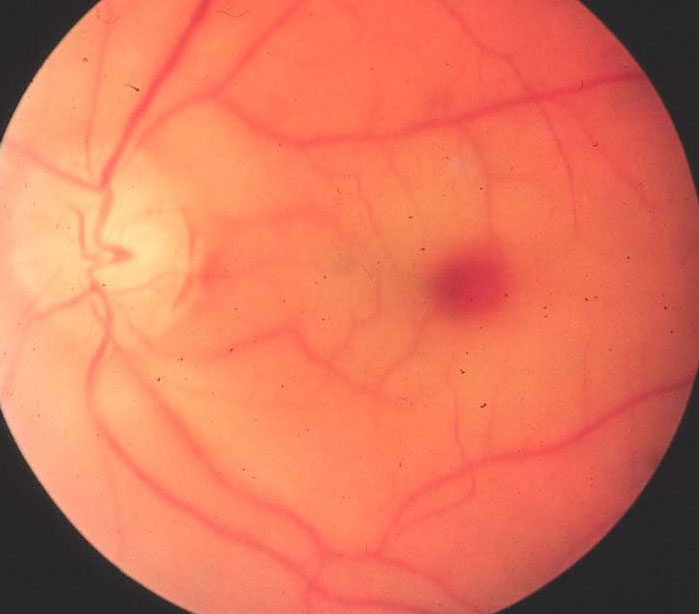 Which of the following is the most likely diagnosis?
 (Multiple Choice)
4.8/5 (73)
(73) A 15-year-old girl is brought to the emergency department due to a 3-day history of fever, chills, malaise, and sore throat. The patient has had difficulty swallowing because of severe throat pain. She has also had hoarseness and dry cough. She has no chronic medical problems and takes no medications. The patient has not received recommended childhood vaccinations due to religious beliefs. Temperature is 38.3 C (101 F), blood pressure is 110/60 mm Hg, pulse is 120/min, and respirations are 20/min. Oropharyngeal examination shows pharyngeal erythema with several spots of grey exudate that have nearly coalesced into a membrane. Scraping of the membrane causes bleeding. There are several enlarged and tender cervical lymph nodes. Breath sounds are normal. Throat swab cultures and PCR for a bacterial toxin are positive. This patient is at greatest risk for which of the following due to complications of her current condition?
(Multiple Choice)
4.9/5 (85)
(85) 
Filters
- Essay(0)
- Multiple Choice(0)
- Short Answer(0)
- True False(0)
- Matching(0)