



 Chat with AI
Exam 2: Foundations of Independent Practice

Exam 1: Advanced Clinical Medicine1 k+ Questions
Exam 2: Foundations of Independent Practice597 Questions
Select questions type


A 55-year-old man with a history of chronic low back pain comes to the physician with a 3-week history of progressive right shoulder pain and a 1-week history of worsening lower back pain. He has tried several over-the-counter medications without significant relief. He smokes 2 packs daily and consumes alcohol occasionally. A chest x-ray reveals a right superior lobe mass. Which of the following additional findings, if present, would indicate a worse prognosis requiring urgent intervention?
(Multiple Choice)
4.8/5  (86)
(86) A 63-year-old man comes to the clinic for a new patient visit. He is pleasant and says he "has never felt healthier." The patient presents a list of regularly taken medications, which include atenolol, sildenafil, terbinafine, minoxidil (topical), aspirin, and saw palmetto. He has no known drug allergies and has a remote history of cholecystectomy. He drinks an ounce of bourbon before bed each night. The patient has a remote 15-pack-year smoking history and has never used illicit drugs. He is married, has 3 grown children, and was recently transferred to this city to assume direction of a local factory. Physical examination is remarkable for a soft midsystolic murmur that is loudest in the second right intercostal space. There is some bony enlargement of the distal interphalangeal joints bilaterally. The patient wishes to discuss his medication list in more depth and indicates an increasing interest in alternative medicines. The patient is counseled appropriately regarding his use of alternative medicines. Which of the following side effects is most strongly associated with saw palmetto?
(Multiple Choice)
4.8/5 (66)
(66) A 62-year-old man comes to the community health center due to a "flaky and itchy" scalp. He is uncertain when the symptoms began and believes his brother has a similar problem. The patient has not attempted any specific treatments but washes his hair with a mild shampoo every other day and washes his face with cold water once daily. Medical history is notable for coronary artery disease, type 2 diabetes mellitus, benign prostatic hyperplasia, and diverticulosis. The patient is a recovering alcoholic and has lived in a group home for the last 3 months. Vital signs are normal. Physical examination shows oily skin with faint erythema and scaling of the scalp, eyebrows, and ears, as shown below. During the course of the visit, the patient repeatedly scratches his head and eyebrows, but the remainder of the skin examination is normal. 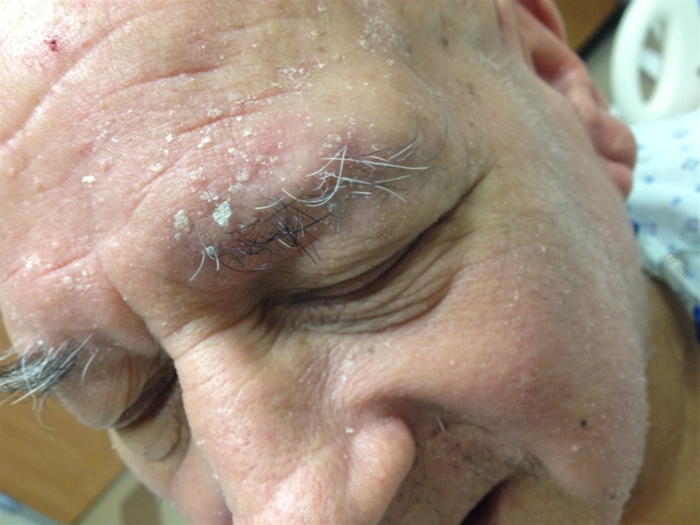 Which of the following is the best initial treatment for this patient?
 (Multiple Choice)
4.8/5 (82)
(82) A 16-year-old girl is brought to the physician by her parents. Her mother is concerned because the girl has lost 10 pounds in the last 3 months. She constantly feels weak and tired. She is doing well in high school. The patient says that she eats well, although her appetite has decreased. Her last menstrual period was 3 months ago. She is not sexually active. She does not use tobacco, alcohol, or illicit drugs. Physical examination shows a young, thin girl with multiple brown freckles. The patient has a decreased amount of axillary and pubic hair for her age. Patchy brown spots are seen on her lips and buccal mucosa. Mild generalized muscular tenderness is present. She appears well-groomed, alert, and communicative and does not appear to be especially anxious. Her parents, on the other hand, are worried about her condition and want to know her diagnosis.
Which of the following is the most appropriate statement regarding this patient's case?
(Multiple Choice)
4.9/5 (75)
(75) A 24-year-old man comes to the emergency department with palpitations. He has had short-lived episodes of palpitations for several years, but this one is persistent. He has no past medical history and takes no medications. ECG shows regular narrow-complex tachycardia (QRS duration of 90 msec) at a rate of 175/min. His blood pressure is 135/80 mm Hg and physical examination is notable for tachycardia but otherwise unremarkable. Vagal maneuvers are ineffective in breaking the tachycardia. The patient receives a rapid intravenous push of adenosine (6 mg) followed by saline chaser. Soon after the bolus, his heart rate becomes 230/min and irregular, and the rhythm rapidly degenerates into ventricular fibrillation. The patient loses consciousness, and the pulse is not palpable. He is immediately defibrillated and regains consciousness. He has poor recollection of the recent events but has no other complaints. Repeat ECG shows normal sinus rhythm at a rate of 89/min, short PR interval of 110 msec, prolonged QRS complex of 130 msec, and delta waves in multiple leads. Which of the following best classifies this patient's encounter?
(Multiple Choice)
4.9/5 (86)
(86) A 15-year-old boy is brought to the office due to concern about puberty being delayed. He is the shortest boy in his class and his voice has not started to change. The patient is otherwise well and has no headaches, vision changes, or vomiting. He is an average student in high school and a member of the cross-country team. He eats a well-balanced diet and has a good energy level. The patient has allergic rhinitis, for which he takes loratadine. He takes no other medications, and his vaccinations are up to date. His mother underwent menarche at age 13 and his father had facial hair at age 14. Vital signs are normal. The patient's growth chart is shown in the exhibit. 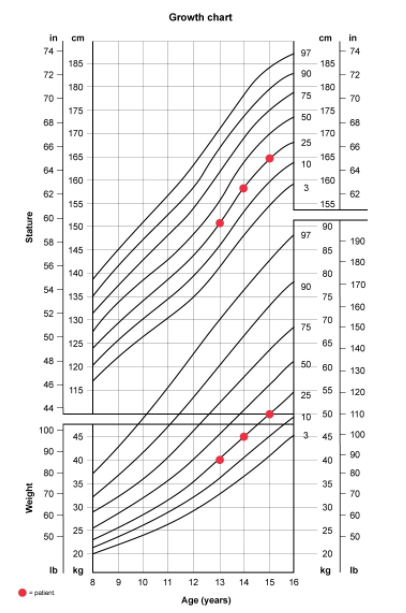 On physical examination, he appears well nourished. Cranial nerves II-XII are intact, and there are no focal deficits. Visual fields are full to confrontation. There is no facial hair or acne. The neck is supple with no masses. Cardiopulmonary examination is normal. The abdomen is soft and nondistended without palpable masses. The genital area has no pubic hair. The testes are symmetric and small, measuring 2.5 cm in length and 2 mL in volume. A bone age radiograph is consistent with age 13 years, 2 months. Which of the following is the best next step in management of this patient?
 (Multiple Choice)
4.8/5 (78)
(78) A 30-year-old woman comes to the office due to tiredness for the past 3 months. She has been unable to exercise due to excessive fatigue and muscle cramps. The patient has had no cold intolerance, constipation, or dry skin. She states, "My menstrual cycles have been unpredictable and very heavy." Medical history is notable for episodic migraines, for which she began taking topiramate 6 months ago. The patient initially had significant weight loss after starting topiramate, but she has regained most of the weight over the last 2 months and continues to have occasional migraines. She also has a history of chronic anxiety and an episode of nephrolithiasis a few months ago. The patient lives alone, is not sexually active, and has had no pregnancies. She does not use tobacco, alcohol, or illicit drugs. The patient's sister underwent a thyroidectomy for unknown reasons. Blood pressure is 136/80 mm Hg and pulse is 68/min. BMI is 28 kg/m2. The thyroid gland is normal in size and nontender. Deep tendon reflexes are normal; the remainder of the examination is unremarkable. Serum TSH is 5.7 µU/mL. Repeat TSH a month later is 5.6 µU/mL, and free T4 is normal. Which of the following additional findings is most likely to be associated with this patient's condition?
(Multiple Choice)
4.8/5 (81)
(81) Gastric adenocarcinoma is typically diagnosed using upper endoscopy and managed with radical gastrectomy and, in some cases, chemoradiation; nevertheless, long-term survival is poor. Researchers in a region with a relatively high incidence of gastric adenocarcinoma are evaluating a novel screening test for early detection of the malignancy in high-risk patients. The novel test is based on the measurement of a recently discovered serologic marker of gastric adenocarcinoma, MGAc. Based on results of a large study sample of representative high-risk patients screened with MGAc and diagnosed with gastric adenocarcinoma, the mean survival of patients since time of diagnosis is 8.2 months. A review of records shows that, compared to these patients, similar high-risk patients who were diagnosed using the traditional endoscopic modality had a statistically significant lower mean survival of 7.1 months, with no statistically significant differences in the rates of radical gastrectomy or in the average number or intensity of chemoradiation cycles. Which of the following best explains these results?
(Multiple Choice)
4.7/5 (69)
(69) A 3-year-old boy is brought to the office by his parents for evaluation of lower extremity weakness. His mother states, "He used to be able to play soccer with his older sisters for hours, but for the past several months, he stops playing after 10 minutes because his legs feel tired." The patient has also been "clumsy" recently and frequently trips while walking. He has no joint pain, incontinence, constipation, numbness, or systemic fatigue. Language development is slightly delayed, and he learned to walk at age 18 months. He has had no chronic medical conditions or surgeries. The patient takes no medications and has received all recommended vaccinations. His aunt has Hashimoto thyroiditis; family history is otherwise noncontributory. Vital signs are normal for age. Physical examination shows a cooperative, nondysmorphic boy. Both calves appear large in circumference compared to the thighs. Strength is 3/5 in the bilateral quadriceps and 4/5 in the calves. Sensation is intact. Achilles deep tendon reflexes are hyporeflexic. The patient walks with a waddling gait. Which of the following is the best next step in management of this patient?
(Multiple Choice)
4.8/5 (100)
(100) A randomized, double-blinded clinical trial was conducted to evaluate the effect of a new hypolipidemic drug on the survival of patients after percutaneous coronary intervention (PCI). 1000 patients undergoing PCI were randomly assigned to the drug or placebo group. 500 patients were in each group. The 2 groups were then followed for 3 years for the development of acute coronary syndromes. Severe acute myositis was reported as a rare side effect of the drug therapy, but the difference between the 2 groups in the occurrence of this side effect was not statistically significant (p = 0.09). A review of the literature shows that, in prior clinical trials and case reports, the same side effect was noted in some patients taking this drug. Which of the following is the most likely cause for the failure to detect a significant statistical difference in the occurrence of acute myositis between the treatment and placebo groups in this randomized trial?
(Multiple Choice)
4.8/5 (79)
(79) A 14-year-old Caucasian adolescent presents to your office for the evaluation of an 'annoying' spot on his face. Physical examination reveals a hypopigmented spot on his chin that is about 2 cm in diameter. Similar spots are present on his right shoulder, chest, and back. His past medical history is insignificant. His family history is significant for a father and an aunt with bilateral deafness. Which of the following is the most probable diagnosis in this patient?
(Multiple Choice)
4.8/5 (78)
(78) A 68-year-old man with a history of paroxysmal atrial fibrillation, rheumatoid arthritis, and heart failure with reduced ejection fraction is admitted for total hip arthroplasty due to fracture from a mechanical fall. During surgery, the patient develops bleeding, and the surgeon requests packed red blood cells in anticipation of potential transfusion. The blood bank requires a confirmatory patient blood sample for type and cross-matching and sends an empty collection tube prelabeled with patient name and date of birth. The anesthesiologist draws the patient's blood into the tube and returns it to the blood bank, which confirms blood type and releases the blood products. However, the surgical nurse discovers that the name on the blood products belongs to a different patient. Internal investigation of the incident reveals that the collection tube sent by the blood bank was prelabeled with the wrong patient information. Which of the following is most likely to describe an active error in this case?
(Multiple Choice)
4.8/5 (88)
(88) A 19-year-old woman, gravida 1 para 0, comes to the office at 28 weeks gestation for a routine prenatal visit. Her prenatal course was complicated by vaginal bleeding at 8 weeks gestation due to a subchorionic hematoma. At that time, laboratory evaluation in the emergency department showed that she was Rh(D) negative, and she received anti-D immune globulin. The vaginal bleeding resolved, and the patient has had no other problems during this pregnancy. She has no chronic medical problems or previous surgeries. The patient does not use tobacco, alcohol, or illicit drugs. Blood pressure is 110/70 mm Hg and heart rate is 80/min. Fundal height is 28 cm and fetal heart rate is 145/min. Laboratory evaluation today shows a negative anti-D antibody screen. The patient is no longer in contact with the father of her child, and his Rh(D) status is unknown. Which of the following is the best next step concerning Rh(D) alloimmunization in this patient?
(Multiple Choice)
4.9/5 (76)
(76) A 32-year-old woman comes to the physician with urinary burning and frequency. She has no fever or back pain. Midstream urine (MSU) cultures grow 105 colony forming units (CFU)/mL of enterococci. A previous publication studied the accuracy of MSU culture in identifying the causative pathogen in patients with uncomplicated cystitis. Women ages 18-49 with symptoms of cystitis provided MSU specimens for culture. The investigators also collected urine by means of a urethral catheter for culture, which served as the gold standard for confirming the causative pathogen. The following results relating to enterococcal growth were reported for 404 specimens: Based on the study results, what is the positive predictive value of enterococcal growth of 105 CFU/mL in the MSU sample?
(Multiple Choice)
4.9/5 (81)
(81) A 56-year-old man comes to the physician due to several months of difficulty in swallowing. At first, meat would stick in his throat, and now he has difficulty swallowing all solid food and occasionally liquids. The patient coughs and sometimes aspirates food particles when eating. He has no shortness of breath, chest pain, or heartburn and has lost several pounds in the last 2 months. The patient was evaluated for persistent right ear pain 4 weeks ago, but no diagnosis could be made. His past medical history is significant for hypertension. He smokes 2 packs of cigarettes daily and consumes 6-8 bottles of beer on weekends. The patient is not sexually active. Lungs are clear to auscultation. Neck palpation shows no lymph node enlargement or thyromegaly. Endoscopy performed on this patient identifies an upper-esophageal mass with irregular contours that partially obstructs the lumen of the esophagus. Which of the following is the most likely histopathologic type of this tumor?
(Multiple Choice)
4.9/5 (69)
(69) An 18-year-old woman who recently immigrated to the United States comes to the office for a pre-employment physical. She is looking forward to starting a job as a nursing aide and also plans to enroll in night classes to become a registered nurse. The patient is engaged to be married and is planning on returning to her country to visit her family next month and to undergo a "female circumcision." She says that this matter is very important because it is considered a rite of passage in her culture. Her family feels strongly that she should undergo the procedure in preparation for marriage. Two of the patient's older sisters have already undergone the procedure. Her medical history is unremarkable and physical examination reveals no abnormalities. Which of the following is the most appropriate response?
(Multiple Choice)
4.8/5 (85)
(85) A 19-year-old Caucasian male comes to clinic complaining of frequent headaches that "make it impossible to do well at work or school." He cannot pinpoint when the headaches started. Recently, he has also noticed a rhythmic pulsating sound in his ears when he bends over. When he straightens, his vision dims in both eyes. He has been diagnosed with depression, attention deficit disorder, and acne vulgaris, and is currently taking fluoxetine, atomoxetine, and isotretinoin. Vital signs are normal. Ophthalmologic examination is remarkable for peripapillary flame hemorrhages, venous engorgement, and hard exudates. There is some constriction of the visual field in the inferior nasal quadrant. Visual acuity is normal. What is the most likely diagnosis?
(Multiple Choice)
4.9/5 (82)
(82) A 3-day-old boy is brought to the office for follow-up after hospital discharge. He was delivered vaginally at 40 weeks gestation to a 28-year-old primigravid mother. All maternal prenatal laboratory results were normal, and Group B Streptococcus culture was negative. Maternal history is significant for lactose intolerance, celiac disease, and shellfish and egg allergies. Birth weight was 3.5 kg (7.7 lb); discharge weight yesterday was 3.35 kg (7.4 lb) and weight today is 3.26 kg (7.2 lb), a 7% decrease from birth weight. Physical examination reveals a crying infant who is easily consoled when held. Cardiopulmonary examination is normal. The Moro reflex is symmetric and the infant has a strong suck. There is an erythema toxicum rash on the trunk. The remainder of the examination is normal. The mother tearfully says, "I would like to continue to breastfeed exclusively, but the baby is still losing weight. He wants to feed all the time, especially at night. My husband thinks we should give the baby formula. What do you think?" Which of the following is the best recommendation for this patient?
(Multiple Choice)
4.9/5 (74)
(74) A 46-year-old woman comes to the office due to persistent joint pains. She has a history of rheumatoid arthritis and, for the past 6 months, has been on methotrexate (Mtx) therapy. However, her symptoms have shown little improvement. She has morning stiffness that lasts for >1 hour, and her erythrocyte sedimentation rate is 40 mm/hr. A discussion is initiated regarding modifying her therapy to include either subcutaneous (SC) tocilizumab (TCZSC) or SC abatacept (ABTSC) in addition to Mtx. The patient expressed wanting to attempt the most effective treatment and avoid having to modify her treatment again. The mean cost of treatment per number needed to treat (NNT), obtained by multiplying the yearly individual cost by the NNT, is considered an indicator of the clinical benefits and costs linked to the use of the therapies. Based on the results of the meta-analysis, which of the following best describes the clinical benefits and costs of rheumatoid arthritis therapies per NNT in patients previously treated with Mtx?
(Multiple Choice)
4.8/5 (84)
(84) Researchers are conducting a cross-sectional study to demonstrate the relationship between renal frame count (RFC), considered the dependent variable, and LDL, considered an independent variable. RFC is an objective quantitative angiographic method of measuring macrovascular blood flow in the main renal artery and its segmental branches. Two hundred patients were categorized into 2 groups according to serum LDL levels-LDL <130 mg/dL (n = 90) and LDL ≥130 mg/dL (n = 110). Other parameters included BMI, platelet count, and creatinine clearance. Which of the following is the best statistical approach for simultaneously evaluating the association between RFC and LDL cholesterol while adjusting for BMI, platelet count, and creatinine clearance?
(Multiple Choice)
4.7/5 (73)
(73) 
Filters
- Essay(0)
- Multiple Choice(0)
- Short Answer(0)
- True False(0)
- Matching(0)