Multiple Choice
A 15-year-old boy is brought to the office due to concern about puberty being delayed. He is the shortest boy in his class and his voice has not started to change. The patient is otherwise well and has no headaches, vision changes, or vomiting. He is an average student in high school and a member of the cross-country team. He eats a well-balanced diet and has a good energy level. The patient has allergic rhinitis, for which he takes loratadine. He takes no other medications, and his vaccinations are up to date. His mother underwent menarche at age 13 and his father had facial hair at age 14. Vital signs are normal. The patient's growth chart is shown in the exhibit. 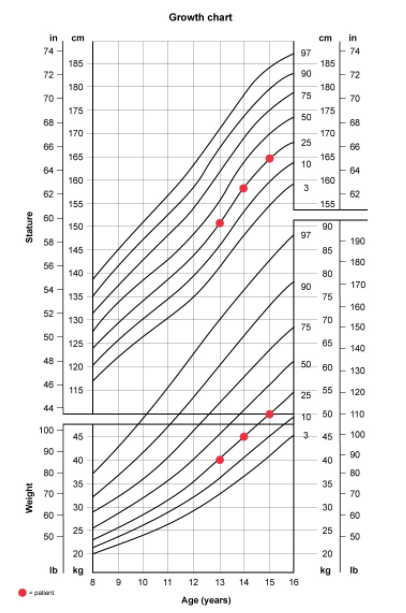 On physical examination, he appears well nourished. Cranial nerves II-XII are intact, and there are no focal deficits. Visual fields are full to confrontation. There is no facial hair or acne. The neck is supple with no masses. Cardiopulmonary examination is normal. The abdomen is soft and nondistended without palpable masses. The genital area has no pubic hair. The testes are symmetric and small, measuring 2.5 cm in length and 2 mL in volume. A bone age radiograph is consistent with age 13 years, 2 months. Which of the following is the best next step in management of this patient?
A) FSH, LH, and testosterone levels
B) GnRH stimulation test
C) Karyotype analysis
D) MRI of the brain
E) Reassurance and follow-up in 6 months
Correct Answer:

Verified
Correct Answer:
Verified
Q481: A 55-year-old man with a history of
Q482: A 63-year-old man comes to the clinic
Q483: A 62-year-old man comes to the community
Q484: A 16-year-old girl is brought to the
Q485: A 24-year-old man comes to the emergency
Q487: A 30-year-old woman comes to the office
Q488: Gastric adenocarcinoma is typically diagnosed using upper
Q489: A 3-year-old boy is brought to the
Q490: A randomized, double-blinded clinical trial was conducted
Q491: A 14-year-old Caucasian adolescent presents to your