



 Chat with AI
Exam 2: Foundations of Independent Practice

Exam 1: Advanced Clinical Medicine1 k+ Questions
Exam 2: Foundations of Independent Practice597 Questions
Select questions type


A 47-year-old man comes to a homeless shelter clinic due to 2 weeks of skin rash. The patient was recently hospitalized and treated for an infection, but he is unsure of the details. He was diagnosed with HIV 10 months ago and is not on antiretroviral therapy. He also has a history of chronic kidney disease and hypertension. He takes no medication regularly. The patient drinks 1-2 cans of beer daily and does not use tobacco. Temperature is 37.2 C (99.0 F), blood pressure is 120/70 mm Hg, pulse is 80/min, and respirations are 14/min. BMI is 17 kg/m2. Oropharyngeal thrush is present. Cardiopulmonary auscultation reveals clear lung fields, and normal first and second heart sounds without murmur or gallop. The abdomen is soft and nontender. The liver is palpable 3 cm below the costal margin, and mild splenomegaly is present. Neurological examination shows no abnormalities. Multiple small papules with central umbilication are present on the face, neck, trunk, and upper thighs. Some of the lesions have central necrosis and are covered with a hemorrhagic crust.
Which of the following is the most likely diagnosis for this patient?
(Multiple Choice)
4.8/5  (72)
(72) A 74-year-old man comes to the office due to memory problems over the past several months. He is accompanied by his wife. The patient says, "I am worried about my memory. I feel like I am losing my mind. I can't remember what I've read in the newspaper, and I even have difficulty following the plot on TV shows." His wife says, "He frequently misplaces things like his keys and wallet and can't recall names of individuals he should know. She adds, "He used to like to cook and watch TV, but he doesn't seem to enjoy these things anymore. When he attempted to make a favorite dish recently, he left out half the ingredients and burned the meal." Over the past 2 months, the patient has been involved in 2 minor car accidents in which he was "not paying attention." He recently told his wife that they are "ruined and going bankrupt," despite her multiple assurances that this is not so. She says, "I show him the bank statements, but a few days later, it's as if he doesn't remember and he asks to see them again." They went through a difficult time over the past year due to his suspicions that she had an affair, which were recently confirmed. The patient's medical history is significant for gastroesophageal reflux disease, rheumatoid arthritis, and hypertension. He has increased soreness and pain in his joints and neck that he attributes to "my body breaking down." The patient has a history of thyroid cancer that was successfully treated 15 years earlier. His medications include lisinopril, levothyroxine, hydrochlorothiazide, aspirin, and antacids. Physical examination is unremarkable. Laboratory studies, including vitamin B12 and thyroid function, are normal.
Which of the following is the best response to this patient's concerns?
(Multiple Choice)
4.9/5 (79)
(79) Women with inflammatory bowel disease (IBD) appear to be at greater risk for human papillomavirus (HPV) infection and HPV-related malignancies compared to healthy counterparts. A new study evaluated knowledge about HPV infection among women with IBD. Potential participants were identified from among patients seeking care at local clinics, and all women age ≥15 with an established diagnosis of IBD from 2009 to 2010 were invited to participate in the study. A questionnaire was used to collect information on demographics, lifestyle, sexual behavior, and HPV-related knowledge; simultaneously, the association between HPV-related knowledge and the other factors was analyzed. Which of the following best describes the study design?
(Multiple Choice)
4.8/5 (86)
(86) A 36-year-old woman comes to the office due to a 3-month history of palpitations and restlessness. In addition, she has had irregular menstrual periods for the last 6 months, and her last menstrual period was 45 days ago. The patient has a normal appetite and has had no weight change, headaches, swelling, shortness of breath, diaphoresis, or muscle weakness. She takes no prescription medications, and medical history is notable only for laparoscopic excision of a benign ovarian cyst at age 28. Family history is unremarkable. She works as a laboratory technician at a community hospital and does not use tobacco, alcohol, or illicit drugs. The patient is single and not sexually active. Temperature is 36.1 C (97 F), blood pressure is 140/70 mm Hg, pulse is 100/min, and respirations are 22/min. Pupils are normal and reactive to light with intact extraocular movements, no proptosis, and mild lid lag. The thyroid is easily palpable, nontender, and has no nodules. The extremities are warm to the touch and there is a slight tremor in the outstretched hands. Laboratory results are as follows: 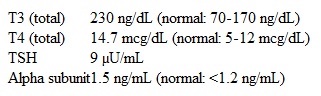 Which of the following is the most likely cause of this patient's thyroid abnormalities?
 (Multiple Choice)
4.9/5 (71)
(71) A 40-year-old woman comes to the office due to intermittent dysphagia for the past several months. The patient says, "I frequently have a sensation of food getting stuck in my chest several seconds after swallowing along with pain behind the sternum. I have noticed no specific triggers and have had several episodes after swallowing liquids also." The patient reports no weight loss, nausea, vomiting, hematemesis, abdominal pain, or melena. She has a history of iron deficiency anemia due to menorrhagia from uterine fibroids. The patient has not been taking oral iron supplements due to associated constipation. She does not use tobacco, alcohol, or illicit drugs. Family history is notable for systemic sclerosis in the patient's sister. Vital signs are within normal limits and physical examination shows no abnormalities. Barium esophagogram is normal. Manometry after a test swallow demonstrates premature and simultaneous contractions of the distal esophagus. Lower esophageal sphincter relaxation is normal. Hemoglobin is 10.8 g/dL. Which of the following is the most accurate response to the patient regarding her current symptoms?
(Multiple Choice)
4.9/5 (72)
(72) A 25-year-old man comes to the emergency department due to a sudden onset of left foot pain. The pain started suddenly an hour ago, when he was sitting at his desk, and has progressed gradually. He has no history of similar episodes or recent trauma to his left leg. On review of systems, the patient admits to tiredness and some weight loss over the last 2 months, which he attributes to stress. He has no significant medical history. He is a college student. The patient does not use tobacco, alcohol, or illicit drugs. His mother was diagnosed with "a blood clot" after elective knee-replacement surgery. Temperature is 37.2 C (99 F), blood pressure is 122/81 mm Hg, pulse is 86/min, and respirations are 14/min. Examination shows clear lung fields and a regular rhythm, with a low-pitched diastolic murmur over the cardiac apex. The abdomen is soft and nontender, with no palpable masses. Examination of the extremities reveals adequate bilateral femoral pulses. The left popliteal and dorsalis pedis pulses are absent. The left foot appears pale and is cooler than the right. Sensations on the left foot are intact, and the patient is able to voluntarily move the limb. There is no tenderness on palpation of the lower left leg or foot. Neurologic examination is within normal limits. Which of the following is the most likely cause of this patient's condition?
(Multiple Choice)
4.7/5 (89)
(89) A 30-year-old woman comes to the office due to tiredness for the past 3 months. She has been unable to exercise due to excessive fatigue and muscle cramps. The patient has had no cold intolerance, constipation, or dry skin. She states, "My menstrual cycles have been unpredictable and very heavy." Medical history is notable for episodic migraines, for which she began taking topiramate 6 months ago. The patient initially had significant weight loss after starting topiramate, but she has regained most of the weight over the last 2 months and continues to have occasional migraines. She also has a history of chronic anxiety and an episode of nephrolithiasis a few months ago. The patient lives alone, is not sexually active, and has had no pregnancies. She does not use tobacco, alcohol, or illicit drugs. The patient's sister underwent a thyroidectomy for unknown reasons. Blood pressure is 136/80 mm Hg and pulse is 68/min. BMI is 28 kg/m2. The thyroid gland is normal in size and nontender. Deep tendon reflexes are normal; the remainder of the examination is unremarkable. Serum TSH is 5.7 µU/mL. Repeat TSH a month later is 5.6 µU/mL, and free T4 is normal.
Which of the following is the best next step in management of this patient?
(Multiple Choice)
4.8/5 (78)
(78) A 76-year-old woman is brought to the emergency department due to altered mental status. Before admission, she had lived independently and had no contact with her family or primary care physician for several months. Past medical history includes type 2 diabetes mellitus, hypertension, and osteoporosis, but she has no history of dementia or alcohol or illicit drug use. The patient's medications include metoprolol, glipizide, hydrochlorothiazide, and alendronate; she has been on these for several years. Her temperature is 36.7 C (98 F), blood pressure is 130/70 mm Hg, pulse is 105/min, and respirations are 16/min. Pulse oximetry is 97% on room air. Examination shows a drowsy woman in no acute distress who is disoriented to time and place. The neck is supple without thyroid enlargement. Cardiopulmonary examination is normal. Pupillary reflexes are intact, but the patient is otherwise not cooperative with neurologic examination. Laboratory studies show normal complete blood count, basic metabolic panel, and urinalysis. Chest x-ray is normal. CT scan of the head shows generalized cerebral atrophy. Lumbar puncture with cerebrospinal fluid analysis is normal. What is the most appropriate next step in evaluation of this patient?
(Multiple Choice)
4.7/5 (78)
(78) A 46-year-old nurse comes to the acute care clinic 3 weeks after injuring her left knee while transferring a patient. She felt a "twinge," but there was no immediate deformity or subsequent edema, and she was able to continue walking normally. Within 2 weeks, she developed intense pain around the left knee and could hardly walk or put any weight on the left leg. Placing clothing or sheets on the left knee produces abnormal discomfort and insomnia. She is prescribed naproxen and oxycodone. Over the next 2 months, the patient notes swelling around her left knee, an increased temperature, and more sweating of the left leg compared to the right. Sometimes the left leg has a mottled, bluish discoloration. Even on analgesics, exacerbation of her knee pain by flexion and extension causes her to limp. She also complains of poor sleep and constant fatigue. Which of the following is the most likely diagnosis?
(Multiple Choice)
4.9/5 (98)
(98) A 32-year-old woman is brought to the emergency department after she passed out at a local bank. The patient had been standing in line for a long time when she felt warm and nauseated and then lost consciousness for a few seconds. She quickly returned to normal. Her friend, who witnessed the episode, saw no abnormal, jerky movements of the extremities. Toward the end of her usual 5-mile run earlier this morning, the patient felt slightly light-headed. She has no known medical conditions. Family history is significant for a paternal uncle who died from a "heart attack" at age 55. Supine blood pressure is 110/70 mm Hg and pulse is 75/min. Two minutes after the patient stands, blood pressure is 108/70 mm Hg and pulse is 88/min. No jugular venous distension is noted. There are no heart murmurs. An S3 is present. Peripheral pulses are full and symmetric. ECG shows normal sinus rhythm with T-wave inversion in lead V1. Chest x-ray reveals a normal heart size. Which of the following is most closely associated with this patient's likely cause of syncope?
(Multiple Choice)
4.7/5 (79)
(79) A 44-year-old woman comes to the office 2 months after the death of her husband in a motor vehicle collision. She sustained numerous injuries but has made a full recovery. The patient initially says she is doing well but then bursts into tears. She says, "I do have good days, but some days are really bad. Yesterday, for example, when I was going through his clothes, I fell apart and spent the whole day in bed crying." The patient has difficulty falling and staying asleep. When she manages to fall asleep, she wakes up around 3:00 or 4:00 AM and cannot fall back asleep. Sometimes the patient dreams about her husband, which she finds comforting. She says, "The dreams make me feel like I can still be close to him. I also sometimes hear his voice and tell him about the children. The other day I even saw him in the hallway. It was just as if he were back home and it was a normal day." The patient has lost 2.26 kg (5 lb) and has little interest in food. She sometimes wishes she would have died with her husband in the collision so she would not have to be alone, but says, "I would never consider hurting myself because of my children." The patient has no psychiatric history. Physical examination, laboratory tests, and vital signs are within normal limits. Which of the following is the most likely diagnosis?
(Multiple Choice)
4.8/5 (89)
(89) A 23-year-old college student comes to the student health center due to 2 weeks of "not feeling well." She has not attended classes for the past several days due to myalgia and fatigue. The patient has also had intermittent fever, headache, dry cough, and malaise. Due to weak appetite and frequent episodes of diarrhea, she has lost a significant amount of weight over the same period. The patient has also had excessive dandruff and scaly facial rash despite using the same shampoo and cosmetic products as before. In the last several months, she has experienced numerous psychosocial stressors, including working 3 jobs to keep up with her finances. Which of the following additional history is most likely to be helpful in reaching the diagnosis in this patient?
(Multiple Choice)
4.8/5 (65)
(65) A 22-year-old woman comes to the physician at 8 weeks gestation for routine prenatal counseling. Her husband has hemophilia A. Her own family history is insignificant. She is concerned about the possibility of her child having hemophilia. Which of the following is the best response to her questions?
(Multiple Choice)
4.9/5 (79)
(79) A 57-year-old woman comes to the primary care physician for a follow-up visit after undergoing a screening colonoscopy. The colonoscopy revealed adenocarcinoma of the ascending colon and 2 well-differentiated, sessile, adenomatous polyps of the sigmoid colon. The patient has a history of mitral valve prolapse and fibromyalgia. She has also had a prior hysterectomy. Her medications include hormone replacement therapy and ibuprofen. The patient eats a high-fiber vegetarian diet and has consumed 3-4 alcoholic beverages per day for the past 30 years. She smoked 1 pack of cigarettes a day for nearly 5 years, but quit 30 years ago. There is no family history of cancer. The patient is very concerned about being diagnosed with colon cancer. Which of the following was her most significant risk factor for developing colon cancer?
(Multiple Choice)
4.8/5 (89)
(89) A 62-year-old Caucasian man comes to the emergency department (ED) and complains of crushing substernal chest pain. The pain started one hour ago while he was shoveling snow on his driveway. At the onset of his pain, he took nitroglycerin sublingually, but the pain did not get any better and he was taken to the ED by his son. He has a history of coronary artery disease, hypertension, hyperlipidemia, and osteoarthritis. He is on daily aspirin, metoprolol, lisinopril, atorvastatin, and naproxen as needed. In the ED, his electrocardiogram reveals a normal sinus rhythm with no acute ST-T wave changes. He is given morphine for his pain, started on nitroglycerin drip, and admitted to the telemetry floor. The next day, an adenosine thallium stress test reveals a moderate size reversible perfusion defect in the lateral wall of the left ventricle. Which of the following coronary vessels is most likely to have a significant occlusion?
(Multiple Choice)
4.7/5 (82)
(82) A 75-year-old woman comes to the office with a 2-week history of palpitations, fatigue, heat intolerance, sweating, and weight loss. She was diagnosed with coronary artery disease 4 weeks ago after having chest pain. Coronary angiography revealed a high-grade stenosis in the right coronary artery; the patient was treated with angioplasty and stent placement and was discharged with prescriptions for aspirin, clopidogrel, atorvastatin, and metoprolol. She also has hypertension and type 2 diabetes mellitus, for which she takes hydrochlorothiazide, lisinopril, and metformin. The patient has a 20-pack-year smoking history but quit 10 years ago; she does not use alcohol or illicit drugs. Temperature is 37.2 C (99 F), blood pressure is 140/76 mm Hg, pulse is 120/min, and respirations are 18/min. Oxygen saturation by pulse oximetry is 96% on room air. On examination, the thyroid is slightly enlarged, firm, irregular, and nontender. There are no carotid bruits or jugular venous distension. The heart has a regular tachycardia with no murmurs or gallops. Bedside glucose is 130 mg/dL. ECG shows sinus tachycardia with no other significant abnormalities. The dose of the patient's beta blocker is increased, and she is sent for laboratory studies. Complete blood count, electrolytes, and hepatic transaminases are normal. Total T3 and free T4 are elevated, and TSH is undetectable. Thyrotropin receptor antibody assay is negative. Thyroid ultrasound reveals a multinodular goiter with increased vascularity. On follow-up 2 days later, the patient reports only partial relief of symptoms. Blood pressure is 135/80 mm Hg and pulse is 105/min. Which of the following is the best next step in management of this patient?
(Multiple Choice)
4.8/5 (65)
(65) An 83-year-old Caucasian man comes to the emergency department because of a sudden onset, transient visual loss in his right eye. He is currently symptom-free, and denies any other new symptoms. His other medical problems include hypertension and peripheral vascular disease. His medications include aspirin, hydrochlorothiazide, and enalapril. His temperature is 36.7 C (98 F), blood pressure is 160/90 mmHg, pulse is 80/min., and respirations are 12/min. Which of the following signs is most likely to be associated with his symptoms/condition?
(Multiple Choice)
4.8/5 (78)
(78) A 46-year-old man is admitted to the hospital with constant mid-epigastric pain for the past 5 days. He has a history of intravenous drug use, alcohol use disorder, and chronic pancreatitis and continues to drink heavily. He has had 3 recent admissions for pancreatitis in the past 4 months and is well known to the hospital staff. After several days, the patient's condition stabilizes and plans are made to discharge him and refer him back to his primary care physician for a posthospitalization visit within a few days of the hospitalization. When contacted, the primary care physician says, "I do not want to continue to be involved in this patient's care. He does not take his medications consistently and exhibits drug-seek behaviors, and he was verbally abusive to my office staff at his last appointment when he did not receive a prescription for opioid pain medications." Which of the following is the most appropriate step at this time?
(Multiple Choice)
4.8/5 (90)
(90) A 62-year-old man comes to the office due to weight loss, persistent cough, hemoptysis, and dyspnea, after having cancelled several previous appointments. The patient has been under stress lately as he is going through a divorce, and he recently had to postpone his retirement plans when several business deals fell through. He has a history of substance abuse, with episodes of residential treatment for cocaine and alcohol abuse. He no longer uses cocaine but continues to use alcohol daily "to relax." During the visit, a chest x-ray shows a suspicious mediastinal mass. The physician explains the need for a chest CT scan and tissue biopsy. The patient says, "My whole life is going to crap. I suppose you're going to tell me to stop smoking. What do you know? You doctors are all the same. Do this, don't do that; meanwhile, you go home in your fancy cars to your fancy homes. Well, you know what? I'm going to keep smoking and get drunk as hell tonight!" Which of the following is the most appropriate response to the patient?
(Multiple Choice)
4.9/5 (90)
(90) A 42-year-old woman is brought to the emergency department by paramedics for evaluation of a day of mental status changes. She has a history of hypothyroidism, major depression, and chronic back pain. Her medications include levothyroxine, amitriptyline, and daily oxycodone. The patient is markedly confused and agitated and talks to herself. Her temperature is 38.9 C (102 F), blood pressure is 92/52 mm Hg, pulse is 110/min, and respirations are 22/min. There is marked flushing, mydriasis, and hyperreflexia. Her electrocardiogram shows sinus tachycardia with a wide QRS interval. She is started on sodium bicarbonate infusion. Which of the following is the primary therapeutic goal of sodium bicarbonate in this patient?
(Multiple Choice)
4.7/5 (87)
(87) 
Filters
- Essay(0)
- Multiple Choice(0)
- Short Answer(0)
- True False(0)
- Matching(0)