



 Chat with AI
Exam 2: Foundations of Independent Practice

Exam 1: Advanced Clinical Medicine1 k+ Questions
Exam 2: Foundations of Independent Practice597 Questions
Select questions type


A 22-year-old woman is hospitalized after a car accident. She sustained a hip fracture, fracture of several ribs, and a blunt abdominal injury that required a laparotomy. The laparotomy revealed a liver laceration and extensive hemoperitoneum. In the early postoperative period, the patient is noted to have hyperactive deep tendon reflexes. Which of the following electrolyte abnormalities may be responsible for this condition?
(Multiple Choice)
4.8/5  (65)
(65) A 57-year-old woman comes to the office for routine follow-up; she has been a patient of the physician for 20 years. She has a history of chronic obstructive pulmonary disease (COPD), hypertension, and type 2 diabetes mellitus. The patient was hospitalized for a COPD exacerbation 4 months ago, but she has done well since. Her husband, who was also a patient of the physician, died 2 years ago of pancreatic cancer. During the visit, the patient happily informs the physician that she finally quit smoking and that she is getting married to a man she met 3 months ago. She says, "You can't imagine how happy I am. You have known me for so long and have seen me through some terrible times. It would be a great honor if you would attend my wedding." Which of the following is the most appropriate response to the patient?
(Multiple Choice)
4.9/5 (67)
(67) An 8-hour-old boy is evaluated in the neonatal intensive care unit due to respiratory distress. The infant was born at term to a 32-year-old woman, gravida 3 para 2. The mother's routine serologic screening in the first trimester was unremarkable except for a lack of antibody against rubella. The pregnancy was complicated by oligohydramnios. Antenatal sonography at 19 weeks gestation showed that the fetal kidneys were in the normal position but moderately dilated and that the bladder was also dilated and had a thickened wall. Growth measurements were appropriate for gestational age. The delivery was uncomplicated, but immediately after birth, the infant developed some mild respiratory distress that is now improving. Weight is 3.35 kg (7 lb 6 oz) and respirations are 70/min. The infant is tachypneic but otherwise comfortable, with no grunting or retractions. The bladder is palpable just above the suprapubic ridge. The remainder of the examination is unremarkable.
Which of the following is the most likely diagnosis in this infant?
(Multiple Choice)
4.8/5 (78)
(78) A 16-year-old boy is evaluated by the medical team in the intensive care unit. He was admitted 3 weeks ago following a motor vehicle accident. The patient sustained a C5-C6 fracture with dislocation, which resulted in quadriplegia. He currently has a tracheostomy tube and requires mechanical ventilation, and is being fed by a percutaneous endoscopic gastrostomy tube. A week ago, the patient was diagnosed with ventilator-associated pneumonia, which is being treated with piperacillin-tazobactam. His mother says that before his injury he was trying to "build up his muscles" by drinking protein shakes and taking creatine supplements. Medical history is otherwise unremarkable. The patient's mother has Graves disease and his father has hypertension. He has no siblings. Blood pressure is 124/70 mm Hg and pulse is 64/min. Coarse crackles are heard at the right lung base. Laboratory results are as follows: 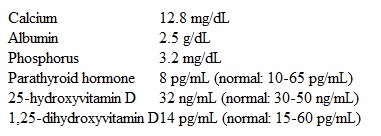 Repeat testing confirms these values. Ionized calcium level is 6.6 mg/dL (normal: 4-5.6 mg/dL). Which of the following is the most likely cause of this patient's hypercalcemia?
 (Multiple Choice)
4.8/5 (72)
(72) A 32-year-old woman comes to the clinic due to persistent thoughts about killing her 3 children. She says, "This is so upsetting because I love my children and would never harm them. I have had these thoughts for the past 3 months and cannot get them out of my head. It happens when I'm in the kitchen preparing dinner. As I reach for a knife in the drawer, I get this sudden thought about stabbing all three of them. The thoughts are senseless and ridiculous, but I worry that I'm going crazy. I wish I never had these thoughts but can't make them stop." The patient is happily married and says that all 3 children are well behaved. Her medical problems include hypothyroidism and microcytic anemia. She has no previous psychiatric history, but recalls being very anxious as a child. The patient says, "I was always worried that something bad was going to happen to my parents if I didn't do the right thing and would get really upset if anyone touched my possessions." Current medications include levothyroxine and iron. Temperature is 37 C (98.6 F), blood pressure is 131/78 mm Hg, and pulse is 87/min. On examination, the pupils are equal and reactive to light and mucous membranes are moist. There is no thyromegaly. Auscultation of the lungs reveals normal breath sounds. Heart sounds are normal. Neurologic examination reveals no focal deficits. At his 4-week follow-up, the patient continues to complain of shaking and claims that "it is starting to become bothersome." Which of the following is the best treatment for this patient?
(Multiple Choice)
4.7/5 (92)
(92) A 55-year-old man is brought to the emergency department after a motor vehicle collision. Due to severe, blunt trauma to the chest and abdomen the patient develops acute respiratory distress syndrome and requires intubation with mechanical ventilation. He receives enteral tube feeding for several days, but has high gastric residuals due to ileus. On hospital day 8, total parenteral nutrition is initiated. Temperature is 36.5 C (97.7 F), blood pressure is 110/60 mm Hg, pulse is 85/min, and respirations are 16/min. Physical examination shows moist mucous membranes and normal jugular venous pressure. Breath sounds are coarse bilaterally and heart sounds are normal. Multiple scattered ecchymoses are present on the chest and abdomen. There is mild pedal edema in the bilateral lower extremities. Laboratory results are as follows: 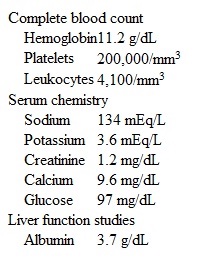 To prevent further complications, which of the following laboratory tests should be monitored closely both before and after initiation of total parenteral nutrition?
 (Multiple Choice)
4.9/5 (74)
(74) A 60-year-old Caucasian female presents to your office with several months history of a sandy sensation in her eyes, especially in the evening, and while watching TV or working in front of the computer. Her past medical history is significant for right knee osteoarthritis. She occasionally takes naproxen to relieve her knee pain. Her family history is significant for a father with hypertension and a mother who was diagnosed with breast cancer at the age of 65. She drinks one cup of decaffeinated coffee in the morning. Physical examination reveals several white patches on her buccal mucosa. Her recent fasting blood glucose level was normal. Which of the following questions is most appropriate in this case?
(Multiple Choice)
4.9/5 (81)
(81) A 9-year-old boy is brought to the office for routine follow-up of his chronic renal disease. He has end-stage renal disease due to focal segmental glomerulosclerosis and was started on hemodialysis 3 months ago. The patient has had failure to thrive due to the disease. His nephrologist has recommended renal transplantation, and several family members have offered to donate a kidney. The patient lives with his mother, his maternal uncle, and his 2 siblings. His father died in a car accident 4 years ago. The patient's blood group is A+. His 7-year-old brother has blood group O-. His 19-year-old sister has blood group A+; she has uncontrolled major depressive disorder and was recently admitted to a psychiatric facility after a suicide attempt. His mother is 38 years old, has asthma, has normal kidney function, and has blood group A+. His uncle is 40 years old and has diabetes mellitus, hypertension, and left ventricular hypertrophy; the uncle has normal kidney function and has blood group A-. Physical examination reveals a boy who appears smaller than his stated age and in no acute distress. Cardiopulmonary examination is normal. Who is the most appropriate potential kidney donor?
(Multiple Choice)
5.0/5 (78)
(78) A 31-year-old man comes to the office for a routine annual examination. The patient mentions that he is engaged to be married, but adds that he is not sure he is ready to make a commitment. He says, "I love my fiancée, but I have recently had some relationships with men. My fiancée wants to have children as soon as we are married, but I feel 'boxed in' by this and want to be absolutely sure that this is what I want." The patient feels conflicted, as he enjoys sex with his fiancée but wonders about other options. He has had sexual intercourse with men in the past and has used condoms most of the time. The patient does not use illicit drugs, except for MDMA occasionally at parties. Examination shows oral thrush and generalized lymphadenopathy. The rest of the physical examination is normal. When the physician recommends that the patient undergo HIV testing, he refuses. Following an extensive discussion with the physician, the patient agrees to undergo testing for HIV and other sexually transmitted diseases. Polymerase chain reaction testing results indicate that he is positive for HIV. The physician discloses these results to the patient during a follow-up appointment later in the week. After he hears this news, he says, "How could this have happened to me? I only had unprotected sex once or twice. Are you sure those are my test results? I am shocked at this. I mean, I am such a healthy person." The physician supports the patient and educates him about HIV infection and antiretroviral therapy. He explains the importance of consistent and correct condom use and the importance of informing his fiancée. The patient begins to cry and says, "I don't know if I could ever tell her; I am afraid she will leave me." Which of the following is the best next step in responding to this patient?
(Multiple Choice)
4.8/5 (73)
(73) A 78-year-old man is brought to the office due to recurrent falls. The patient is a nursing home resident, and the nursing home staff noticed that he has a progressive decrease in vision. The patient has not had any double vision, dizziness, nausea, vomiting, headache, or vertigo. Medical problems include Alzheimer dementia, peptic ulcer disease, diverticulosis, and degenerative joint disease. Vital signs are stable. On examination, he has decreased vision in both eyes, and bilateral anterior cortical cataracts. Which of the following associated conditions is most likely contributing to his decreased vision?
(Multiple Choice)
4.8/5 (76)
(76) A 15-year-old boy is brought to the office due to fever. He has had fever, chills, fatigue, and myalgias for the past 10 days. He has lost some weight, which was attributed to poor appetite. Three weeks ago, the patient and his family returned from a trip to the Dominican Republic; he has not traveled anywhere else. There are no sick contacts at home. The patient has no significant medical history and takes no medications. Temperature is 38.3 C (101 F), blood pressure is 110/60 mm Hg, and pulse is 108/min. Physical examination shows a tired-looking boy in no acute distress. The tympanic membranes are not erythematous; mucous membranes are moist; and tonsils are enlarged and erythematous with white exudate. S1 and S2 are normal without murmurs. The lungs are clear to auscultation bilaterally. Lymphadenopathy is present in the anterior cervical, posterior cervical, axillary, and inguinal chains. The abdomen is soft and nontender. Laboratory results are as follows: 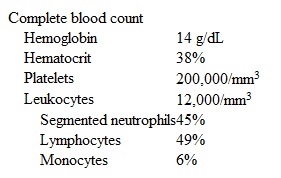 The peripheral blood smear is shown in the image:
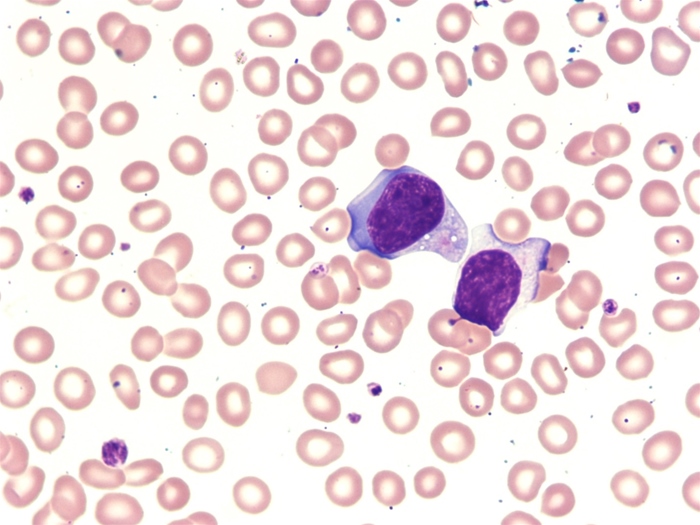 What is the most likely reason for these findings?
The peripheral blood smear is shown in the image:
What is the most likely reason for these findings? (Multiple Choice)
4.9/5 (68)
(68) A 20-year-old man comes for an initial visit for treatment of attention-deficit hyperactivity disorder. He is currently in his third year of college and says that he is doing well, but his inattentive symptoms are causing significant problems. Specifically, he frequently loses focus while studying and it takes him much longer than it should to complete assignments. The patient describes a history of hyperactive and inattentive symptoms since second grade. He says, "I could never sit still. I was always running around and getting into trouble with teachers for not listening. I have taken stimulants for most of my life and function better on medication." The patient tolerates stimulants well and has never experienced side effects. He has tried many different stimulant formulations of methylphenidate and amphetamines. He usually needs a high dose, and immediate-release formulations work best. The patient has no other psychiatric symptoms or history. He takes no medications and does not use illicit drugs. Physical examination is normal. Before prescribing medication, which of the following is the most appropriate course of action?
(Multiple Choice)
4.9/5 (76)
(76) A 2-day-old girl is in the neonatal intensive care unit due to respiratory failure. The infant was born vaginally at term to a 19-year-old primigravid woman who had limited prenatal care. Ultrasound at 22 weeks gestation revealed severe limb shortening and small thoracic circumference, suggestive of severe skeletal dysplasia. The parents were distraught by the information and did not return for additional imaging or counseling. The infant had profound respiratory distress and hypoxia immediately after delivery and was intubated. Currently, the infant is sedated and ventilated. The upper and lower extremities are extremely short, and the abdomen is protuberant. Chest radiograph reveals small ribs, a narrow thoracic cavity, and severe pulmonary hypoplasia. After consultation with a genetic specialist, the diagnosis is determined to be thanatophoric dysplasia, a skeletal dysplasia that is virtually always lethal in the newborn period. The findings and prognosis are discussed with the family during a multidisciplinary meeting. Multiple specialists are present and agree that tracheostomy will not change the newborn's course. Redirection of care to end-of-life comfort is recommended by the medical team. However, the parents continue to demand surgery. Which of the following is the most appropriate next step in management?
(Multiple Choice)
4.9/5 (73)
(73) A 64-year-old man is found unresponsive, pulseless, and with asystole when the ambulance arrives. He is intubated, resuscitated, and transferred to the hospital. Initial workup is consistent with subarachnoid bleeding. The patient has a history of coronary artery disease, multiple percutaneous coronary interventions, and congestive heart failure with low left ventricular ejection fraction. On repeat evaluation 24 hours later, he is comatose and does not respond to any verbal stimuli. The patient's temperature is 36.7 C (98.1 F), blood pressure is 123/82 mm Hg, and pulse is 78/min. Pupils are dilated and fixed at 8 mm. Which of the following findings would most likely suggest brain death in this patient?
(Multiple Choice)
4.9/5 (95)
(95) A healthy 27-year-old Caucasian man is brought to the emergency department after being involved in a motor vehicle accident. He complains of right knee pain and swelling. He was sitting in the front seat without a seat belt. His knees hit the front dashboard. His vital signs are stable. On examination, there is mild swelling and stiffness. Which of the following was most likely injured in this patient's knee joint?
(Multiple Choice)
5.0/5 (76)
(76) A 35-year-old woman, gravida 3 para 3, comes to the office due to a lump in her right breast. She noticed the mass last week and it has not grown. There is no associated nipple discharge, breast pain, or skin rash. The patient has no chronic medical conditions. She has had 3 full-term deliveries, 1 cesarean and 2 vaginal. She finished breastfeeding her youngest child 12 months ago. Menstrual periods are now regular, occurring every 28 days with 5 days of moderate bleeding. The patient is sexually active and had a bilateral tubal ligation with her last delivery. She takes ibuprofen occasionally and has no known allergies. The patient does not use tobacco, alcohol, or illicit drugs. Her maternal grandmother died of breast cancer at age 62; family history is otherwise unremarkable. Vital signs are normal. BMI is 28 kg/m2. Examination reveals a firm, ill-defined, 2-cm density in the upper outer quadrant of the right breast. Bilateral breasts have no nipple retraction or expressed discharge. No axillary or supraclavicular lymphadenopathy is present. Which of the following is the most appropriate next step in management of this patient?
(Multiple Choice)
4.8/5 (84)
(84) A 22-year-old white male who underwent a laparotomy two weeks ago for a perforated appendix, develops a swinging fever, dry cough, and pain in his right shoulder-tip. His temperature is 38.9 C (102 F), blood pressure is 120/76 mmHg, pulse is 110/min, and respirations are 20/min. Examination shows tenderness over the 8th to 11th rib. Abdominal and rectal examinations are within normal limits. The WBC count is 14,000/micro-L, with 6% bands. Which of the following is the best diagnostic test for this patient?
(Multiple Choice)
4.9/5 (74)
(74) A 65-year-old man comes to the office due to a foot ulcer. The ulcer began 2 weeks ago, a few days after he scrubbed a callus off the bottom of his left foot. The patient tried over-the-counter antibiotic creams, but the ulcer gradually enlarged and started draining a foul discharge. The foot is not painful and he has had no fever. The patient has a history of hypertension, hyperlipidemia, and type 2 diabetes mellitus. His diabetes has been poorly controlled by oral medications, and he has refused to take insulin. The patient is a retired veteran and does not use tobacco, alcohol, or illicit drugs. Temperature is 37.2 C (99 F), blood pressure is 130/86 mm Hg, and pulse is 80/min. BMI is 32 kg/m2. Examination of the left foot shows a 2×2 cm plantar ulcer with a necrotic base. No surrounding erythema or induration is present, and metal probing does not contact bone. Lower extremity pulses are diminished but palpable. Sensation to light touch and vibration is reduced, and ankle reflexes are absent bilaterally. Leukocyte count is 13,000 cells/mm3 and erythrocyte sedimentation rate is 95 mm/hr. Blood cultures and wound swab cultures are obtained.
Which of the following is most helpful for ruling out bone infection in this patient?
(Multiple Choice)
4.7/5 (86)
(86) A 44-year-old man comes to the office due to concern for hepatitis infection. The patient donated blood at an office blood drive event, and a few days later received a letter saying that hepatitis testing performed on his sample was positive. He has no chronic medical issues and feels healthy. He takes no medications. The patient does not smoke cigarettes and drinks alcohol at social events. He used injection drugs for several years in his 20s but not since then. He is in a monogamous relationship with his wife, who is also healthy. The patient works in a car dealership and is fairly active. Family history is significant only for hypertension in his father. Vital signs are normal. The sclerae are anicteric and mucous membranes are moist with no lesions. No lymphadenopathy is present. Lung fields are clear to auscultation and heart sounds are normal with no murmur. The abdomen is soft, nondistended, and nontender. There is no hepatomegaly or splenomegaly. He has no skin rash or extremity edema. Laboratory results are as follows: 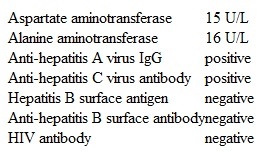 Which of the following is the best next step in management of this patient?
 (Multiple Choice)
4.8/5 (83)
(83) A 32-year-old woman comes to the office for a follow-up. She has a history of mild asthma, migraine headaches, and bipolar I disorder. The patient was hospitalized for a depressive episode 8 months ago and was started on quetiapine. She responded well to the medication and was feeling fine, so she discontinued it 3 months ago. The patient tells the psychiatrist, "The depression lifted after a few months on the medication, which was such a relief. I was so down before and couldn't enjoy anything, but now I am really doing great. I just applied for 2 new jobs. Also, I met a fantastic new guy 2 weeks ago, and we've been together ever since. He is literally the man of my dreams." She also says, "We are engaged, and we're getting married in 3 weeks; I'm so excited. I really don't want to take medicine because I feel terrific and we plan to start a family right away." The patient's mood, quality of sleep, and appetite are good, and she continues to maintain her job at a real estate office. On mental status examination, she is neatly dressed and groomed; she has a bright affect and mildly pressured speech. Which of the following is the most appropriate intervention for this patient?
(Multiple Choice)
4.9/5 (76)
(76) 
Filters
- Essay(0)
- Multiple Choice(0)
- Short Answer(0)
- True False(0)
- Matching(0)