



 Chat with AI
Exam 2: Foundations of Independent Practice

Exam 1: Advanced Clinical Medicine1 k+ Questions
Exam 2: Foundations of Independent Practice597 Questions
Select questions type


A 24-year-old woman is admitted to the hospital after a motor vehicle accident resulted in a right humerus fracture, multiple rib fractures, and a contusion over her right leg. The patient receives multiple packed red blood cell transfusions. Chest and abdominal evaluation show a right-sided hemothorax. A chest tube is inserted. Pain is controlled with intravenous morphine. The next morning, she has a crawling and burning sensation and worsening pain in her right leg despite repeated doses of morphine. Temperature is 37.2 C (99 F), blood pressure is 140/82 mm Hg, heart rate is 96/min, and respirations are 18/min. The right leg is swollen and tense. Pulses are palpable in both lower extremities. Laboratory results this morning are as follows:
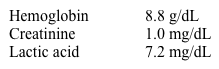 Which of the following is the best next step in management of this patient?
 (Multiple Choice)
4.9/5  (79)
(79) A 51-year-old man comes to the emergency department due to abdominal cramping, nausea, and bloody diarrhea. The patient reports having 2 episodes of large-volume, red- to maroon-colored, liquid stool over the past hour. He has also been feeling lightheaded but has had no vomiting, chest pain, or dyspnea. He sprained his ankle while playing racquetball 2 weeks ago and has been taking ibuprofen. He reports no chronic health issues and has never had similar symptoms in the past. Screening colonoscopy a year ago revealed scattered diverticulosis but was otherwise unremarkable. He smokes a pack of cigarettes daily and drinks a 6-pack of beer every week. Temperature is 37.3 C (99.1 F), pulse is 112/min, and blood pressure is 116/70 mm Hg while supine and 90/60 mm Hg while standing. The patient appears anxious and diaphoretic. Cardiopulmonary examination is normal with the exception of tachycardia. The abdomen is nondistended and soft with mild generalized tenderness. There is no guarding or rebound tenderness, and bowel sounds are hyperactive. Rectal examination reveals maroon-colored stool. Fingerstick hemoglobin is 12 g/dL. Blood samples for cell counts, serum chemistry, and type and crossmatch are obtained. Intravenous access is established and intravenous fluids are administered. Which of the following is the best next step in management of this patient?
(Multiple Choice)
4.8/5 (78)
(78) A randomized, double-blinded clinical trial was conducted to assess the role of a multidrug chemotherapy regimen for the treatment of newly diagnosed stage III and IV stomach cancer. In the study, 150 patients were enrolled in the treatment group and received the new multidrug treatment, and 100 patients were enrolled in the control group and were treated with standard first-line therapy. All patients were followed for 24 months. A total of 120 patients in the treatment group (80%) and 80 patients in the control group (80%) died during this follow-up period. Despite these calculations, the investigators concluded that the new multidrug regimen was more effective than standard therapy. Which of the following most likely accounts for the conclusion reached by the study investigators?
(Multiple Choice)
4.8/5 (75)
(75) A 13-month-old boy is brought to the clinic for a well-child visit. His father says that the child has not been eating as much solid food since he started walking. The parents think that he is "too busy exploring to eat" and have been supplementing his diet with whole milk in a cup that he carries with him. The patient's daily diet consists of 900 mL (30 oz) of whole cow's milk, rice, and occasional fruits and vegetables. He eats and drinks without gagging or choking; he can hold a spoon and feed himself finger foods. The child was born at term. Weight, height, and head circumference are at the 10th percentile for age. Examination shows a pale child who is playing in the examination room. The anterior fontanelle is open. Cardiac examination reveals a normal rhythm with no murmurs. The abdomen is soft, nontender, and without hepatomegaly. The skin has normal turgor and capillary refill is <2 seconds. Complete blood count shows a hemoglobin of 9.2 g/dL. The most likely diagnosis is discussed with the parents. Without treatment, this patient is at risk for which of the following long-term complications?
(Multiple Choice)
4.8/5 (85)
(85) A 24-year-old Caucasian male was involved in a major motor vehicle accident. The ambulance service that arrived several minutes after the accident found him dead. He was found in the driver's seat, and the steering wheel in front of him was broken. Which of the following is the most likely cause of his death?
(Multiple Choice)
4.8/5 (82)
(82) A research group is studying a new biomarker for prostate cancer screening in a random sample of asymptomatic men >50 years of age. As the majority of prostate cancers are slowly progressive, the investigators are concerned that the benefits of the new screening tool will be overestimated due to detection of a disproportionate number of slowly progressive, benign cases. The research group is most likely concerned about the presence of which of the following types of bias?
(Multiple Choice)
4.9/5 (78)
(78) A 60-year-old Caucasian man is admitted to the hospital with an episode of bacterial pneumonia. Upon review of his past medical history, you notice that he has had three recent admissions within the past seven months for bacterial pneumonia. All the episodes were successfully treated with intravenous antibiotics. Previous chest x-ray comparisons reveal that the infiltrate always occurs at the right middle lobe and leaves a persistent scar. The scar was not noted on the chest x-ray prior to the episodes of pneumonia. He has a 50-pack year history of smoking. He quit smoking 10 years ago. Which of the following is the most likely to definitively confirm the diagnosis in this patient?
(Multiple Choice)
4.9/5 (79)
(79) A 35-year-old woman at 38 weeks gestation is admitted to the hospital after premature rupture of membranes at home. The vaginal delivery is uneventful and the patient and newborn are doing well. When the physician informs the patient that she will be discharged tomorrow, the patient says, "I am tired and was hoping I could stay in the hospital a little longer. I have two kids under the age of 5 at home. It will be overwhelming coming home with a new infant. It would be so helpful to have an extra day or two to rest up. Can you come up with a reason to keep me?" Vital signs and physical examination are unremarkable. The patient is not depressed. Her insurance covers only a 2-day hospital admission for an uncomplicated vaginal delivery. Which of the following is the most appropriate response to the patient's concerns?
(Multiple Choice)
4.8/5 (96)
(96) A 56-year-old man with a recent diagnosis of cirrhosis comes to the hospital for elective upper gastrointestinal endoscopy to evaluate for esophageal varices. The patient has elevated liver aminotransferase levels, and a hepatitis serology was positive for chronic hepatitis C. Abdominal imaging studies revealed mild ascites, a nodular-appearing liver, and splenomegaly. He has no other medical problems. The patient has a remote history of injection drug use and does not use tobacco or alcohol. Vital signs are within normal limits. Benzocaine throat spray is used for topical anesthesia, and procedural sedation is obtained with midazolam and fentanyl. During the procedure, the patient's oxygen saturation by pulse oximetry gradually decreases to 85% on ambient air and does not improve with application of supplemental oxygen via face mask. Physical examination demonstrates bluish discoloration of the lips and fingertips. Lung fields are clear to auscultation, and heart sounds are normal. Results of urgent laboratory tests are as follows: 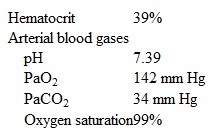 Which of the following is the most likely cause of this patient's decrease in oxygen saturation?
 (Multiple Choice)
4.9/5 (67)
(67) A 65-year-old man comes to the office due to a rough lesion on the left cheek for the past 6 months. The lesion has not changed and is painless and nonpruritic. Medical history includes type 2 diabetes mellitus. The patient lived most of his life in Florida and has a history of several sunburns. Household pets include a dog and a cat. Skin examination findings are shown in the exhibit. 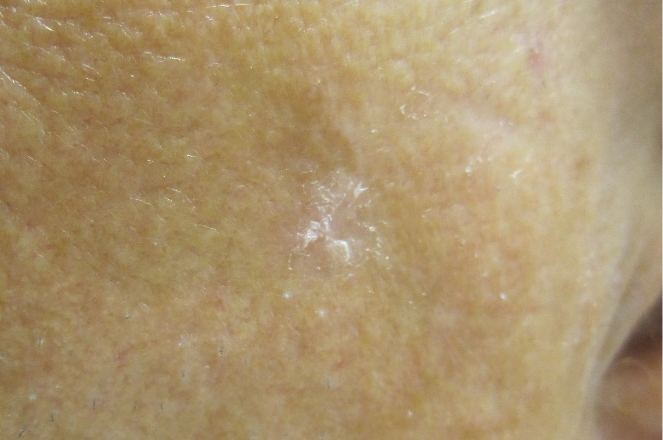 Which of the following is the most appropriate treatment for this patient's skin condition?
 (Multiple Choice)
4.8/5 (62)
(62) A 19-year-old man is seriously injured in a multi-car accident on a busy highway. He was driving a motorcycle when a car changed lanes unexpectedly and hit him. He lost control and slid under an oncoming truck. The patient is unresponsive when paramedics arrive on the scene. They provide initial stabilization of the patient and transport him to the nearest emergency department. At the hospital, health care providers continue aggressive, life-saving measures, including endotracheal intubation with mechanical ventilation, even though the unconscious patient is not able to give consent. They also work tirelessly to control the patient's hemorrhaging. In providing these interventions, the physicians involved are most readily applying which of the following ethical principles of medicine?
(Multiple Choice)
5.0/5 (83)
(83) A healthy 28-year-old man comes to the office for a routine health maintenance examination. The patient is seen by his primary care provider, who has known him since childhood. The provider also cares for the patient's 26-year-old wife, who is currently pregnant. The wife is also followed regularly by a high-risk obstetrician for serial ultrasounds due to complications of Rh(D) alloimmunization. She is Rh(D)-negative; her husband is Rh(D)- positive. Her records indicate that she had been pregnant previously with another partner and had an elective termination of pregnancy. During the visit, the patient discusses how excited he and his wife are to become new parents. He mentions that he has done some research about Rh sensitization and has read about cases similar to his wife's. He asks how his wife could have this problem considering this is the couple's first child. Which of the following is the most appropriate response?
(Multiple Choice)
4.8/5 (92)
(92) A 52-year-old woman comes to the office for an annual examination. The patient reports increased urinary frequency and involuntary leakage of urine for the past several years. The leakage occurs when she stands up, sneezes, or coughs. The patient manages the leakage by wearing a pad, but for the past 6 months she has needed to use 2 or 3 pads daily. She reports no dysuria or hematuria. The patient has type 2 diabetes mellitus that she manages with diet and oral medication. She has had 3 uncomplicated pregnancies, each resulting in spontaneous vaginal deliveries. The patient has smoked a quarter of a pack of cigarettes daily for the last 30 years and drinks alcohol socially, but she does not use illicit drugs. She drinks 2 cups of coffee each morning and a glass of caffeinated diet soda with dinner. Blood pressure is 130/84 mm Hg and pulse is 76/min. BMI is 29 kg/m2. A pelvic examination shows a small anteverted, nontender uterus and no adnexal masses. The vagina is pale and without rugae. During examination, leakage of urine occurs with coughing while lying down and standing. Results of urinalysis are normal. Which of the following additional tests is required prior to recommending treatment for this patient's condition?
(Multiple Choice)
4.8/5 (82)
(82) A 60-year-old construction worker presents to your office with a one-week history of back pain. The pain is brief, severe, and radiates along the posterior surface of the right thigh. It is provoked by bending forward and straining, and abates on lying down. His past medical history is insignificant. He has tried several over-the-counter pain relievers without success. Which of the following is most likely to be present in this patient?
(Multiple Choice)
4.9/5 (83)
(83) A 20-year-old woman comes to the office due to a rash on the face for 2 days. The rash started abruptly as mildly painful vesicles on the eyelids and cheeks. Medical history includes atopic dermatitis involving the face, arms, and legs that has been well controlled with an emollient and low-potency topical corticosteroid as needed. Temperature is 38 C (100.4 F), blood pressure is 115/75 mm Hg, and pulse is 95/min. Examination findings are shown in the exhibit. 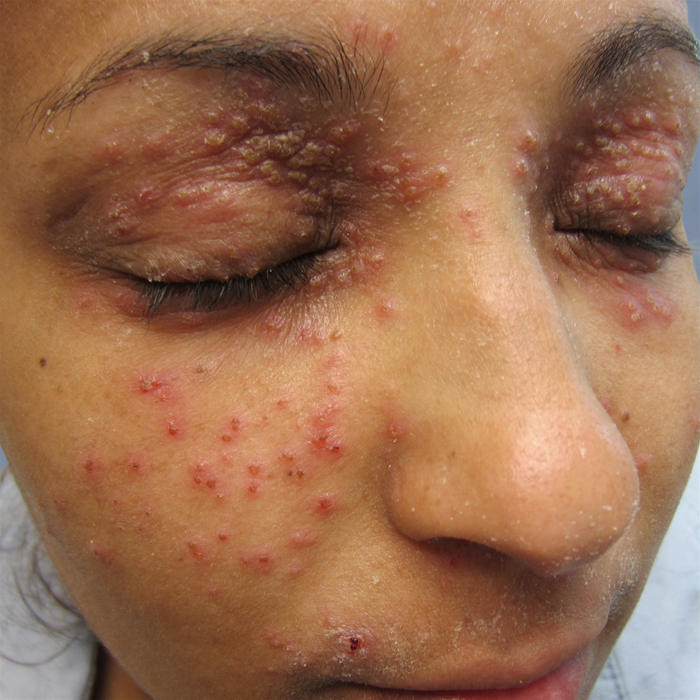 Tender cervical lymphadenopathy is present. The remainder of the examination is unremarkable. Which of the following is the most likely etiology of this patient's rash?
 (Multiple Choice)
5.0/5 (84)
(84) A 4-year-old girl presents to the pediatrician for her annual physical examination. Her height for age is at 55th percentile and her weight for age is at the 95th percentile. All of her vaccinations are current. She is enrolled in preschool three days per week, and greatly enjoys time spent with classmates. She is able to hop on one foot without losing her balance and can throw a ball overhand in a coordinated fashion. She remains unable to tie her shoelaces and continues to wear pull-up diapers at night because she occasionally urinates while asleep. Her sentences are typically four to six words long and she can count to five. She frequently discusses her imaginary playmates and enjoys singing simple songs. Which of the following is the most likely explanation for her condition?
(Multiple Choice)
5.0/5 (69)
(69) It is estimated that the prevalence of smoking in a population is 50%. A cohort study conducted using a random sample from this population showed that the 5-year risk of ischemic stroke is 1:1000 among smokers and 0.5:1000 among non-smokers. What percentage of ischemic strokes observed in the population can be attributed to smoking?
(Multiple Choice)
4.9/5 (82)
(82) A non-inferiority study is conducted to assess a new anti-Xa inhibitor (drug A) in patients with atrial fibrillation. Warfarin is chosen as comparator. Study results are shown on the image below. 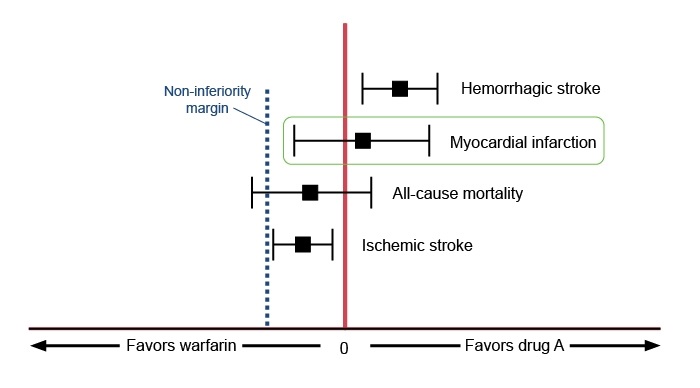 Which of the following best describes the effect of drug A in preventing myocardial infarction?
 (Multiple Choice)
4.9/5 (77)
(77) An 8-hour-old boy is evaluated in the neonatal intensive care unit due to respiratory distress. The infant was born at term to a 32-year-old woman, gravida 3 para 2. The mother's routine serologic screening in the first trimester was unremarkable except for a lack of antibody against rubella. The pregnancy was complicated by oligohydramnios. Antenatal sonography at 19 weeks gestation showed that the fetal kidneys were in the normal position but moderately dilated and that the bladder was also dilated and had a thickened wall. Growth measurements were appropriate for gestational age. The delivery was uncomplicated, but immediately after birth, the infant developed some mild respiratory distress that is now improving. Weight is 3.35 kg (7 lb 6 oz) and respirations are 70/min. The infant is tachypneic but otherwise comfortable, with no grunting or retractions. The bladder is palpable just above the suprapubic ridge. The remainder of the examination is unremarkable. Which of the following is the best test for confirming this infant's condition?
(Multiple Choice)
4.8/5 (73)
(73) A 36-year-old woman comes to the emergency department due to 4 weeks of weight gain, shortness of breath, and headaches. Her symptoms have become progressively more severe, and now she has shortness of breath with mild activity. The patient has had HIV for several years but refused antiretroviral treatment until recently. Her most recent CD4 count was 220/mm3. The patient smokes a pack of cigarettes daily and drinks 2 or 3 beers most evenings. She has a history of intravenous heroin use but quit several years ago. Temperature is 36.8 C (98.2 F), blood pressure is 184/100 mm Hg, pulse is 78/min, and respirations are 14/min. Physical examination shows moist mucous membranes, rales at the bilateral lung bases, and normal first and second heart sounds. The abdomen is soft and nontender. Anasarca is present. The remainder of the examination is normal. A urine sample appears cloudy on gross inspection. Laboratory results are as follows: 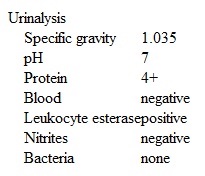 During preparation for the microscopic examination of the patient's urine, the laboratory technician inadvertently splashes a small amount of urine into her eye. Besides generously flushing the technician's eyes with water, what is the most appropriate next step in management of this occupational exposure?
 (Multiple Choice)
4.9/5 (85)
(85) 
Filters
- Essay(0)
- Multiple Choice(0)
- Short Answer(0)
- True False(0)
- Matching(0)